

15 Bedroom Wall Art Ideas for Blank Walls
A completely blank bedroom wall can make an otherwise beautiful room feel unfinished, especially when the furniture is already arranged, but something still seems missing. The challenge is choosing artwork that fills the space without making the bedroom feel crowded, random, or visually overwhelming.
The best bedroom wall art ideas for blank walls depend on the wall’s size, the furniture nearby, the room’s color palette, and the atmosphere you want to create.
A large landscape can add depth, a carefully arranged gallery can tell a personal story, while textured abstracts can provide interest without introducing complicated imagery. These 15 ideas explore different ways to turn empty bedroom walls into intentional focal points while keeping the room comfortable and visually balanced.
1. Large Botanical Canvas
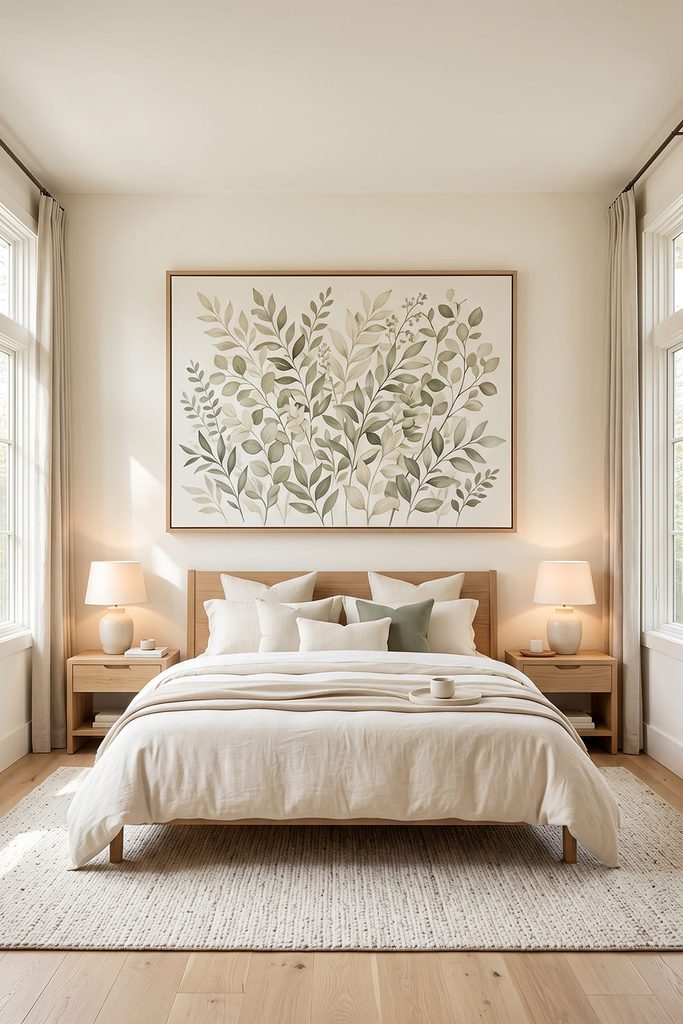
A large botanical canvas can instantly give a blank bedroom wall a natural focal point without making the room feel crowded.
Choose soft leaves, delicate branches, or layered foliage in sage, olive, cream, and muted green, then center the artwork above the bed or dresser; repeat one subtle color through bedding or cushions so the canvas feels connected to the room, while leaving surrounding wall space open allows the botanical shapes to remain visually prominent without competing with furniture or lighting beautifully.
2. Panoramic Landscape Artwork
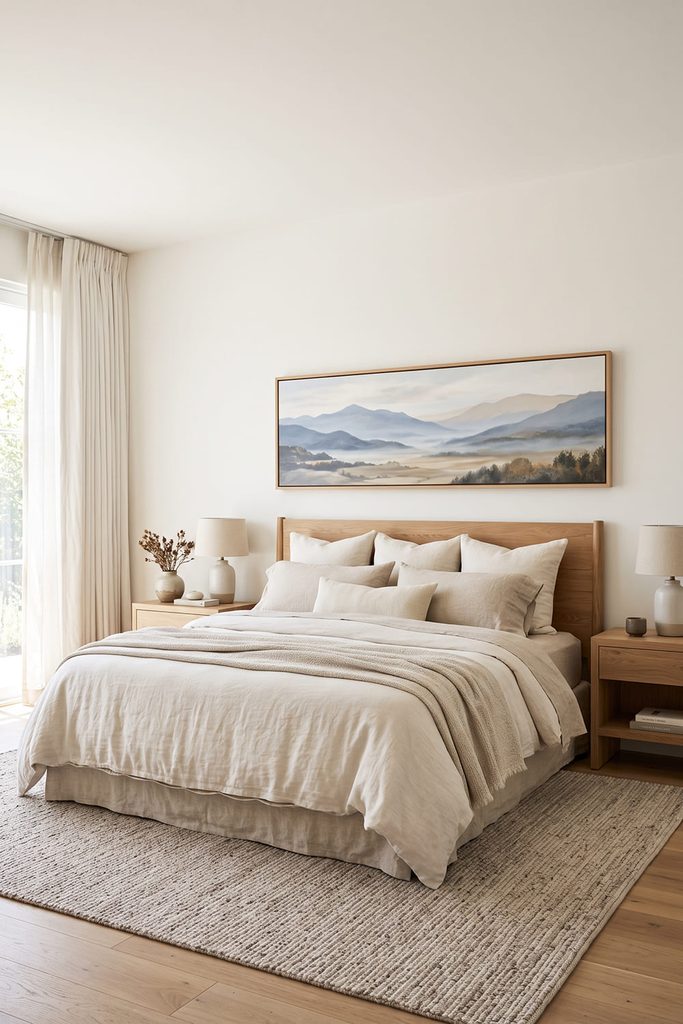
A panoramic landscape can turn an empty wall into a peaceful visual window while adding depth to the bedroom.
Consider distant mountains, misty valleys, open fields, or quiet hills in softened blue, gray, beige, or green tones, then choose a wide horizontal format that relates naturally to the bed; keeping nearby decor simple helps the landscape establish a calm focal point without overwhelming the room or creating too many competing colors, patterns, or decorative objects around the sleeping area naturally easily.
3. Two-Piece Art Arrangement

A two-piece art arrangement can fill a blank wall while providing a balanced, organized appearance that works especially well above a bed.
Choose related botanical drawings, abstract shapes, landscapes, or photographs, then use matching frames and consistent spacing so the pair reads as one composition; center the arrangement over the bed rather than judging each piece separately, and repeat one artwork color elsewhere in the room to create a subtle connection between the wall decor and existing bedroom furnishings.
4. Curated Gallery Wall
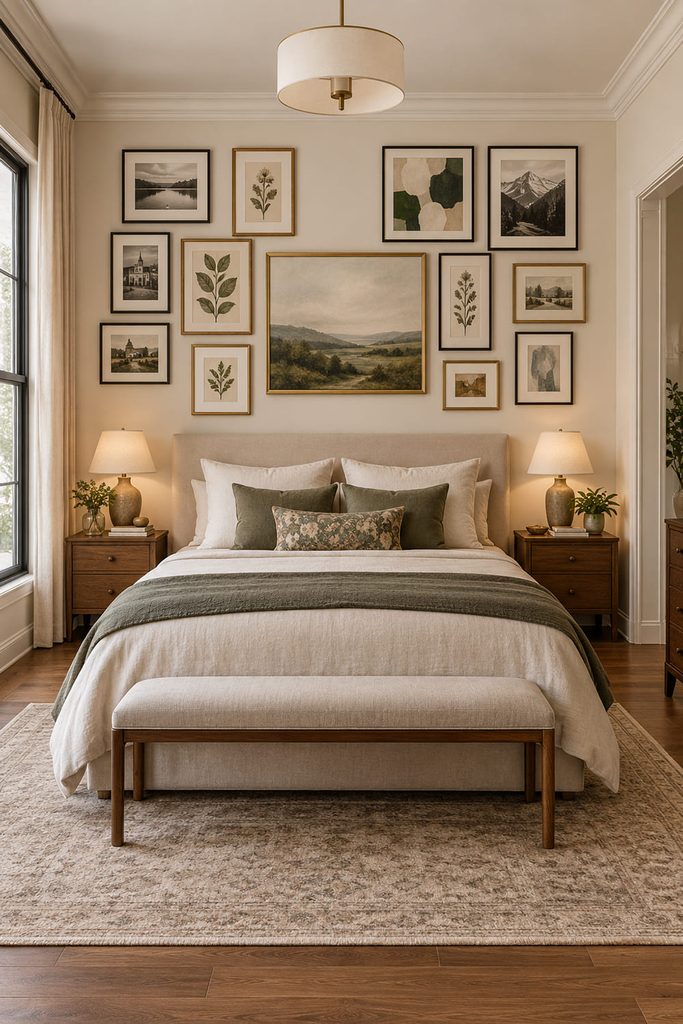
A gallery wall can give a large blank bedroom wall personality while allowing you to combine several smaller artworks into one intentional arrangement.
Select a limited color palette and mix photographs, illustrations, abstract prints, and meaningful images, then establish an invisible outer boundary before hanging anything; keeping the spacing consistent and the composition balanced prevents the display from looking random, while a calmer palette helps the gallery feel suitable for a restful bedroom rather than a busy public room today.
5. Large Textured Artwork

A large textured artwork can bring depth to a blank wall when you prefer subtle decoration over detailed imagery.
Look for canvas featuring raised brushwork, layered plaster-like marks, woven surfaces, or tonal imperfections in ivory, beige, taupe, and warm gray, then position it where natural or soft artificial light can reveal the surface; the restrained palette creates visual interest without introducing strong contrast, making this approach especially useful for minimalist, neutral, contemporary, or warm bedroom interiors beautifully throughout beautifully.
6. Pair of Floral Prints

A pair of large floral prints can make a blank bedroom wall feel softer and more finished without requiring an oversized single artwork.
Choose two complementary compositions with muted flowers, branches, or petals in dusty rose, cream, sage, lavender, or terracotta, then use matching frames and equal spacing; placing the pair above the bed creates symmetry, while repeating one floral color through a cushion or throw helps the artwork connect naturally with the bedroom rather than appearing separately decorated at all.
7. Minimalist Line Art
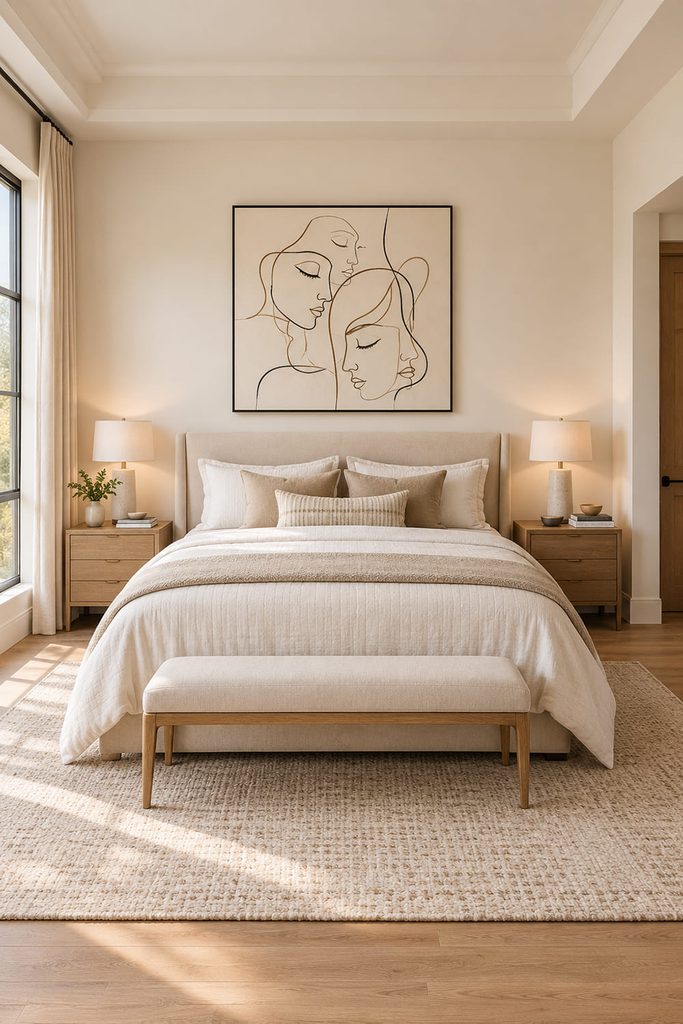
A minimalist line-art composition can fill an empty bedroom wall while maintaining a clean and sophisticated appearance.
Choose one large print featuring flowing figures, abstract faces, continuous curves, or botanical outlines, preferably in charcoal, black, brown, or cream, then surround it with generous negative space; simple bedding and streamlined furniture allow the artwork to remain the focal point, while the restrained design adds personality without introducing excessive color, detail, or visual stimulation to the sleeping space at night comfortably daily.
8. Calm Ocean Artwork

A calm ocean artwork can make a blank wall feel expansive while introducing a peaceful natural subject into the bedroom.
Choose a wide horizon, gentle waves, distant shoreline, or softly painted water in blue-gray, sand, cream, and muted green, then place it above the bed or on the wall opposite it; the open composition creates breathing room, while coordinated bedding and natural textures help the artwork feel integrated instead of turning the bedroom into an overly literal coastal theme.
9. Geometric Abstract Print
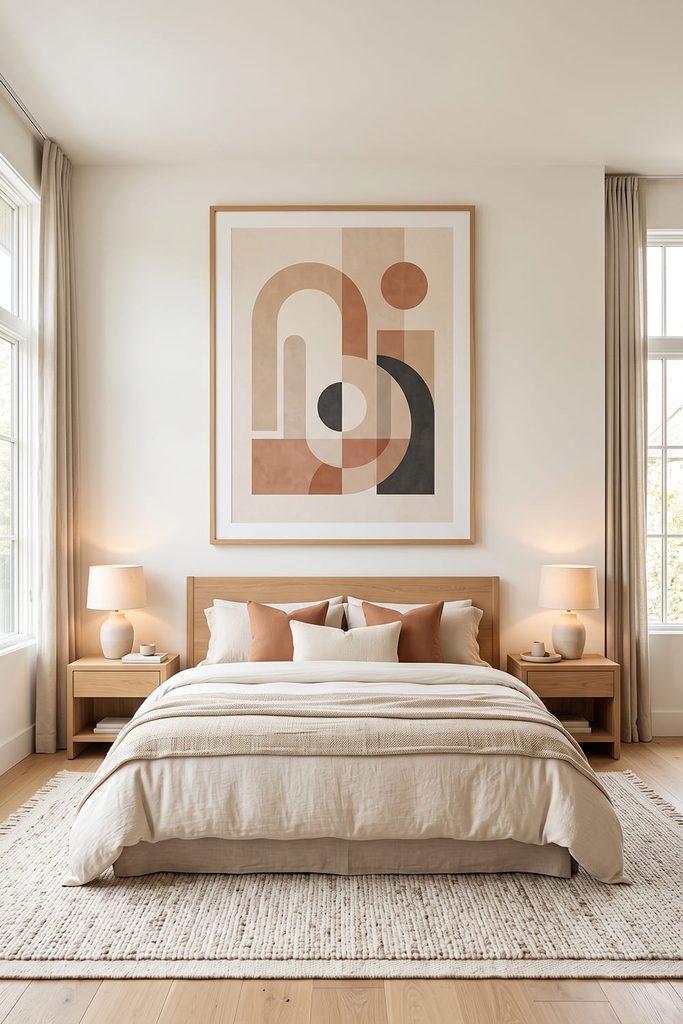
A geometric abstract print can give a blank bedroom wall structure when the surrounding furniture has simple shapes and clean lines.
Choose arches, circles, blocks, or overlapping forms in two or three coordinated colors, then leave enough space around the artwork so the shapes remain easy to appreciate; repeating one accent shade in bedding or accessories creates continuity, while avoiding excessive patterns nearby keeps the arrangement contemporary, balanced, and comfortable rather than visually demanding in bedrooms.
10. Black And White Photography

A black and white photographic print can create a strong focal point on a blank wall without adding another color story to the bedroom.
Choose an atmospheric landscape, architectural detail, quiet street, or natural texture, then use a slim frame or clean canvas edge; the monochromatic treatment works with neutral bedding and furniture, while generous wall space around the image prevents its contrast from feeling overwhelming and allows the photograph to provide character without making the bedroom look cluttered.
11. Dreamy Celestial Artwork

A dreamy celestial artwork can give a blank bedroom wall an atmospheric quality while remaining sophisticated enough for an adult interior.
Choose a moonlit sky, subtle stars, cloudy night scene, or abstract celestial composition in navy, charcoal, cream, and muted gold, then pair it with simple bedding and warm lighting; keeping the surrounding decoration restrained prevents the theme from becoming excessive, while the darker artwork can create a memorable focal point above the bed without dominating the entire room visually.
12. Personalized Photography Display

A personalized photography display can turn a blank bedroom wall into a meaningful part of the room rather than simply filling space.
Select photographs from memorable places, family moments, nature scenes, or personal experiences, then edit them with a consistent tone and place them in matching frames; arranging two, three, or four images within a clear boundary creates visual order, while coordinating the frame color with existing furniture makes the collection feel intentional, polished, and personal for bedrooms.
13. Soft Watercolor Landscape

A soft watercolor landscape can bring delicate color to a blank bedroom wall without creating a heavy visual statement.
Choose misty mountains, quiet fields, distant trees, gentle water, or abstract washes in pale blue, sage, blush, cream, or lavender, then pair the artwork with simple bedding; the translucent appearance adds softness and depth, while keeping nearby accessories understated allows the painting to remain noticeable without competing with curtains, lamps, furniture, patterns, or other decorative elements nearby at night.
14. Large Neutral Abstract Canvas
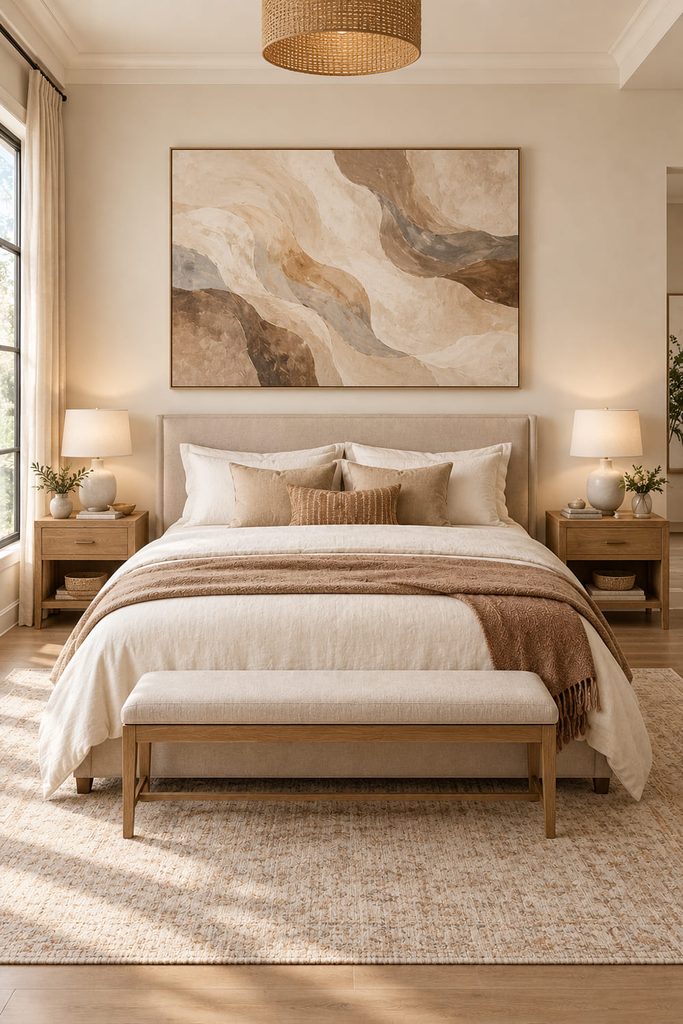
A large neutral abstract canvas can fill an empty wall while preserving a warm, understated bedroom atmosphere.
Look for layered shapes, curved brushstrokes, organic forms, or subtle tonal transitions using cream, beige, taupe, brown, and warm gray, then choose a size substantial enough to relate to the furniture below; repeating one tone through bedding or a rug creates cohesion, while the quiet palette provides texture and movement without making the bedroom feel overly decorated or visually restless overall.
15. Mirror And Artwork Arrangement

A decorative mirror combined with surrounding artwork can make a blank wall more functional while creating an interesting layered arrangement.
Place a large rounded or organically shaped mirror as the central element, then add two smaller prints beside it using complementary colors and matching frames; the mirror provides reflection and light, while the artwork introduces personality, and keeping the overall arrangement symmetrical or visually balanced prevents the wall from feeling crowded or disconnected from the bedroom furniture nearby overall comfortably.
How to Choose Bedroom Wall Art for Blank Walls
A blank wall gives you more freedom than a wall already occupied by furniture, windows, or architectural features. However, that freedom can make choosing artwork harder because there is no obvious starting point.
Begin by identifying what the wall needs.
Does it need:
- A strong focal point?
- More color?
- Texture?
- Personal meaning?
- Visual height?
- A connection to the bed?
- Decoration above a dresser?
Once you know the purpose, choosing the artwork becomes much easier.
1. Measure the Wall First
Do not choose artwork based only on how attractive it looks online.
Measure:
- Wall width
- Wall height
- Nearby furniture
- Windows
- Doors
- Light switches
- Wall sconces
For artwork above a bed, current interior guidance commonly uses the bed or headboard as the primary scale reference, with the complete artwork arrangement occupying roughly 60% to 75% of its width as a useful starting point.
This is a starting guideline rather than a strict rule.
2. Consider the Furniture Below
Artwork usually looks more intentional when it relates to something underneath it.
For example:
- Artwork above a bed should relate to the headboard.
- Artwork above a dresser should relate to the dresser width.
- Artwork above a bench should visually connect with the bench.
- Artwork on an empty wall can stand more independently.
The furniture gives the artwork a visual anchor.
3. Do Not Automatically Fill Every Blank Wall
An empty wall is not necessarily a decorating problem.
Some walls benefit from remaining relatively quiet, especially when another wall already contains substantial artwork.
A bedroom can feel more balanced when one wall acts as the main focal point while other walls provide visual breathing room.
4. Use the Bedroom Mood as Your Guide
Think about how you want the room to feel.
For a calm bedroom, consider:
- Soft landscapes
- Botanical artwork
- Watercolor
- Neutral abstracts
- Ocean horizons
For a more dramatic bedroom, consider:
- Dark photography
- Strong abstract artwork
- Deep celestial scenes
- Architectural compositions
The artwork should support the atmosphere rather than fight against it.
5. Choose a Color Connection
Your artwork does not need to match everything in the bedroom.
Instead, connect it to one or two existing colors.
For example:
A sage artwork can relate to a green cushion.
A terracotta artwork can connect with warm wood.
A blue landscape can complement blue-gray bedding.
A neutral abstract can reinforce cream, beige, and brown furnishings.
This creates cohesion without making the room look overly coordinated.
6. Consider a Gallery Wall for Very Large Spaces
A huge blank wall can sometimes make one medium-sized artwork look undersized.
Instead of placing one small print in the center, consider creating a gallery arrangement with a clearly defined outer boundary.
The entire grouping should be treated as one artwork when considering its width and placement.
Consistent spacing is especially important.
7. Try Paper Templates Before Hanging
One of the easiest ways to avoid scale mistakes is to use paper or painter’s tape to mark the proposed artwork dimensions on the wall.
View the outline from:
- The doorway
- The foot of the bed
- The side of the room
- A seated position
- The actual bed
This can reveal problems before you drill holes.
Current bedroom-art guidance similarly recommends testing the full dimensions on the wall before installation.
8. Think About Artwork Height
Artwork above furniture should generally relate visually to the furniture below it rather than being pushed close to the ceiling.
For artwork above a headboard, several current design guides use roughly 6 to 10 inches as a practical starting gap between the headboard and artwork, then recommend adjusting according to the room’s proportions.
The important goal is making the furniture and artwork feel like one composition.
9. Use Texture on Plain Walls
If your bedroom already has a neutral color scheme, adding another plain print may not create enough visual interest.
Textured artwork can provide depth through:
- Brushwork
- Canvas texture
- Layered surfaces
- Raised marks
- Tonal variations
This can be especially effective when you want interest without adding strong colors.
10. Use Multiple Pieces Carefully
Multiple artworks can look beautiful, but they need structure.
Use:
- Consistent spacing
- Related colors
- Similar visual weight
- A defined outer boundary
- A clear center point
Avoid placing random small frames across a large wall without considering the complete arrangement.
A bedroom generally benefits from controlled groupings rather than scattered decoration.
11. Think About Side Walls
The wall above the bed is not the only place for artwork.
A blank side wall can work well for:
- One vertical print
- A small gallery
- A large mirror
- Artwork above a dresser
- A pair of coordinated prints
- A decorative textile
Side walls can be particularly useful when the headboard wall already has enough visual weight.
12. Match the Frame to the Room
The artwork itself is only part of the finished appearance.
Consider:
- Natural wood for warm interiors
- Black for modern spaces
- White for light minimalist rooms
- Thin metallic frames for refined interiors
- Frameless canvas for contemporary spaces
The frame should support the artwork rather than becoming the main feature.
13. Consider Lighting
Lighting changes how wall art looks throughout the day.
Check your artwork in:
- Morning daylight
- Afternoon light
- Evening lighting
- Bedside lamp illumination
Highly reflective surfaces can become distracting when positioned opposite strong lights, so consider the viewing angle before finalizing your choice.
14. Keep the Bedroom Visually Calm
The bedroom is different from a living room or hallway.
You may want artwork with:
- Softer colors
- Simpler compositions
- Natural subjects
- Moderate contrast
- Comfortable visual rhythm
Current bedroom-art guidance commonly favors calmer palettes and less visually aggressive compositions for spaces intended for rest.
This does not mean your artwork needs to be boring. A dramatic piece can work when the rest of the room gives it enough space.
Final Thoughts
Blank bedroom walls offer an opportunity to create a focal point that changes the entire character of the room. The right artwork can add color, texture, personality, depth, or simply give the furniture a stronger visual relationship with the surrounding space.
Start with the wall’s dimensions and the furniture nearby, then decide whether you want one large statement piece, a pair, a gallery arrangement, or a functional combination such as a mirror and artwork. Most importantly, choose artwork that you genuinely enjoy seeing every day. A blank wall does not need to be filled simply because it is empty; it needs the right detail to make the bedroom feel complete.


