
20 Blue and Orange Bathroom Ideas That Are Stunning and Bold
Blue and orange are not just colors — they are each other’s perfect opposites. Positioned directly across from one another on the color wheel, blue and orange form a complementary pair of extraordinary chromatic power — a pairing rooted in the fundamental science of color theory. When placed together, each color makes the other more vivid, more saturated, and more visually alive than it could ever be in isolation. It is the same optical principle that makes a Van Gogh starry night feel electric, that makes a Mediterranean sunset over cerulean water look almost impossibly beautiful, and that makes a blue and orange bathroom feel like a deliberate, stunning work of art.
The range within this pairing is staggering. Blue alone spans from the palest powder blue and misty aqua to the deepest midnight navy and moody cobalt — each shade carrying an entirely different emotional resonance. Orange, equally vast, moves from the softest blush-adjacent peach and apricot through warm coral, terracotta, and burnt sienna to the most vivid tangerine and vermillion. The particular shades of blue and orange you choose will define whether your bathroom feels like a tranquil coastal spa, a vibrant Moroccan riad, a glamorous Art Deco powder room, or a sun-drenched Mediterranean escape.
1. Navy Blue Shiplap Walls with Terracotta Tile Floors
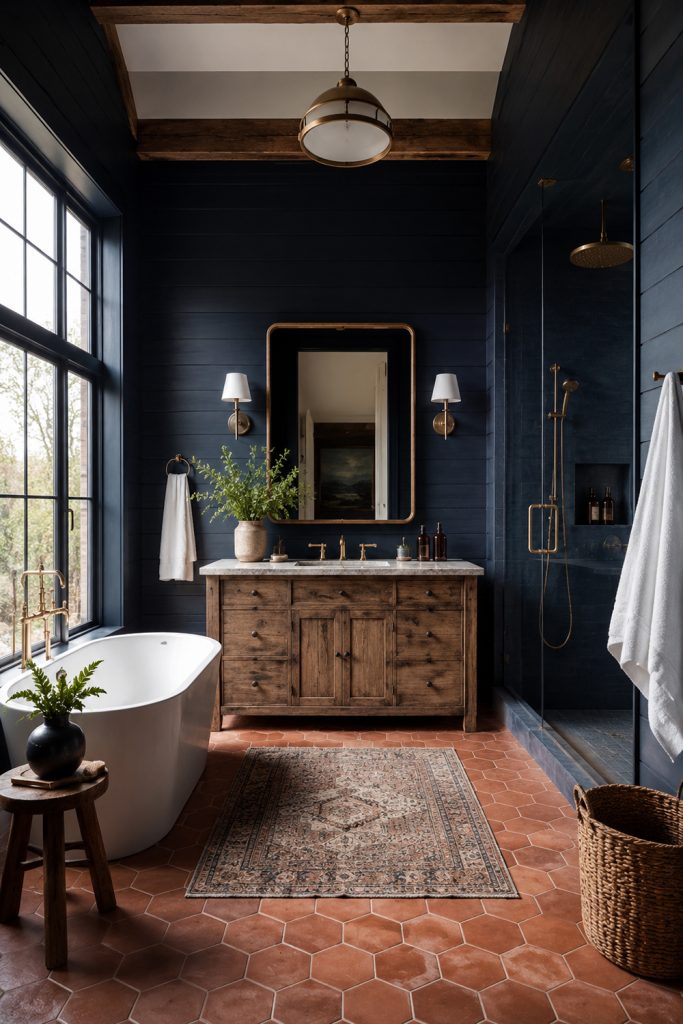
Navy blue shiplap panelling paired with warm terracotta hexagonal floor tiles is one of the most visually arresting and emotionally satisfying interpretations of the blue and orange palette available in bathroom design. The deep, inky richness of navy — a color historically associated with depth, stability, and authority — creates walls of profound, enveloping character. Against this dark, structured backdrop, terracotta tiles glow with their ancient, sun-baked warmth, creating a color contrast that feels simultaneously rugged and refined. Choose a horizontal shiplap installation for a coastal, beachhouse energy, or a vertical installation for more formal, architectural height. Pair with unlacquered brass fixtures and white cotton towels.
2. Cobalt Blue Zellige Tiles with Burnt Orange Plaster Walls

Cobalt blue zellige tiles — handcrafted Moroccan clay tiles known for their brilliant glaze, irregular surface, and shimmering, multidimensional light-play — installed against adjacent walls finished in warm burnt orange limewash or Venetian plaster create a bathroom of extraordinary North African sensory richness. The cobalt’s depth and the orange’s warmth are complementary colors that intensify each other’s vibrancy when placed in proximity — a phenomenon color theorists call simultaneous contrast. The handmade quality of zellige means no two tiles catch light identically, creating a constantly shifting, living wall of glimmering blue. Finish with arched niches, hammered brass accessories, and a carved wooden mirror frame for full Moroccan opulence.
3. Powder Blue Walls with Copper and Amber Accents

Powder blue — that soft, romantic, barely-there blue with a slight grey or lavender undertone — creates bathroom walls of extraordinary gentleness and nostalgic charm. It is the color of vintage French perfume bottles, of faded Parisian shutters, of morning sky before the day grows warm. Against powder blue walls, copper and amber accents introduce precisely the right temperature of orange warmth: not aggressive, not bold, but quietly, romantically glowing. Install copper light sconces with amber glass shades, copper-framed mirrors, and copper soap dispensers. Add apricot towels, a peach bath mat, and small amber glass vessels on the vanity shelf. The result is a bathroom of genuine, unhurried romantic beauty.
4. Midnight Blue Bathroom with Herringbone Terracotta Tile Feature Wall

The sophistication of a midnight blue and terracotta bathroom lies in how it channels the ancient color tradition of cobalt-and-clay — a pairing seen across centuries of Mediterranean ceramics, Islamic tilework, and Delftware pottery — into a thoroughly contemporary bathroom. Paint three walls in a deep, ink-like midnight blue — Farrow & Ball’s “Hague Blue” or Sherwin-Williams’ “Naval” are exemplary choices — then install a feature wall of handmade terracotta tiles in a precise herringbone pattern behind the vanity. The herringbone layout transforms the warm orange-red tiles into a geometric artwork that commands the room. Pair with a marble countertop in warm cream and polished brass hardware throughout.
5. Sky Blue and White with Burnt Orange Towels and Accessories
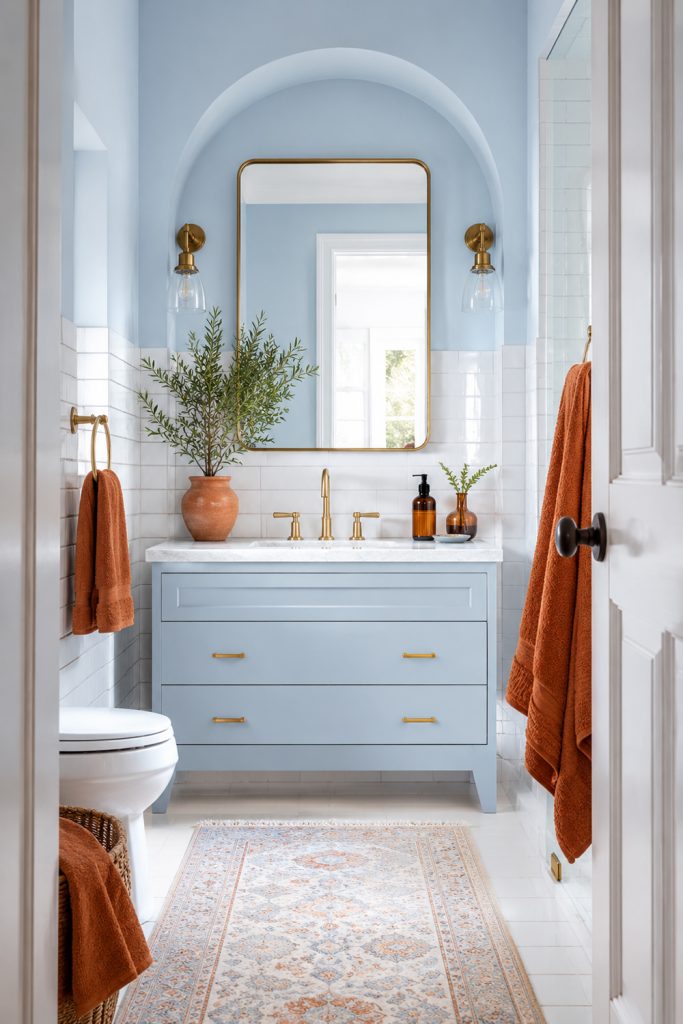
Not every blue and orange bathroom needs to be a renovation project. One of the most accessible and equally beautiful approaches is a sky blue and white bathroom — painted walls or white subway tiles with a sky blue accent — brought to vivid life through the strategic introduction of burnt orange accessories. Plush burnt orange towels folded on a ladder shelf, an amber glass soap dispenser, a terracotta pot overflowing with greenery, an orange ceramic tray on the vanity — each of these elements introduces the complementary orange note without a single tile being laid or a wall being replastered. This is the blue and orange bathroom as an exercise in styling intelligence, not renovation investment.
6. Teal Blue Wet Room with Warm Amber Lighting
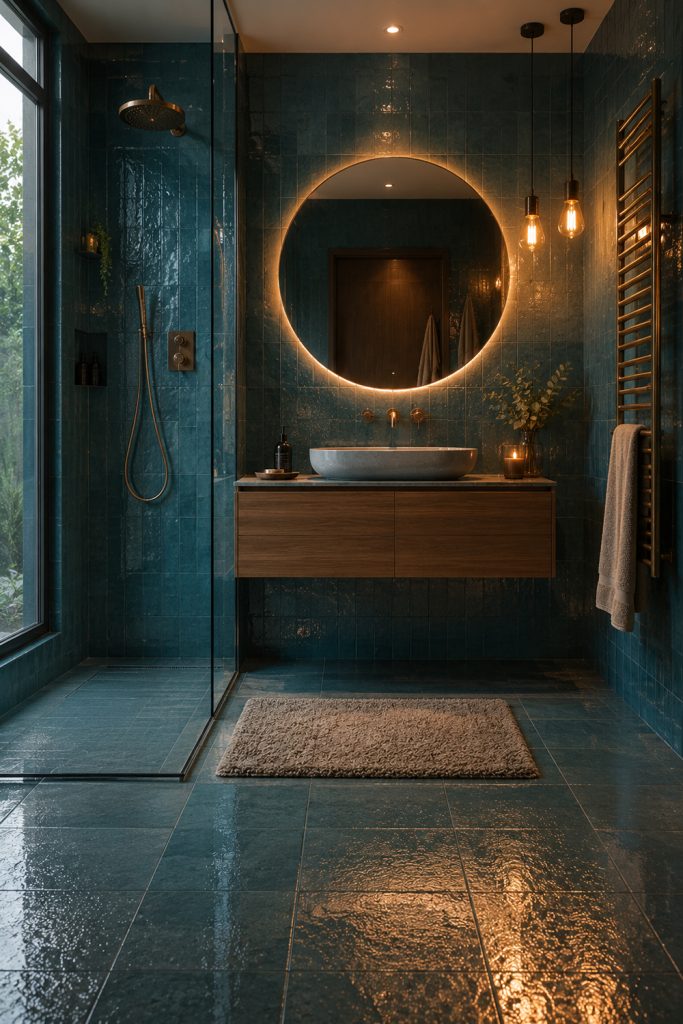
Teal — the complex, depth-rich cousin of turquoise, balancing blue and green in equal measure — makes a breathtaking statement in a fully tiled wet room bathroom, particularly when the amber warmth of thoughtfully chosen lighting introduces the complementary orange note as a thermal quality rather than a physical color. A wet room where floor, walls, and ceiling are clad in large-format teal porcelain tiles creates an immersive, cave-like atmosphere of extraordinary depth. Install warm Edison filament bulbs in simple ceramic or brass wall fixtures — their amber glow warms the teal surfaces beautifully, introducing the orange-warmth counterpoint that makes the teal sing. Add natural oak details and a simple floating vanity.
7. French Navy and Coral: A Sophisticated Coastal Bathroom
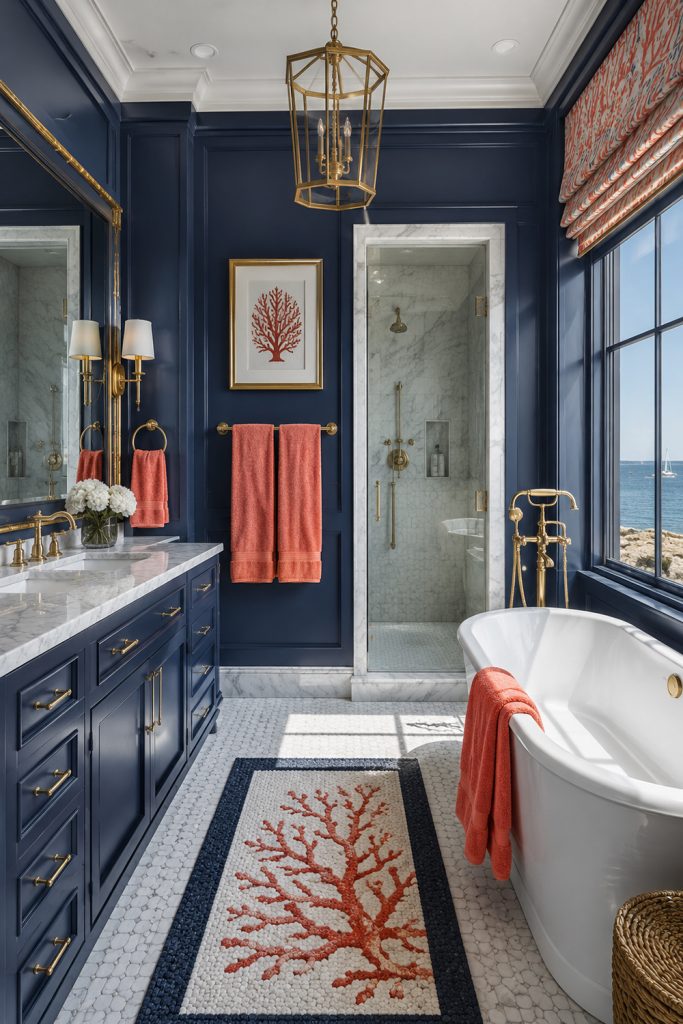
The pairing of French navy — a blue with warm, slightly purple undertones that prevent it from reading as cold — and coral — the joyful, sun-kissed midpoint between pink and orange — creates a bathroom that is coastal without being kitsch, bold without being brash, and unforgettably beautiful without being difficult to live with. Paint the bathroom in French navy — Benjamin Moore’s “Hale Navy” HC-154 is the gold standard — and introduce coral through generous, oversized bath towels in Turkish cotton, a coral-printed shower curtain with white ground, and coral ceramic accessories. A white marble countertop and brushed gold tap fittings complete a bathroom that feels like the very best kind of seaside hotel room.
8. Indigo and Tangerine: A Bold Maximalist Statement Bathroom
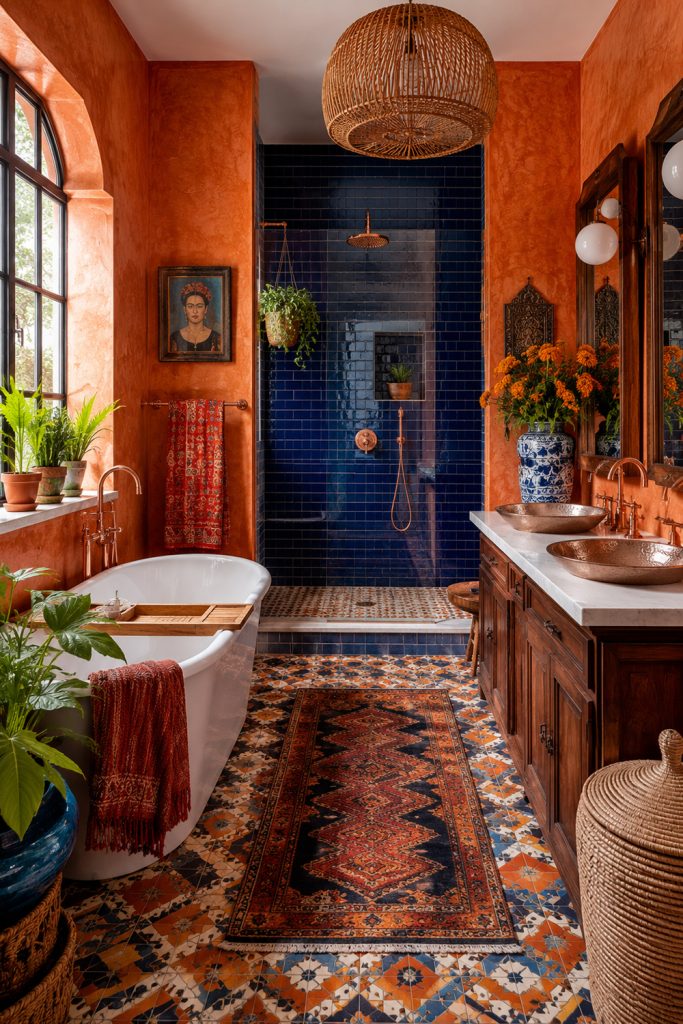
Indigo — the deepest, most spiritually resonant blue, sitting at the boundary where blue tips toward violet — paired with tangerine orange creates a color combination of spectacular, near-psychedelic boldness that is rooted in the rich tradition of Indian textile arts, Balinese batik printing, and Japanese shibori dyeing. In a maximalist bathroom, give both colors equal weight: deep indigo subway tiles in the shower enclosure, tangerine orange limewash on the facing wall, an indigo-and-tangerine kilim-patterned floor tile, a hand-block-printed indigo shower curtain, and tangerine ceramic vessels arranged on an open oak shelf. Layer rattan, macramé, and copper for a maximalist bathroom of world-travelled, artisanal richness.
9. Pale Aqua and Burnt Sienna: A Desert Spa Bathroom
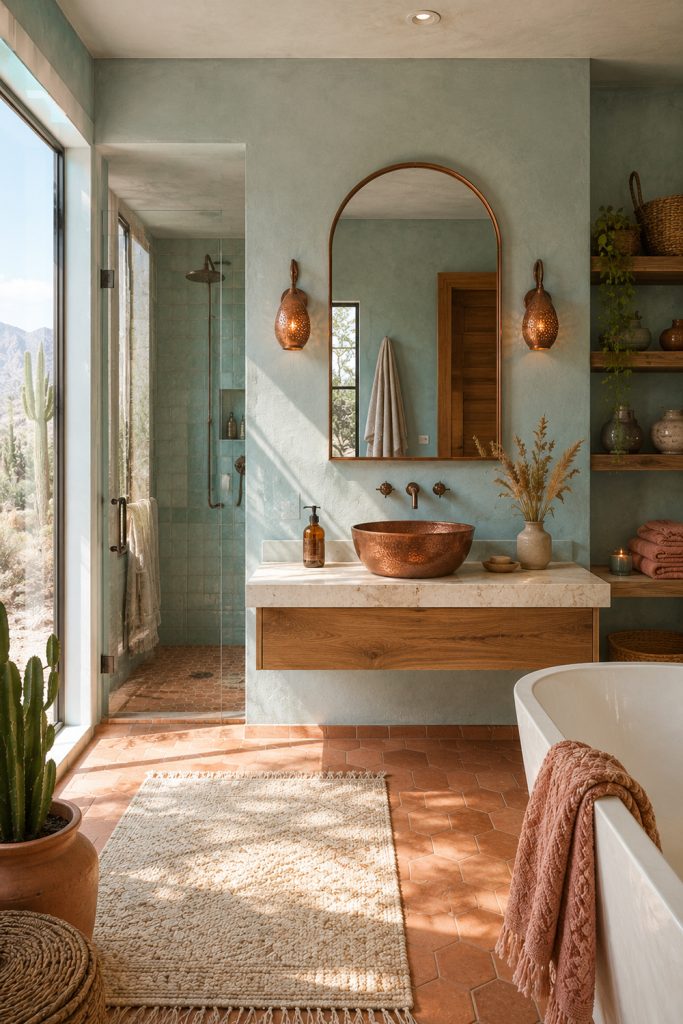
Aqua and burnt sienna — the specific combination of a cool, mineral-tinged blue-green and the deep, iron-rich reddish-orange of desert earth — creates a bathroom that channels the extraordinary landscape of the American Southwest: the turquoise sky above Monument Valley, the red canyon walls, the pale sage of desert grasses. This is the desert spa bathroom: pale aqua on the walls or in large-format gloss tiles, burnt sienna on the floor in honed terracotta or Saltillo tiles, natural travertine or pale limestone on the countertop, and weathered oak floating shelves. A hammered copper vessel sink adds a final artisanal note of warming, handcrafted orange. Install warm-toned dimmable sconces to replicate that golden desert light.
10. Royal Blue and Copper Metallic: An Art Deco Bathroom
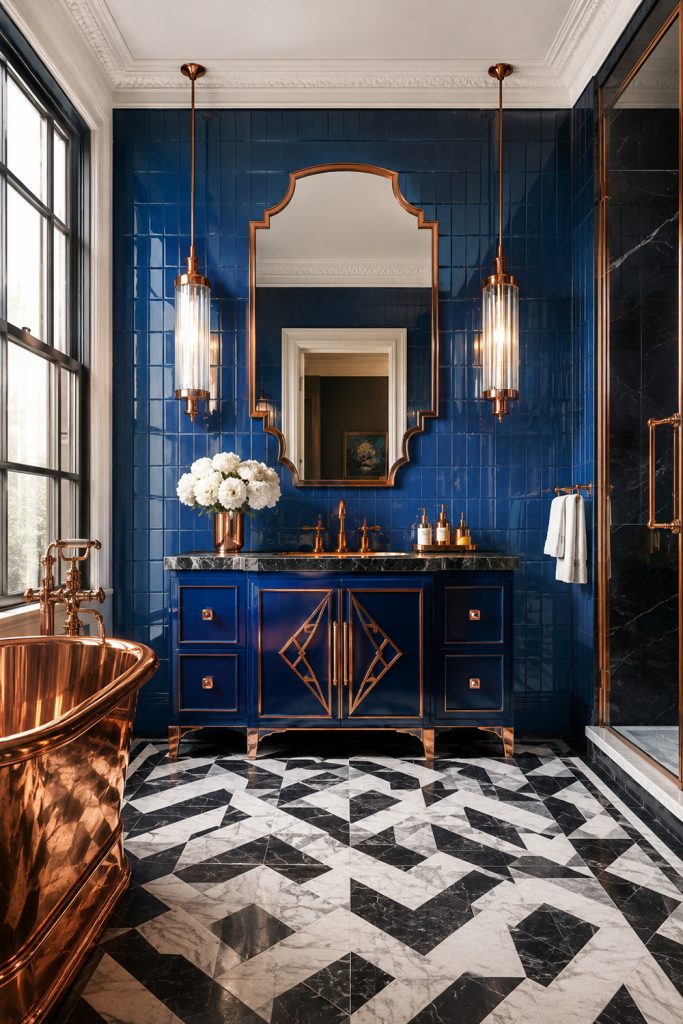
The Art Deco movement of the 1920s and 1930s was defined by its celebration of bold colors, geometric precision, and luxurious metallic contrasts — and the pairing of royal blue with copper metallic is one of its most magnificent expressions. In a bathroom designed around this aesthetic, royal blue appears in glossy wall tiles with subtle geometric relief patterns, a deep blue lacquered vanity, or rich blue encaustic floor tiles with gold geometric inlay. Copper introduces the complementary orange note through pendant light fittings, exposed copper pipework styled as a deliberate design feature, a copper basin, and copper-framed mirrors. Add gold geometric hardware and a monochrome black and white marble floor for pure Art Deco grandeur.
11. Dusty Blue Shiplap with Pumpkin and Rust Autumn Accents
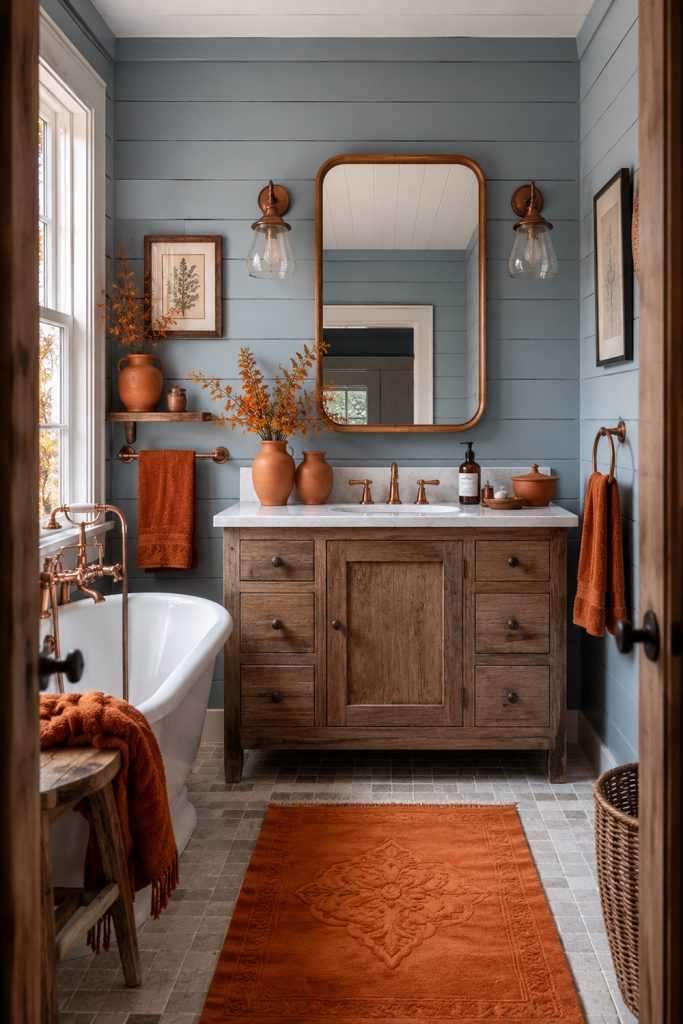
The dusty blue and pumpkin-orange bathroom is the interior design equivalent of a perfect autumn morning — the combination of a cool, slightly weathered blue and the warmth of harvest-season orange creates a bathroom atmosphere of nostalgic comfort and genuine seasonal beauty. Dusty blue shiplap panels in a matte chalk-paint finish line the bathroom walls, creating a textured, softly rustic backdrop. Against this, introduce pumpkin and rust through accessories that celebrate the season: a velvet bath mat in pumpkin orange, a ceramic pumpkin-shaped soap dispenser, terracotta candle holders, a copper-toned towel rail with cinnamon-toned linen towels. Natural wood accents in weathered oak or pine complete the cozy, autumnal farmhouse aesthetic.
12. Steel Blue Concrete Tiles with Rust Orange Industrial Fixtures
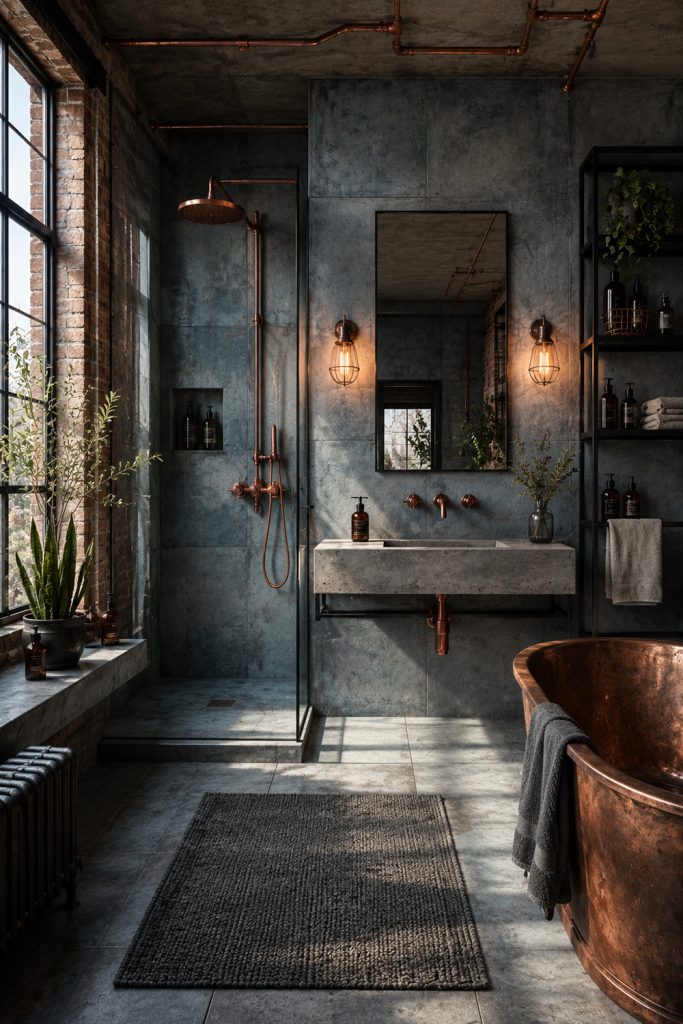
For the bathroom that embraces the raw, unfinished aesthetic of industrial design — exposed brickwork, concrete surfaces, bare metal pipework — steel blue concrete-effect tiles paired with rust orange industrial fixtures create a space of compelling, urban grit and unexpected beauty. Steel blue concrete porcelain tiles on the floor and walls establish the industrial base: cool, structural, and architectural. Against this, rust orange introduces warmth through deliberately styled exposed copper pipework, a rust-patinated metal mirror frame, an orange heat lamp in an industrial wire cage shade, and terracotta bath accessories arranged on an open metal shelf. The contrast between cool blue-grey and warm rust creates a bathroom with genuine urban character and design authenticity.
13. Turquoise and Terracotta: A Mediterranean Escape
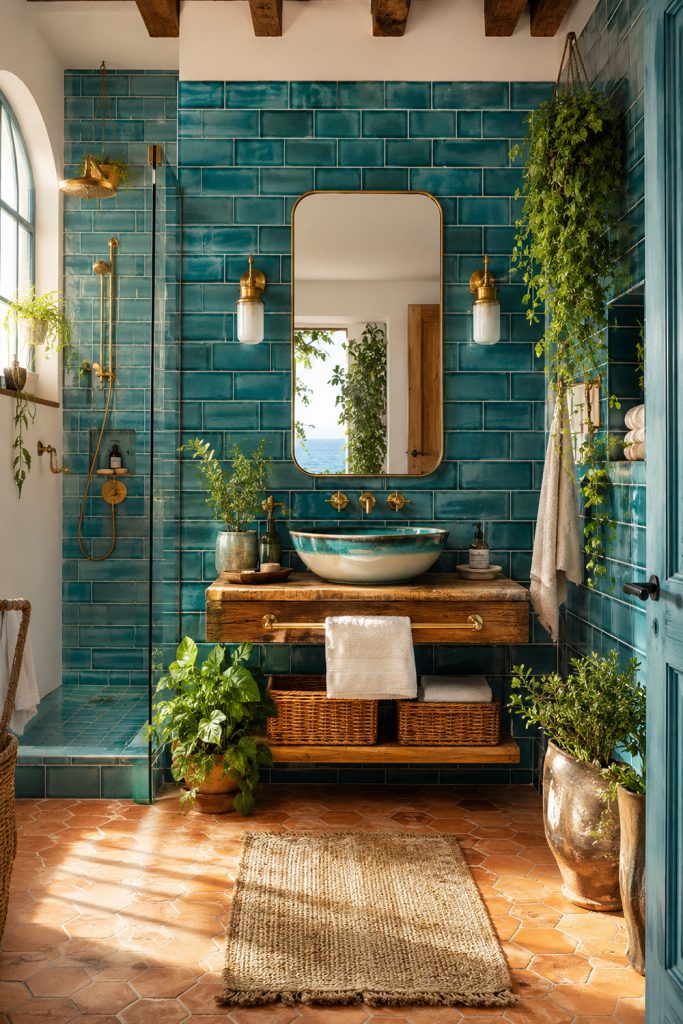
Turquoise and terracotta is the color pairing of the Mediterranean basin — from the turquoise painted woodwork of Greek island houses against terracotta-roofed villages, to the glazed blue pottery of Moroccan souks displayed against sun-baked clay walls, this combination carries two thousand years of Mediterranean design history in its chromatic DNA. In the bathroom, turquoise glazed subway tiles in the shower enclosure and a feature wall behind the vanity bring the color of Aegean water directly into the space. Terracotta hexagonal floor tiles — unsealed or lightly sealed to preserve their natural texture — provide the earthen, sun-warmed counterpoint underfoot. Complete with aged brass fixtures, a hand-thrown ceramic basin, and trailing Mediterranean herbs on the windowsill.
14. Navy Blue Vanity with Burnt Orange Accent Wall
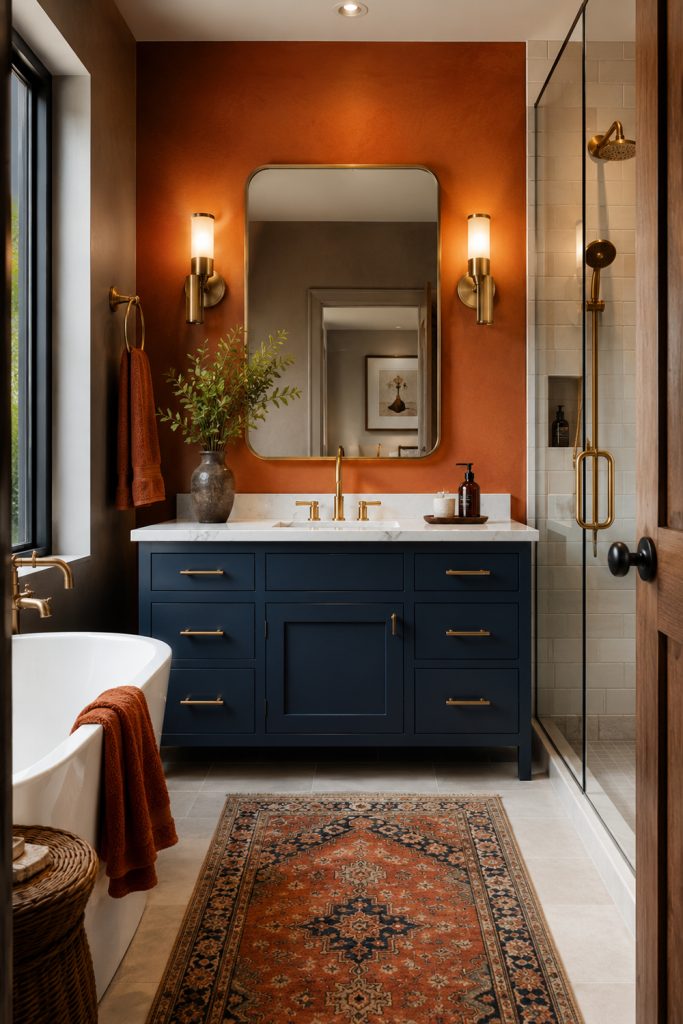
Rather than committing to a full-room color transformation, the targeted combination of a navy blue painted or lacquered vanity unit against a single burnt orange accent wall creates a bathroom of bold, confident color contrast with surgical design precision. The navy vanity — ideally a freestanding furniture-style piece with legs, or a floor-mounted cabinet with a clean shaker door profile — becomes a grounded, authoritative piece of bathroom furniture when painted in a deep, rich navy. The burnt orange accent wall behind the vanity or bathtub introduces the complementary warmth with dramatic effect. A white quartz countertop, brushed brass mirror, and warm amber lighting above the vanity complete the carefully composed, high-impact scheme.
15. Baby Blue Retro Bathroom with Tangerine Orange Wallpaper

The 1950s and 1960s produced bathrooms of extraordinary chromatic confidence — pastel blue fixtures paired with warm citrus accents were commonplace in the mid-century American home, and this retro aesthetic has aged into something genuinely desirable and designerly rather than merely dated. A retro-inspired blue and orange bathroom features a baby blue clawfoot tub or pedestal basin as its hero piece, white hexagonal floor tiles in the classic Victorian tradition, and a feature wall of tangerine orange geometric or floral wallpaper in a moisture-resistant formulation. Pair with chrome fixtures, a globe-shade vanity light in polished chrome, and retro-inspired ceramic accessories in complementary tones. This bathroom earns its boldness through genuine design historical reference.
16. Slate Blue and Sunset Orange Desert Modern Bathroom
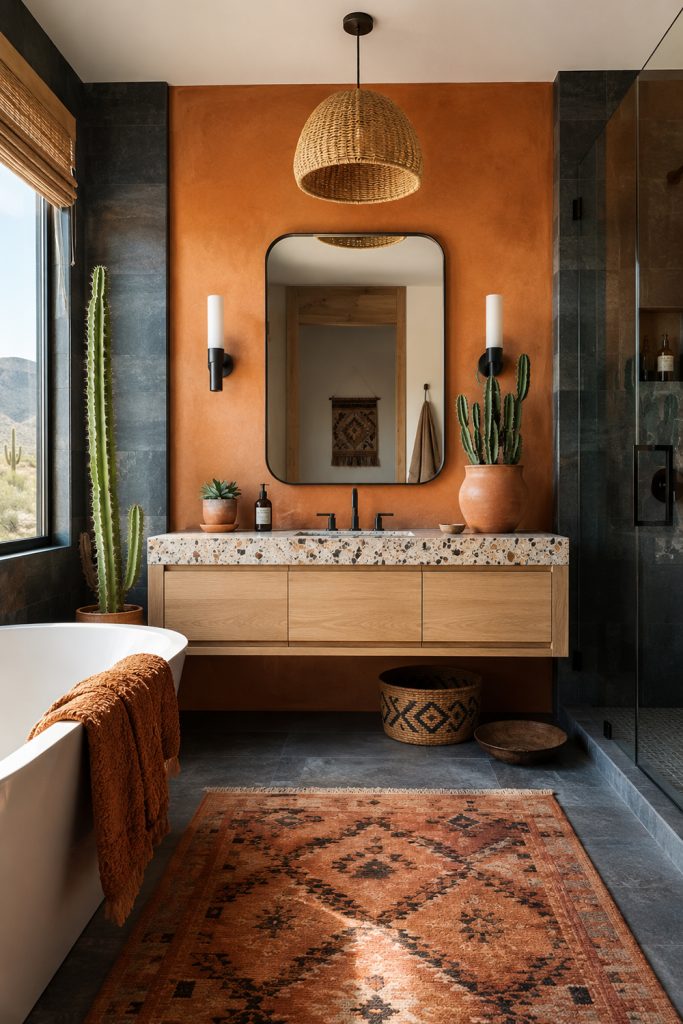
Desert modern design — the aesthetic born from the convergence of Mid-Century Modern architecture, Southwestern materials, and the vast, color-saturated landscapes of the American desert — finds its ideal bathroom expression in the pairing of cool slate blue and warm sunset orange. Large-format slate blue porcelain tiles in a matte finish cover the floor and primary walls, their cool, mineral tones evoking the twilight desert sky. A single accent wall in sunset orange paint — applied in a limewash technique for textural depth — captures the exact warmth of a desert horizon at golden hour. Pair with a floating white oak vanity, a rattan pendant light, a terrazzo countertop, and potted cacti in terracotta pots.
17. Periwinkle Blue and Cantaloupe Orange: French Country Bathroom

Periwinkle blue — that enchanting, lavender-leaning blue that exists at the precise meeting point of blue and violet — paired with the soft, sun-warmed sweetness of cantaloupe orange creates a bathroom of French country charm and quietly sophisticated color poetry. Periwinkle-painted shaker cabinets anchor the vanity with romantic, Provençal character. Cantaloupe orange is introduced through oversized bath towels in heavyweight Turkish cotton, a woven bath mat in warm melon tones, and a cluster of dried flowers in cantaloupe and amber arranged in a glazed ceramic vase. Cream marble subway tiles, antique brass fixtures, and a distressed wooden mirror frame complete a bathroom that feels entirely handcrafted, warmly personal, and deeply French in spirit.
18. Bold Cobalt Blue and Neon Orange: Contemporary Maximalist
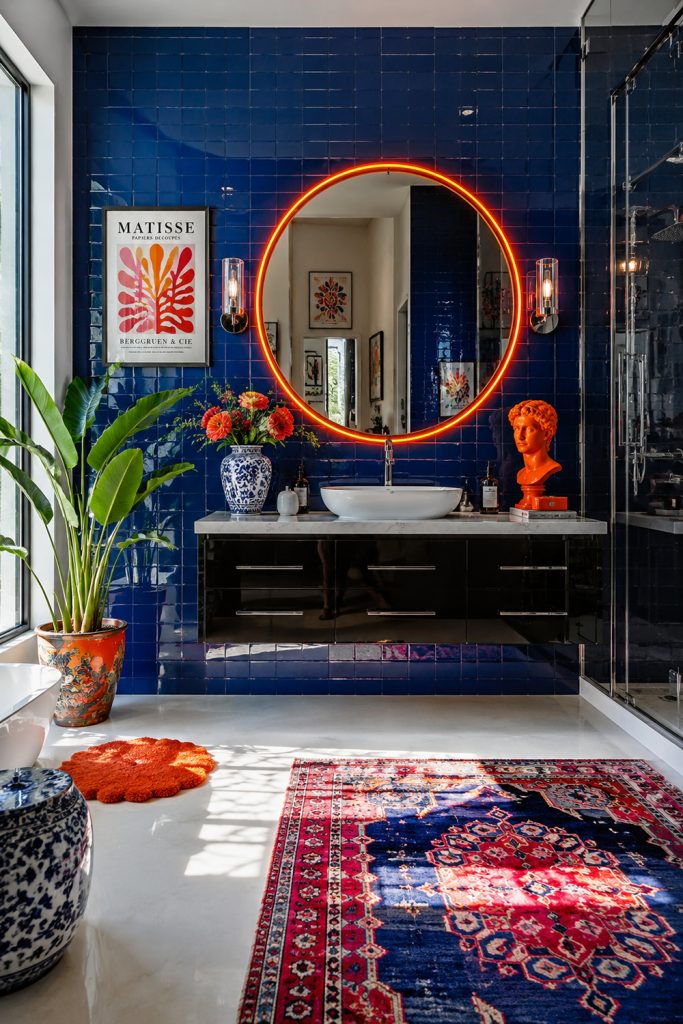
For the design maximalist who wants their bathroom to function as a statement of joyful, fearless aesthetic identity, cobalt blue and neon orange pushed to their most vivid, saturated extremes creates a space of exhilarating contemporary boldness. Cobalt blue large-format gloss tiles cover the shower enclosure from floor to ceiling, their high-gloss surface amplifying the depth and richness of the color. The vanity unit is lacquered in high-gloss cobalt to match. A neon orange circular mirror frame — in powder-coated steel or lacquered wood — provides the blazing complementary accent above the vanity. Pair with a polished white concrete floor, white grout, chrome fixtures, and a single neon orange ceramic vase to complete the composition. Reserved for those with genuine design courage.
19. Soft Teal Blue and Peach: A Gentle, Romantic Pairing
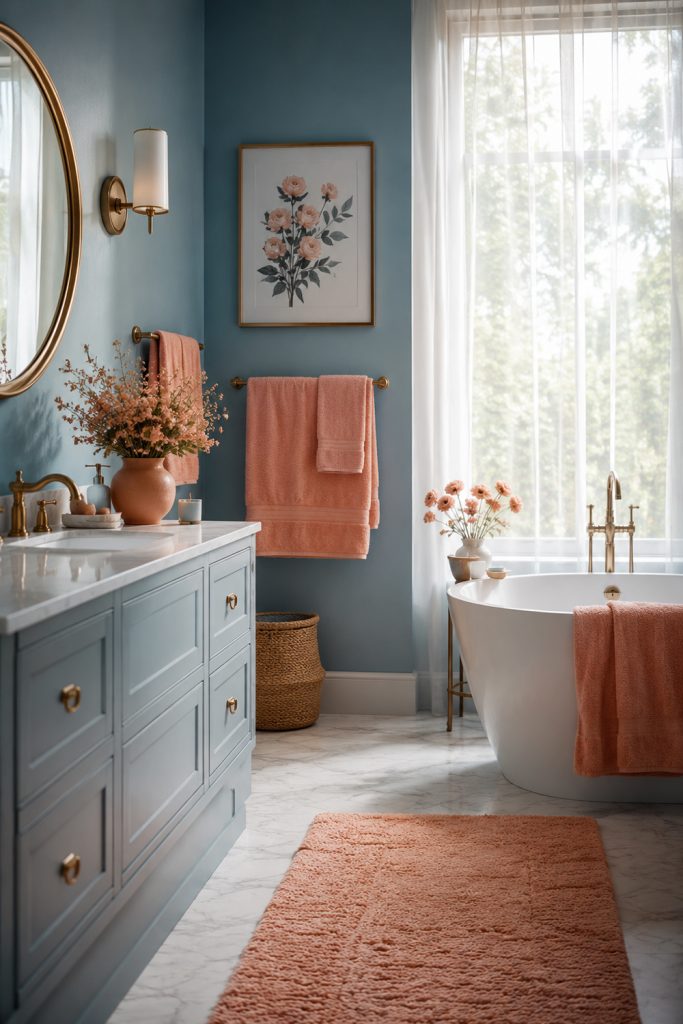
Not all blue and orange bathrooms need to be dramatic or daring. The softest, most romantic, and most universally flattering interpretation of this complementary palette is the pairing of soft teal blue and warm, blushing peach — the two colors of a summer evening sky, where the day’s warmth lingers in the horizon while the first cool blue of dusk descends. Soft teal — a blue-green with warmth and depth but no harshness — on bathroom walls creates an atmosphere of serene, mineral calm. Peach introduces the complementary orange note in its most delicate, skin-tone-flattering form: peach towels, a peachy-pink bath mat, warm peach ceramic accessories, and a peach lampshade on the vanity light. Flattering, gentle, and genuinely beautiful.
20. Oceanic Deep Blue and Amber: A Moody Luxury Bathroom
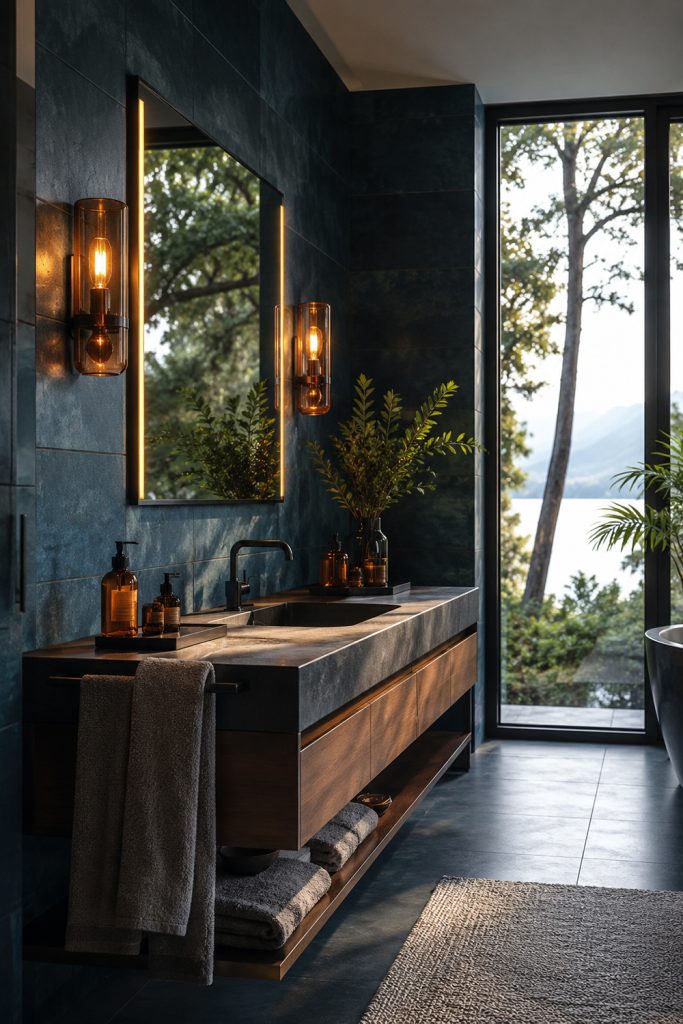
The pairing of deep oceanic blue — a complex, dark blue that carries suggestions of teal, navy, and midnight in its depths — with warm, glowing amber creates a bathroom of remarkable moody opulence, evoking the extraordinary beauty of deep ocean light filtered through warm amber. Deep oceanic blue large-format tiles — in a honed, matte finish to prevent glare — cover the shower walls and main bathroom walls. Amber glass accessories — a wall light with an amber glass shade, an amber glass soap dispenser, amber glass perfume bottles arranged on the vanity shelf — introduce the warm complementary orange-gold note with jewel-like luminosity. Install a dimmable warm white lighting system that enhances the amber glow at evening, transforming the bathroom into a deeply atmospheric, spa-worthy sanctuary.
The Complete Blue and Orange Bathroom Design Guide
Designing a blue and orange bathroom with genuine skill and confidence requires an understanding of the color science, material choices, and spatial considerations that separate inspired design from accidental decoration. Here is everything you need to know:
Understanding Color Theory: Why Blue and Orange Work
Blue and orange are complementary colors — positioned exactly opposite each other on the traditional RYB (Red-Yellow-Blue) color wheel used in art and interior design. The fundamental property of complementary pairs is that they intensify each other when placed in proximity: blue appears more vibrantly blue next to orange, and orange appears more vibrantly orange next to blue. This optical phenomenon, described by color theorist Michel Eugène Chevreul in 1839 and later explored by Josef Albers in his seminal work “Interaction of Color,” explains why blue and orange interiors feel so visually alive and energetically charged. Understanding this is not merely academic — it determines how much of each color to use and where to use it.
The 70-20-10 Rule for Blue and Orange Bathrooms
The most reliable proportion framework for a blue and orange bathroom is the 70-20-10 rule: 70% of the room in the dominant color or neutral (typically the blue, or white/grey with blue accents), 20% in the secondary supporting color or material (natural stone, wood, brass), and 10% in the accent complementary color (the orange). This structure prevents the pairing from becoming overwhelming or visually fatiguing. A bathroom that is 50% blue and 50% orange will feel chaotic; one that is 70% deep navy, 20% warm white marble, and 10% burnt orange accessories will feel deliberate, balanced, and genuinely beautiful.
Choosing the Right Blue for Your Bathroom
The shade of blue you choose is the single most important decision in a blue and orange bathroom, as it determines the entire emotional register of the space:
- Navy and midnight blue — authoritative, dramatic, and luxurious. Works best in larger bathrooms or as a vanity accent in smaller ones. Pairs with burnt orange, terracotta, and copper.
- Cobalt and royal blue — vivid, energetic, and bold. Best deployed as tile or cabinet color in spaces with strong natural light. Pairs with burnt orange and amber.
- Dusty and powder blue — soft, romantic, and nostalgic. Works in any size bathroom. Pairs with peach, apricot, and cantaloupe.
- Teal and turquoise — complex, warm-cool, and exotic. Pairs with terracotta, burnt sienna, and copper with particular success.
- Slate and steel blue — cool, contemporary, and understated. Pairs with rust orange and warm amber for industrial-luxe results.
- Periwinkle — romantic, lavender-tinged, and French in character. Pairs best with peach and cantaloupe orange for a soft, feminine aesthetic.
Choosing the Right Orange to Complement Your Blue
Similarly, the shade of orange you choose must be matched carefully to your chosen blue:
- Terracotta and burnt sienna — earthy, ancient, and Mediterranean. Pairs with virtually every shade of blue, from cobalt to navy to teal.
- Copper and amber — warm, metallic, and rich. Most effective as an accent material (fixtures, accessories) rather than as a surface color.
- Coral — fresh, coastal, and energetic. Pairs best with navy, sky blue, and French blue for a coastal aesthetic.
- Apricot and peach — soft, gentle, and universally flattering. Pairs beautifully with powder blue, dusty blue, and periwinkle.
- Burnt orange and pumpkin — autumnal, warm, and rustic. Pairs magnificently with dusty blue, slate blue, and midnight navy.
- Tangerine and neon orange — bold, vivid, and contemporary. Best reserved for accent use only — a mirror frame, a single accessory — against deep, saturated blues.
Material Companions for Blue and Orange Bathrooms
The materials you introduce alongside your blue and orange palette will fundamentally define the final aesthetic character of the room:
Brass and gold — warm metallic tones that bridge blue and orange beautifully, amplifying the warmth of orange accents while providing elegant contrast against blue surfaces. Brushed or unlacquered brass is the most sophisticated choice.
Natural wood — oak, walnut, teak, and bamboo all introduce organic warmth that softens the intensity of bold blue and orange combinations. Essential for preventing a blue and orange bathroom from feeling too graphic or cold.
White marble — the classic neutralizer. A white marble countertop or floor provides visual relief that allows both blue and orange surfaces to breathe and be appreciated without competing. Avoid cold grey marble — choose marble with warm cream or honey undertones.
Rattan and wicker — introduce handcrafted, organic texture that grounds vivid blue and orange palettes with natural warmth. Particularly effective in coastal, bohemian, and Mediterranean-inspired bathroom schemes.
Copper and hammered metal — simultaneously serve as a material, a texture, and an orange-adjacent color accent. Hammered copper basins, copper pipework, and patinated copper accessories are among the most beautiful material choices in a blue and orange bathroom.
Lighting Considerations for Blue and Orange Bathrooms
Lighting plays a critical and often underestimated role in how a blue and orange bathroom reads at different times of day. Blue surfaces — particularly dark navy and cobalt — absorb significant amounts of light and will cause a bathroom to feel dramatically darker as natural light diminishes in the evening. Counteract this with a layered lighting strategy: recessed downlighters on a dimmer for overall ambient light, wall sconces at face height for flattering task lighting at the vanity, and accent lighting — LED strip beneath a floating vanity, or uplighting behind a freestanding bath — to introduce warmth and atmosphere.
Always choose warm white bulbs (2700–3000K) in a blue and orange bathroom. Cool daylight bulbs will shift blue surfaces toward grey and strip the warmth from orange accents, destroying the complementary harmony of the palette. Warm white light, by contrast, enriches the blue’s depth and amplifies the orange’s warmth — exactly what the palette requires to look its most beautiful.
Grout Color: A Critical Detail
In a blue and orange tiled bathroom, grout color is a design decision of genuine consequence:
- White grout — maximizes tile color impact; keeps the scheme feeling light and airy; suits coastal and Scandi-influenced blue and orange bathrooms.
- Cream or ivory grout — softens the contrast between tiles; suits terracotta-adjacent orange tones beautifully; adds warmth.
- Terracotta or orange-toned grout — reinforces the orange element of the palette; most effective with blue tile and terracotta grout combination for a Mediterranean or Moroccan effect.
- Dark navy or charcoal grout — adds graphic precision and contemporary edge; particularly effective with white or light blue tiles where you want the grout pattern to become a deliberate design feature.
Bathroom Size Considerations
Small bathrooms: Use blue as an accent color rather than a dominant wall color to avoid making the space feel enclosed. A single navy blue or cobalt vanity against white walls with terracotta accessories delivers bold impact without visual compression. Glossy blue tiles also reflect more light than matte, helping to maintain a sense of spaciousness.
Medium bathrooms: The 70-20-10 rule works perfectly in medium-sized bathrooms. Use blue on two walls and the shower enclosure, white on the remaining walls and ceiling, and orange in accessories and fixtures throughout.
Large bathrooms: Large bathrooms can support the most dramatic blue and orange combinations — including floor-to-ceiling deep navy or cobalt tile, book-matched blue marble, or a full-room Art Deco treatment in royal blue and copper. The spaciousness of the room prevents even the darkest and most vivid color combinations from feeling overwhelming.
Final Thoughts
There is a fundamental truth in interior design that the most cautious choices rarely produce the most satisfying results. The bathroom designed entirely in safe, inoffensive white is forgotten the moment you step outside it. The bathroom that commits to the extraordinary complementary alchemy of blue and orange — executed with knowledge, confidence, and genuine design intelligence — is the bathroom that guests remember, that you appreciate more deeply with every passing season, and that photographs with the kind of vivid, compelling beauty that makes people stop scrolling.
Blue and orange has the color wheel’s most powerful complementary relationship working in its favor. It has the authority of naval history, the warmth of Mediterranean sunshine, the glamour of Art Deco gold, and the earthy grounding of ancient terracotta all simultaneously available within its spectrum. It is, at once, the color of the ocean and the color of the sand it breaks upon. The color of the sky and the color of the desert beneath it. The color of the deep sea and the amber light of a lantern in the dark.
Choose your shade of blue. Choose your shade of orange. Design with knowledge, furnish with quality, and light with warmth. The result will be a bathroom that is not merely decorated — it is truly, beautifully, unforgettably designed.


