

15 Grandma Core Kitchen Ideas — Nostalgic, Patterned & Practical
Some kitchens are admired. A grandma’s kitchen was loved — usually while something was in the oven and a kettle was coming to the boil. Grandma core kitchen ideas, often called grandmacore, bring that feeling home again: floral patterns, honest enamelware, jars of real ingredients on open shelves, and textiles that soften every hard edge. Every piece earns its place by being useful first, charming second.
The good news is that this look needs no renovation. It is built in layers — a curtain here, a shelf of jars there — and most of it can be thrifted or inherited. If you love slower, storybook cooking spaces, our village kitchen ideas explore the same spirit in a more rustic register; here, the focus stays on grandma’s own details.
1. Start With Ditsy Floral Wallpaper
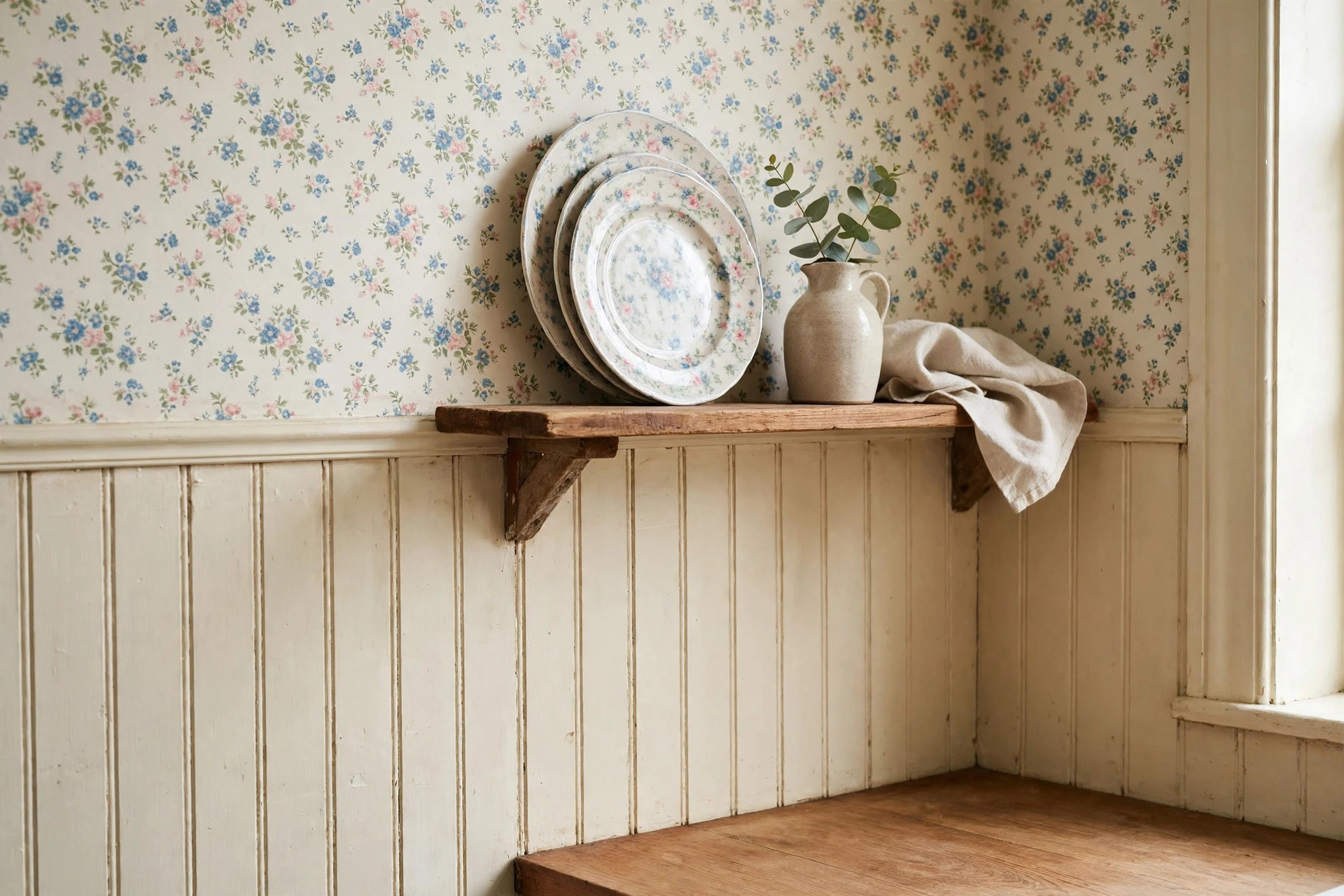
A small-scale floral print sets a grandma core mood faster than anything else, because pattern is what people remember first about those kitchens. Keep the scale tiny and the colours soft — faded rose, sage and butter on cream — and use it on one wall, the top half above beadboard, or the back of a shelving unit. A busy print on a small area charms; on every wall, it overwhelms. Before committing, tape up a large sample and watch it in morning and evening light; a tiny repeat that looks sweet in the shop can turn busy across a wall.
2. Hang Lace Café Curtains at the Window

Café curtains cover only the lower half of the window — exactly the part neighbours can see into — so you get privacy and plenty of light at once. White or ivory lace is the classic choice, with a short gingham valance above for a cheerful second pattern. They are inexpensive, washable and easy to swap seasonally. For more ways to dress a hardworking window, see our kitchen window decor ideas. Fit them on a tension rod if you cannot drill, and choose lace that survives a gentle machine wash — kitchen windows gather steam and splashes faster than any other curtains in the house.
3. Fill Open Shelves With Glass Pantry Jars
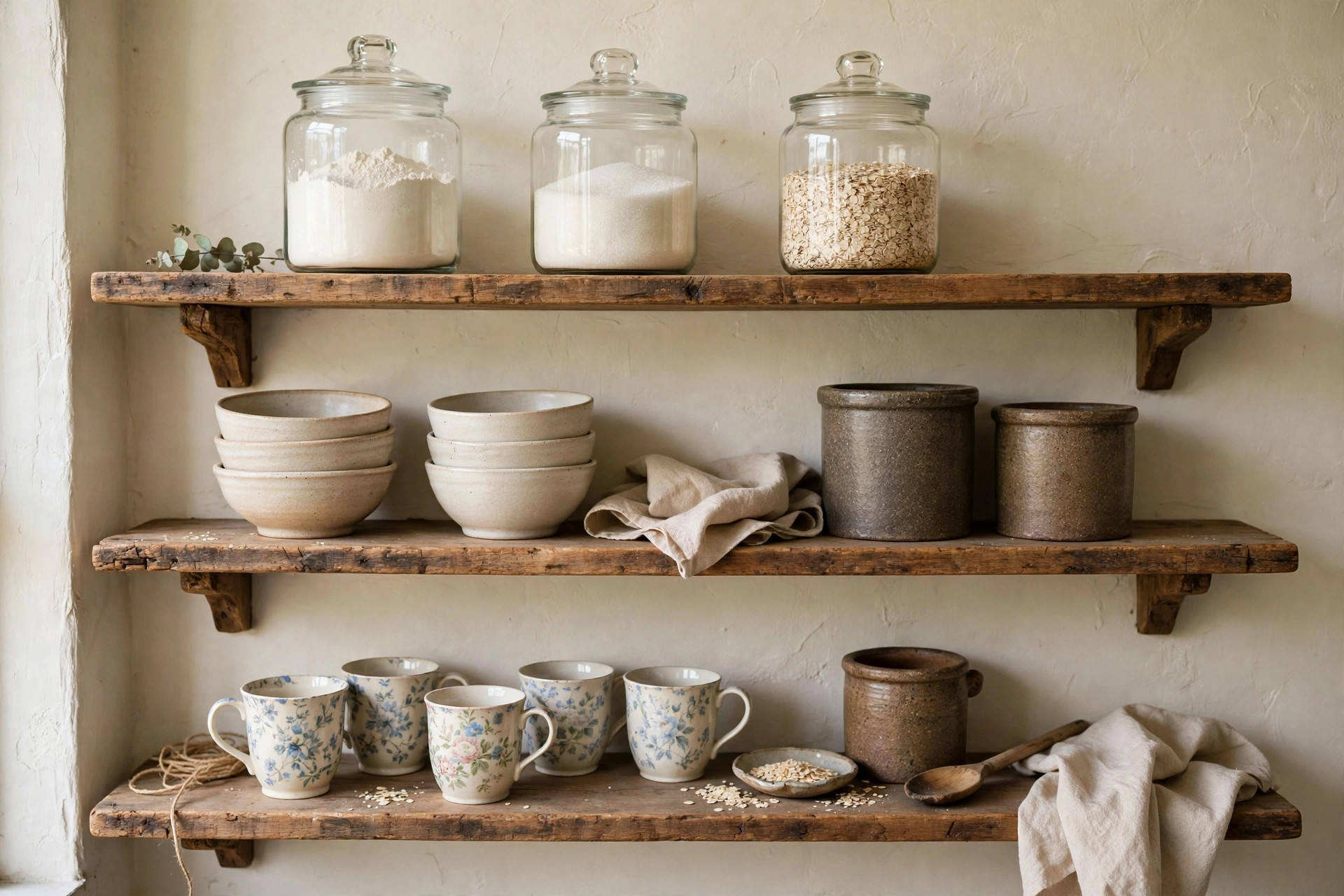
Open shelves lined with clear glass jars of flour, oats, sugar and pasta are pure grandma core — part storage, part display, entirely practical. You see at a glance what is running low, and the pale contents become the decoration. Keep the jars in one family, all glass with similar lids, so the shelf reads calm rather than chaotic, and tuck everyday bowls and crocks between them for rhythm. Tape a small label to each lid with the contents and filling date, keep flour away from the stove’s heat, and wipe the shelf weekly so it reads cared-for, never dusty.
4. Cook and Serve With Vintage Enamelware

Cream enamel with a coloured rim — red, blue or green — is the signature material of the nostalgic kitchen. A stovetop kettle, mixing bowls, a pitcher that doubles as a vase: enamel is light, hard-wearing and just imperfect enough to feel real, and small chips are part of its story. Start with pieces you will genuinely use every week, and let the collection grow slowly. Wash enamel in warm soapy water, dry it straight away so chips do not rust, and never use abrasive scourers; stand the hot kettle on a trivet to protect wooden counters.
5. Lay a Gingham Tablecloth Over the Table
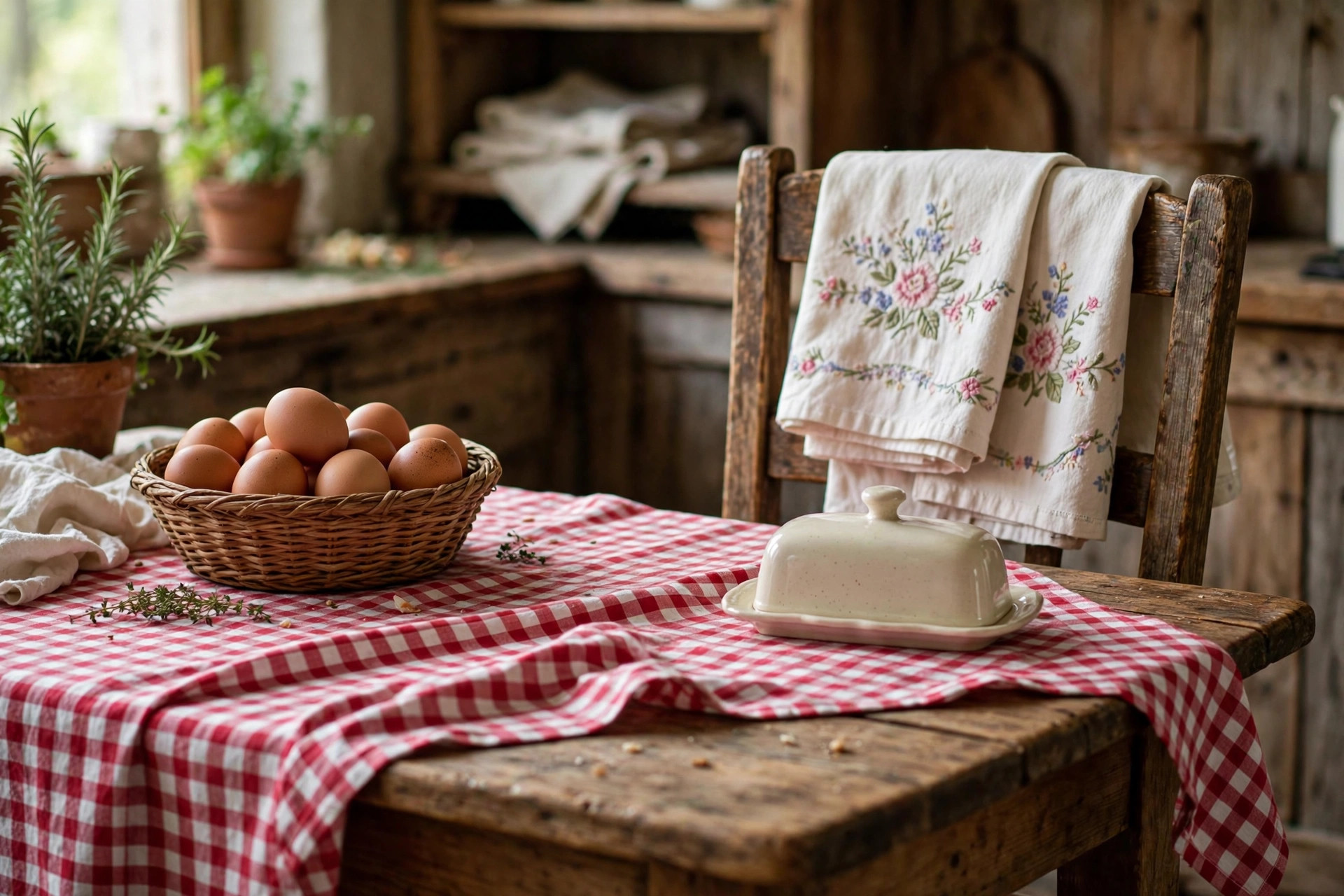
A checkered cloth turns a plain wooden table into the heart of the room, and quietly hides rings, crumbs and homework underneath. Red and white is the bold classic; blue or sage checks feel calmer. Choose a washable cloth that drops just past the edge, because in this kind of kitchen the table is for living at, not looking at. Keep embroidered tea towels folded where they can be seen, not shut in a drawer. Keep two cloths in rotation, so one can be washed while the other stays in service, and favour cotton that irons flat in a couple of minutes after each wash.
6. Lay a Checkered Floor, or Fake It Well

A checkerboard floor in black and cream, or softer red and cream, gives the room its nostalgic backbone and pairs with almost any cabinet colour. If relaying a floor is too big a step, peel-and-stick tiles, a checked runner, or a large checked rug by the sink delivers the same rhythm for far less commitment. Match the scale to the room: big squares for big kitchens, a finer grid for small ones. With peel-and-stick tiles, start from the centre of the room, work outward, and keep that first row dead straight — a crooked first row is the one shortcut the eye always catches.
7. Choose Retro-Style Appliances in Cream

Appliances with rounded corners and a cream or pastel finish blend into a grandma core scheme instead of shouting over it. You need not replace everything — a kettle and toaster in soft retro shapes, kept out where they are used daily, do most of the visual work. When a large appliance does come up for replacement, cream is the forgiving choice beside wood, checks and florals. Let the small pieces carry the colour — a cream kettle and toaster in daily use — while older stainless items sit quietly behind them, and wipe rounded seams often, where grease settles first.
8. Display Floral China on a Plate Rack

Grandma’s best plates were never hidden in a cupboard, and yours should not be either. A wooden plate rack, a rail with hooks for teacups, or a row of floral plates along one wall turns everyday china into the room’s artwork. Mismatched patterns are welcome — arguably preferred — provided they share a colour family. Use the pieces, too: a rack that refills with real meals beats a display nobody may touch. Fix the rack into studs or solid wall plugs, because a loaded plate rack is heavier than it looks, and space the plates so each one lifts out without chipping its neighbour.
9. Build a Proper Baking Corner
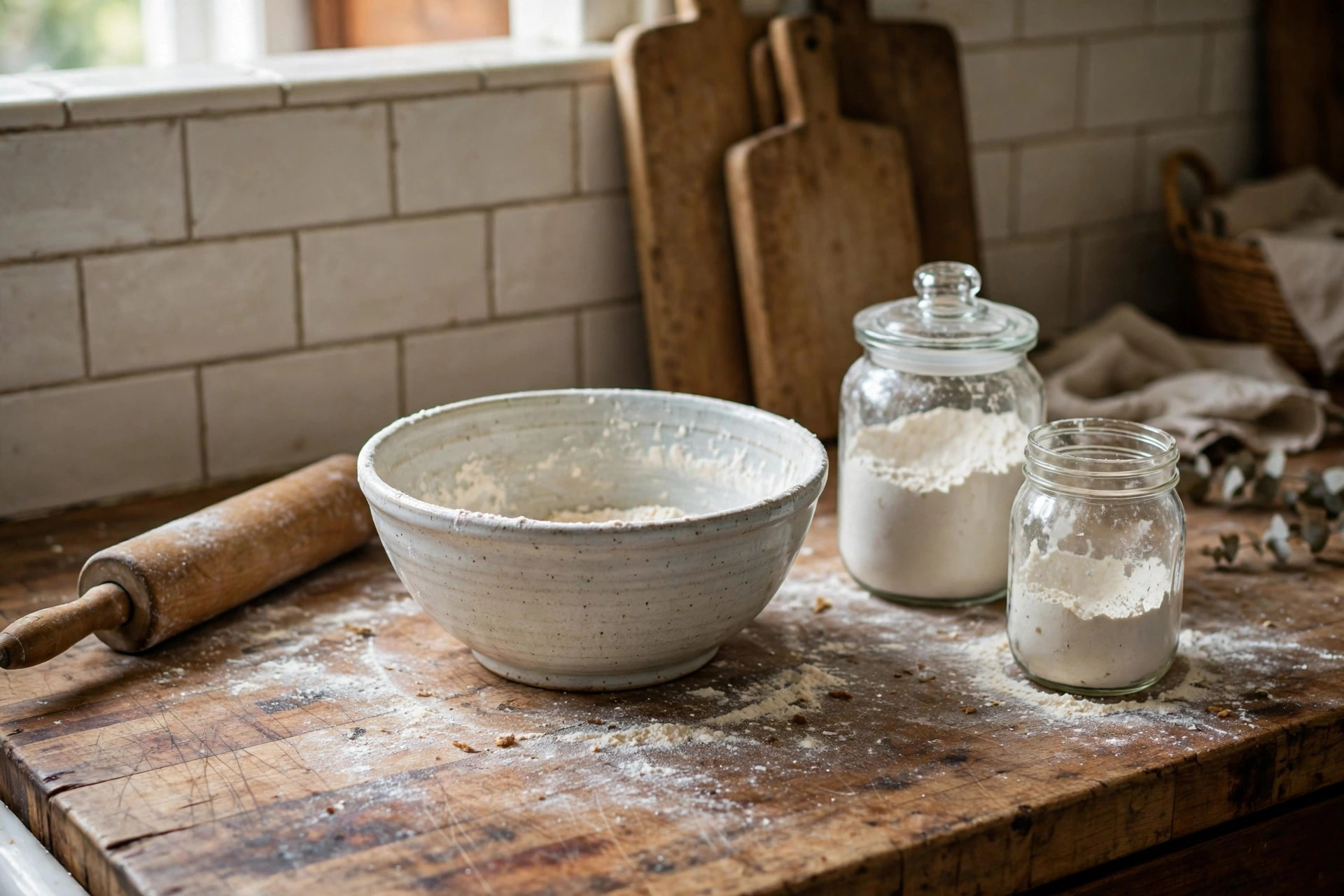
Every nostalgic kitchen had a spot where the baking actually happened: a stretch of wooden worktop, a heavy mixing bowl, a rolling pin within reach, bread boards leaning against the wall. Recreate it by gathering what you already own into one corner rather than scattering it through drawers. Leave the bowl out on the wood — a baking corner that is always ready gets used far more often. Keep it compact and ready: a scoop resting in the flour jar, measuring cups nested inside the bowl, and boards washed, dried upright and oiled occasionally so the wood never dries out.
10. Hang Aprons and Linens on Hooks
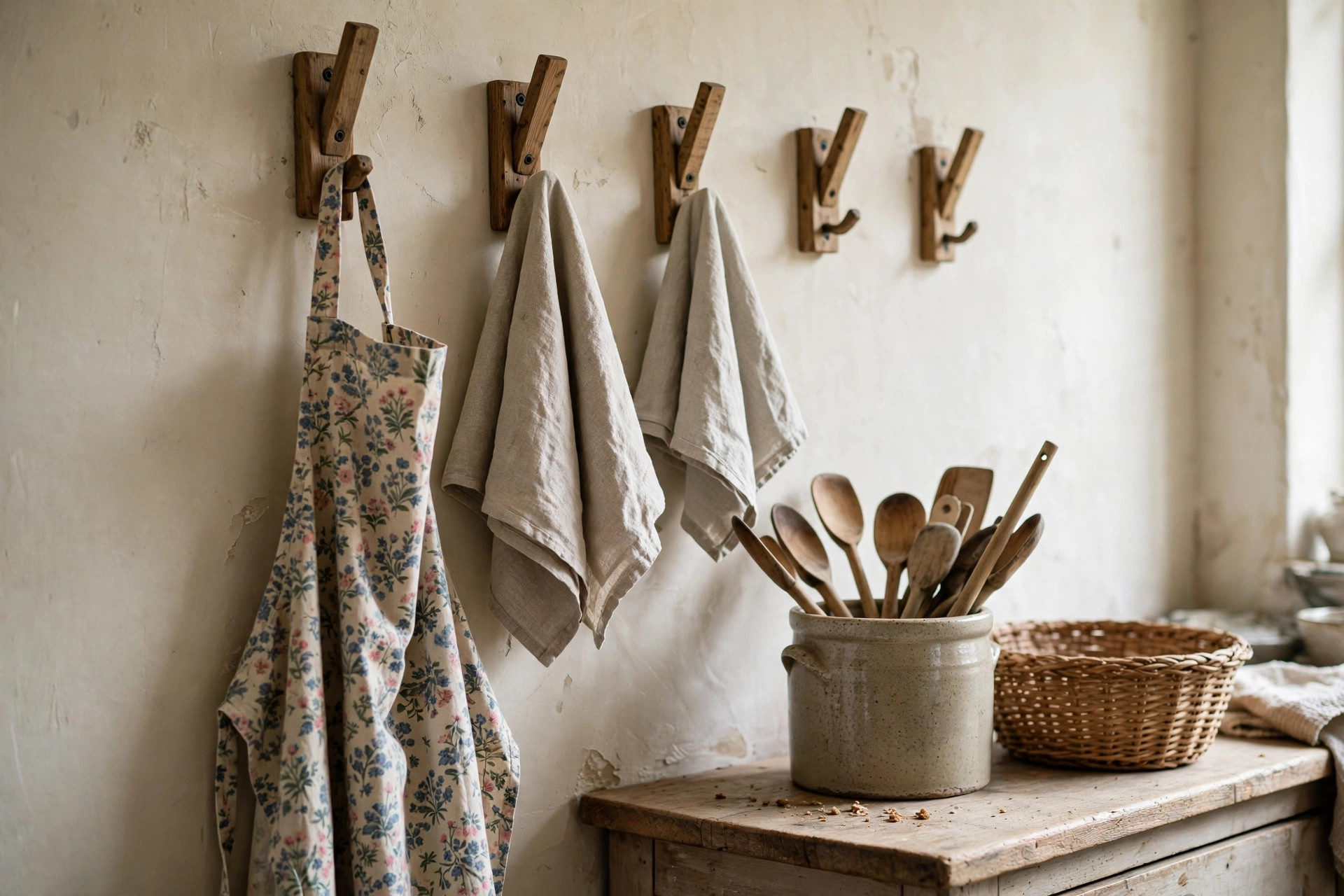
A row of simple hooks near the stove, holding a floral apron and your best linen tea towels, is storage you can see — and in this style that is a feature. Textiles soften all the hard, wipe-clean surfaces a kitchen needs, and a pretty apron on a hook is an open invitation to cook. Add a crock of wooden spoons below, and the whole wall becomes a small, useful still life. Space the hooks so damp towels dry properly between uses, keep the most-used towel on the hook nearest the stove, and launder everything often — softly faded cotton suits this style best.
11. Skirt the Sink Cabinet in Floral Fabric
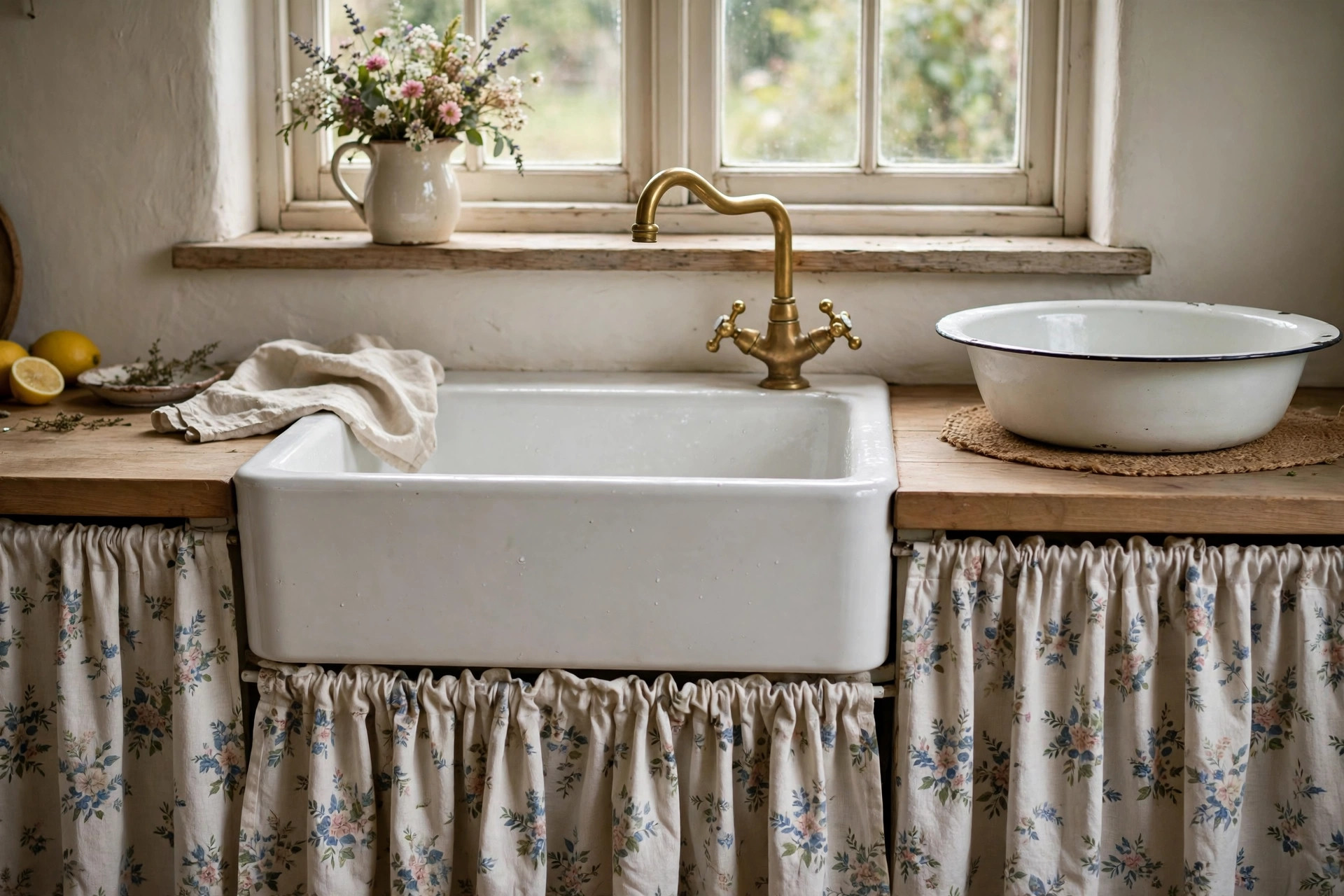
A gathered fabric skirt under the sink, or along open shelving, is one of the oldest tricks in the country kitchen: it hides cleaning bottles and spare pans while adding a generous dose of pattern. Choose a washable small floral or simple check, hung from a rod or wire so it slides aside easily. With a deep farmhouse sink and traditional faucet, even a newer kitchen gains an older soul. Gather the fabric to about one and a half times the width it covers so it hangs in soft folds, hem it properly, and choose a cloth you can unhook and wash easily.
12. Line the Windowsill With Geraniums and Herbs

A row of terracotta pots on the sill — red geraniums for pure nostalgia, basil and parsley for the cook — brings the garden into the room. Terracotta is the right material here: its warm, dusty orange flatters cream cabinets and floral prints, and it breathes around the plants’ roots. Keep the arrangement slightly uneven, as if it grew over time, and snip the herbs often so the display stays part of daily cooking. Turn each pot a quarter turn every few days so the plants grow evenly toward the light, pinch basil just above a leaf pair to keep it bushy, and stand pots on saucers.
13. Create a Pantry Corner With Baskets and Canisters

Turn one spare corner or short run of shelving into a miniature pantry: wicker baskets for onions, potatoes and fruit, enamel canisters for tea and coffee, jars for everything else. The baskets do the visual heavy lifting — woven texture is the warmth this style runs on — while lids keep contents tidy. It is the honest, everything-visible approach behind our farmhouse kitchen ideas, scaled down to a single corner. Group things by job — breakfast together, baking together — rather than by looks alone, and keep the heaviest baskets at waist height or lower, so the corner works as hard as it charms.
14. Carve Out a Cozy Breakfast Nook

A small round table, two chairs with floral cushions and a teapot that lives there permanently — the breakfast nook is where grandma core becomes a daily ritual instead of decor. A corner by a window is enough, and a round table keeps traffic flowing in a tight room. Our small cottage kitchen ideas show more ways to make a compact corner work hard. Choose cushion covers you can wash, because a nook used daily will collect jam and tea, and add a small lamp above the table so it still invites you on dark winter mornings.
15. Finish With Flowers, Fruit and Something Baking
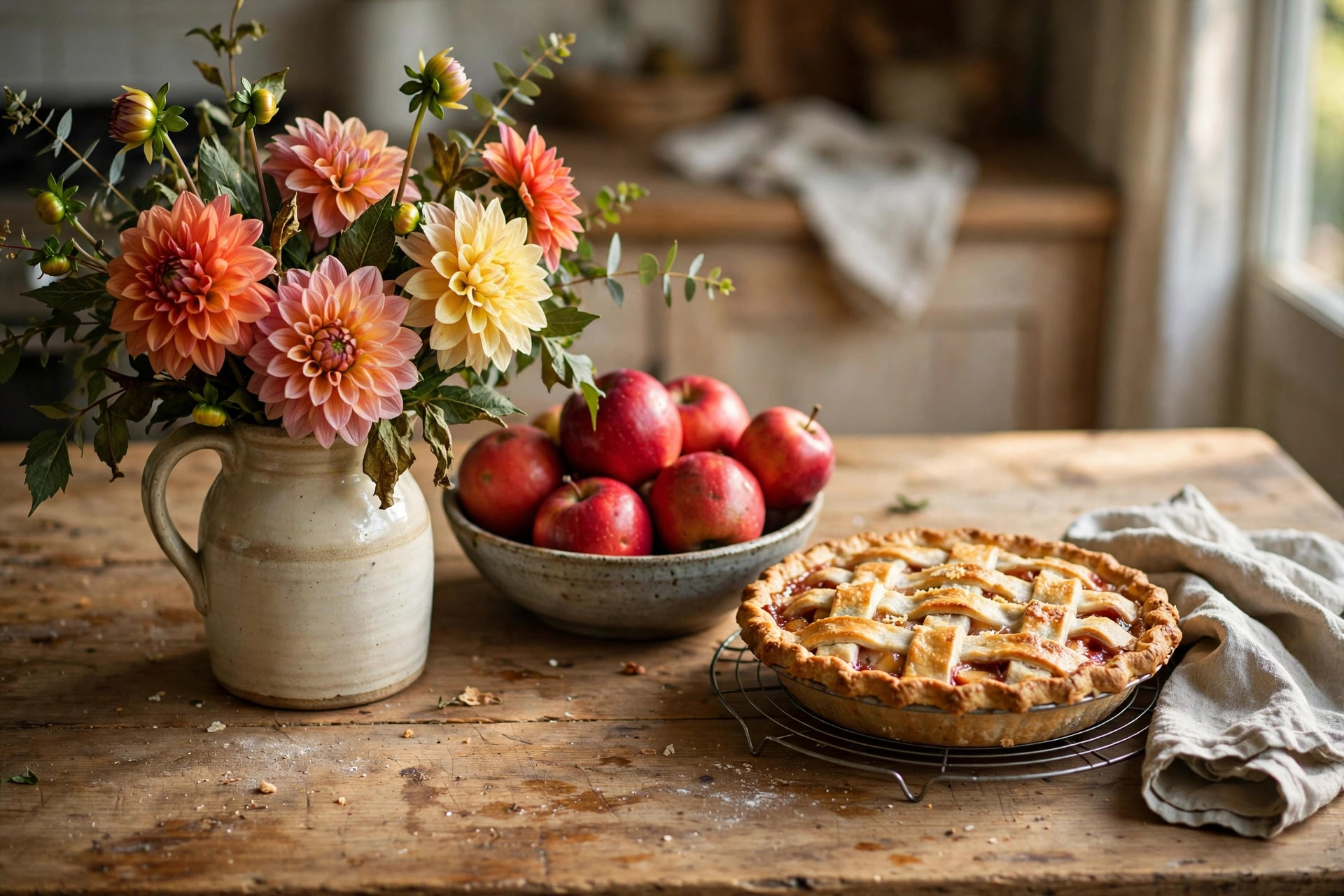
The last layer is not bought at all: a jug of garden flowers, a bowl of apples where people pass, and something — a pie, a loaf, a tray of scones — cooling on a rack. It is what made those kitchens feel alive rather than styled, and it costs almost nothing. Treat it as an idea in its own right. Rotate the layer with the week — cut herbs standing in a jam jar one day, eggs left out before a baking day the next — and let nothing match too neatly; looseness is the charm.
How to Keep Grandma Core Nostalgic, Not Cluttered
The line between collected and cluttered is editing. Give every category a home and a limit: one shelf system for jars, one rack for plates, one row of hooks for linens — and when a new treasure arrives, something else rotates into a cupboard. Keep counters and the table mostly clear between meals; clear space around a few loved objects is what lets them be seen.
Colour discipline helps too. Let one palette — say cream, faded red and sage — run through every pattern, so florals, checks and stripes from different decades still feel like relatives. Favour real materials as well: wood, enamel, cotton and ceramic all grow more characterful with use, which is the whole point of the style.
Work in a simple order. First, settle the palette and choose the one pattern that will lead. Second, add the textiles — curtains, cloth, skirt and aprons — because they change the mood fastest. Third, build the displays: the jar shelf, the plate rack and the pantry corner, each with its own limit. Fourth, place the working pieces, the baking corner and the nook. Last, remove one thing; that final edit is usually what saves a room from clutter.
Common Mistakes to Avoid
1. Mixing every pattern at full strength. Floral wallpaper, a checkered floor and a gingham cloth can coexist, but not all at their loudest. Let one pattern lead, keep the rest smaller or softer, and leave some plain surfaces for the eye to rest on.
2. Buying a whole “vintage look” in one trip. Instant, matched nostalgia reads as themed rather than collected. Add pieces gradually — inherited, thrifted and genuinely useful first — so the room accumulates the layered, personal quality that makes the style convincing.
3. Making everything display-only. Jars nobody opens and plates nobody eats from turn a warm kitchen into a museum. Grandma core is a working style: if a piece cannot be used, washed and used again, it does not belong in the middle of the room.
Frequently Asked Questions
What is the difference between grandma core and farmhouse style?
They overlap in wood and enamel, but farmhouse leans neutral and pared-back, while grandma core adds pattern and sentiment — florals, lace, checks and displayed china. Think of farmhouse as the bones and grandma core as the dressing. If a piece makes the room feel remembered and looked after, it belongs to grandma core.
Can I do grandma core in a modern kitchen without renovating?
Yes. Most of the look is portable: café curtains, a gingham cloth, shelf jars, enamelware, hooks and sill plants can all be added in a weekend — and removed just as easily if you rent.
Which colours suit grandma core best?
A warm, faded palette: cream and ivory as the base, with faded rose, sage, butter yellow, cornflower blue and soft red as accents. Keep tones muted rather than bright, so new pieces sit comfortably beside older ones.
Where should I start if my budget is small?
Start with textiles and the window. Café curtains and a checkered cloth change the mood for very little, and are easy to find second-hand. Add jars and enamelware gradually, choosing usefulness first.
Final Thoughts
Grandma core lasts because it was never really a trend — it is simply what a kitchen looks like when it is loved, used daily and filled with things that mean something. Build it slowly, and keep every pretty thing in genuine service. For a bolder kind of warmth, our aubergine kitchen ideas show what a deep, dramatic colour can do for a traditional room.


