

15 Small Balcony Makeover Ideas That Prove Size Isn’t Everything
There’s something quietly magical about stepping onto a balcony with your morning coffee, even if that balcony is barely bigger than a doormat. A small balcony often gets dismissed as a wasted corner of an apartment — too tight for furniture, too exposed for privacy, too awkward to decorate.
But some of the most charming outdoor spaces we’ve ever seen are compact ones, transformed through clever furniture choices, layered textures, and a willingness to think vertically instead of horizontally. A small balcony makeover isn’t about cramming in more; it’s about editing down to what actually earns its place, then styling those few elements so well that the space feels intentional rather than incidental.
Whether you’re working with a narrow Juliet balcony, a slim rectangle off a city apartment, or an oddly shaped nook with a railing, the right approach can turn it into a genuine extension of your living space — somewhere to read, garden, entertain a friend, or simply breathe. Below are fifteen makeover ideas that balance beauty with practicality, so you can find the direction that fits your space, your climate, and your lifestyle.
1. Go Vertical With a Living Green Wall

When floor space is nonexistent, the walls become your best real estate. A vertical garden — whether a modular planting system, a pegboard with hanging pots, or simple tiered shelving — lets you pack in greenery without sacrificing an inch of walking room. Choose trailing plants like pothos or string of pearls for the upper tiers and let them cascade downward for a lush, layered look. Herbs and small succulents work well lower down within easy reach. This approach also softens hard railings and walls, creating a sense of enclosure and privacy that a small balcony often lacks, while keeping the floor completely clear for a chair or two.
2. Choose a Bistro Set Scaled to Fit

Full-size patio furniture rarely belongs on a small balcony, but a compact bistro set — one small round table and two folding chairs — can make even a narrow ledge feel like a proper outdoor room. Look for slim metal or bentwood designs that read as delicate rather than bulky, and prioritize foldable options if the space doubles as a walkway. A round table is often more forgiving than a square one in tight corners, since it eliminates sharp edges that eat into circulation space. Add a small vase or candle to the tabletop, and suddenly you have a genuine spot for morning coffee or an evening glass of wine.
3. Layer an Outdoor Rug
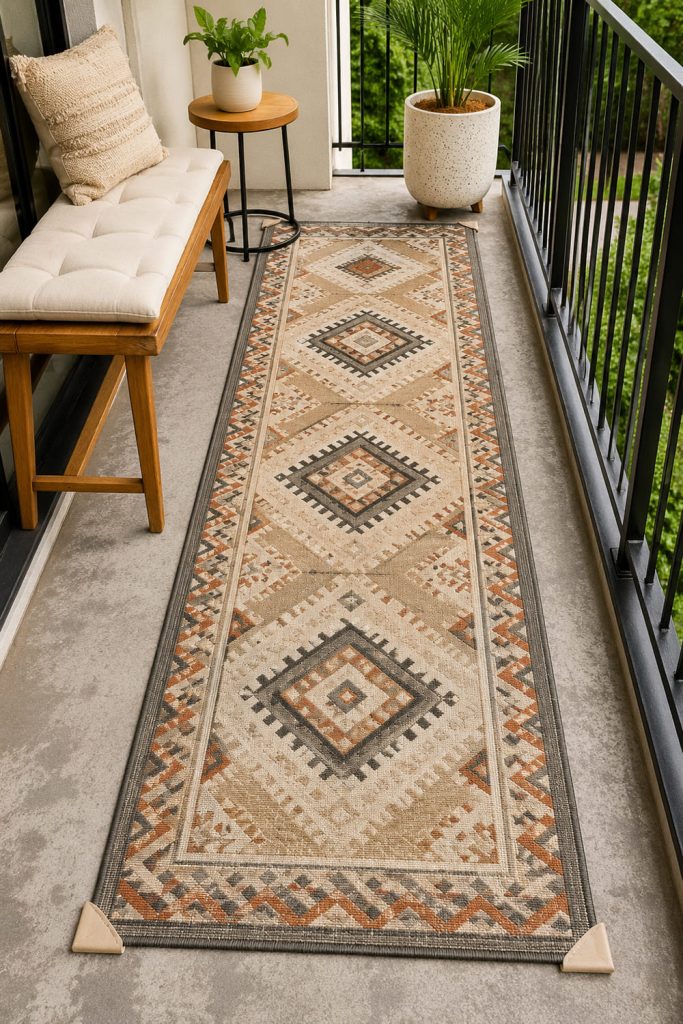
An outdoor rug is one of the fastest, most affordable ways to visually anchor a small balcony and make it feel like a designed space rather than an afterthought. Choose a weather-resistant material like polypropylene, which withstands rain and sun without fading or mildewing, and pick a pattern or color that contrasts gently with your flooring. A rug also has a practical benefit on stone or concrete balconies: it adds softness underfoot and helps define a “room” within an otherwise undefined slab. For very narrow balconies, a runner-style rug elongates the space visually, drawing the eye down its length rather than across it.
4. Install a Fold-Down or Wall-Mounted Table
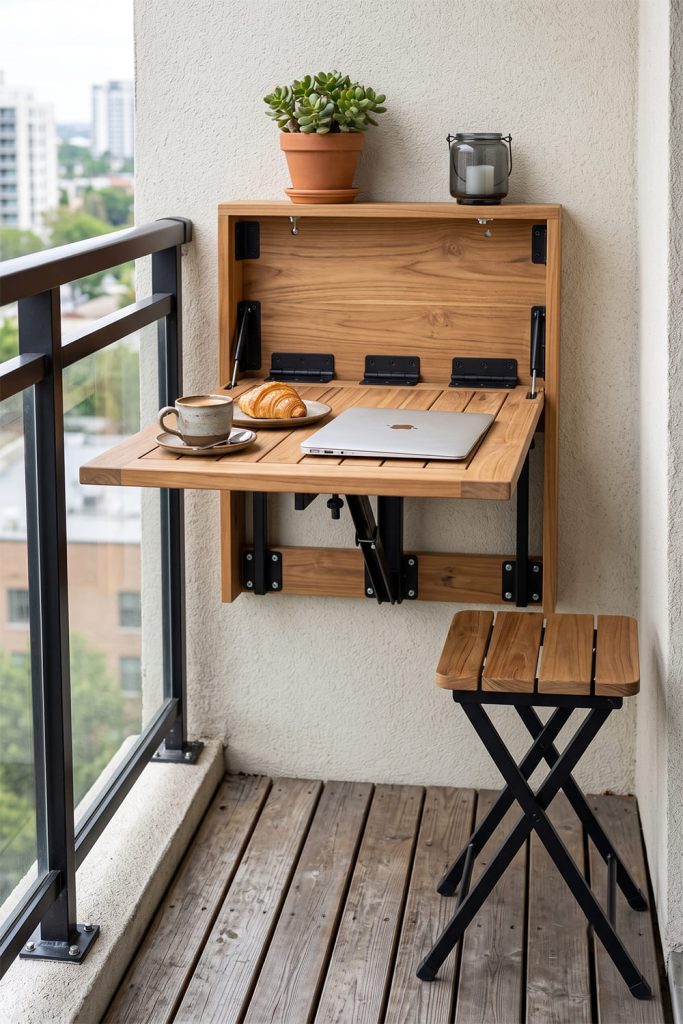
For balconies too narrow for any freestanding furniture, a fold-down table mounted directly to the railing or wall solves the space problem entirely. These tables tuck flat against the surface when not in use and unfold into a functional surface for meals, plants, or a laptop when needed. Pair it with a single folding stool or chair that can also collapse and lean against the wall. This setup is especially useful for balconies under three feet deep, where every inch of floor space matters. Choose a table with a weatherproof finish, like powder-coated aluminum or teak, so it holds up to the elements without warping or rusting.
5. Add String Lights or Lanterns
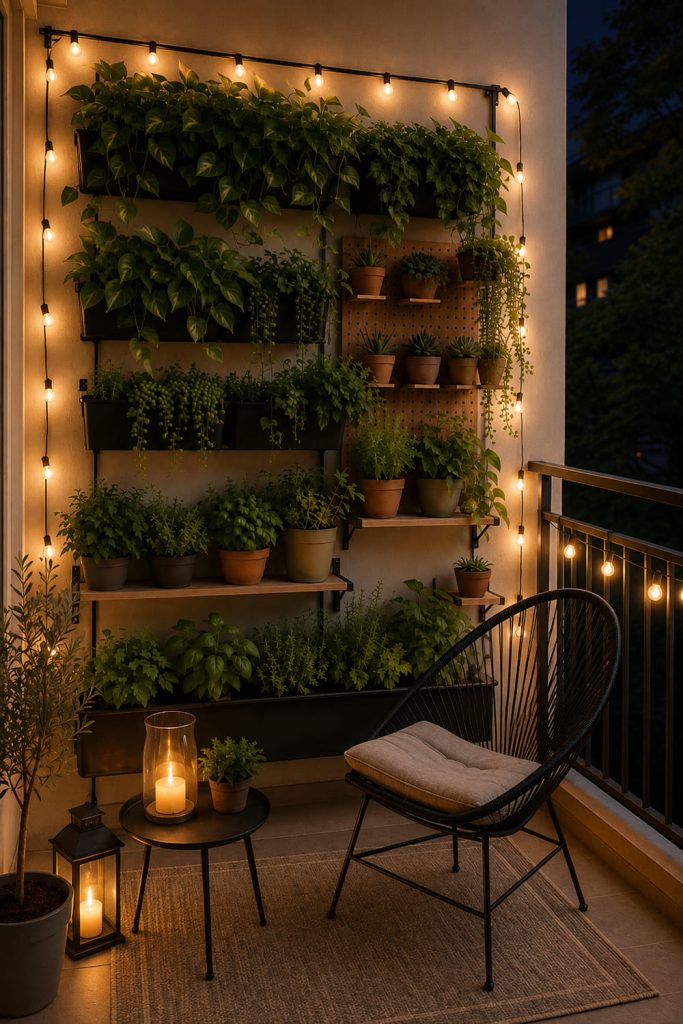
Lighting transforms a small balcony from a daytime-only space into somewhere you actually want to linger after sunset. Warm white string lights strung along the railing or overhead beam instantly soften the atmosphere and make the space feel cozy rather than clinical. Battery-powered or solar lanterns are another low-effort option, requiring no wiring and easily repositioned as needed. For a more elevated look, consider flame-effect LED candles in glass hurricanes, which offer the ambiance of candlelight without the fire risk in a tight, often windy space. Even a small balcony feels transformed once it’s lit for evening use.
6. Use Railing Planters to Free Up Floor Space
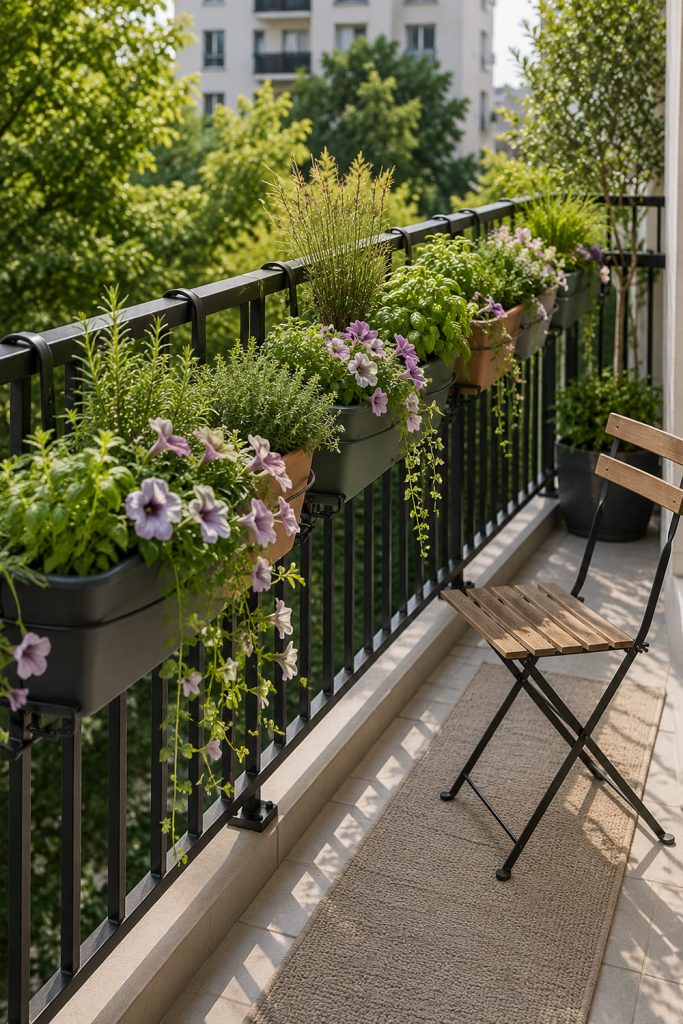
Railing planters hook directly onto the balcony rail, suspending pots either on the inside or outside edge without ever touching the floor. This is one of the most efficient ways to introduce greenery or flowers to a small balcony, since it uses vertical real estate that would otherwise sit empty. Trailing petunias, herbs, or small ornamental grasses all do well in railing-mounted containers, and self-watering versions cut down on maintenance for balconies with irregular sun exposure. Because these planters run along the perimeter, they also create a soft visual border that makes the balcony feel more enclosed and garden-like.
7. Bring In a Weatherproof Pouf or Floor Cushion
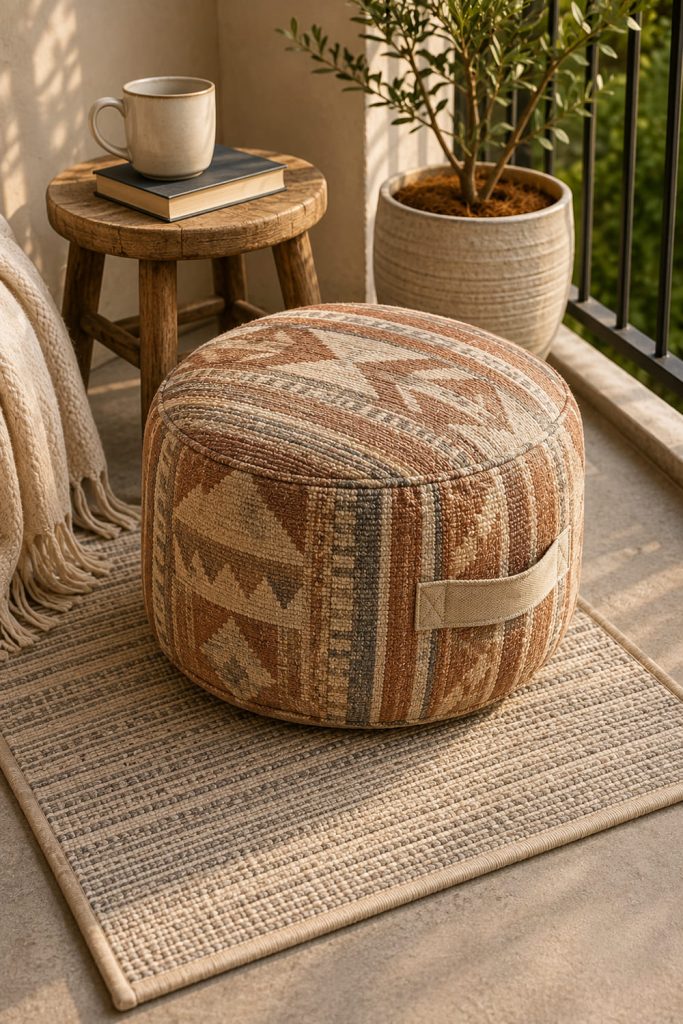
When even a small stool feels like too much furniture, a weatherproof pouf or floor cushion offers flexible, low-profile seating that can be tucked away easily. Look for outdoor fabrics like Sunbrella or treated polyester that resist mold and fading, and choose a design with a handle for easy carrying indoors during storms. Poufs are especially useful on balconies shared between plant displays and occasional seating, since they can be pulled out only when needed and stored elsewhere the rest of the time. A patterned or textured pouf also adds a pop of personality without requiring any permanent commitment.
8. Create Privacy With Bamboo or Reed Screening

Small balconies, especially in dense apartment buildings, often suffer from a lack of privacy as much as a lack of space. Bamboo or reed screening attached to the railing offers an affordable, natural-looking solution that blocks sightlines from neighboring units without making the balcony feel closed in. These screens also double as a windbreak, which can make a real difference on higher floors where wind makes sitting outside uncomfortable. For renters, look for screening that attaches with zip ties or clips rather than permanent hardware, so it can be removed cleanly without damaging the railing.
9. Install a Compact Vertical Shelving Unit
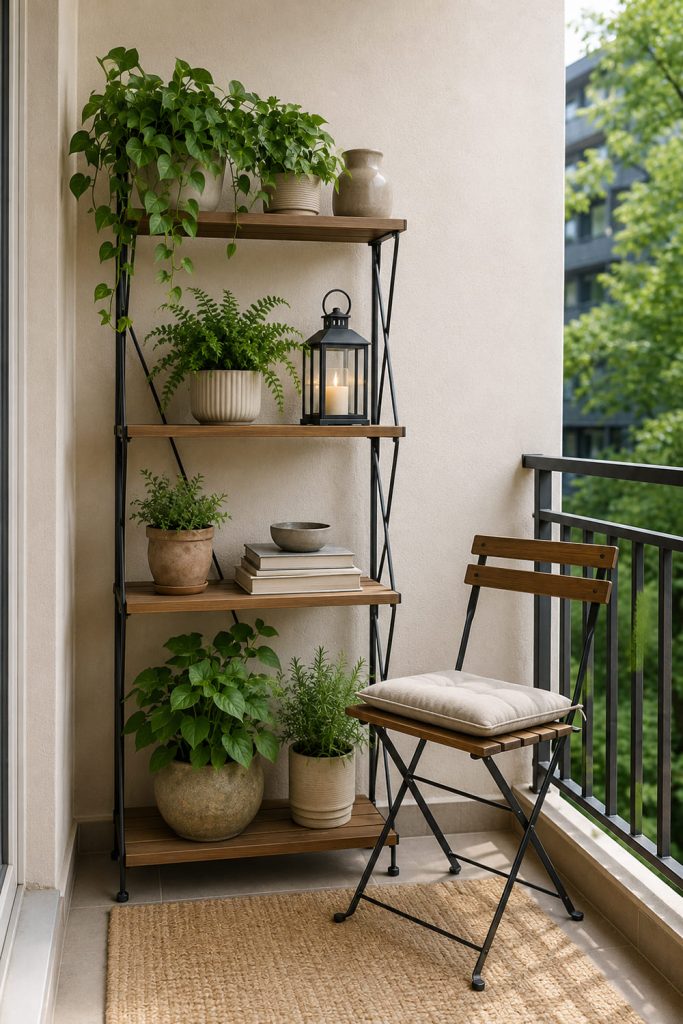
A narrow vertical shelving unit, sometimes called a plant stand or etagere, is ideal for balconies where floor space is too tight for a table but there’s still room for a slim tower of shelves. Use it to display a mix of potted plants, a small stack of books, and a lantern or two, layering heights to create visual interest. Metal or teak units hold up best against weather, and many fold flat for storage during winter months. This vertical approach lets you display far more than a single planter could hold, without ever encroaching on the walking or seating area.
10. Paint the Floor for an Instant Refresh

If your balcony has a concrete or wood floor that feels dull or dated, a coat of outdoor floor paint can completely change the mood of the space for relatively little money. A soft terracotta, deep charcoal, or crisp white all read as intentional design choices rather than an afterthought, and a painted floor pairs beautifully with a simple outdoor rug layered on top. Stenciled patterns, like Mediterranean tile motifs, are also popular for adding character to an otherwise plain slab. Be sure to use a paint specifically formulated for exterior floors, since it needs to withstand foot traffic, rain, and UV exposure without peeling.
11. Hang a Mini Hammock Chair or Swing
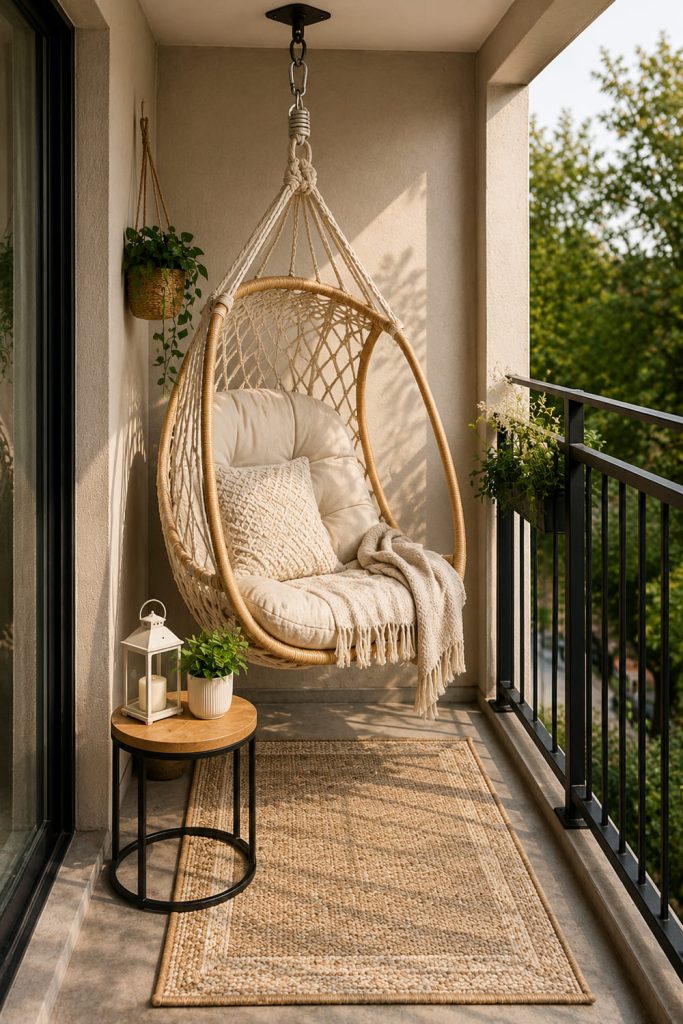
For balconies with enough overhead structure to support it, a hanging chair or mini hammock swing adds a playful, relaxing focal point that regular seating can’t match. Look for compact, single-person designs in breathable cotton rope or weatherproof rattan, and confirm the mounting hardware can bear weight safely before installing. Positioned in a corner, a hanging chair takes up surprisingly little floor space while still offering a genuine place to unwind. Add a small cushion and a throw blanket nearby, and the balcony instantly becomes the kind of spot you look forward to using every day.
12. Add a Narrow Console or Bar Cart
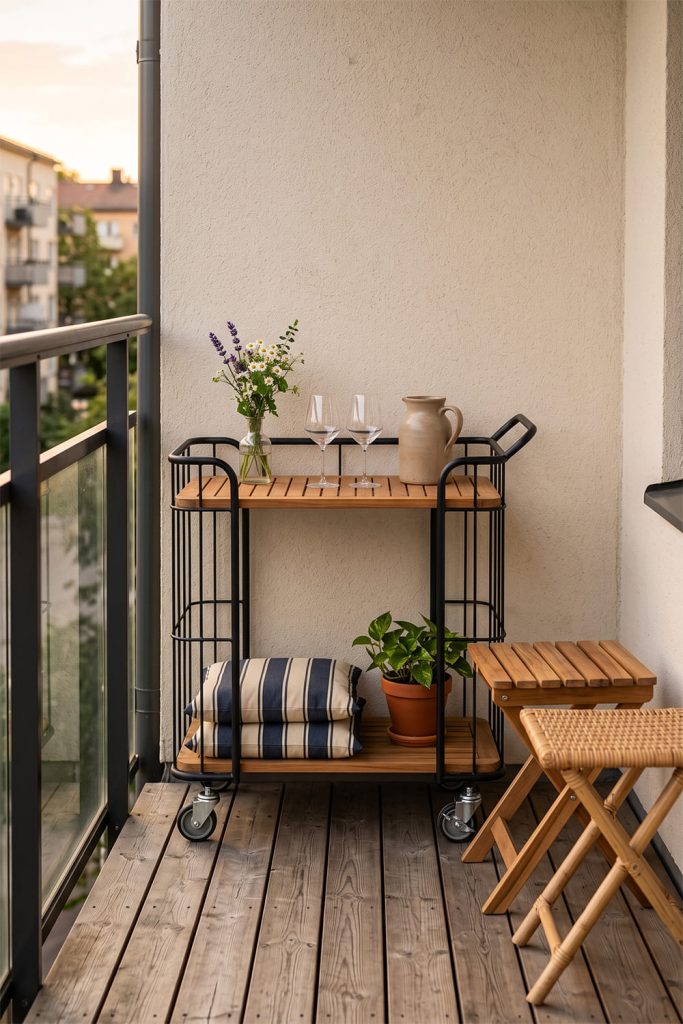
A slim console table or a narrow bar cart pushed against the railing or wall gives a small balcony a functional surface for drinks, plants, or a stack of magazines, without eating into the walkway. Bar carts have the added advantage of mobility, since they can be rolled indoors during bad weather or repositioned depending on how the space is being used that day. Choose a piece with a weather-resistant finish and open, airy construction, like a wire frame or slatted wood, so it doesn’t visually overwhelm the compact footprint. Style the top shelf with a small vase and the bottom with folded outdoor cushions.
13. Introduce a Statement Umbrella or Shade Sail

Sun exposure can make a small balcony unusable during peak hours, so a compact umbrella or a triangular shade sail solves both comfort and style in one move. A cantilever or clamp-mounted umbrella works well since it doesn’t require a heavy base that eats into limited floor space, while a shade sail can be anchored to the wall and railing for a sleeker, more architectural look. Choose a bold color or stripe pattern to make the shade element a design feature rather than a purely functional add-on. This single addition often determines whether a balcony gets used daily or ignored entirely.
14. Mix Textures With Outdoor Throw Pillows and Blankets
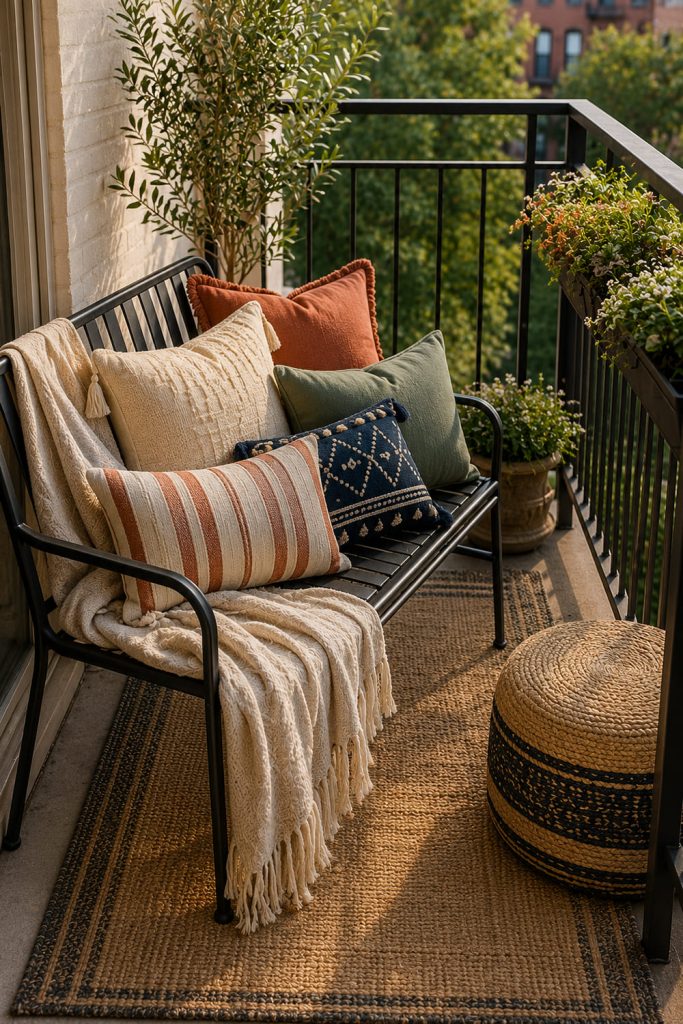
Textiles do a lot of heavy lifting on a small balcony, softening hard surfaces like metal railings and concrete floors while adding color and personality cheaply. Outdoor throw pillows in weather-resistant fabric can dress up a single bench or chair, and a folded throw blanket draped over the seat back signals comfort even in a tiny footprint. Rotate textiles seasonally — lighter linens and rattan textures in summer, deeper knits and warmer tones in fall — to keep the space feeling current without any structural changes. This is one of the lowest-cost, highest-impact upgrades available for any small outdoor space.
15. Use Mirrors or Reflective Accents to Expand the Space Visually

A small outdoor mirror, mounted securely to an exterior wall, can trick the eye into perceiving a balcony as larger and brighter than it actually is by bouncing light and reflecting greenery into the space. Choose a mirror rated for outdoor use so it resists fogging and corrosion, and position it to reflect a plant or view rather than a blank wall. Metallic planters, lanterns, or accent trim in brass or chrome can achieve a similar effect on a smaller scale, adding sparkle and depth. Combined with light-colored furnishings, reflective accents make a compact balcony feel noticeably more open.
Small Balcony Planning & Buying Guide
Before buying furniture or décor, take stock of your balcony’s exact dimensions, weight limits, and sun exposure, since these three factors will shape nearly every decision that follows. Many apartment balconies have posted weight restrictions, particularly for water-filled planters and heavy stone furniture, so check with your building management if you’re unsure. Measure the depth carefully, since even six inches can determine whether a chair fits comfortably or blocks the doorway.
Prioritize multi-functional and foldable pieces wherever possible — a table that folds flat, a stool that doubles as a side table, a pouf that tucks away — since these give you flexibility without permanent clutter. Stick to a cohesive color palette of two or three tones to keep a small space from feeling visually busy, and choose materials rated for your climate: teak and metal hold up well in most conditions, while natural rattan may need to come indoors during heavy rain or snow.
Finally, think about maintenance realistically. Self-watering planters, low-maintenance perennials, and weather-resistant fabrics will keep the space looking good with minimal upkeep, which matters most during busy seasons when a balcony is easy to neglect.
Conclusion
A small balcony doesn’t need square footage to feel special — it needs intention. By choosing scaled-down furniture, layering in greenery and texture, and paying attention to light and privacy, even the tightest outdoor nook can become one of the most-used corners of a home.
Start with one or two ideas from this list rather than attempting a full overhaul at once, and let the space evolve as you discover how you actually use it. The best small balconies aren’t the ones that try to do everything; they’re the ones edited down to exactly what makes stepping outside worth it.


