

15 Sunroom Ideas for Plant Lovers Who Want a Green Retreat
A sunroom is the one room in the house that already wants to be a garden. It has the glass, the warmth and the long hours of daylight that houseplants spend the rest of the home quietly wishing for.
Yet many sunrooms end up as a row of pots along one windowsill and a chair nobody sits in, which wastes the best light you own.
The sunroom ideas for plant lovers in this guide treat the room as a retreat first and a plant collection second, so the greenery and the living happen in the same place instead of competing for it.
That shift changes every decision.
Plants are placed where you will actually enjoy them, seating is tucked in among the leaves rather than pushed to the edges, and the practical jobs — watering, turning pots, wiping leaves — are given a proper home so care feels like a pleasure.
If your growing space is currently outdoors, our balcony herb garden ideas pair beautifully with the indoor approach here.
Work through the ideas in order if you are starting from an empty room, or dip into the ones that solve your particular problem — harsh sun, nowhere to sit, pots crowding every surface.
Together they build a layered, calm room that earns its keep in every season, including the grey months when a living, growing room matters most.
This post contains affiliate links. If you buy through them, we may earn a small commission at no extra cost to you. See our Affiliate Disclosure.
How to Plan a Sunroom Plant Retreat, Step by Step
Start by watching the room for a full day before you buy or move anything. Note where the sun lands in the morning, which corner stays bright all afternoon, and where the light turns fierce enough to scorch leaves.
Sketch those zones on paper — bright direct, bright indirect, and gentle shade — because every later choice hangs off that map.
Sun-lovers go in the direct zone, most foliage plants thrive in the bright indirect band, and the shadier corners suit seating and plants that prefer a softer life.
Save your tallest planting for the edges of the view from the doorway, the picture you will see most often.
Next, plan the room in layers rather than in a single row.
Think floor, table height, shelving and hanging height as four planting levels, and give each one a moment — a tall plant anchoring a corner, a cluster at chair height, a shelf of smaller pots, something trailing from above.
Place furniture among the layers instead of against the walls, leaving clear paths for watering. Finally, add the working pieces early: a watering station and a small store of tools.
A retreat planned this way grows gracefully, because there is always a right-sized gap waiting for the next plant you fall for.
1. Map the Light Before You Move a Single Pot
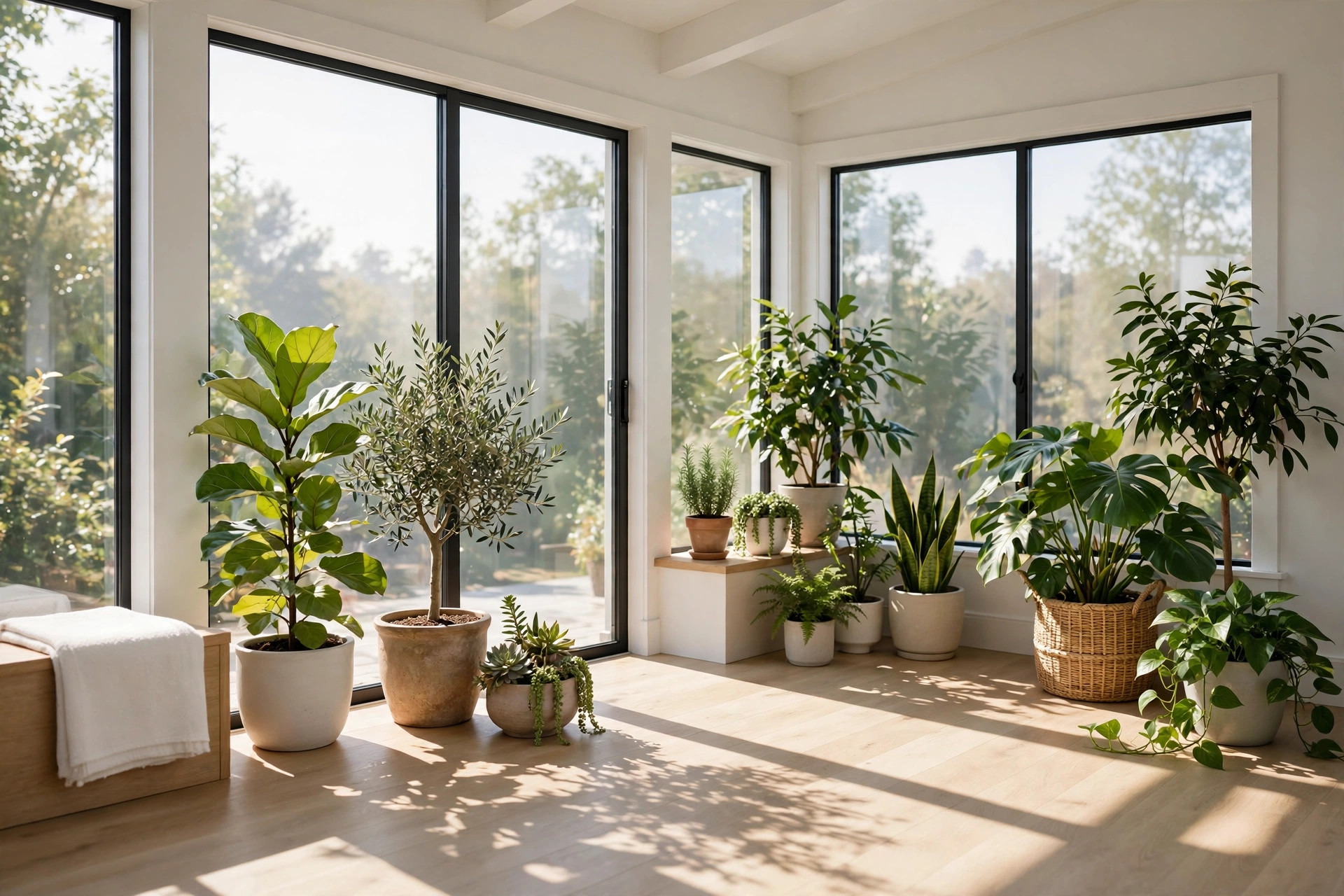
Most plant failures in a sunroom are light decisions made in a hurry. A pot placed by guesswork either stretches pale and leggy reaching for brightness it cannot find, or scorches in a patch of direct afternoon sun.
Spending one day observing the room costs nothing and prevents both. Take a photo of the floor every couple of hours; by evening you will have an honest map of how the light actually moves, which is often quite different from how you imagined it.
Then plant to your zones: herbs, succulents and flowering plants in the sunniest stretch; leafy foliage plants a step back in bright indirect light; ferns in the soft corners.
Keep a few spots free, because the sun’s path changes with the seasons and a plant placed perfectly in spring may need a shuffle by midsummer.
2. Build Tiered Shelving Along the Sunniest Wall
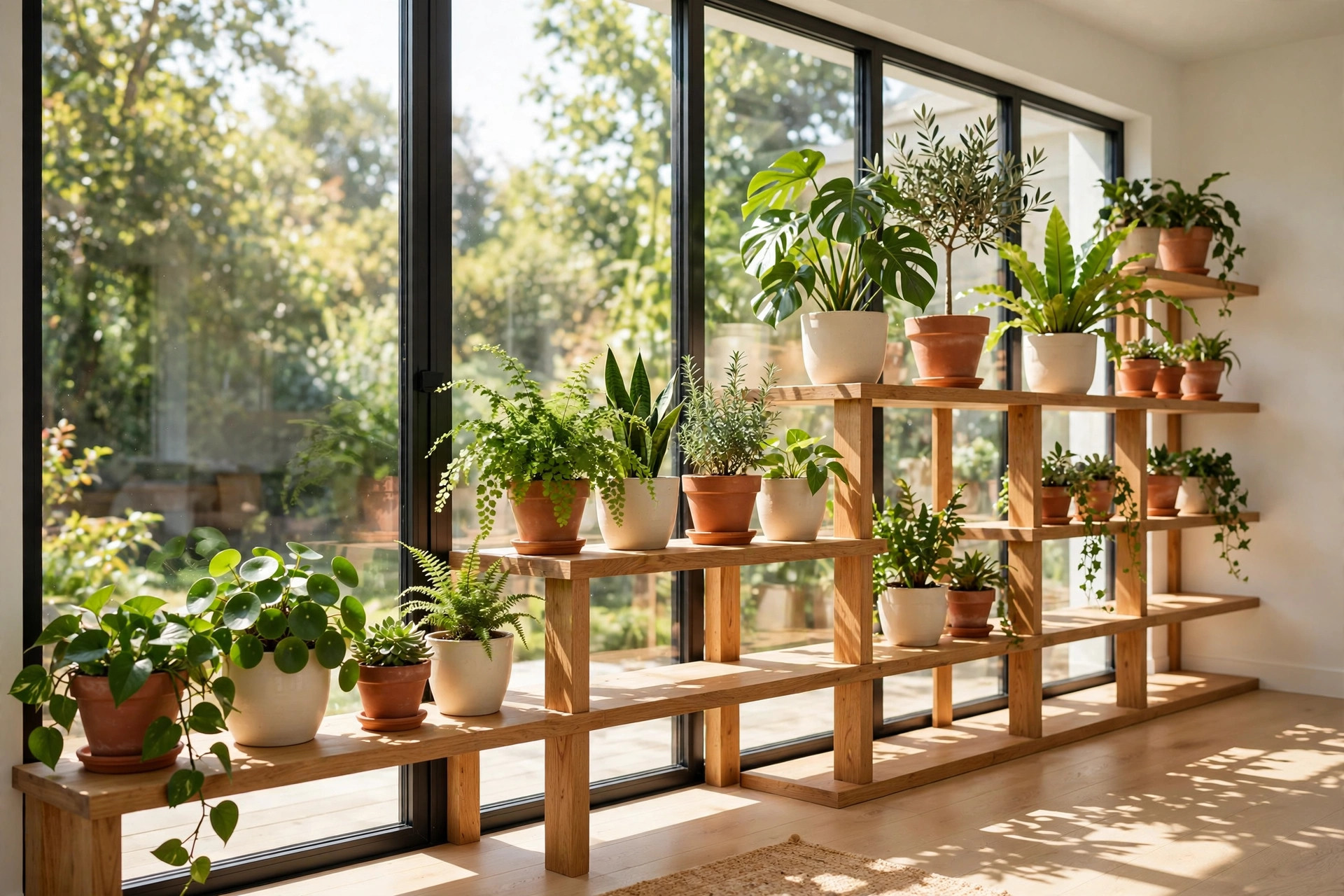
A single flat windowsill wastes most of a sunroom’s best wall.
Tiered shelving — two or three open shelves stepped like stadium seating along the sunniest stretch — multiplies your prime planting space while keeping every pot in the light instead of shaded behind a taller neighbour.
Open slatted or glass shelves work especially well because light passes through them to the plants below, and smaller pots sit at the front where you can water and rotate them easily.
Style the shelves as you would a bookcase: group pots in odd numbers, mix leaf shapes and heights, and repeat one pot colour across the tiers so the display reads as one calm composition.
Leave breathing room between groups — a shelf crammed edge to edge is harder to water and quickly looks like storage.
3. Hang a Canopy of Trailing Plants From Above
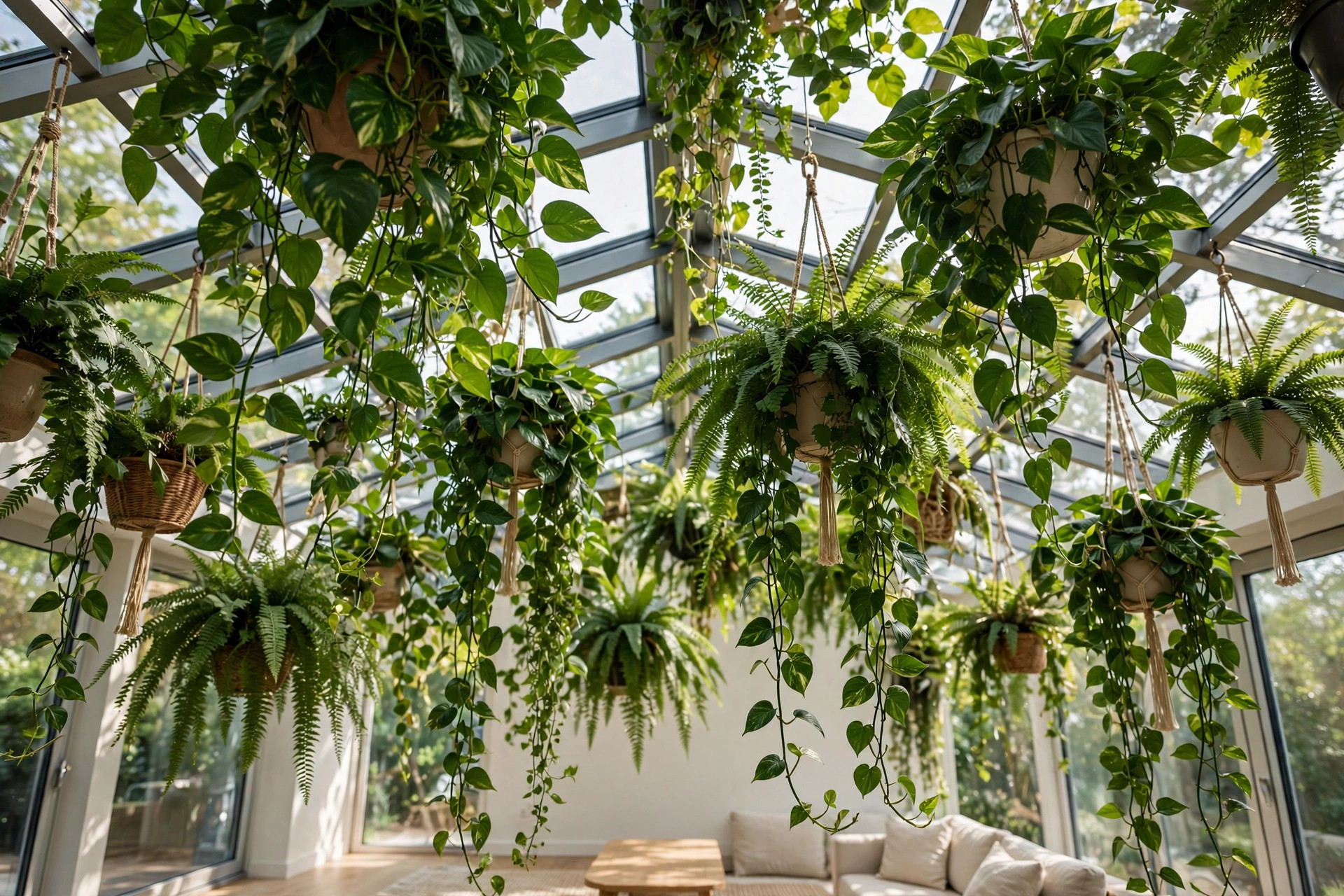
The ceiling is the most underused planting space in any sunroom, and trailing plants are made for it.
Pothos, philodendron and hanging ferns soften the hard lines of glass and frames, filter strong light into a pleasant dapple, and free up every shelf and surface below for seating.
Hang them at varied heights rather than in a straight row, and let a few trails grow long enough to brush the top of a bookcase — that gentle softness is what makes the room feel like a retreat instead of a showroom.
Be practical about the mechanics. Use secure fixings, choose lightweight pots overhead, and hang trailers where you can reach them with a small step rather than a stretch.
Position the canopy over walkways rather than directly above a favourite chair, so drips land where a mat can catch them.
4. Create a Reading Nook Buried in Greenery
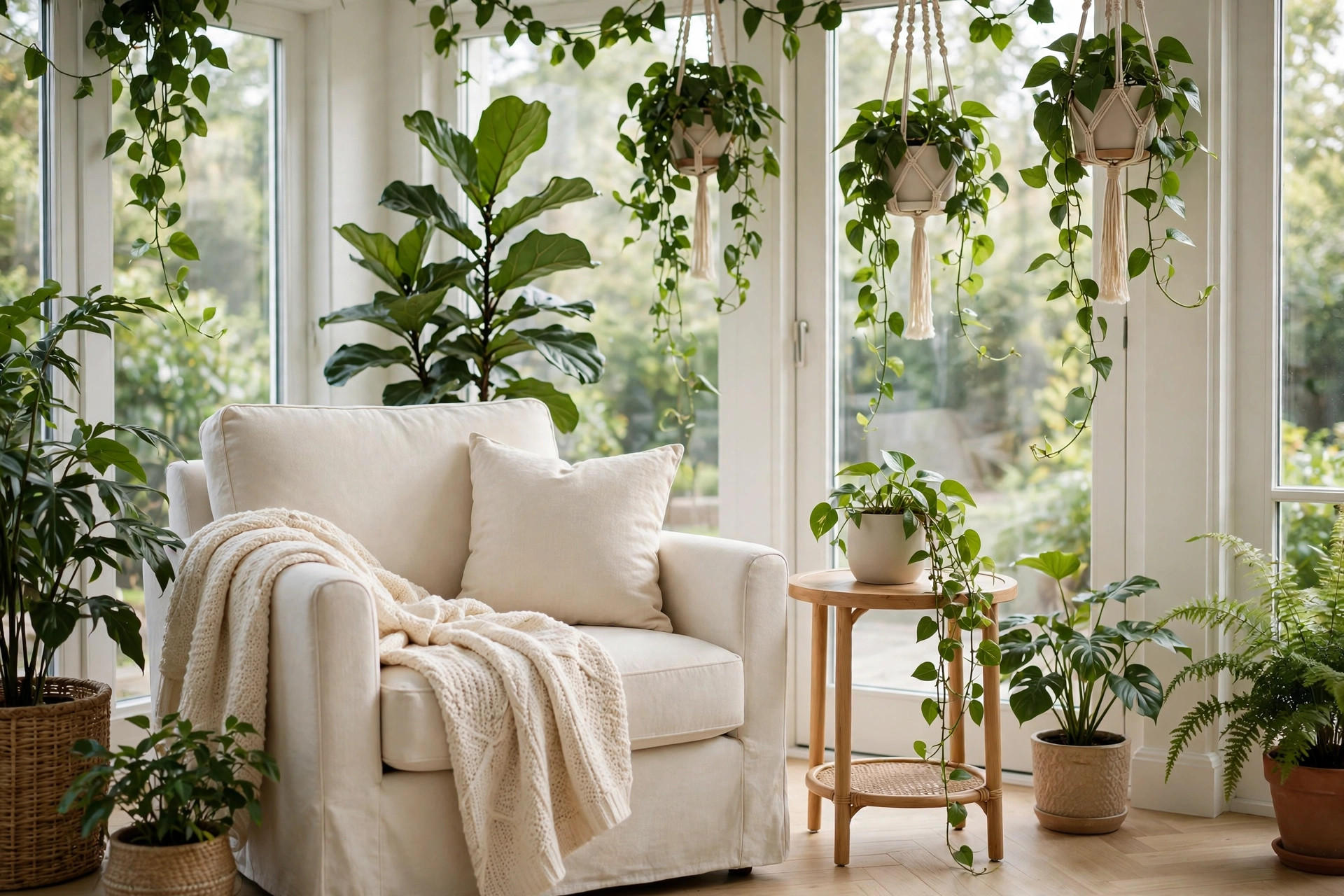
A plant retreat only earns the name when there is somewhere comfortable to sit inside it.
Choose the corner with the softest light — bright but not blazing — and give it one genuinely comfortable chair, a small side table and a lamp for the evening.
Then plant around the chair deliberately: a tall plant behind it for that sheltering canopy effect, medium plants at arm height on either side, and something trailing nearby at eye level. Sitting down should feel like stepping into the planting, not facing it from outside.
Keep the nook uncluttered so it stays inviting: one cushion, one throw and a spot for a book and a drink are enough, because the greenery does the decorating.
If you are furnishing your very first home at the same time, our guide to first apartment living room ideas shows how one well-chosen chair can anchor a whole room. A nook like this quickly becomes the most contested seat in the house.
5. Group Plants by Thirst, Not Just by Looks
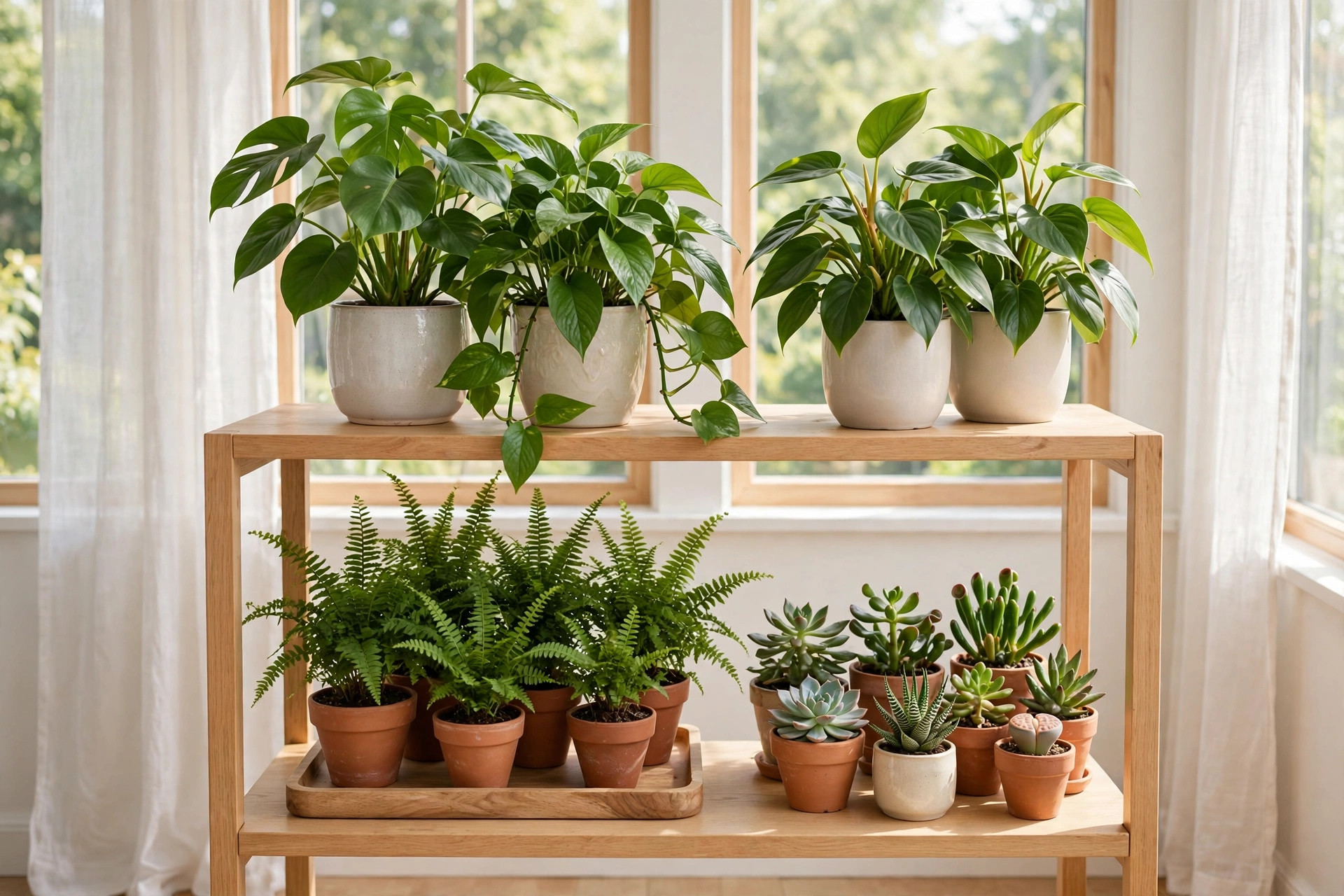
The prettiest arrangement will not survive a watering routine that treats every plant the same. Grouping plants by how they like to drink — the thirsty ones together, the drought-tolerant ones together, the humidity lovers together — makes care faster and far more forgiving.
When a whole shelf shares the same rhythm, you can water it on its day without checking every pot, and you stop drowning succulents just because they sat beside a fern.
Thirst-based groups can still look beautiful. Within each group, vary heights, leaf sizes and pot finishes so the cluster reads as a designed vignette, and stand the humidity lovers together on trays.
Grouping also makes problems easier to spot: if one plant looks thirsty while its neighbours are fine, that is an early warning about its roots rather than your routine.
6. Add a Slim Plant Ladder for Small Pots and Cuttings

A leaning plant ladder turns a narrow slice of wall into a vertical garden without any building work.
The rungs hold small pots, cuttings in jars and young plants that would otherwise scatter across every table, and the open frame lets light and air move freely around them.
Ladders suit sunrooms especially well because they can be shifted a foot or two as the seasons change, following the best light around the room in a way fixed shelving never can.
Style it from the bottom up: heavier pots on the wide lower rungs for stability, lighter pieces higher up, and one trailing plant near the top so its stems soften the frame.
A ladder is also the perfect halfway house for new arrivals — a week in bright light but slightly apart from the main collection lets you check a new plant over before it joins the shelves.
If you love the layered effect, our small balcony vertical garden wall ideas use the same principle outdoors.
7. Set Up a Dedicated Watering and Potting Station
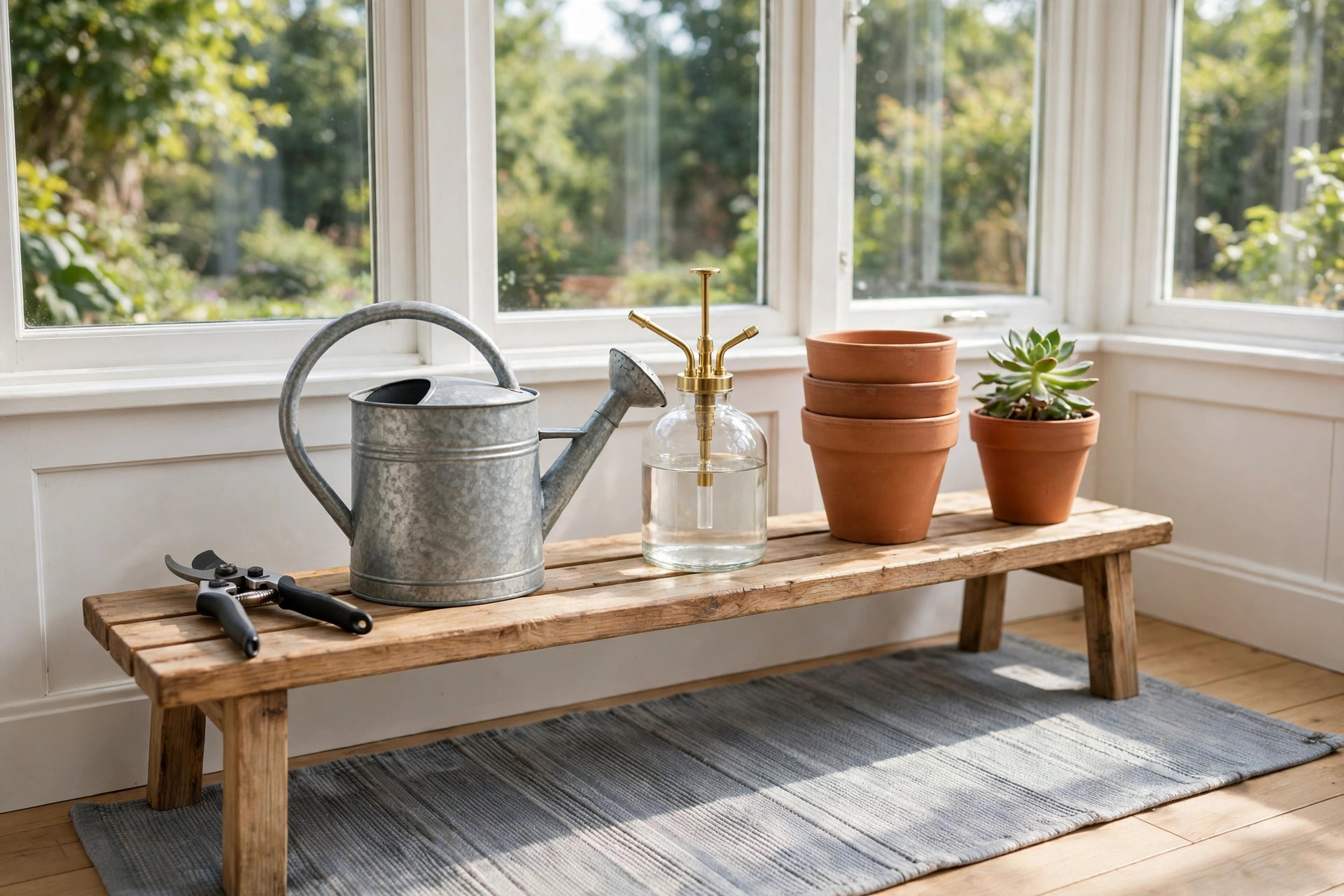
Nothing kills the retreat feeling faster than potting mix on the rug and a watering can living on the coffee table.
Give the work its own small station — a narrow potting bench, a sturdy tray table or a repurposed bar cart — stocked with a watering can, a mister, pruning snips, potting mix in a lidded container, spare pots and a cloth for wiping leaves.
When everything lives in one place, a repot takes minutes and leaves no trace.
Site the station near the door or a sink if you can, with a washable mat underneath to catch splashes. Plants get checked more often because the tools are right there, and small jobs get done immediately instead of being postponed.
Think of it as the kitchen counter of your green retreat — small, hardworking and wiped clean at the end of every job.
8. Use Sheer Curtains to Soften Harsh Midday Sun

Glass that is a blessing in January can be a magnifying lens in July.
Sheer curtains are the gentlest fix: they take the scorch out of direct midday sun, protect leaf edges and furniture fabrics, and turn hard glare into the soft, diffused light that most foliage plants love best.
Draw them for a few hours on the hottest days and open them again in the gentler late afternoon, and you have a simple way to moderate the room without blinds clattering against every frame.
Choose light, airy fabrics in a pale colour so the room stays bright even when they are drawn, and hang them on the sunniest elevation only, leaving the other glass clear.
Sheers also add privacy and softness to a room that is otherwise all hard surfaces — glass, tile and terracotta — and that softness is a big part of what makes a sunroom feel restful.
9. Anchor the Room With One Statement Tree
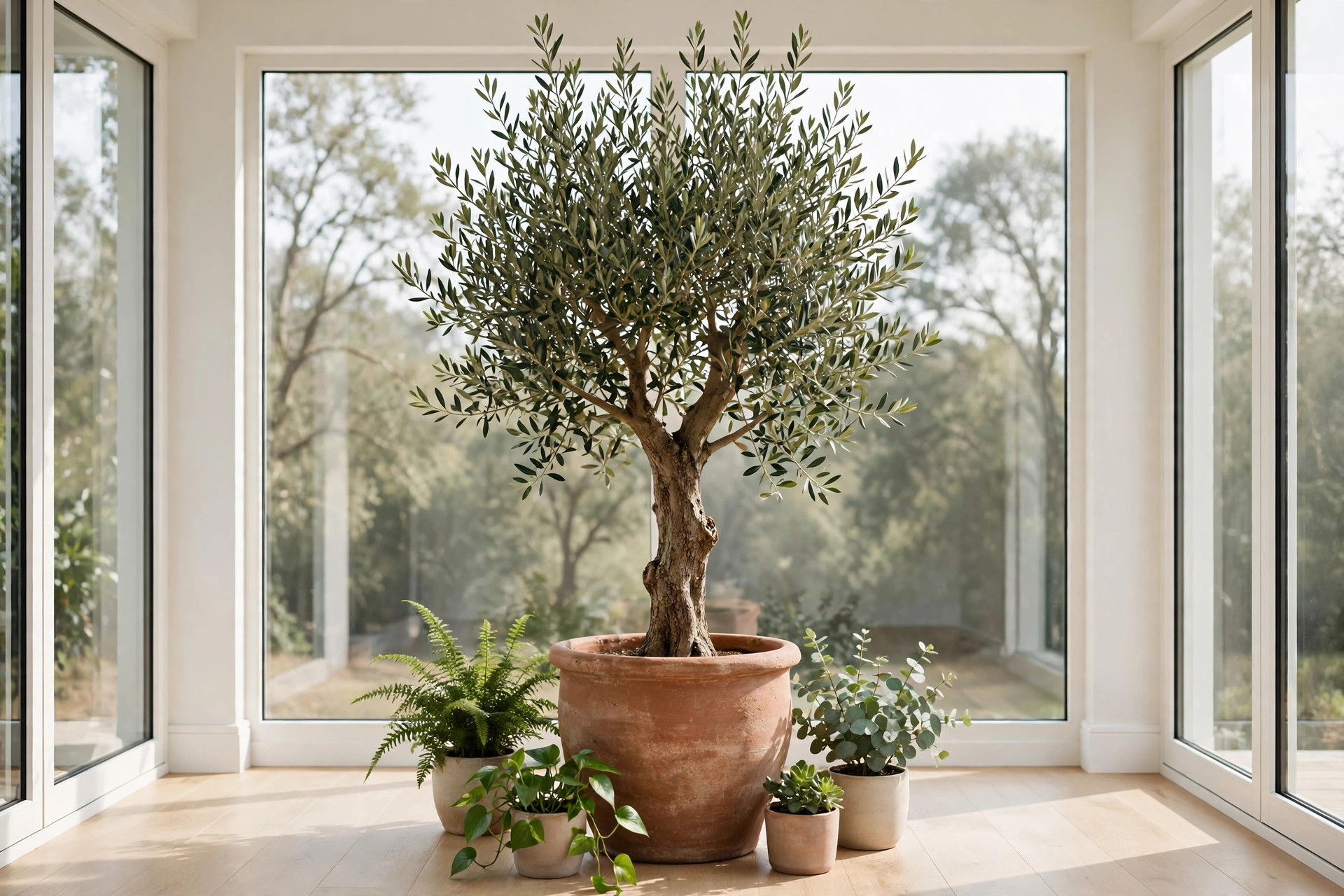
Every retreat needs one plant with presence.
A single statement tree — a fiddle-leaf fig, an olive, a citrus or a tall dracaena, chosen for the light your room actually offers — anchors the scheme.
It fills the vertical space between the furniture and the glass, and gives the smaller plants something to gather around.
One generous specimen in a beautiful pot looks calmer than a dozen medium plants competing in the same corner.
Give the tree room to be seen: a clear patch of floor, nothing crowding its pot, and a backdrop of plain glass so its silhouette reads clearly. Choose the pot as carefully as the plant, because at this scale the pot is furniture.
Turn it a quarter every week or two so growth stays even instead of leaning toward the glass.
10. Line the Windowsills With Herbs and Small Growers
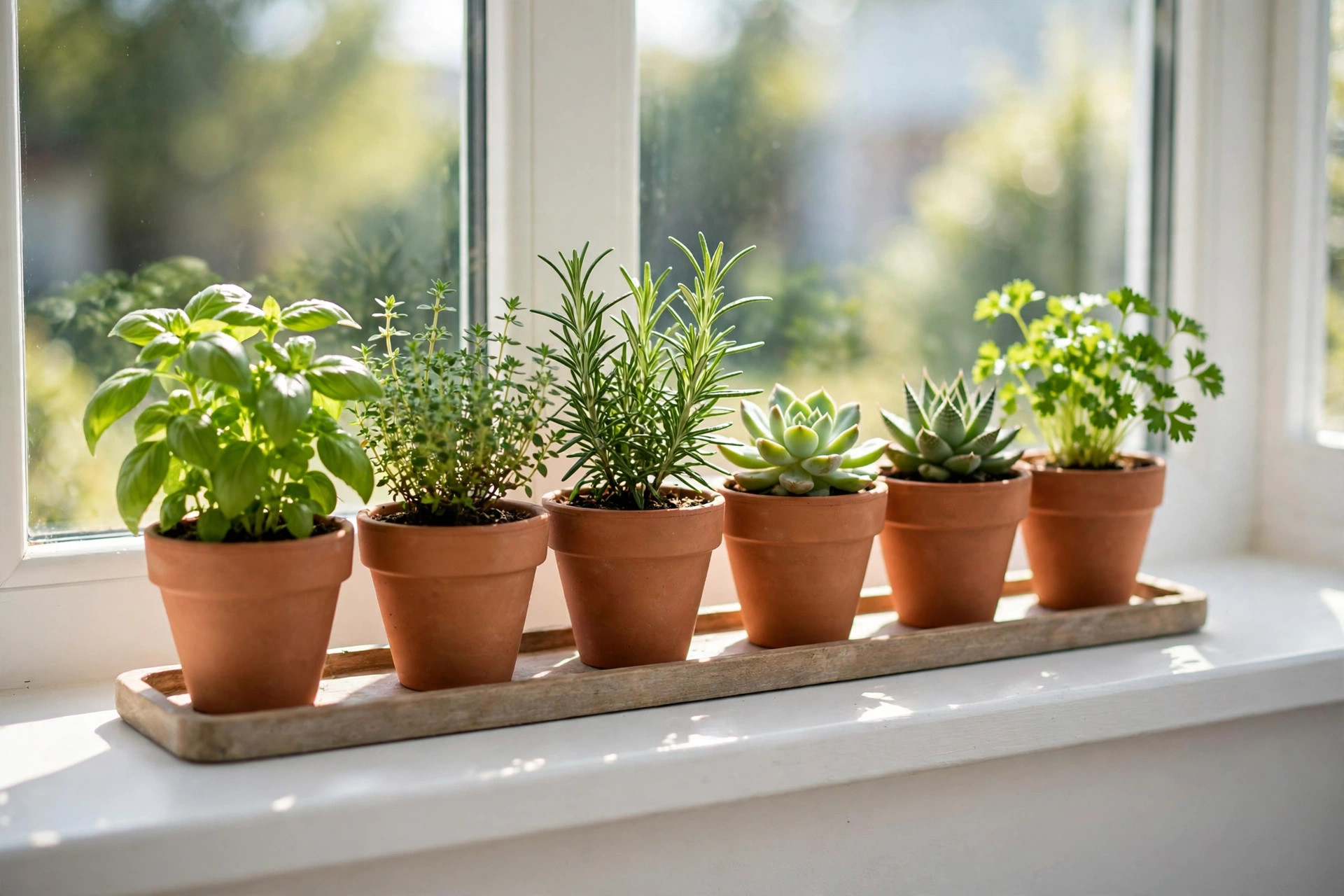
The windowsill is prime real estate for the small and the sun-hungry.
Herbs you can snip for the kitchen, small succulents, baby plants growing on from cuttings and anything flowering will all thrive in that front-row seat, and a sill lined with matching small pots gives the whole room a finished, deliberate border.
It is also the most visible planting from the doorway, so a tidy sill quietly lifts the impression of the entire space.
Keep the sill disciplined: one pot style repeated, a narrow tray beneath to catch drips and protect the paintwork, and enough spacing that each plant can be lifted out for watering without a domino run.
Rotate the pots a little at each watering so growth stays even. If your indoor sill sparks bigger ambitions, our urban jungle balcony ideas show how to carry the same layered, leafy look outside.
11. Choose Light, Breathable Furniture That Lets Plants Breathe
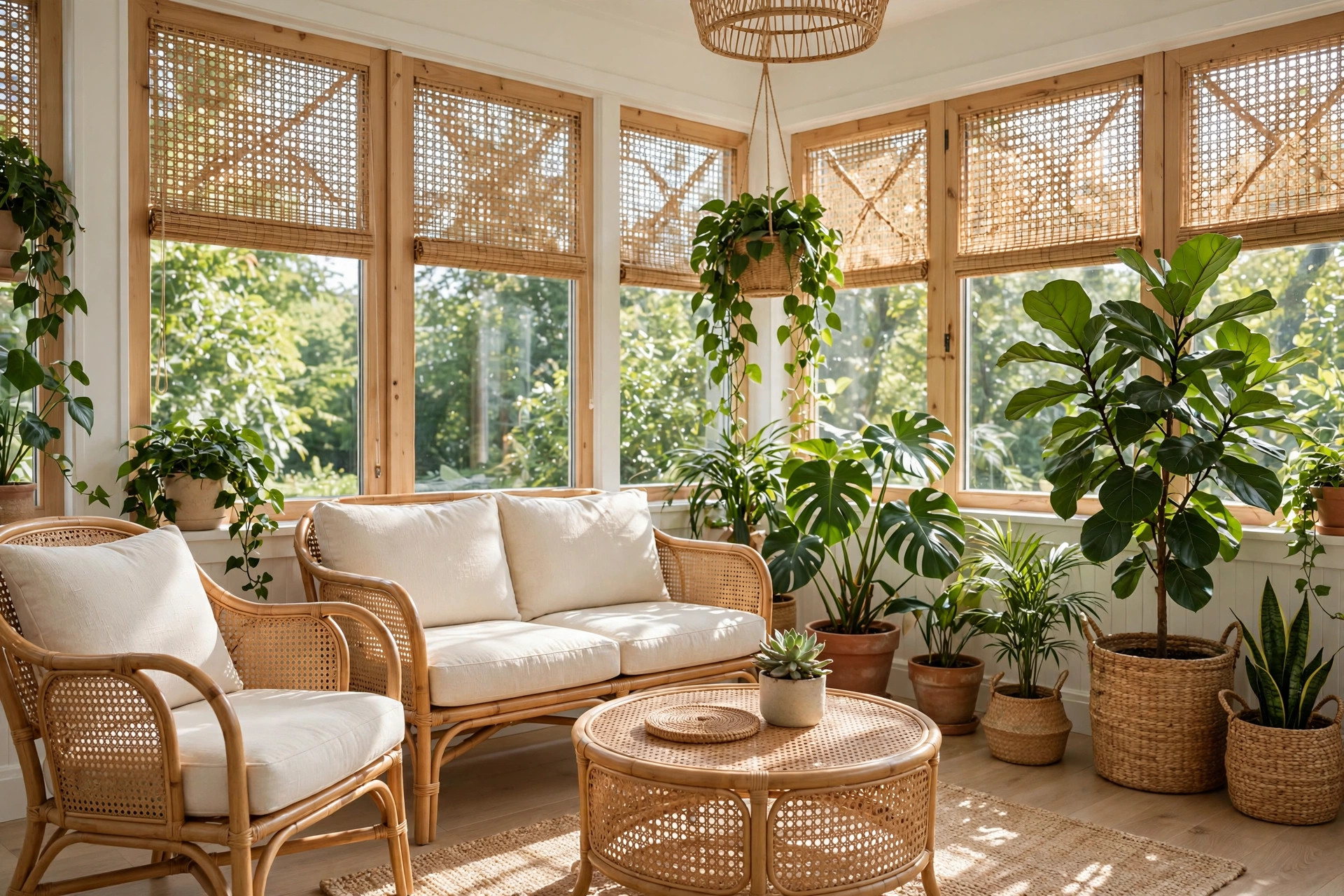
Heavy, dark furniture fights a sunroom twice over: it blocks light to the plants behind it and makes a bright room feel weighed down. Rattan, cane, light wood and open-framed pieces suit the space far better, letting daylight pass through and around them.
Low-backed chairs and a slim sofa keep sightlines open to the greenery, and pieces raised on legs allow air to circulate underneath — good for the floor, good for the plants and good for how fresh the room feels.
Breathability matters for fabrics too. Removable, washable covers cope best with humidity and splashes, and pale colours will not show fading the way deep tones can.
Keep the furniture count modest — a seat or two, one table, one bench — and let the plants provide the abundance.
12. Start a Propagation Corner on a Bright Side Table
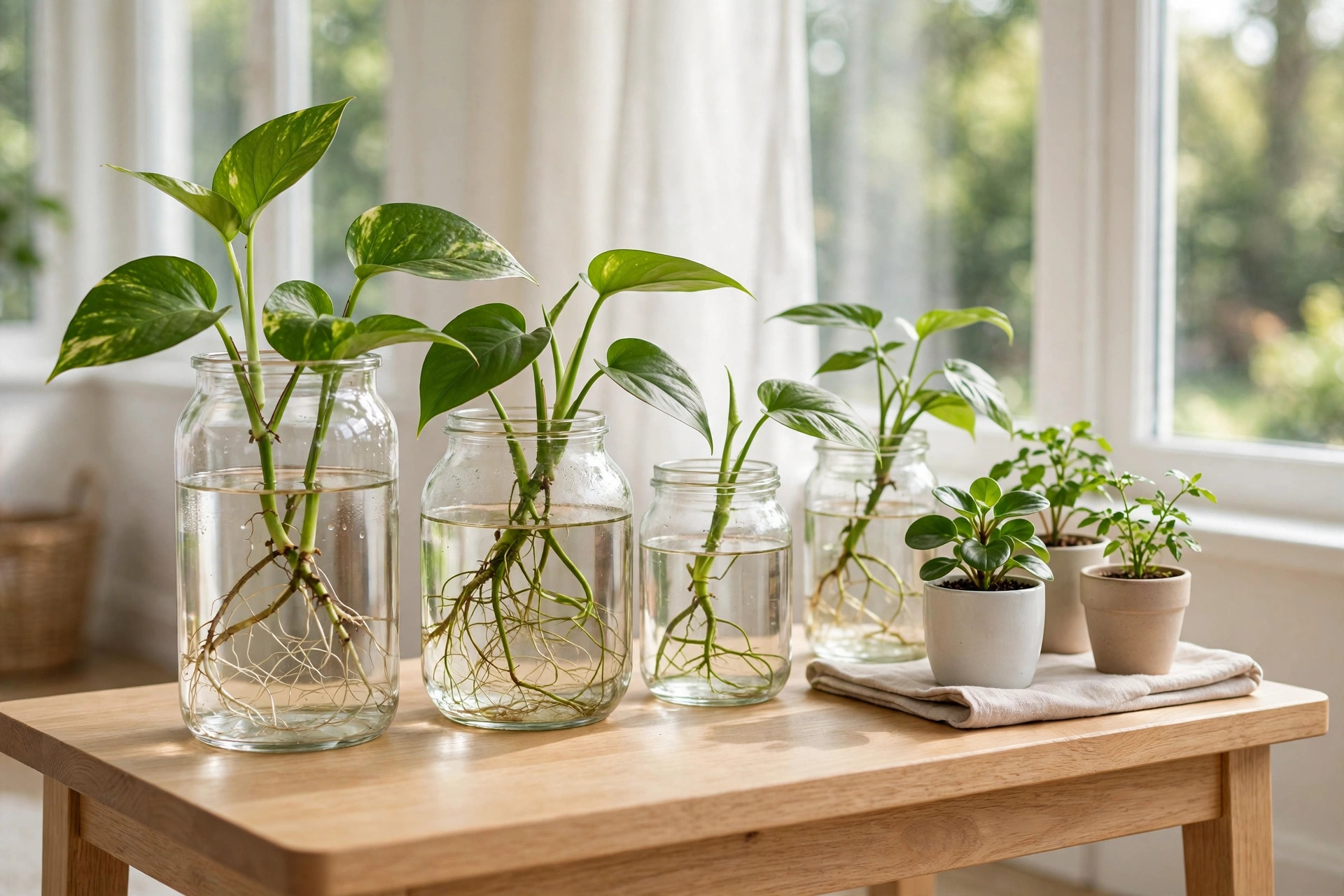
A small propagation corner turns one healthy plant into next season’s collection for free, and it is one of the most satisfying sights in a sunroom.
Set aside a bright side table out of direct scorching sun, kept simply equipped: clean glass jars of fresh water for stem cuttings, small pots of light potting mix, and labels with the date each cutting was taken.
Watching roots appear through glass is a quiet daily pleasure, and a labelled row of jars looks charming rather than clinical.
Propagation also keeps the collection younger and fuller. Leggy plants can be cut back, the cuttings rooted, and the new plants tucked into gaps or potted up as gifts.
Change jar water regularly, pot cuttings up once roots are a few centimetres long, and keep newcomers slightly separate until they have settled.
13. Layer Natural Textures and a Rug Underfoot
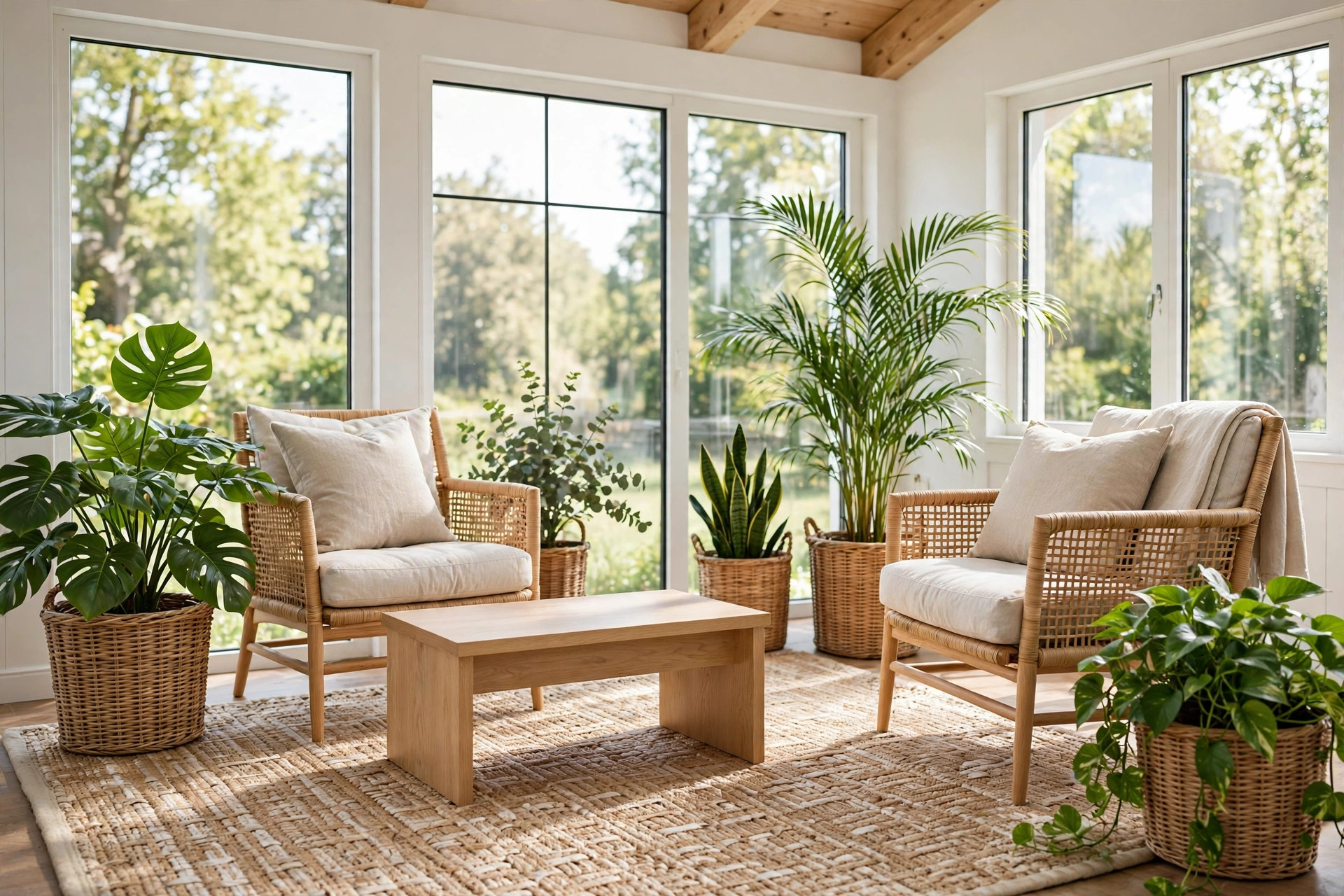
A sunroom full of glass and pots can feel hard underfoot, and a rug is what turns it into a room you linger in.
Choose a flatweave or indoor-outdoor style rug that shrugs off splashes and soil, in a natural fibre look that sits comfortably with terracotta, cane and leaf green.
Sized generously under the seating, it defines the living zone within the planting, softens footsteps, and gives bare feet somewhere warm to land on a bright winter morning.
Extend the same thinking to the smaller textures: woven baskets as cachepots for plain nursery pots, a linen cushion or two, a wooden stool doing duty as a plant stand.
Repeating two or three natural materials across the room ties dozens of different plants into one coherent scheme, because the eye reads the materials as the design and the plants as the richness within it.
The same instinct works at the threshold too — our small front porch ideas use natural texture and greenery to make an entrance feel welcoming.
14. Keep a Rolling Plant Caddy for Seasonal Shuffles
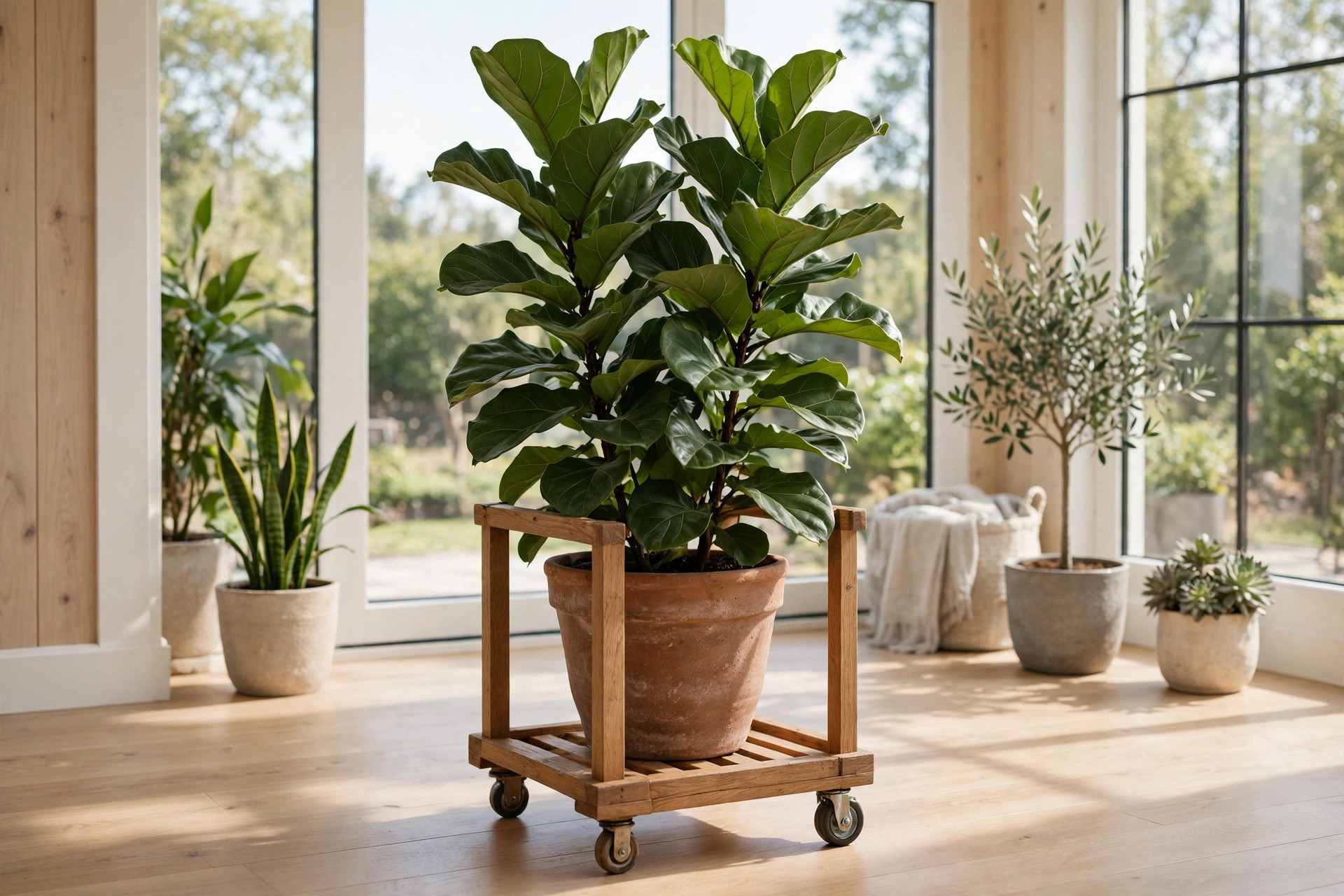
Sunrooms change more across the year than any other room: plants need moving closer to the glass in winter, back from scorching panes in summer, and out of the way entirely when the room hosts a crowd.
A sturdy rolling caddy or wheeled stand under your largest pots turns those shuffles from a back-straining lift into a gentle push.
It is a small, unglamorous detail that quietly protects your floor, your back and the plants themselves, which suffer most of their damage while being carried.
Wheels help with weekly care too. Big plants can be rolled to the watering station, turned in place to even out growth, and rolled aside for sweeping.
Choose lockable castors for anything tall, and size the caddy slightly larger than the pot so it feels steady rather than balanced.
15. Finish With Soft Evening Light for After-Dark Hours
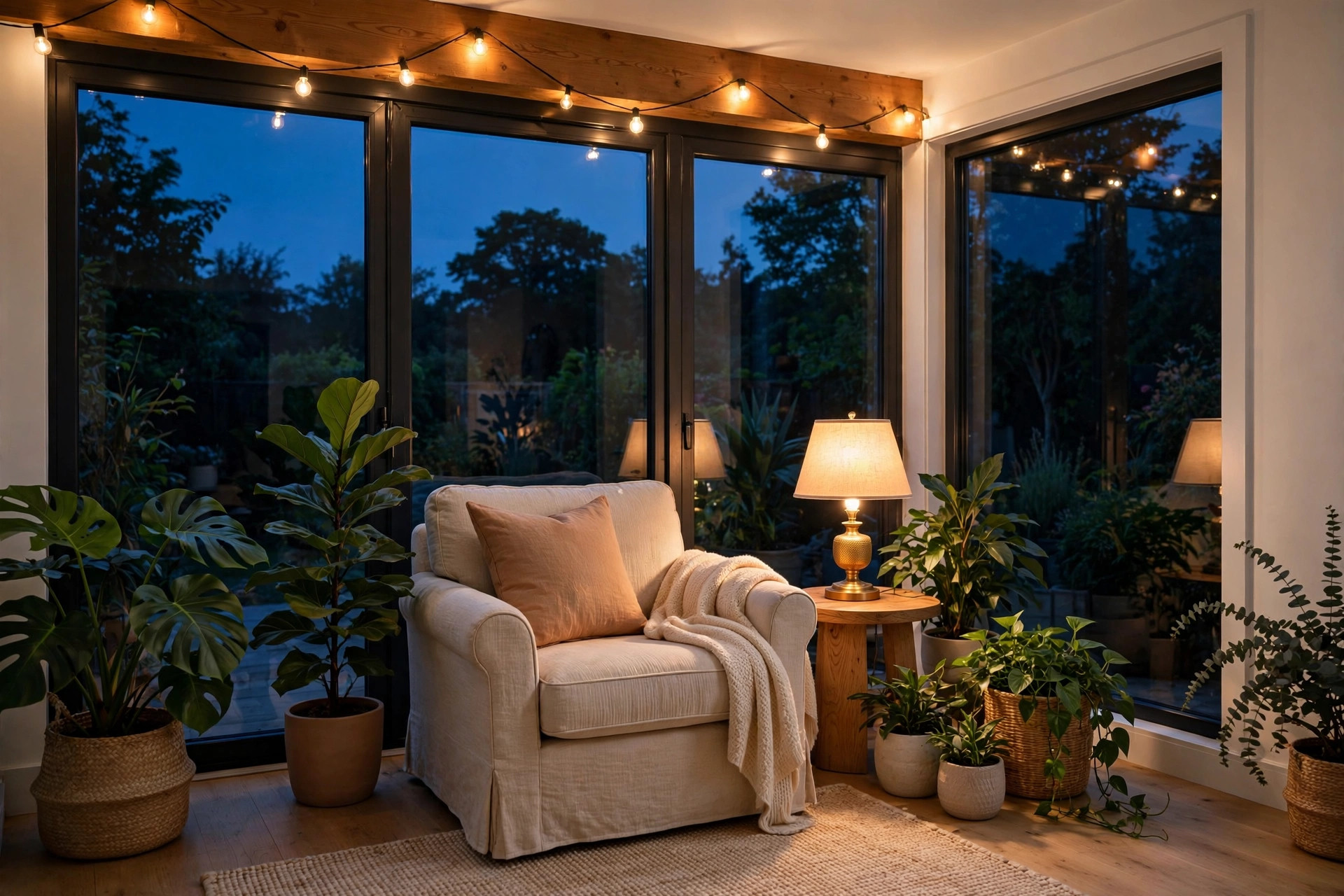
A retreat that only works in daylight wastes half its life. As the sun drops, a sunroom can turn into a black glass box — unless you plan its evening light with the same care as its planting.
Warm, low-level lighting is the answer: a lamp in the reading nook, a soft light tucked behind the statement tree so its leaves are silhouetted, and perhaps a string of warm lights along a beam.
Lit from within, the plants look sculptural and the room stays inviting long after dark.
Keep evening light warm and indirect, and avoid harsh overhead bulbs that flatten everything they touch. A simple timer makes the effect effortless — the room glows into life at dusk.
That final layer completes the transformation from a place where plants are kept to a place where you genuinely live.
Common Mistakes to Avoid
Mistake 1: Filling every surface in the first month. A sunroom planted all at once leaves no room to grow. Plants increase in size, new favourites arrive, and a room with no gaps becomes a crowded store rather than a retreat.
Plant perhaps half the space first, and let the collection fill in as you learn the room’s light.
Mistake 2: Watering everything on the same schedule. A calendar-based routine ignores what each plant actually needs and is the fastest route to root rot and drought stress in the same week.
Group by thirst as described above, check the soil with a fingertip before watering, and let the plants — not the day of the week — tell you when they are ready for a drink.
Mistake 3: Forgetting airflow and heat. A sealed sunroom can overheat plants surprisingly fast, and still, damp air invites problems that ventilation prevents.
Open vents whenever the room feels stuffy, keep space between pots so air can move, and never let foliage press against hot glass in summer.
Frequently Asked Questions
Which plants are happiest in a sunroom? It depends on your light, but leafy foliage plants that enjoy bright indirect light — such as pothos, philodendron, monstera and many ferns — suit most sunrooms well, while herbs, citrus and succulents suit the sunniest spots.
Always match the plant to the zone it will actually live in, and start with forgiving plants while you learn your room.
How do I stop my sunroom getting too hot for plants? Use sheer curtains or shading on the sunniest glass during the fiercest hours, open vents or windows to keep air moving.
Group plants together to share humidity, and move sensitive plants back from the glass in midsummer.
Watering in the morning also helps plants face a hot day in good shape.
Can I use a sunroom as a living room as well as a plant room? Yes — that is exactly what a retreat is.
Keep the furniture light and modest in number, plant in layers around the seating rather than in a separate block, and give watering and potting their own small station so the living space stays clean and calm.
How often should I water sunroom plants? There is no single schedule, because light, heat, pot size and plant type all change the answer.
Check the soil before you water, group plants by thirst so whole sections share a rhythm, and expect the room to drink more in bright summer weeks than in winter. Observing beats scheduling every time.
Final Thoughts
A green retreat is not built with a single dramatic purchase; it grows, one good decision at a time.
Map your light honestly, plant in layers from the floor to the ceiling, give yourself a comfortable seat inside the greenery and a proper home for the watering can.
The room will repay you every day — in calmer evenings and the simple pleasure of watching things thrive under your care.
Start with whichever idea solves your biggest frustration, whether that is scorching sun, nowhere to sit or a floor crowded with pots. Add the next layer when the first has settled.
Before long, your sunroom will be the seat everyone hopes is free — a small, green, light-filled retreat attached to your house.


