

15 Staircase Gallery Wall Ideas That Make the Climb Beautiful
The staircase is the one wall everyone passes every day, yet it is so often left completely blank. That long, sloping stretch can feel awkward to decorate, because arrangements designed for flat, eye-level walls rarely suit a flight of steps.
A well-planned staircase gallery wall solves that problem, turning an in-between space into one of the most personal and welcoming parts of your home.
The secret is to let the stairs guide you. When frames follow the rise of the steps, mix sizes you love, and repeat one colour or frame finish throughout, the arrangement feels intentional rather than scattered.
Whether your taste runs to family photographs, calm prints, or a mix of both, there is a layout here for your hallway. If you are new to gallery arrangements, our guide to bedroom gallery wall ideas will help you build confidence first.
Below are fifteen practical ideas, from a gentle diagonal that climbs with the steps to ledges you can restyle in minutes. Start with the planning steps, pick the idea closest to your home, and adapt it freely.
A staircase gallery can grow slowly, one frame at a time, and that collected feeling is often what makes it so charming.
This post contains affiliate links. If you buy through them, we may earn a small commission at no extra cost to you. See our Affiliate Disclosure.
How to Plan a Staircase Gallery Wall, Step by Step
Begin by measuring the wall and marking the handrail line, because every good staircase gallery respects that diagonal. Keep the bottom edge of your arrangement running roughly parallel to the handrail, with a comfortable gap above it so frames never feel crowded by passing hands.
Cut paper templates to the size of each frame, tape them up with low-tack tape, and live with the layout for a day or two. View it from the bottom step, the landing, and halfway up, because a staircase gallery is seen in motion.
Next, decide on your thread: the one thing that ties different pieces together. It might be matching frames, a shared colour palette, all-black-and-white photography, or a single subject such as landscapes.
That thread makes a mixed collection feel calm instead of chaotic, as in modern bedroom wall art ideas as on the stairs. Lay everything out on the floor first, in the shape of your staircase, until the balance of large and small feels right.
Then fix frames from the centre outwards, checking levels as you go.
1. Follow the Stair Angle in a Gentle Diagonal
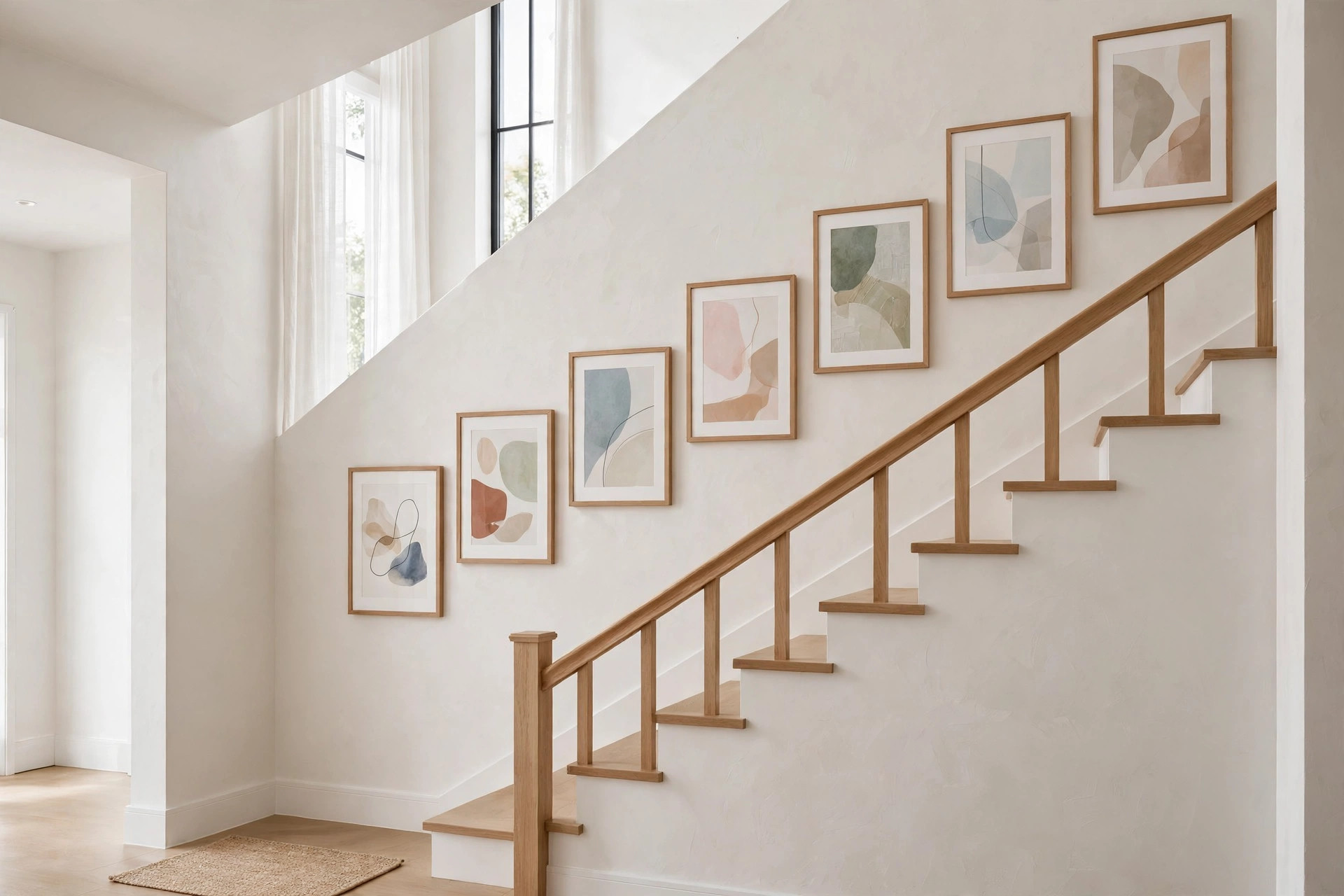
The classic staircase gallery follows the angle of the stairs, with frames stepping up in a loose diagonal that mirrors the handrail. It works in almost any home because it respects the architecture.
Keep spacing broadly consistent and let an imaginary line under the frames echo the slope.
Mark the diagonal with painter’s tape first and step back often; the eye forgives small variations, so focus on the overall flow, so the arrangement reads as one rising movement rather than separate pictures that happen to be climbing.
2. Mix Frame Sizes for a Collected, Layered Look
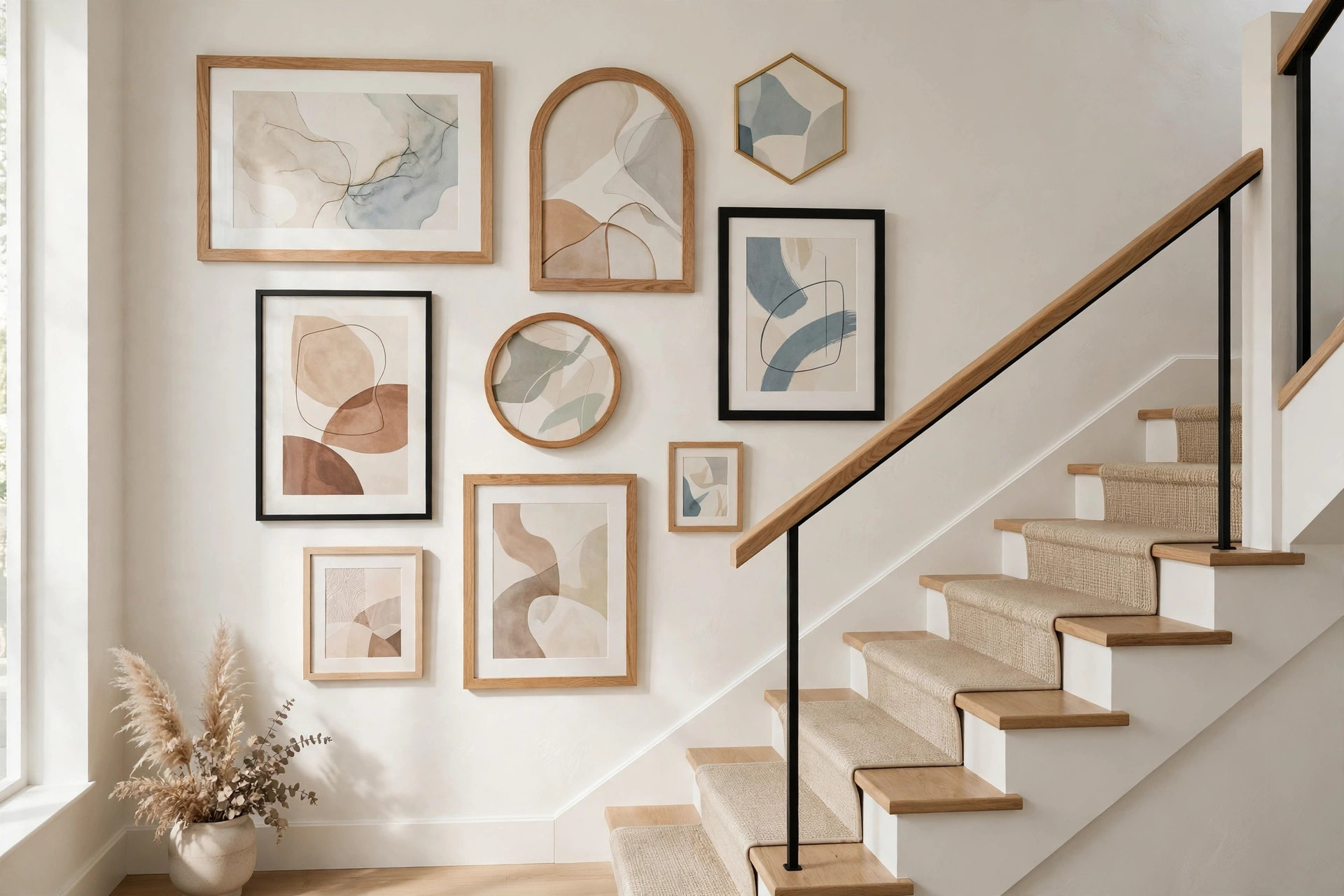
A mix of large, medium, and small frames gives a gallery its collected, over-time feeling. Place your largest piece first, roughly above the middle steps, then build smaller frames around it, filling gaps like a puzzle.
Vary shapes too: a tall portrait frame beside a wide landscape print keeps the eye moving. Just repeat something so the variety feels deliberate, such as the same frame finish or mount colour throughout.
With that small thread of repetition, every frame you add later will slot in naturally.
3. Tell Your Family Story in a Photo Run
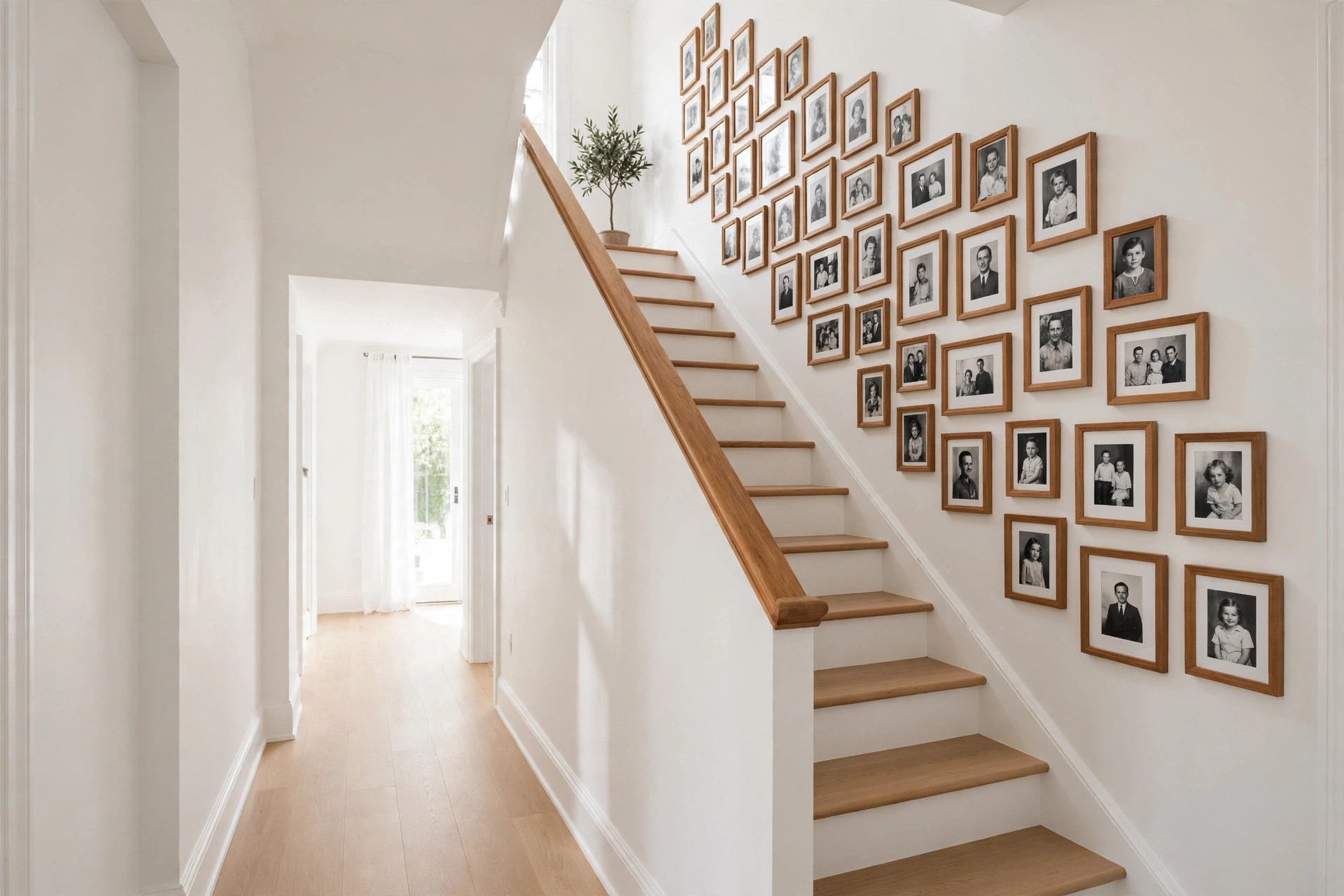
Few things warm a hallway like family photographs climbing the stairs. Choose pictures that mark the years: holidays, birthdays, everyday kitchen-table moments, and grandparents alongside the newest additions. Arranged roughly in order, the run becomes a quiet timeline you pass each morning.
Print photographs consistently so the display feels like one story; converting everything to black and white is the simplest unifier and is forgiving of phone snaps taken in different lights. Leave a spare space near the top for next year’s chapters.
4. Keep It Crisp With Uniform Black Frames
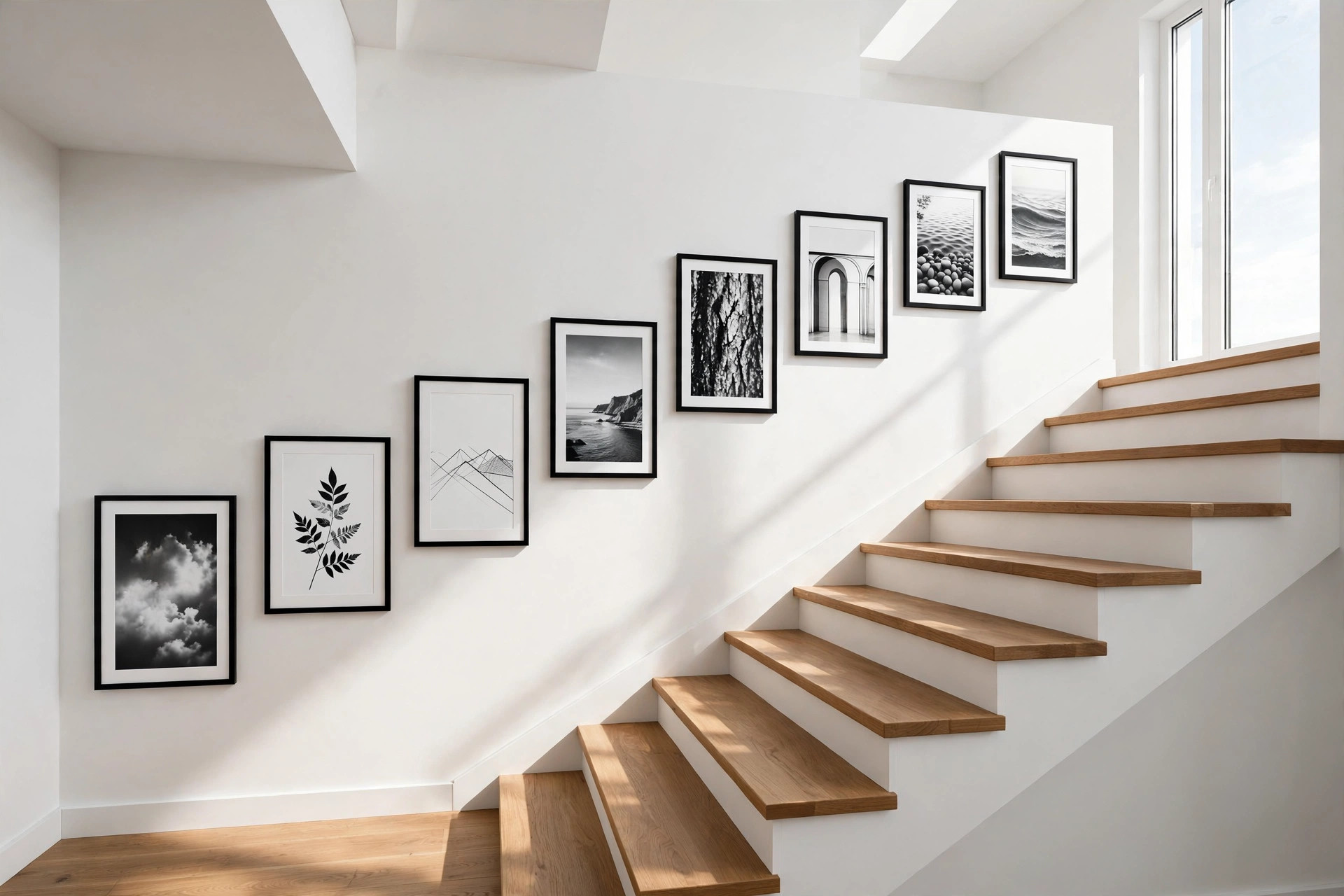
Uniform black frames are the easiest route to a smart, confident gallery. The repeated dark outline gives even a very mixed set of images a tailored, graphic quality, and black works against pale walls, warm neutrals, and deeper colours alike.
Inside the frames, almost anything works: monochrome photographs, line drawings, pressed leaves, or colourful prints that pop for their dark edging. If you enjoy this contrast elsewhere, see these black and white bedroom wall art ideas. Choose non-reflective glazing for the sunniest spots.
5. Go Art-Led With Prints, Paintings and Posters
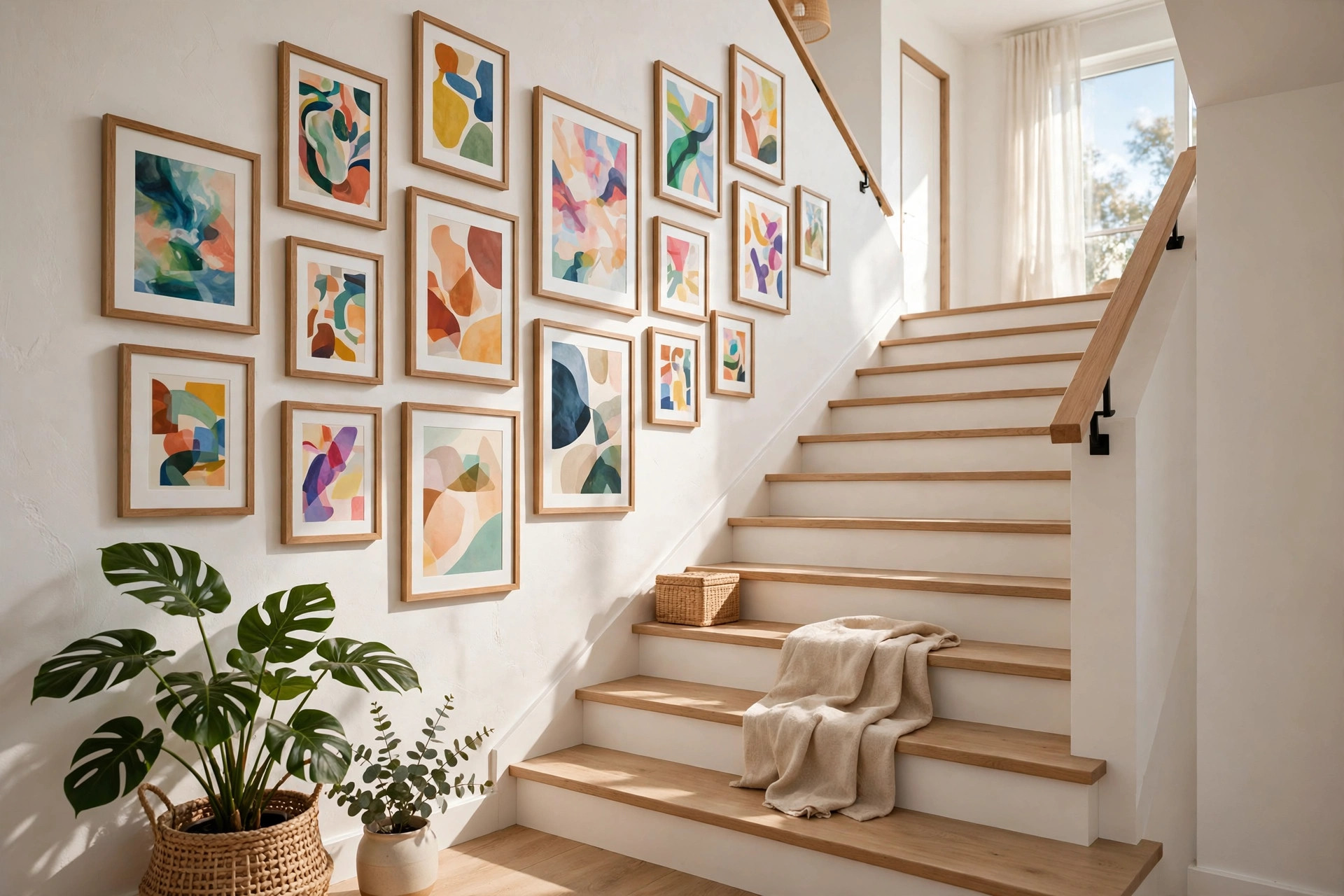
An art-led gallery treats the staircase like a small gallery you walk through daily. Mix paintings, prints, and posters around a loose theme: coastal scenes for a light hall, abstract shapes for a contemporary home, or vintage-style travel posters for character.
Pair one or two larger, quieter pieces with smaller, bolder ones so nothing shouts over its neighbours.
Keep a shared colour note running through the selection, perhaps a muted blue or warm ochre appearing in most pieces, and the arrangement will feel curated rather than gathered by accident.
6. Add Mirrors to Catch the Light
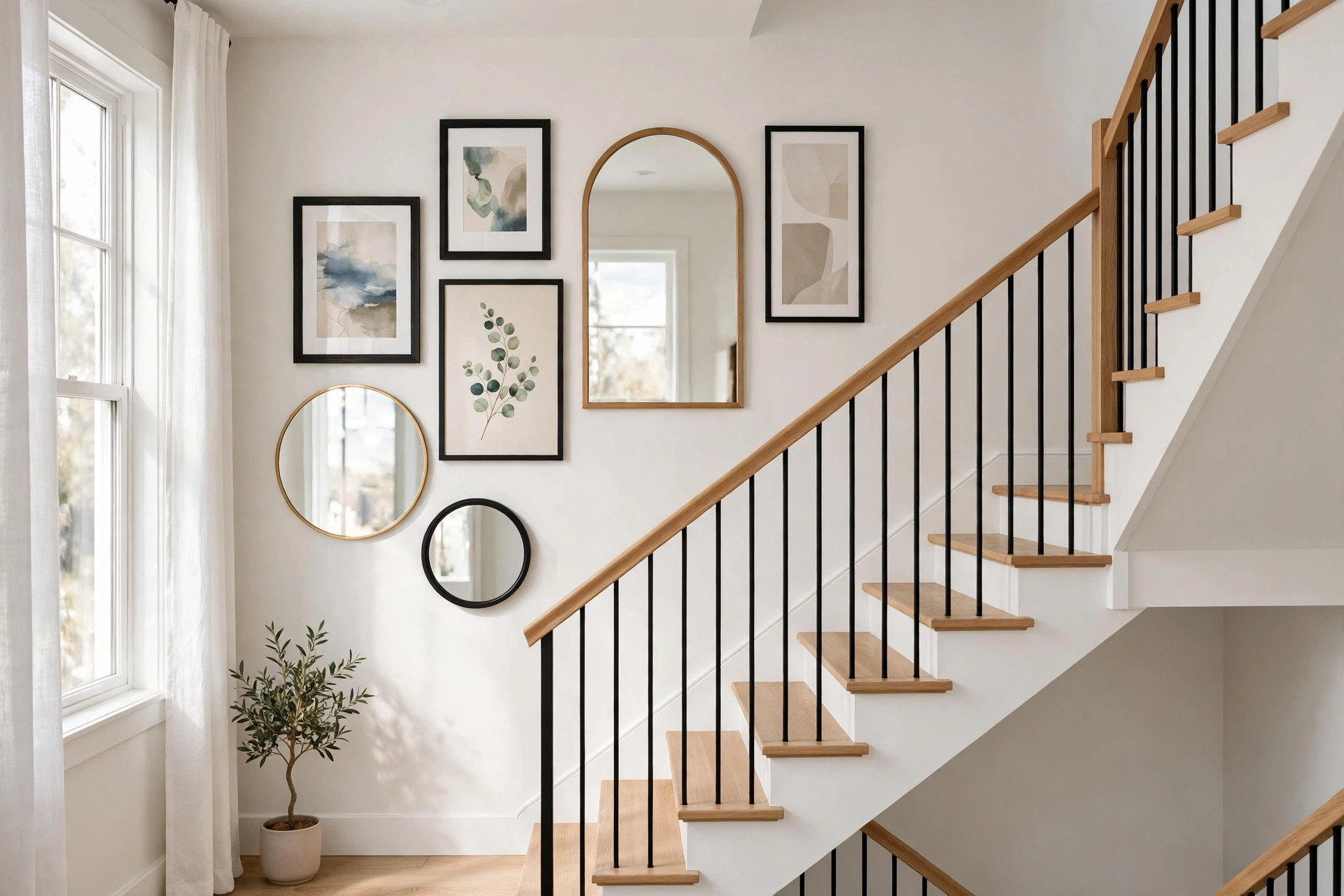
Staircases are often the dimmest part of a house, which makes mirrors a genuinely practical addition.
A small round mirror among the frames, or two or three spaced along the run, will catch light from a landing window and bounce it into corners pictures cannot lift.
Position each mirror where it reflects something pleasant, a window, a pendant light, or the gallery itself, rather than a blank ceiling. Round and arched shapes soften a run of rectangular frames beautifully. Check every angle from the steps before fixing.
7. Layer In Wall Sconces for Evening Glow
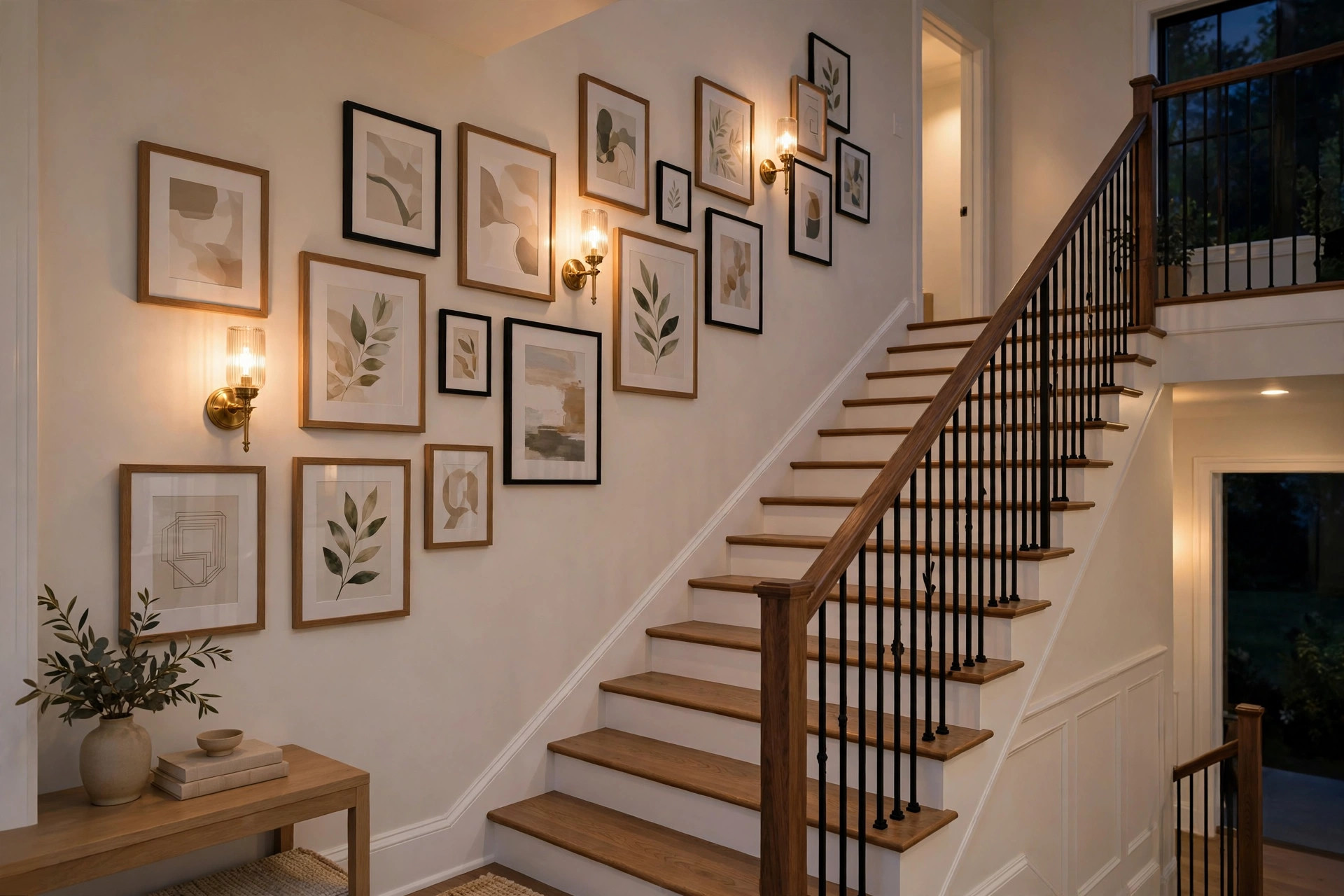
Wall sconces turn a staircase gallery from a daytime feature into an evening one. Simple fittings spaced along the flight wash the frames in warm light, make the climb feel more inviting after dark.
Battery-operated and rechargeable styles make this possible where new wiring would be disruptive. Plan sconce positions before hanging frames, so each light sits comfortably within the layout.
Keep the fitting style in tune with your frames, and choose dim, warm light to avoid glare on glass.
8. Make the Landing a Pause Point
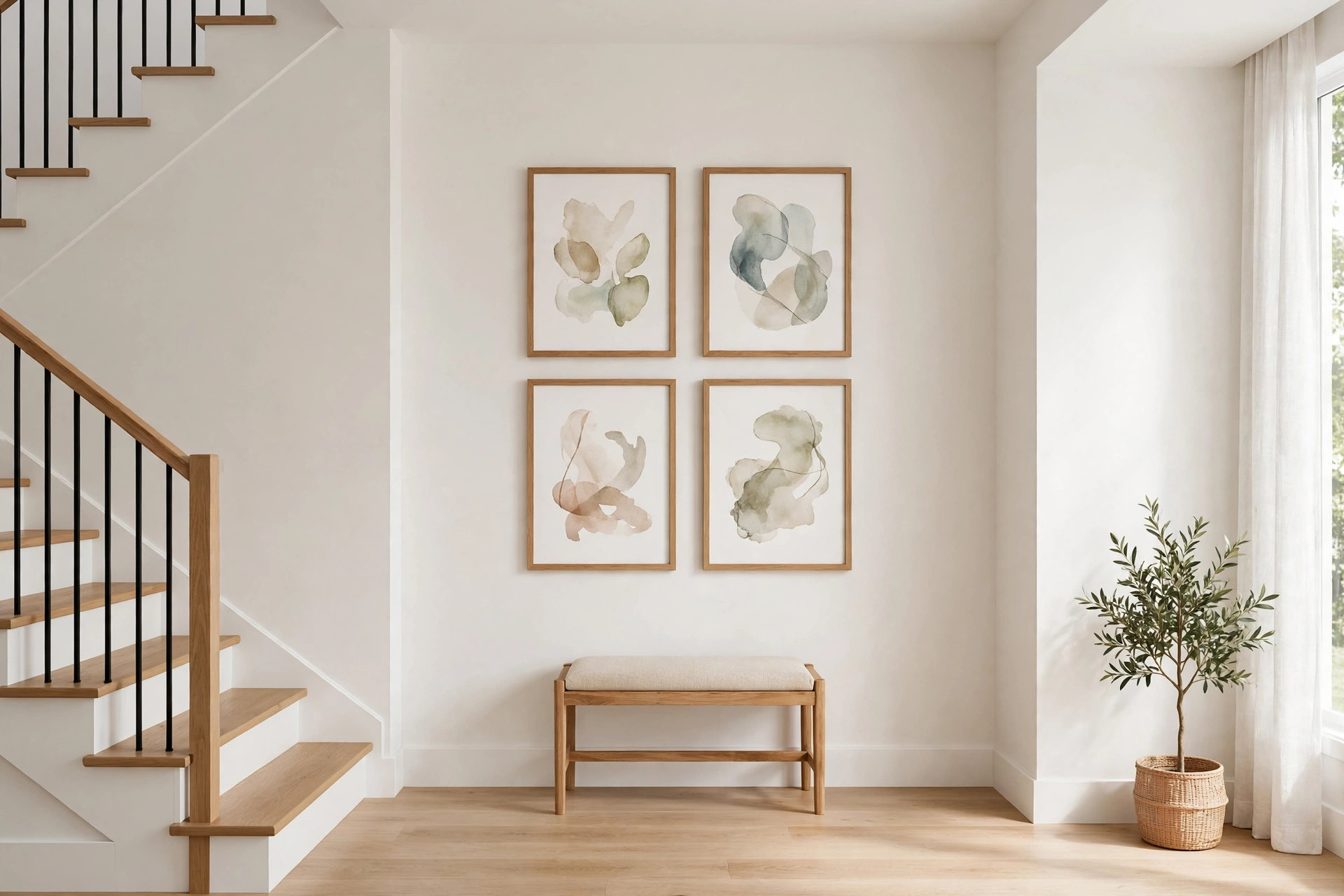
If your staircase turns at a landing, treat that flat wall as the gallery’s pause point.
A landing can carry a more symmetrical arrangement than the slope: a neat group of four matching frames, one generous statement piece, or a small bench beneath a row of pictures.
The contrast between the climbing diagonal and a calm landing display gives the whole scheme rhythm. Put the piece you love most here, where it can be viewed straight on and at leisure rather than in passing. Keep walkways clear.
9. Choose a Single Colour Palette Throughout
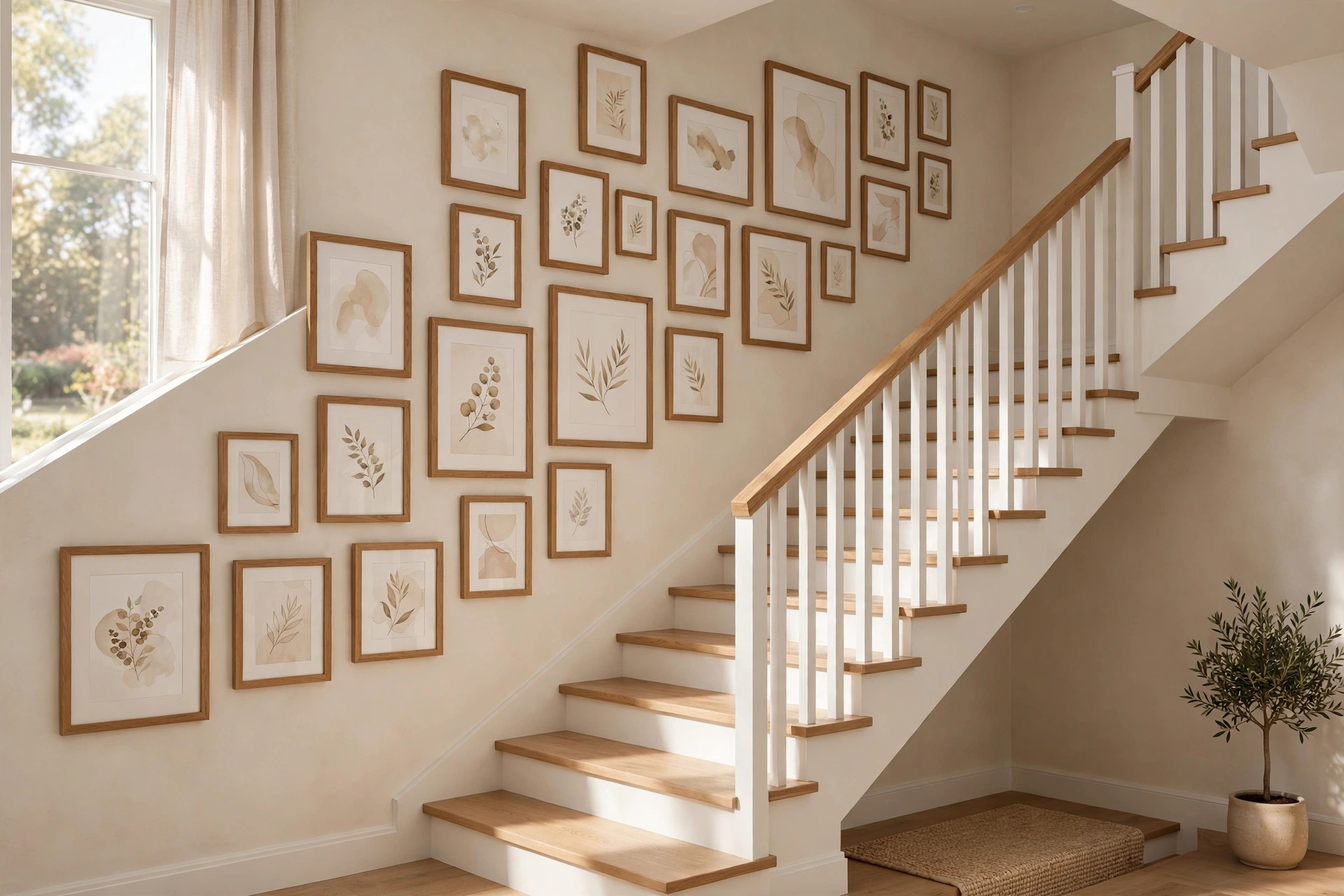
Restricting your gallery to one colour palette is a gentle way to make very different images belong together. Soft neutrals, warm wood tones, and cream mounts create a calm climb that suits a busy entrance, while deep greens with brass-toned frames feel rich and cocooning.
Choose the palette from something already in the hall: the runner, the front door colour, or the handrail wood. When the gallery borrows its colours from its surroundings, the space feels pulled together, and choosing future pieces becomes easy.
10. Try a Tight Grid for a Calm, Orderly Feel
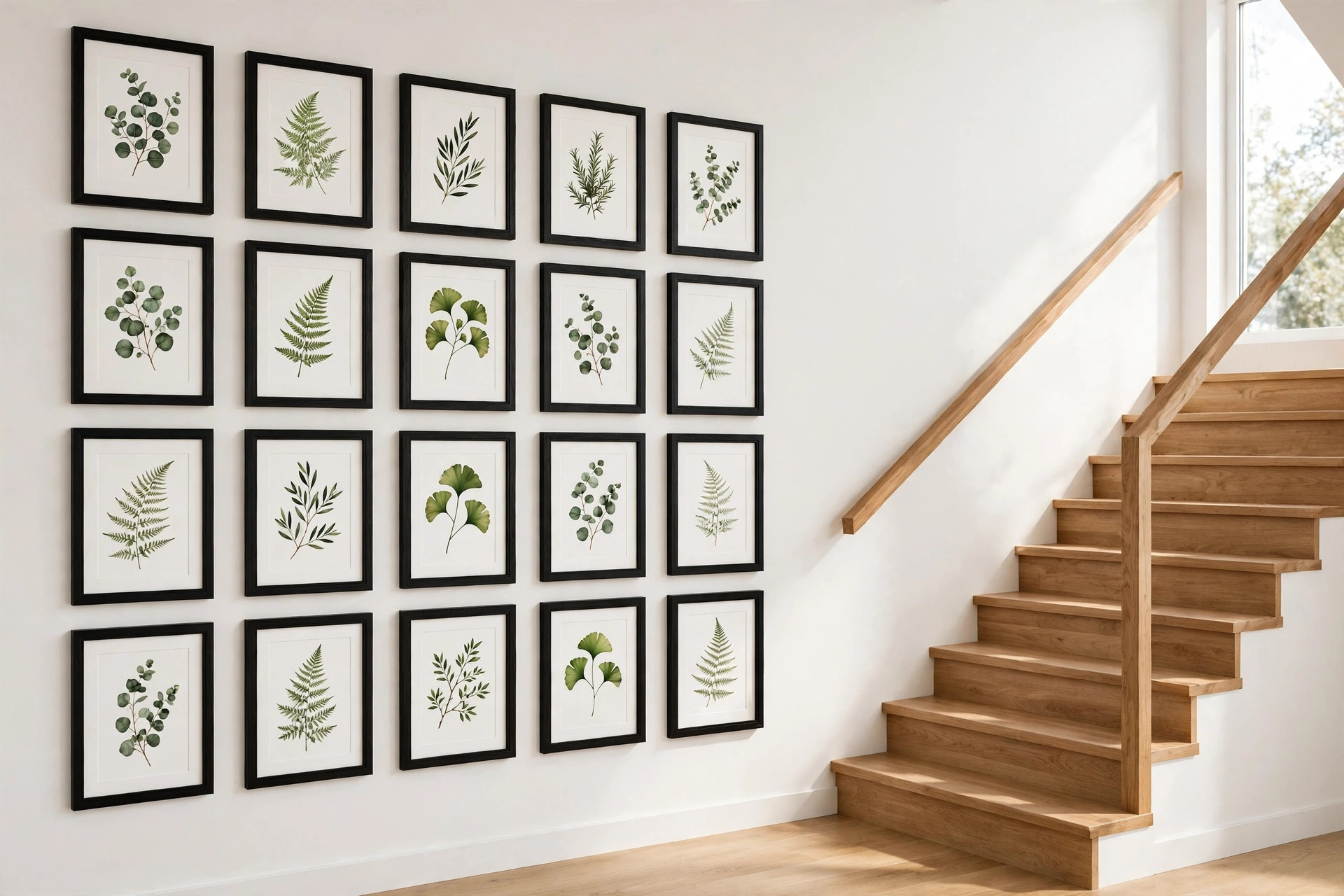
Not every gallery needs to wander. On a straight flight with a long, unbroken wall, a tight grid of identical frames can look calm and architectural.
Grids work best on the flattest section of wall, above a half-landing or along the upper stretch, where equal spacing is achievable. Precision matters here, so measure carefully, use a spirit level, and template the whole grid before drilling.
Matching series, such as botanical studies or portraits taken the same way, reward this treatment and feel orderly without being cold.
11. Mix In Plates, Baskets and Textile Art
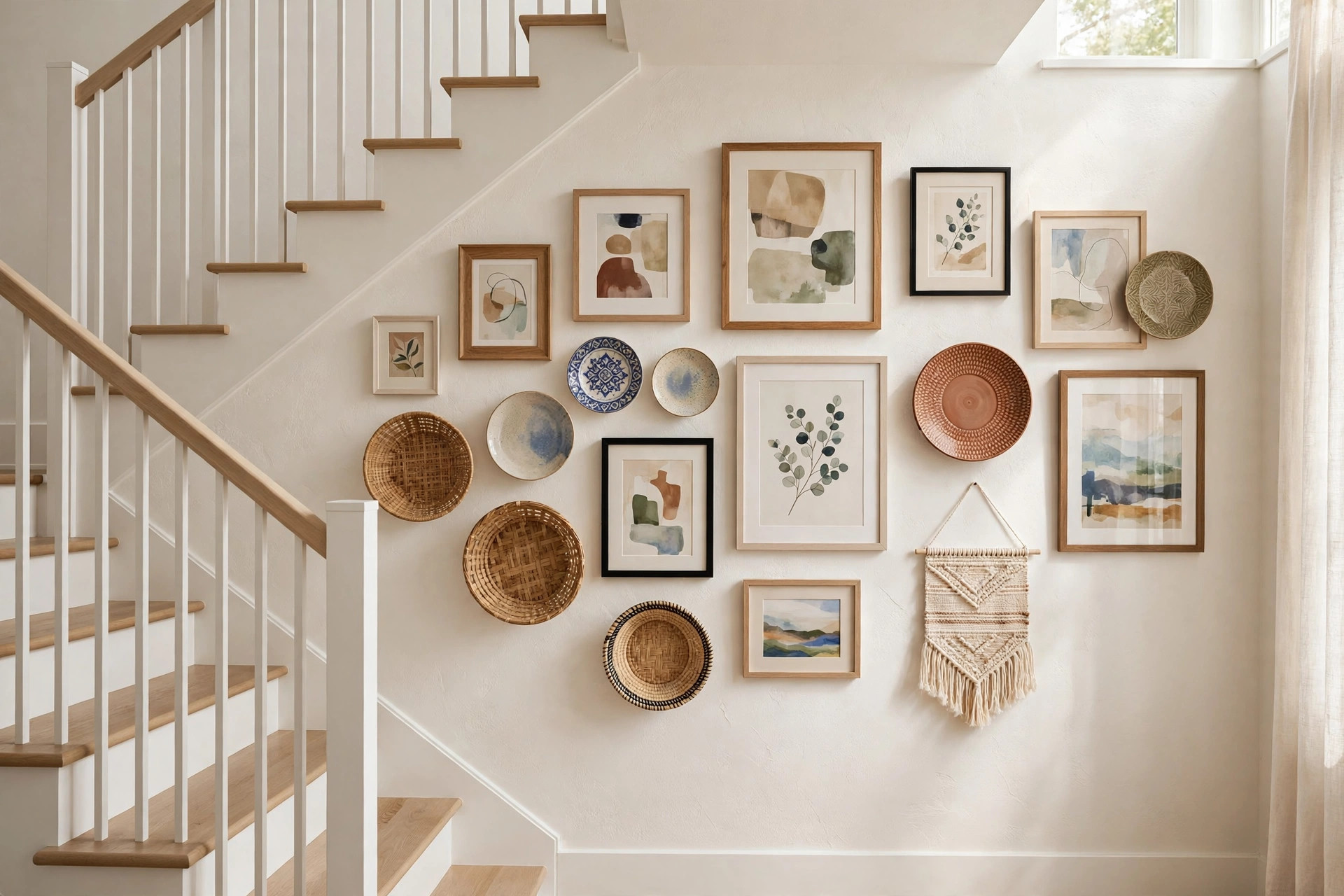
A gallery wall does not have to be only pictures. Decorative plates, shallow woven baskets, a small textile hanging, or framed fabric add shape and texture that flat frames cannot, and they break up a long wall in the most interesting way.
Use them sparingly, perhaps one tactile piece for every four or five frames, so the wall still reads as a gallery. Keep anything fragile or projecting well above handrail height, out of the path of laundry baskets and school bags.
On a staircase, practicality and beauty climb together.
12. Use Picture Ledges So You Can Swap and Restyle
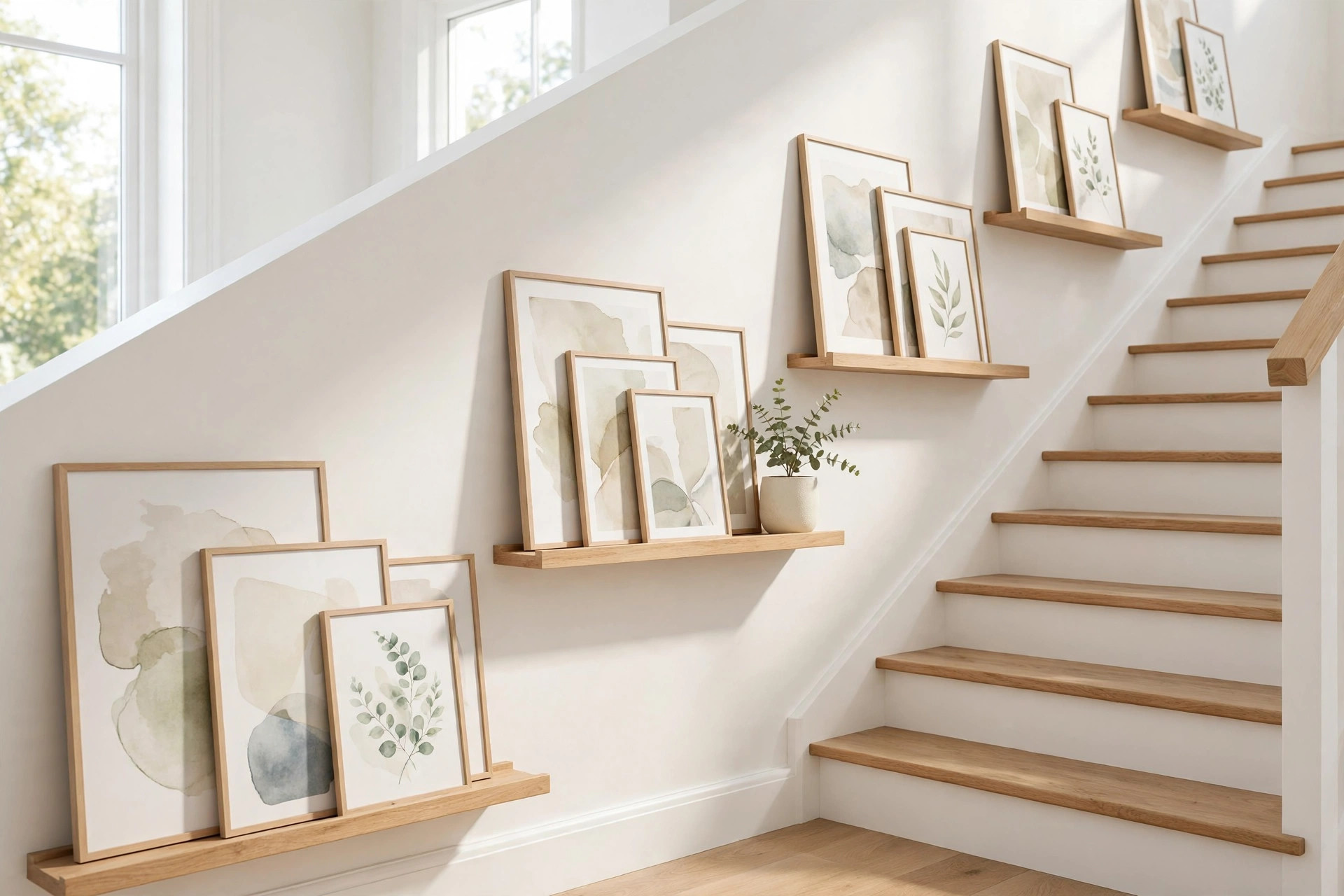
Picture ledges are the flexible friend of the indecisive decorator. Shallow ledges following the slope, or one along the landing wall, let you lean frames in overlapping layers and swap them whenever you print something new, with no fresh holes.
Lean larger frames at the back and smaller ones in front, and mix in a small plant or favourite object.
If you are setting up a first home, this adaptable approach pairs well with our guide to first apartment living room ideas, where every piece must earn its place.
13. Fill a Tall, Narrow Stairwell Wall
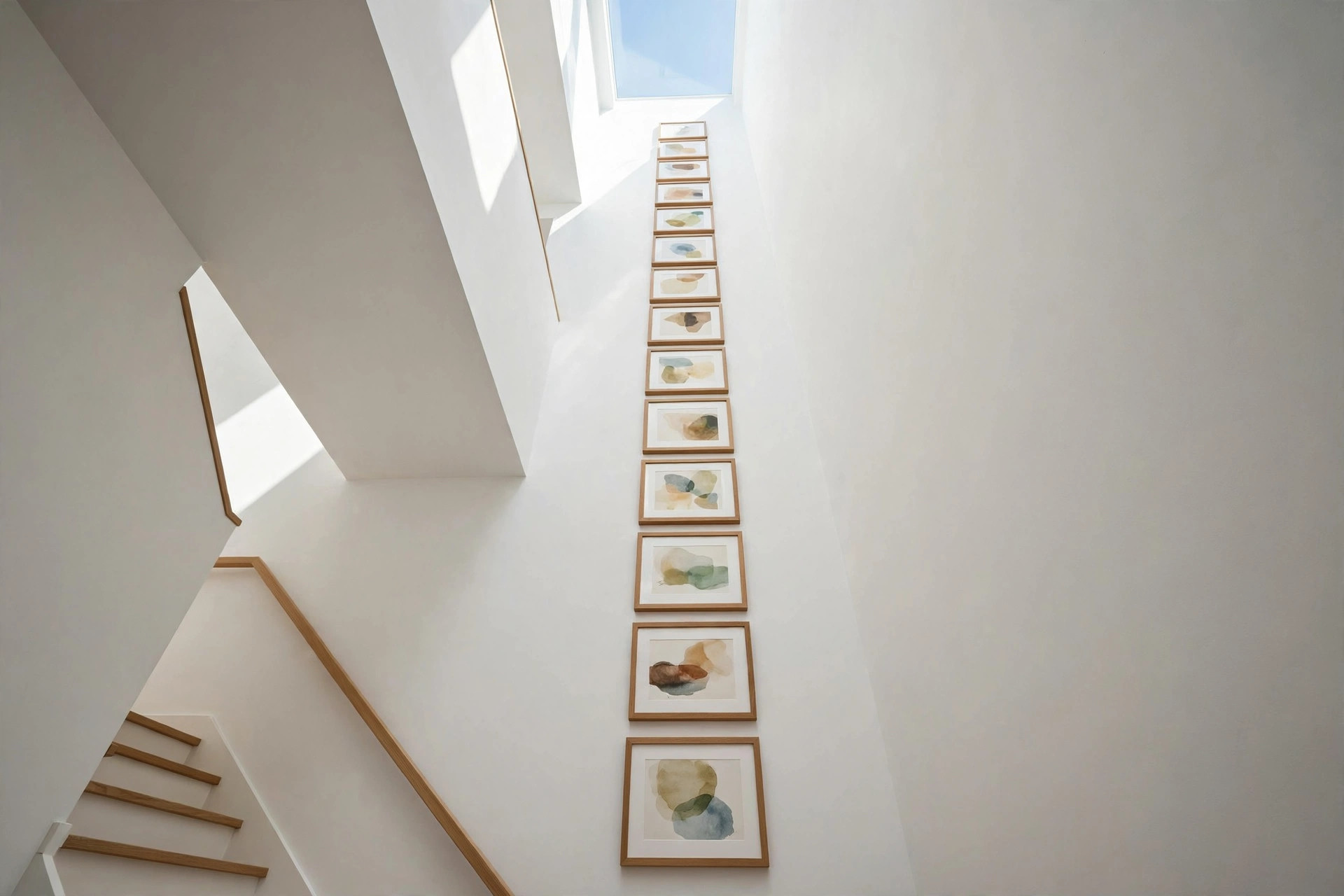
Some stairwells have the opposite problem: a tall, narrow wall that soars above the flight and dwarfs ordinary pictures. Here, think vertically. Stack frames in a column that climbs higher than feels obvious at first, drawing the eye up and celebrating the height.
Put the largest pieces at comfortable eye level from the steps and let smaller ones drift upward. Safety comes first: hang only what you can reach securely, and leave the highest spaces for lightweight pieces or simply for warm painted colour.
14. Go Oversized With One or Two Statement Pieces
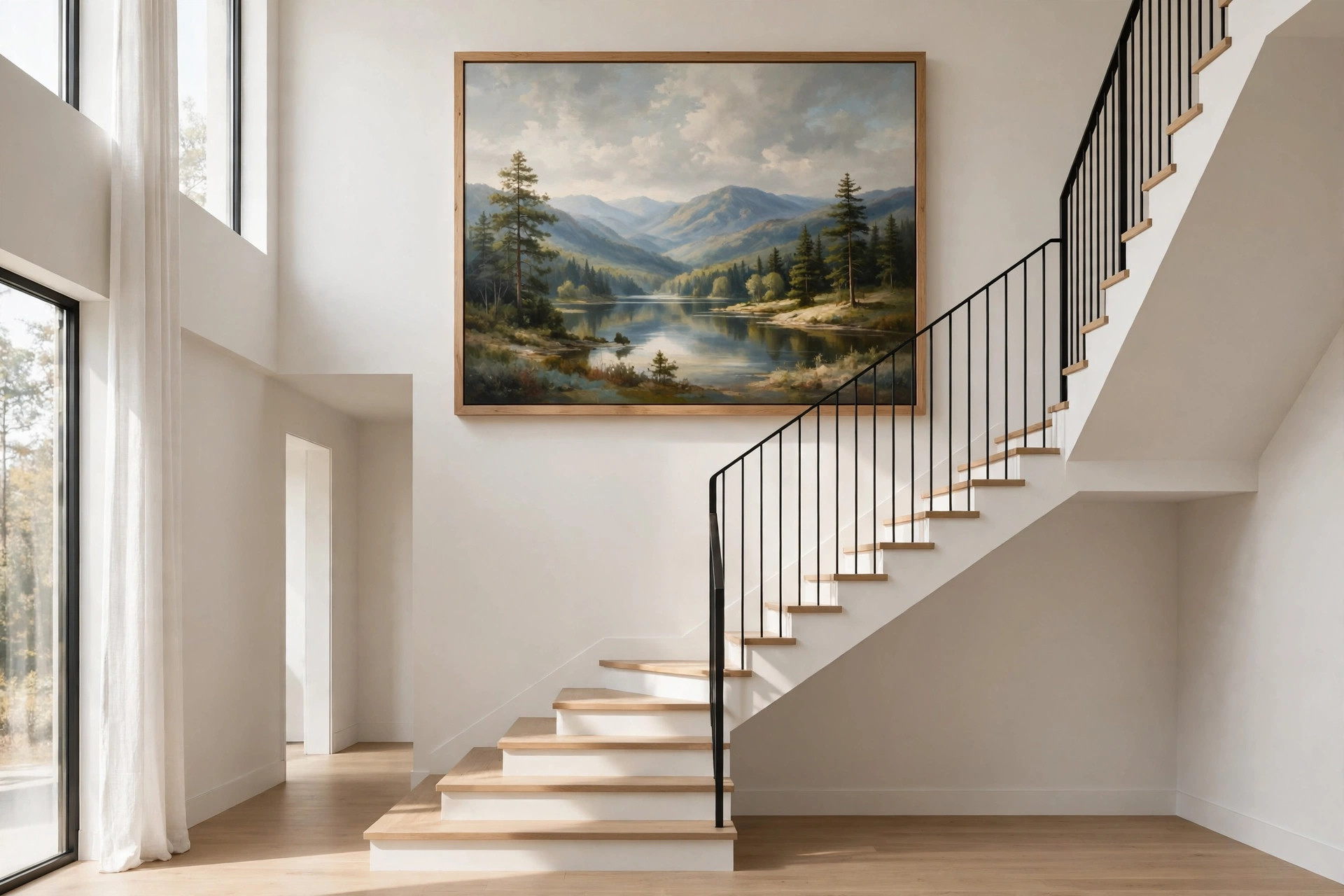
Sometimes the boldest gallery is the simplest: one or two oversized pieces instead of many small ones.
A large print above the middle of the flight, or a generous canvas on the landing wall, gives the eye a clear focal point and can make a modest hallway feel grand.
Choose artwork with a little distance in it, landscapes or soft abstracts, because big pieces are mostly viewed from several steps away. Keep frames simple, relate two pieces by colour or subject, and give them generous space apart.
15. Keep a Small-Scale Wall Light and Airy
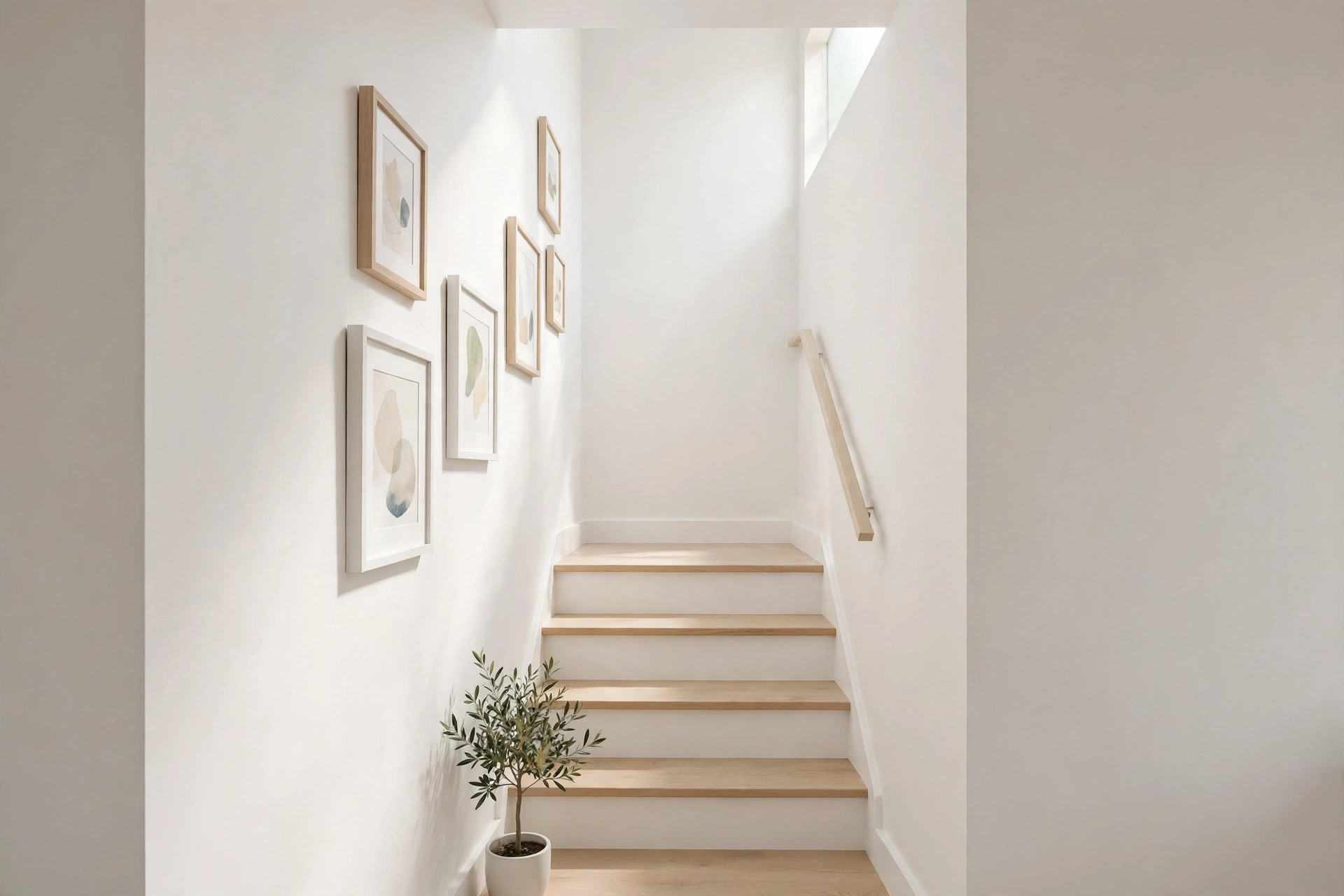
In a compact home or on a short flight, scale everything down and keep the palette light.
Small frames in pale wood or white, airy prints with plenty of white space, and generous gaps between pieces will make a narrow stairwell feel brighter and less enclosed. Five or six well-chosen frames beat fifteen squeezed in.
This lighter touch is wonderfully welcoming for guests too, and if your spare space hosts them overnight, our sofa bed living room ideas for guests will help the welcome continue beyond the stairs.
Common Mistakes to Avoid
Hanging frames too high or too low. Placing frames at standing eye level, as if the wall were flat, leaves them floating above the steps or crowding the handrail.
Keep the arrangement related to the treads, with a fairly even gap above the slope of the stairs. Paper templates, checked from below, above, and halfway up, catch this error before any holes are made.
Forgetting about glare and passing traffic. A sunny stairwell can turn glass-fronted frames into mirrors for half the day, hiding your pictures. Note where light falls before fixing positions, and use non-reflective glazing where needed.
Keep frames flush and secure, and never let a deep frame project where shoulders and bags pass within inches daily.
Trying to finish everything at once. Galleries rushed into one weekend often end up with hurried filler and spacing that serves the drill rather than the design. Hang your strongest pieces well and live with a few gaps instead.
A gallery that grows gradually, as you find pieces you genuinely love, almost always ends up more personal and better balanced.
Frequently Asked Questions
How high should a staircase gallery wall start? Keep the lowest frames a comfortable distance above the handrail line, following its slope, so hands pass freely.
Mark the line with tape, hold a frame against the wall while standing on the steps, and adjust until the gap looks even from the bottom of the flight. Comfort and clearance matter more than any fixed measurement.
How many frames do I need? There is no required number. A short flight can look complete with five or six frames, while a long staircase might carry fifteen or more.
Start with pieces you already own and love, arrange them as templates, and add only where a genuine gap appears.
Can I mix photographs and artwork on the stairs? Yes, and the mix is often what makes a gallery interesting. Photographs bring the personal story, while prints bring colour, scale, and breathing space.
Tie them together with matching frames or a shared palette, and spread photographs evenly through the arrangement rather than grouping them at one end.
What if I am renting and cannot drill? Removable hanging strips rated for your frame weights, picture ledges with minimal fixings, and frames leaned on a landing surface are all renter-friendly routes.
Test strips on an inconspicuous patch first, keep frames lightweight, and avoid hanging anything heavy above the steps themselves.
Final Thoughts
A staircase gallery wall asks for a little patience, a roll of painter’s tape, and pictures you genuinely enjoy, and in return your home tells its story every time you climb the stairs.
Follow the angle, keep one simple thread running through your frames, and let the collection grow at its own pace.
Whether you choose black frames, a photo run, or picture ledges, the best gallery makes you slow down on your way up. Pick your favourite idea, template it this week, and enjoy making the climb beautiful.


