

15 Work Outfits for Women Over 50 Working in Healthcare or Nursing
Working in healthcare requires clothing that can keep up with a demanding day. Nurses and other healthcare professionals may spend hours walking between rooms, standing beside patients, sitting at a workstation, bending to reach equipment, assisting with daily care, or moving quickly when a situation changes.
An outfit that looks polished but restricts movement can become uncomfortable long before the shift is over. For women over 50, workwear can be practical without looking plain and professional without feeling overly formal.
The best wardrobe depends heavily on the role. A hospital nurse may wear facility-approved scrubs for most of the shift, while a nurse manager, clinic professional, medical receptionist, administrator, therapist, or healthcare educator may have more flexibility with trousers, blouses, cardigans, dresses, or smart casual clothing.
Healthcare clothing also has requirements that ordinary office clothing does not. Depending on the task and anticipated exposure, appropriate protective clothing and other PPE may be required. CDC guidance emphasizes selecting protective garments according to the hazards and patient interaction involved, while fit, comfort, durability, and compatibility with other protective equipment are also important considerations.
The following 15 work outfits focus on polished, comfortable ideas for women over 50 working in healthcare or nursing, with options ranging from practical scrub combinations to more polished outfits for administrative, clinical, and office-based healthcare roles.
1. Navy Scrub Set With a Lightweight Undershirt
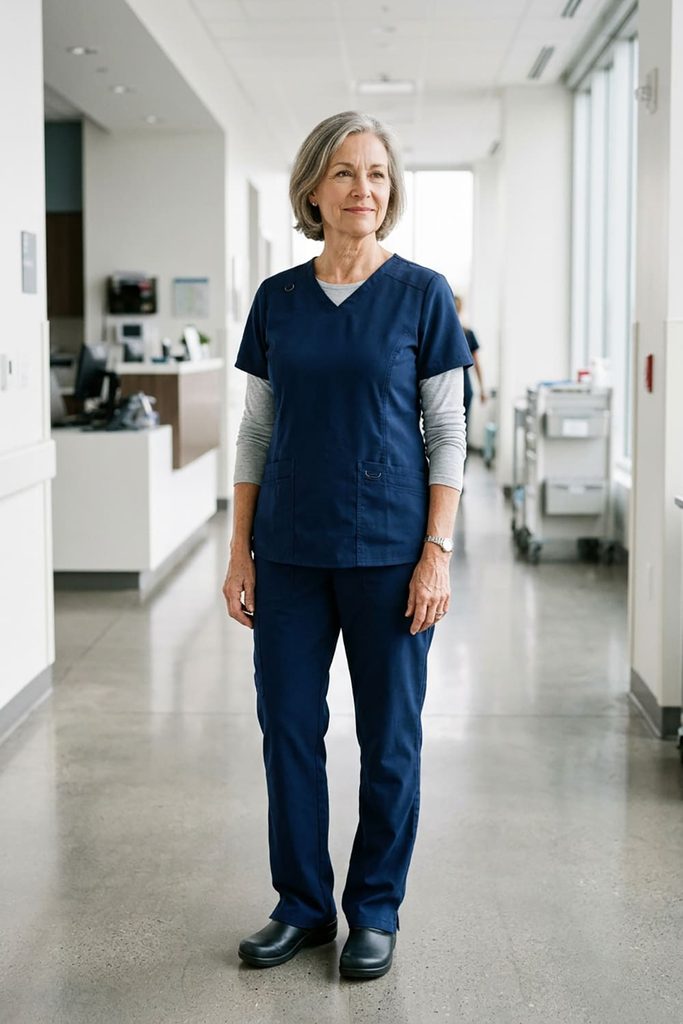
A well-fitting navy scrub set can provide a polished foundation for a long clinical shift. Navy is practical, easy to coordinate, and less visually stark than some brighter uniform colors. Choose a scrub top that allows comfortable movement through the shoulders and sleeves without being excessively loose.
Underneath, a lightweight short- or long-sleeve undershirt can provide additional comfort in cooler clinical environments, provided it is permitted by the facility’s uniform policy.
Comfortable closed-toe work shoes complete the outfit. Keep jewelry minimal so it does not interfere with patient care or hand hygiene.
The most important detail is fit. Scrubs should provide enough room for bending, reaching, walking, and assisting patients without being so oversized that they catch on equipment. Healthcare protective clothing also needs to fit properly because oversized garments can snag while garments that are too small may restrict movement or compromise coverage.
2. Charcoal Scrubs With a Coordinated Jacket
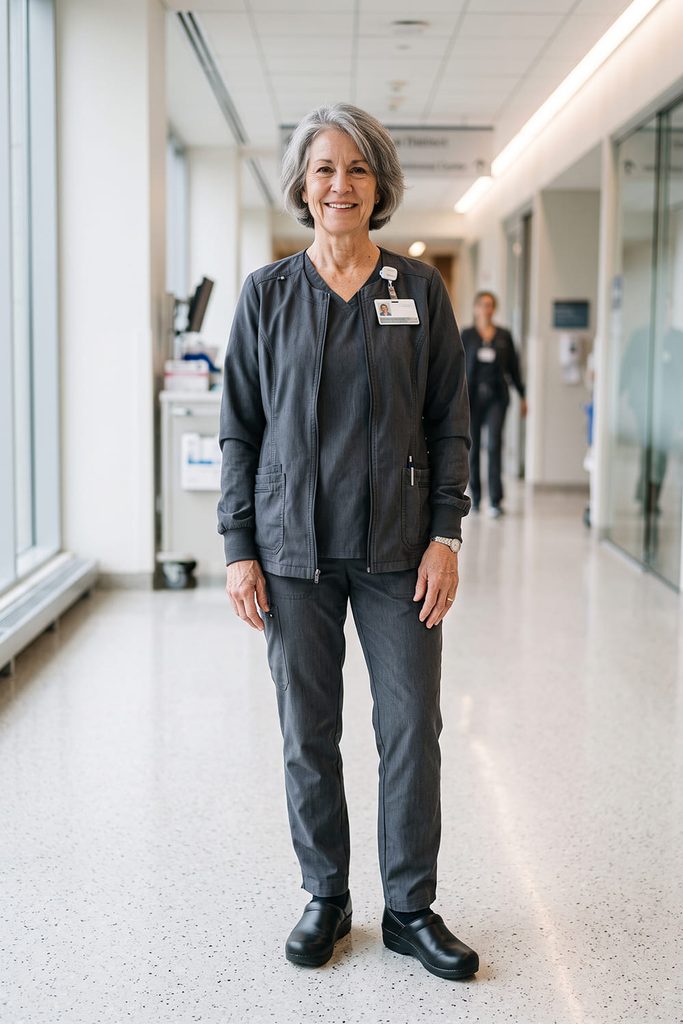
Charcoal scrubs create a refined, understated appearance while remaining practical for clinical work. Pair them with a lightweight scrub jacket in the same color family or a facility-approved contrasting shade.
A coordinated jacket is particularly useful for women who become cold in air-conditioned clinical areas but do not want to wear a bulky layer.
Look for a jacket with enough room through the shoulders and upper arms to allow unrestricted movement. Pockets can also be useful for permitted work essentials, although anything carried on the body should comply with workplace infection-control and uniform policies.
Keep footwear comfortable and closed-toe where required. A supportive shoe can make a substantial difference during a long shift spent moving between patient rooms.
For clinical duties, remember that an ordinary jacket or cardigan is not a substitute for required PPE. Protective garments are selected according to the anticipated task and exposure.
3. Burgundy Scrubs With Black Accessories
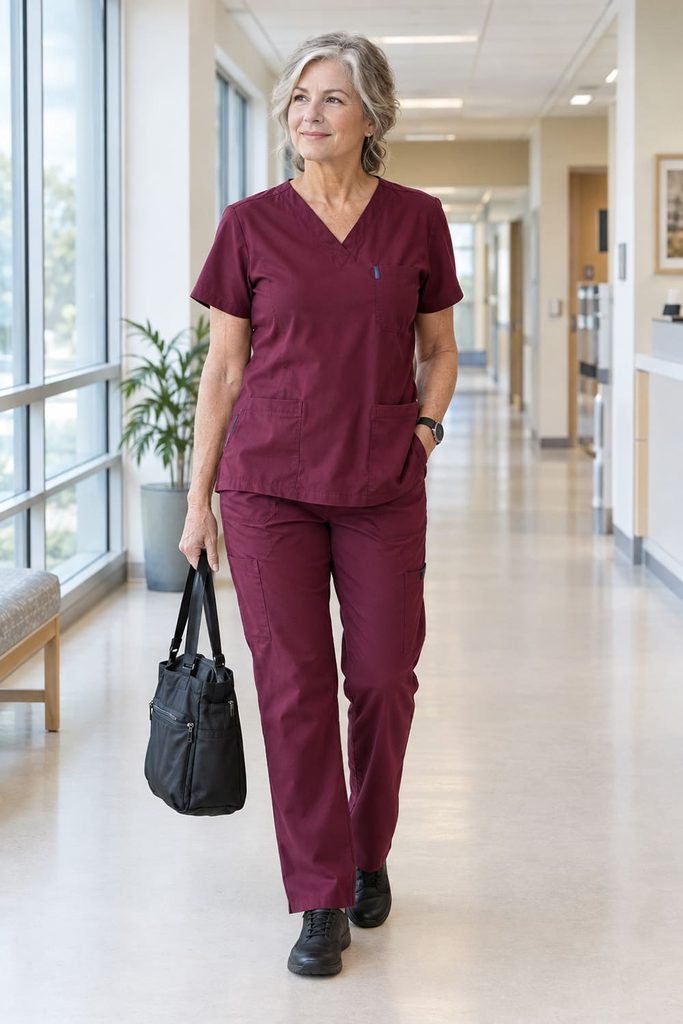
Burgundy can add personality to a clinical wardrobe while maintaining a professional appearance if the facility permits that color. Pair burgundy scrub trousers and a matching top with simple black accessories.
The accessories should remain functional rather than decorative. A practical bag, approved footwear, and a simple watch can complete the look without creating unnecessary distractions.
If your workplace permits a fitted undershirt, black can create a subtle contrast under the scrub top. Otherwise, keep the entire outfit within the approved uniform requirements.
Choose scrub trousers with a comfortable waistband and enough room through the hips and thighs. Nurses frequently squat, bend, walk, and sit throughout a shift, so rigid clothing can become frustrating quickly.
This combination is especially useful for women who want their everyday work wardrobe to have more color while still maintaining a restrained professional appearance.
4. Black Scrub Trousers With a Soft Blue Scrub Top
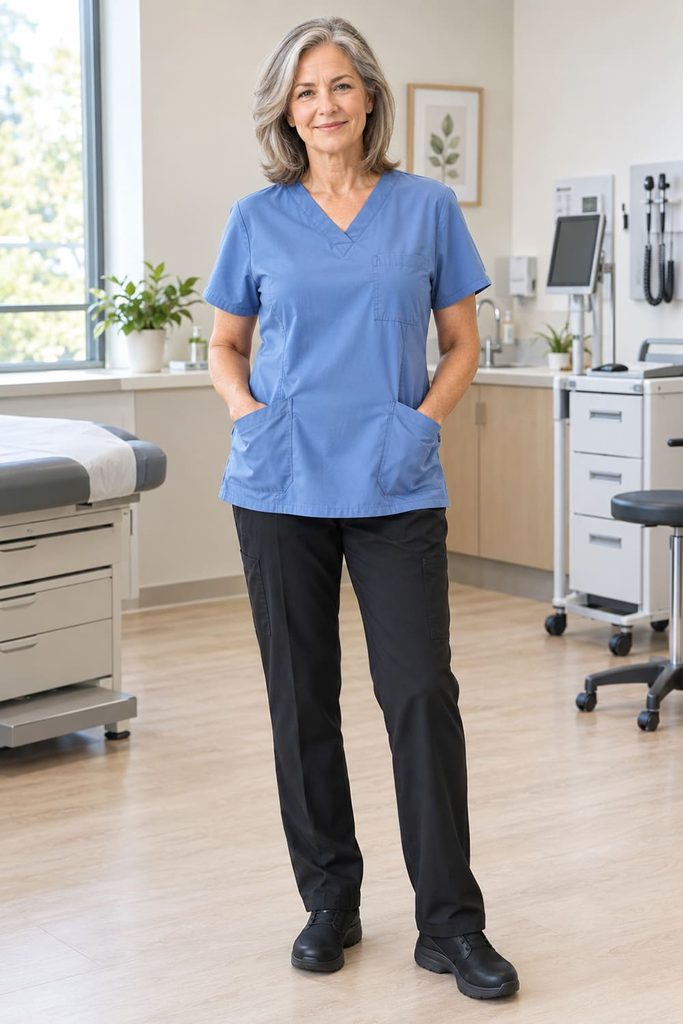
A dark trouser with a softer blue top creates a balanced combination for healthcare environments that allow separates.
Black or very dark scrub trousers can provide a clean base, while a muted blue top makes the outfit feel lighter. Choose a blue that works with your facility’s approved color requirements.
This outfit can also be useful for healthcare workers who prefer visual separation between the top and bottom rather than a single-color scrub set.
Look for fabrics that allow airflow and movement while being appropriate for the laundering requirements of your workplace. Healthcare clothing may need frequent laundering, and the garment’s durability matters as much as its appearance.
Keep the footwear simple and practical. Closed-toe, washable footwear may be appropriate in some healthcare settings, particularly where exposure risks are higher. Facility policies should determine the exact requirements.
5. Straight-Leg Trousers With a Knit Top for Clinic Staff

Not every healthcare position requires traditional scrubs. Nurses working in outpatient clinics, healthcare offices, administrative departments, or certain professional settings may have a dress code that permits conventional workwear.
For those roles, straight-leg trousers with a fine-knit top can create a comfortable but polished outfit.
Choose trousers in navy, charcoal, black, or taupe and pair them with a cream, pale blue, burgundy, or muted green knit top. The knit should skim the body without being restrictive. A lightweight blazer or cardigan can be added when additional polish is needed.
This combination works especially well for nurse managers, clinic coordinators, healthcare educators, and administrative professionals who spend part of the day at a desk and part of the day walking through a healthcare facility.
Always check whether personal clothing is allowed in your specific clinical environment and whether additional protective garments are required for patient-care activities.
6. Navy Trousers With a Button-Up Blouse
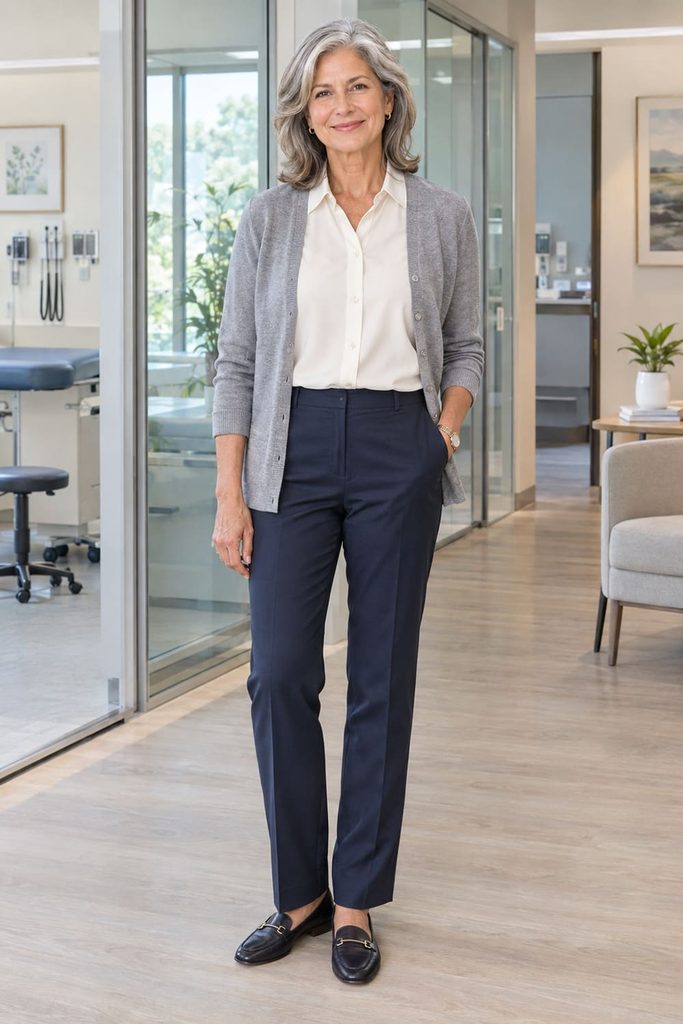
For healthcare professionals working in offices, clinics, administrative departments, or non-bedside roles, navy trousers and a button-up blouse provide a classic professional foundation.
Choose a blouse made from a comfortable fabric that does not require constant adjustment. A soft white, ivory, pale blue, or subtle print can work well with navy.
Straight-leg trousers provide a clean silhouette while leaving enough room for movement. Avoid extremely narrow trousers if your work involves frequent walking or climbing stairs. A simple cardigan can replace a blazer when you want a softer appearance.
Comfortable loafers or low-profile flats complete the outfit. This combination is particularly useful on days involving staff meetings, consultations, administrative work, or professional events when scrubs are not required.
7. Midi Dress With a Lightweight Cardigan
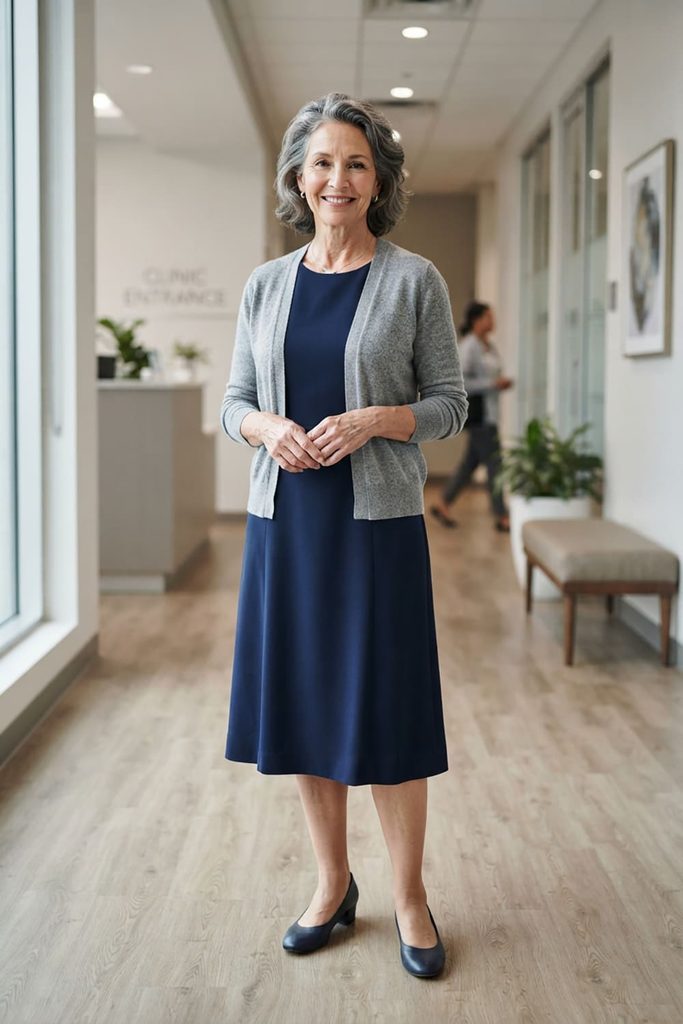
A midi dress can be an easy option for healthcare professionals who work in less clinical environments. Choose a dress with a modest neckline, comfortable sleeves, and enough room for normal movement.
A simple navy, charcoal, burgundy, green, or neutral dress can be worn with a lightweight cardigan. Avoid excessive embellishment, dangling accessories, or clothing that requires frequent adjustment. Healthcare work often involves movement and interaction, so practical simplicity is usually more useful than elaborate styling.
The dress should also be appropriate for sitting, standing, walking, and moving through the workplace.
If the role includes direct patient care, confirm that the dress is compatible with your employer’s uniform and infection-control requirements. Personal clothing is not a substitute for task-specific PPE when protective equipment is required.
8. Wide-Leg Trousers With a Structured Knit Top
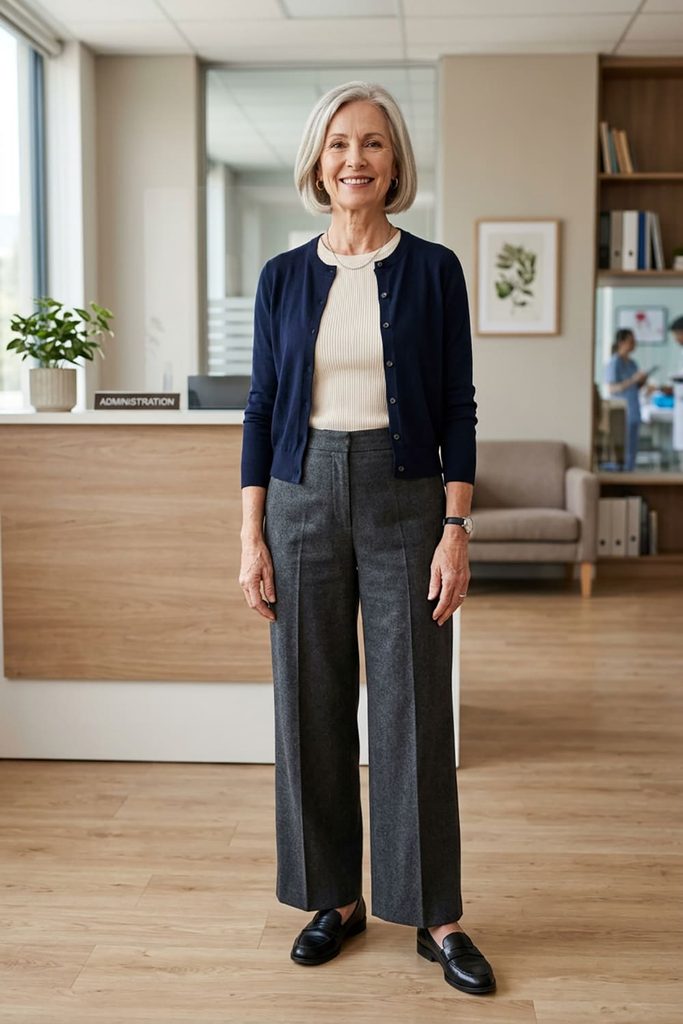
Wide-leg trousers can work well in office-based healthcare roles when the workplace permits them. Choose a moderate width rather than an extremely oversized silhouette.
Pair them with a fine-knit top that has enough structure to balance the fuller trousers. Cream, navy, charcoal, beige, and muted colors are particularly easy to coordinate. Add a short cardigan or lightweight jacket if necessary.
The main consideration is length. Trousers should not drag across the floor, particularly in a workplace where cleanliness and mobility are important.
For women who work in healthcare administration, medical education, scheduling, or other non-clinical roles, this combination offers a contemporary alternative to narrow trousers while remaining professional. If you move between clinical and office areas, follow your facility’s requirements regarding uniforms and protective clothing.
9. Monochromatic Gray Scrub Outfit
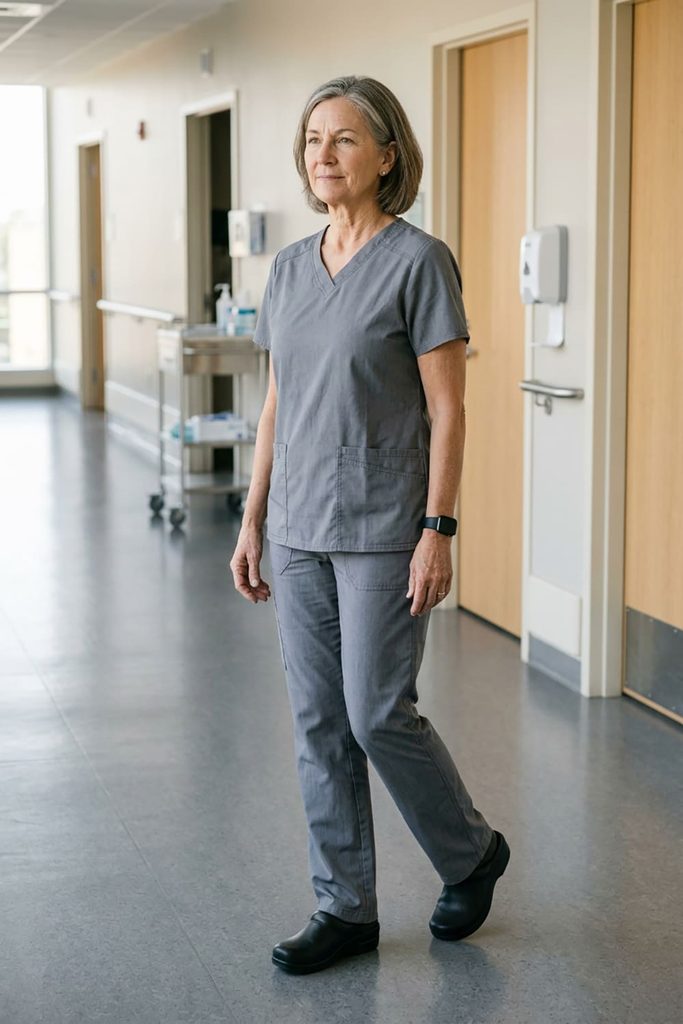
A monochromatic gray scrub outfit can create a neat, sophisticated appearance without compromising practicality. Choose a gray scrub top and trousers in similar but not necessarily identical shades. For example, medium gray trousers can be paired with a slightly lighter top.
The tonal approach keeps the outfit simple and coordinated. It can also make it easier to add an approved undershirt or jacket without creating too many competing colors.
Choose a fit that allows unrestricted movement. Healthcare workers may need to bend, kneel, reach, push equipment, and assist patients, so garments should accommodate those actions comfortably.
Keep personal accessories restrained. In clinical environments, workplace policies regarding jewelry, watches, sleeves, and other items may be more important than fashion preferences. Hand hygiene and appropriate PPE remain essential regardless of how coordinated the uniform looks.
10. Olive or Deep Green Scrubs With a Neutral Undershirt

If your workplace permits olive, forest green, or another deep green uniform shade, it can provide a sophisticated alternative to navy or gray. Pair the scrub set with a neutral undershirt if permitted.
Cream, black, gray, or white can create different effects, although the undershirt should comply with your facility’s uniform policy. Choose a scrub top with practical pockets and a neckline that stays comfortable throughout the shift. The trousers should have enough room for movement without excessive fabric.
This outfit is particularly useful for women who prefer earthy colors and want a little variety in their weekly clinical wardrobe.
Because healthcare uniforms are often washed frequently, prioritize durable construction and fabrics suitable for your workplace’s laundering process rather than choosing solely by appearance.
11. Tailored Trousers With a Long Cardigan
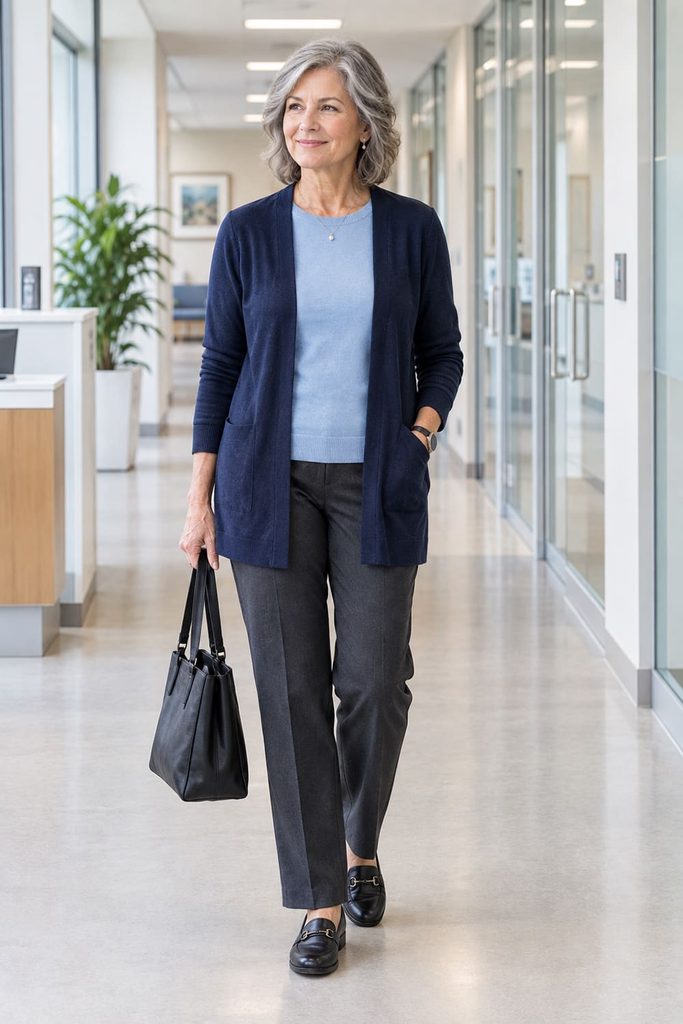
A long cardigan can create a polished healthcare-office outfit without the stiffness of a traditional blazer. Start with tailored straight-leg trousers and a simple blouse or knit top. Add a cardigan that falls around the hip or upper thigh.
Navy trousers with a cream top and gray cardigan make a classic combination. Alternatively, try charcoal trousers with a pale blue top and navy cardigan. This outfit can work for nurse managers, healthcare administrators, reception teams, medical educators, and other professionals whose dress codes allow business casual clothing.
Choose a cardigan that does not have excessively loose sleeves or dangling details, particularly if you spend time in clinical areas. If you will be providing direct patient care, change into the appropriate uniform and PPE according to workplace requirements.
12. Scrub Top With Stretch Straight-Leg Trousers
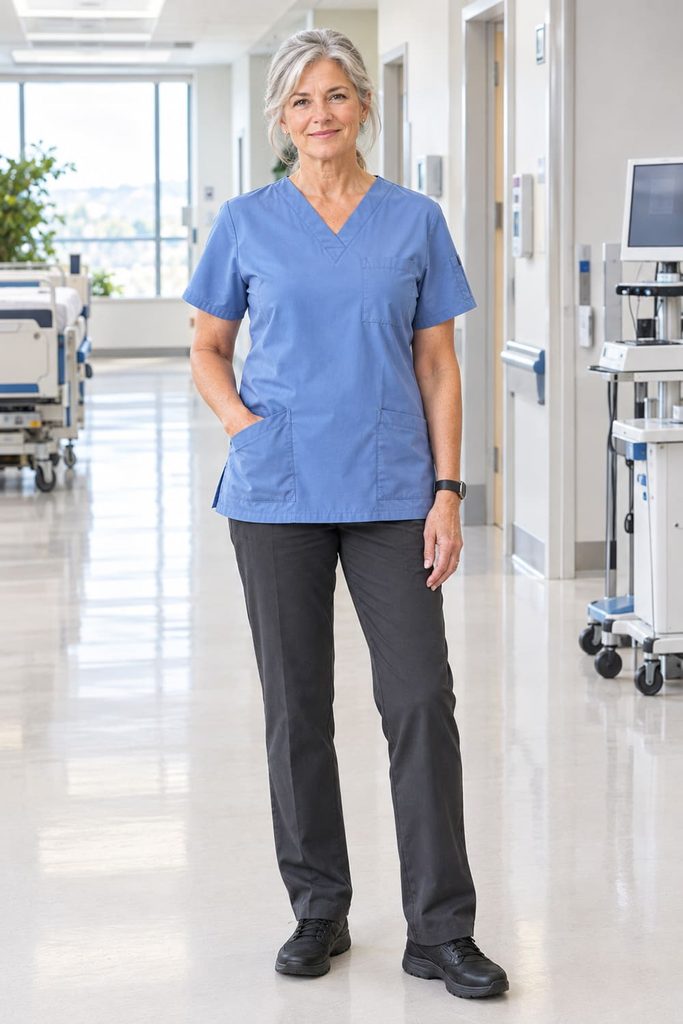
For healthcare workers who have some flexibility in choosing their uniform pieces, a scrub top with comfortable stretch trousers can provide a useful combination.
The trousers should still meet the requirements of the workplace. Choose a straight or gently tapered leg that allows movement without creating excessive fabric around the ankles. Pair a solid-colored scrub top with a complementary neutral bottom.
This outfit can be especially practical for women who dislike extremely loose scrub trousers but still need a uniform that allows constant movement. Look for stretch that supports mobility rather than garments that feel excessively tight. A healthcare worker may need to bend deeply, sit on a low chair, assist a patient, or move quickly across a room.
Fit is therefore a functional consideration, not simply a style preference. Protective clothing guidance also identifies comfort, ergonomics, durability, and garment size as important factors when selecting healthcare protective apparel.
13. Black Trousers With a Jewel-Tone Blouse
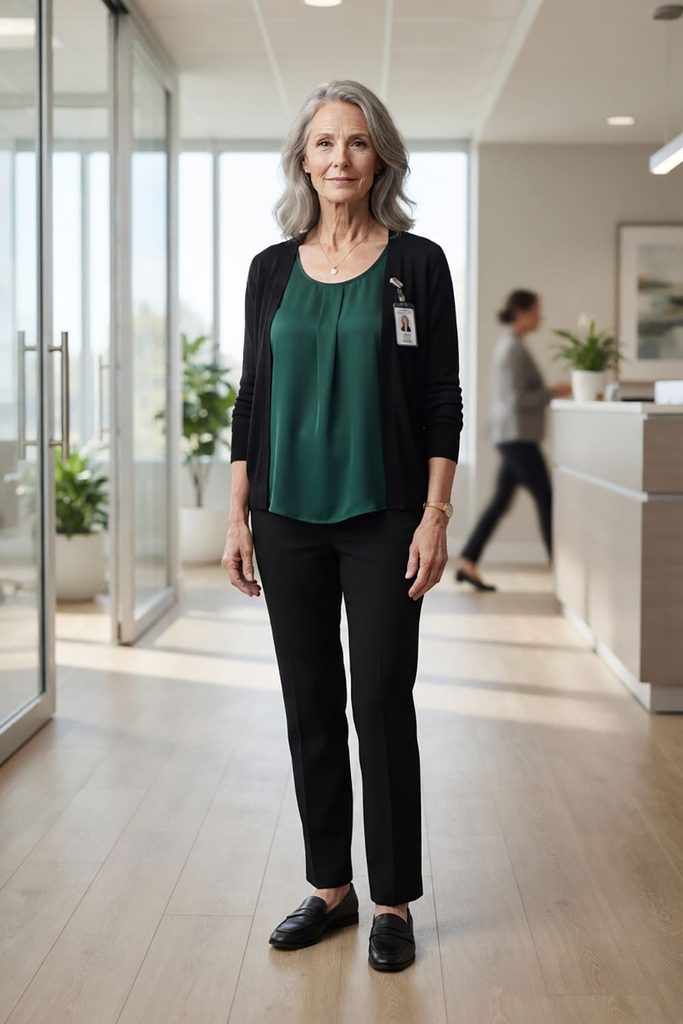
For healthcare professionals working in administrative, consultation, or office-based settings, a jewel-tone blouse can bring color into a traditional work wardrobe. Try a deep blue, burgundy, emerald, or plum blouse with straight black trousers.
Keep the blouse relatively simple and choose a fabric that allows comfortable movement. A soft blouse with a modest neckline can look polished without feeling as formal as a traditional suit shirt. Add a lightweight cardigan or simple jacket if required.
This outfit is particularly useful for meetings, presentations, professional development days, or occasions when you want to look more formal than you would in everyday clinical clothing. Simple flats or loafers provide a practical finishing touch.
14. Coordinated Scrub Set With a Contrasting Jacket
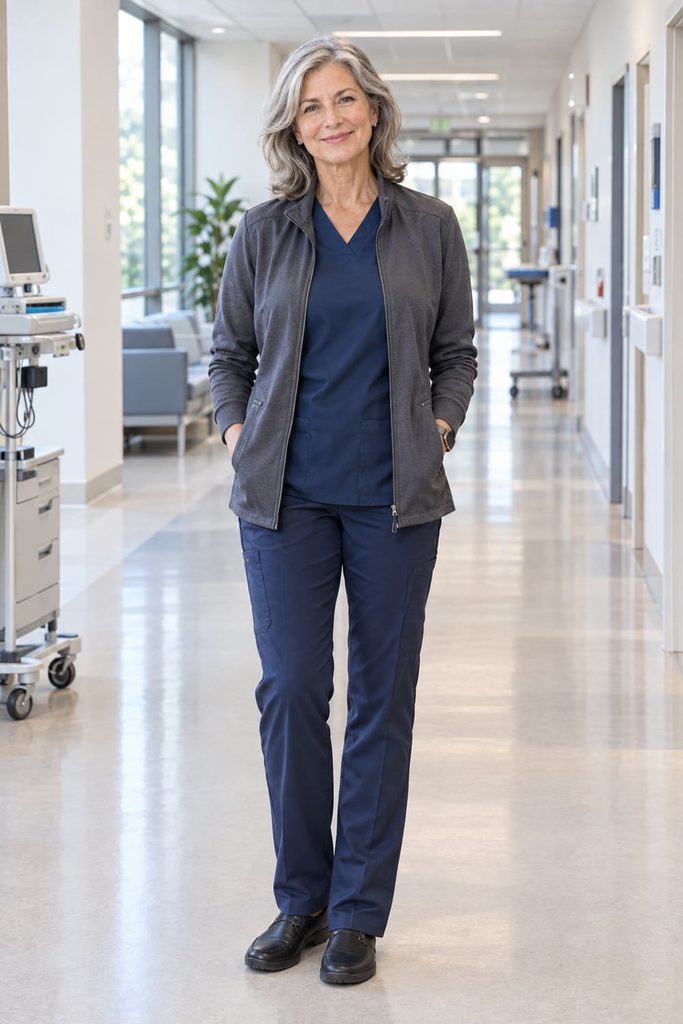
A coordinated scrub set can become more versatile when paired with a contrasting but approved jacket. For example, navy scrubs can be worn with a charcoal jacket, while gray scrubs can work with a navy layer. If your employer specifies particular colors, those requirements should take precedence.
The jacket should allow full arm movement and should not interfere with gloves, gowns, or other protective equipment when those are required.
This matters because protective clothing is an ensemble. CDC guidance notes that garments should be considered in relation to other PPE and that interfaces between sleeves, gloves, collars, and other protective equipment can affect overall protection.
For a woman over 50, a well-fitting jacket can also provide a more structured appearance without requiring an uncomfortable fit.
15. Smart Neutral Outfit With a Colorful Scarf for Healthcare Offices

For healthcare workers who spend most of their day in a non-clinical office, a neutral outfit with one colorful accessory can create an elegant and understated appearance. Try charcoal trousers with an ivory knit top and a scarf featuring muted blue, burgundy, green, or plum.
The scarf can be removed easily if you move into an area where it is not appropriate. Keep accessories minimal and follow your facility’s rules when entering patient-care environments.
This outfit is particularly useful for healthcare administrators, nurse educators, consultants, reception professionals, and other roles where conventional professional clothing is permitted.
The neutral foundation makes the outfit easy to repeat with different scarves or cardigans, which can reduce the number of separate pieces needed in the wardrobe.
Choosing Comfortable Healthcare Workwear After 50
Comfort becomes especially important when clothing is worn through long shifts. A healthcare professional may spend considerably more time standing and walking than someone with a conventional desk job.
Start with fit.
A garment should allow you to reach forward, raise your arms, bend your knees, sit, and walk without pulling or restricting movement. At the same time, excessively loose clothing can catch on equipment or interfere with movement.
Fabric matters as well. Look for materials that can tolerate the cleaning and laundering routine required by your workplace. Healthcare garments may need frequent washing, and some clinical environments require specific handling of contaminated or visibly soiled clothing.
A few useful questions to ask before purchasing workwear include:
- Can I move my arms freely?
- Can I bend and sit comfortably?
- Does the waistband remain comfortable after several hours?
- Can the fabric withstand frequent washing?
- Does the garment fit underneath required PPE?
- Are the sleeves practical for my work?
- Can I walk comfortably in the shoes for an entire shift?
- Does the clothing comply with my employer’s dress code?
- Can I easily replace the garment if it becomes heavily soiled?
These questions are more useful than judging an outfit only by how it looks in a changing room.
Why Footwear Matters in Healthcare
Footwear deserves special attention for nurses and other healthcare professionals who spend much of the day on their feet.
A stylish shoe that becomes painful after several hours can affect the entire workday. Choose footwear based on the requirements of your role and workplace.
Closed-toe footwear may be required in some healthcare environments. Some situations also call for washable footwear or specific protective characteristics. For example, CDC guidance for certain high-risk PPE situations describes footwear as closed-toe, soft-soled, washable, and closed-back. Requirements vary by setting, so workplace policy should determine what you wear.
Look for shoes that provide a stable base and enough room for your toes. If you work long shifts, consider keeping an additional pair available so you can change when appropriate. Neutral colors such as black, navy, gray, and white are easy to coordinate with most uniforms.
Layering for Hospitals and Clinics
Healthcare buildings can have very different temperatures from one area to another. A hospital corridor may feel different from a consultation room, nurses’ station, break room, or office. Layers can help, but they need to be appropriate for the environment.
A facility-approved scrub jacket is generally more useful for clinical work than a bulky sweater. For office-based roles, a cardigan or lightweight blazer may provide additional comfort. Avoid layers with loose components that could interfere with patient care or equipment.
Most importantly, a personal cardigan or jacket should never be treated as a replacement for required PPE. PPE selection depends on the anticipated patient interaction and exposure risk.
Building a Practical Healthcare Wardrobe
A useful wardrobe depends on your exact healthcare role. A bedside nurse may need several sets of approved scrubs, comfortable clinical shoes, undershirts where permitted, and facility-approved layers. A nurse manager may need a mixture of scrubs and professional clothing. A healthcare administrator may need mostly business casual outfits.
For a clinical wardrobe, consider starting with:
- Three to five approved scrub sets
- Two or three approved undershirts
- One or two appropriate jackets
- Two pairs of comfortable work shoes
- A practical work bag
- A small selection of approved accessories
For an office-based healthcare wardrobe, consider:
- Two pairs of tailored trousers
- One pair of comfortable wider-leg trousers
- Three or four professional tops
- Two cardigans
- One lightweight blazer
- One or two simple dresses
- Comfortable loafers or flats
The exact number depends on your schedule, laundering routine, and workplace requirements.
Dressing for Long Shifts
Long shifts call for clothing that remains comfortable for hours rather than pieces that look impressive for only a short period.
Avoid waistbands that become uncomfortable after sitting or standing for extended periods. Avoid sleeves that restrict arm movement. Avoid shoes that feel fine for twenty minutes but become painful after several hours. A simple outfit can often work better than an elaborate one.
For example, a well-fitting scrub set, comfortable shoes, an approved jacket, and minimal accessories may be more practical than adding unnecessary layers and decorative pieces.
Healthcare work already demands considerable attention. Your clothing should make your day easier rather than give you another problem to manage.
Keeping Personal Style in a Healthcare Wardrobe
Practical clothing does not mean giving up personal style. Color is one of the easiest ways to make a healthcare wardrobe feel personal. If your uniform policy allows it, rotate between navy, burgundy, gray, green, blue, or other approved shades.
You can also pay attention to silhouette. Some women prefer straight-leg trousers, while others feel more comfortable in gently tapered or wider styles. For non-clinical roles, blouses, dresses, cardigans, and tailored trousers offer even more possibilities.
The important point is to work within the boundaries of your professional environment. In healthcare, infection prevention, patient safety, PPE requirements, and workplace policies take priority over fashion preferences. Protective garments should be selected according to the anticipated exposure and task rather than simply by appearance.
Conclusion
Workwear for women over 50 in healthcare or nursing needs to balance comfort, mobility, professionalism, and the practical demands of patient care. The right outfit can help you feel put together without making a long shift more difficult.
Scrubs remain the foundation for many clinical roles, and they can still offer plenty of variety through color, fit, approved layers, and practical accessories. For women working in healthcare offices, administration, education, management, or other settings where conventional clothing is permitted, tailored trousers, knit tops, blouses, dresses, and cardigans provide additional options.
The most important consideration is not whether an outfit looks fashionable for a few minutes. It is whether the clothing continues to work after several hours of walking, standing, bending, sitting, and helping others.
Choose garments that fit properly, allow movement, withstand the demands of your work, and follow your facility’s uniform and PPE requirements. With those foundations in place, women over 50 can build a healthcare wardrobe that feels polished, practical, comfortable, and genuinely suited to the work they do.


