

15 Basement Apartment Living Room Ideas That Feel Bright, Not Gloomy
A basement apartment living room starts with three handicaps no paint colour alone can fix: windows that sit small and high near the ceiling, a ceiling that sits low, and a concrete floor that stays cool and can hold moisture. Treat it like an ordinary dark room and it stays gloomy. Treat it like a below-grade room with its own rules, and it can feel genuinely bright, dry and welcoming.
If your dark room is above ground, with full-size windows facing the wrong way, our guide to living room ideas for dark rooms covers that properly. This post is different on purpose: every idea answers a basement reality, from window wells to landlord limits on drilling. Needing dining space too? These living room dining room combo ideas for small apartments pair well with the zoning here.
Read the ground rules first, then work through the fifteen ideas in order: colour and flooring, light borrowed and added, furniture scaled to the ceiling, and habits that keep the flat fresh rather than musty.
The Basement Ground Rules: Light, Moisture and Ceiling Height
Basement light arrives from above and one side only. Small high windows throw a band of daylight across the upper wall, then leave seating level in shade, so catch that light high and bounce it down: pale ceilings, mirrors opposite the windows, lamps at several heights. Never block a window top with tall furniture — up there is where your daylight lives.
Moisture is the second rule. Basement air is cooler and heavier, and anything soft sitting directly on concrete can turn musty. Choose moisture-proof flooring, raise furnishings on legs, leave a small air gap behind furniture on outside walls, and run a dehumidifier as routine, not emergency.
Ceiling height is the third. Basement flats give you less headroom than the floors above, often with beams or boxed-in pipes. Measure the lowest point — under a beam, not beside it — and let that number set the height of everything you buy.
1. Paint the Walls and Ceiling One Warm Light Colour
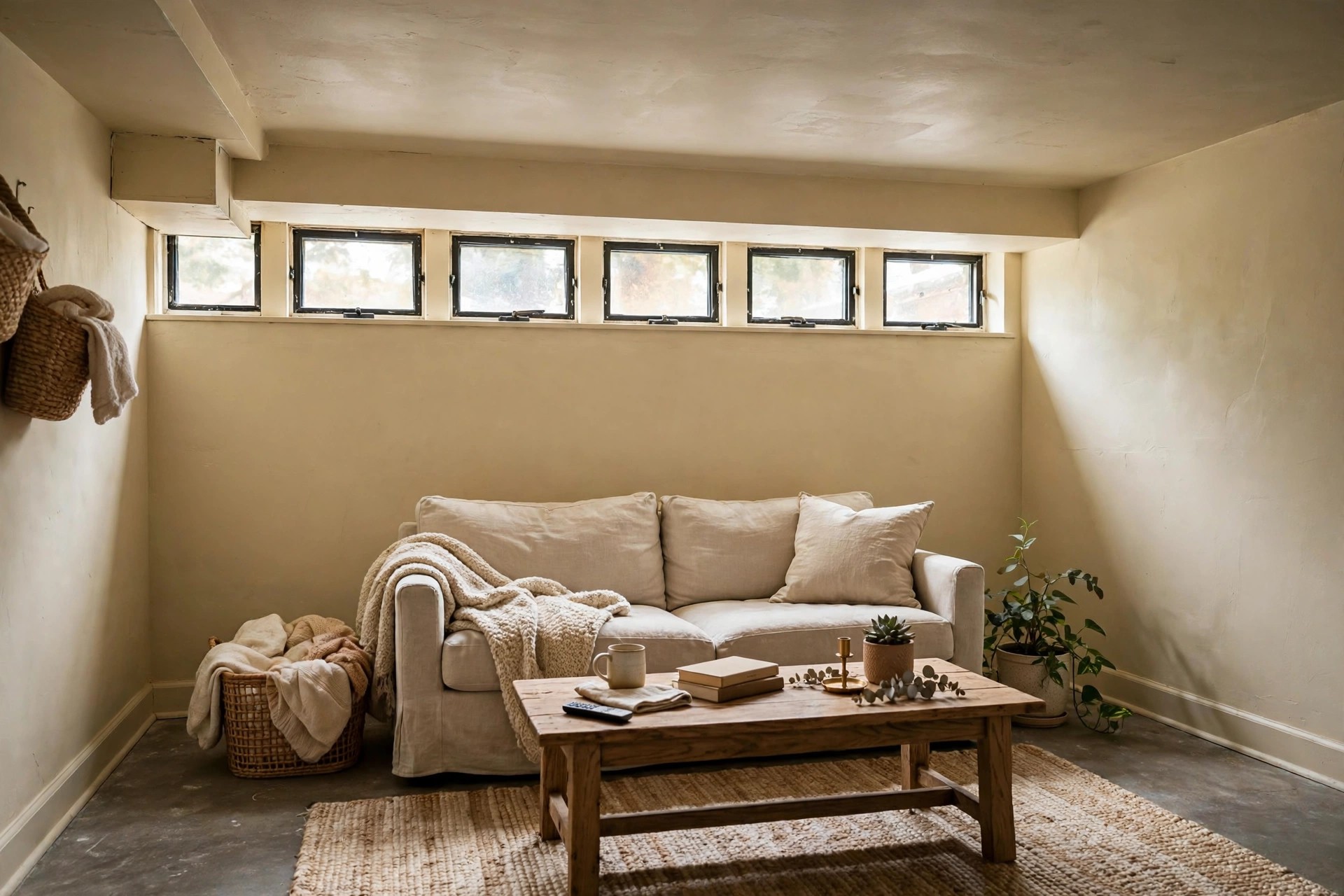
A contrasting ceiling draws a hard line exactly where the room is already shortest, and a dark ceiling presses down. Painting walls and ceiling one continuous warm, pale colour — soft warm white, pale stone, very light greige — blurs that line, so the eye cannot find where wall ends and low ceiling begins.
The warmth matters as much as the lightness: basement daylight arrives cool and grey, and a warm undertone corrects it on contact. Carry the colour over beams and pipework so they recede, keep the finish matte, and ask your landlord first — many agree to a light neutral in writing.
2. Choose Moisture-Proof Flooring You Can Lay Over Concrete

Bare concrete is cold, dusty however often you sweep, and quick to show damp patches. Luxury vinyl planks are the basement standard: waterproof rather than merely water-resistant, warm in wood-effect tones, and laid floating with click-together boards — no adhesive, landlord-friendly, and liftable when you leave.
Use a proper membrane underlay suited to concrete to block rising cool and damp. Avoid solid wood and ordinary laminate on a basement slab, which can swell with moisture, and skip wall-to-wall carpet, which traps damp against the concrete and is almost impossible to dry after a leak.
3. Layer Lighting Around the Edges Since the Windows Are Small
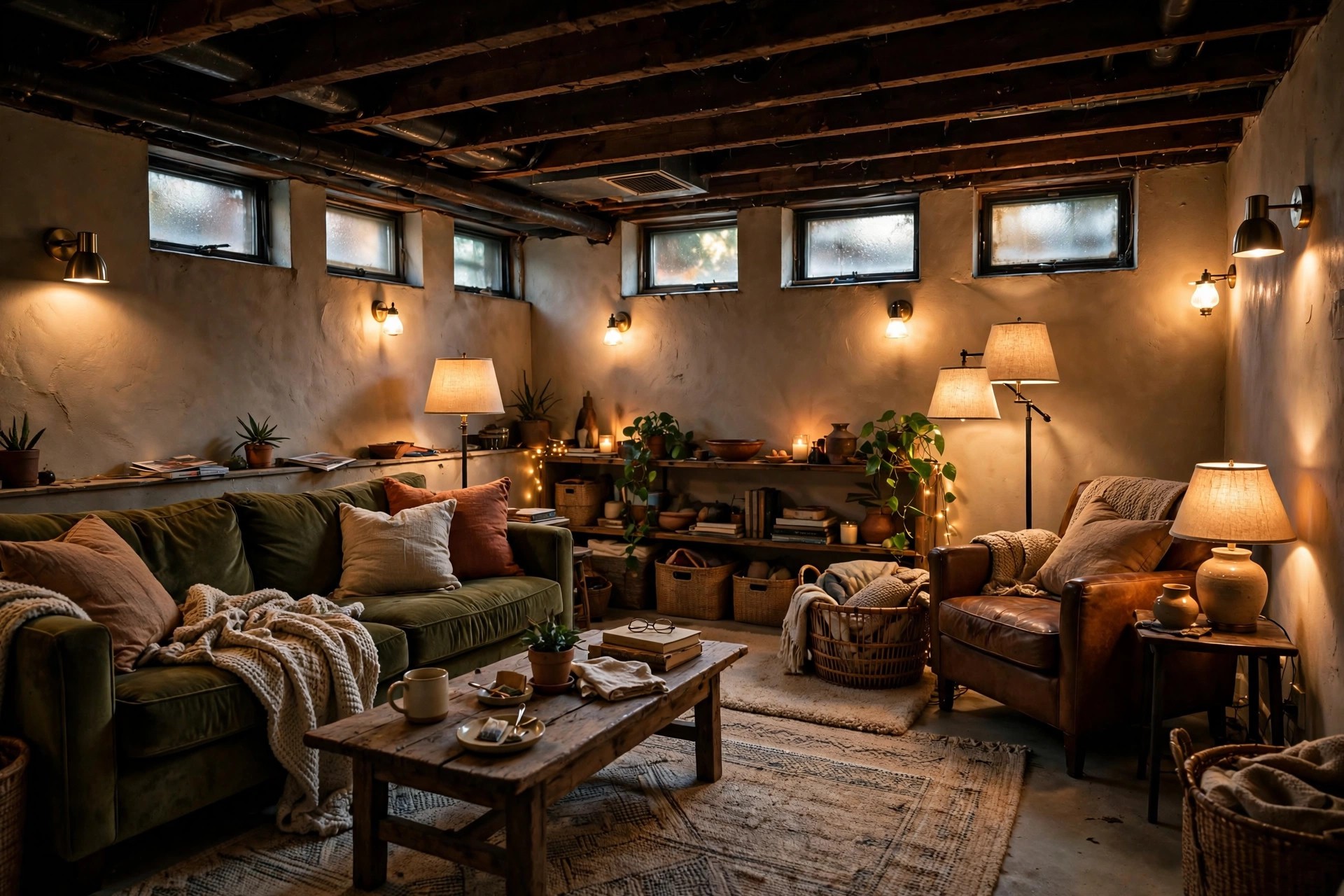
One central ceiling light flattens everything, shadows the corners, and leaves the room’s ends dark because the small windows cannot help. Layer light around the edges instead: a floor lamp in the far corner, table lamps at both sofa ends, a small lamp on a low unit — pools of light at sitting height.
Place lamps where window light fades first: the opposite wall and the corners furthest from the window wells. Renting and cannot rewire? Plug-in lamps do the same job; our renter-friendly living room ideas collect more no-rewiring swaps.
4. Dress Small High Windows With Curtains Hung Wide and High

Basement windows are often short, wide rectangles just under the ceiling, sometimes opening onto a window well at pavement level. A short curtain covering exactly the glass advertises how small the window is. Hang curtains wide instead, the pole extending well beyond the frame, so open curtains sit on the wall and every centimetre of glass works.
Hang them high, the track close to the ceiling, and end the fabric at the sill rather than pooling it on a cool floor. Choose light, loosely woven fabric for privacy from the pavement without losing daylight. Banned from drilling? Tension rods keep it reversible.
5. Pick Low-Profile Furniture That Suits a Low Ceiling
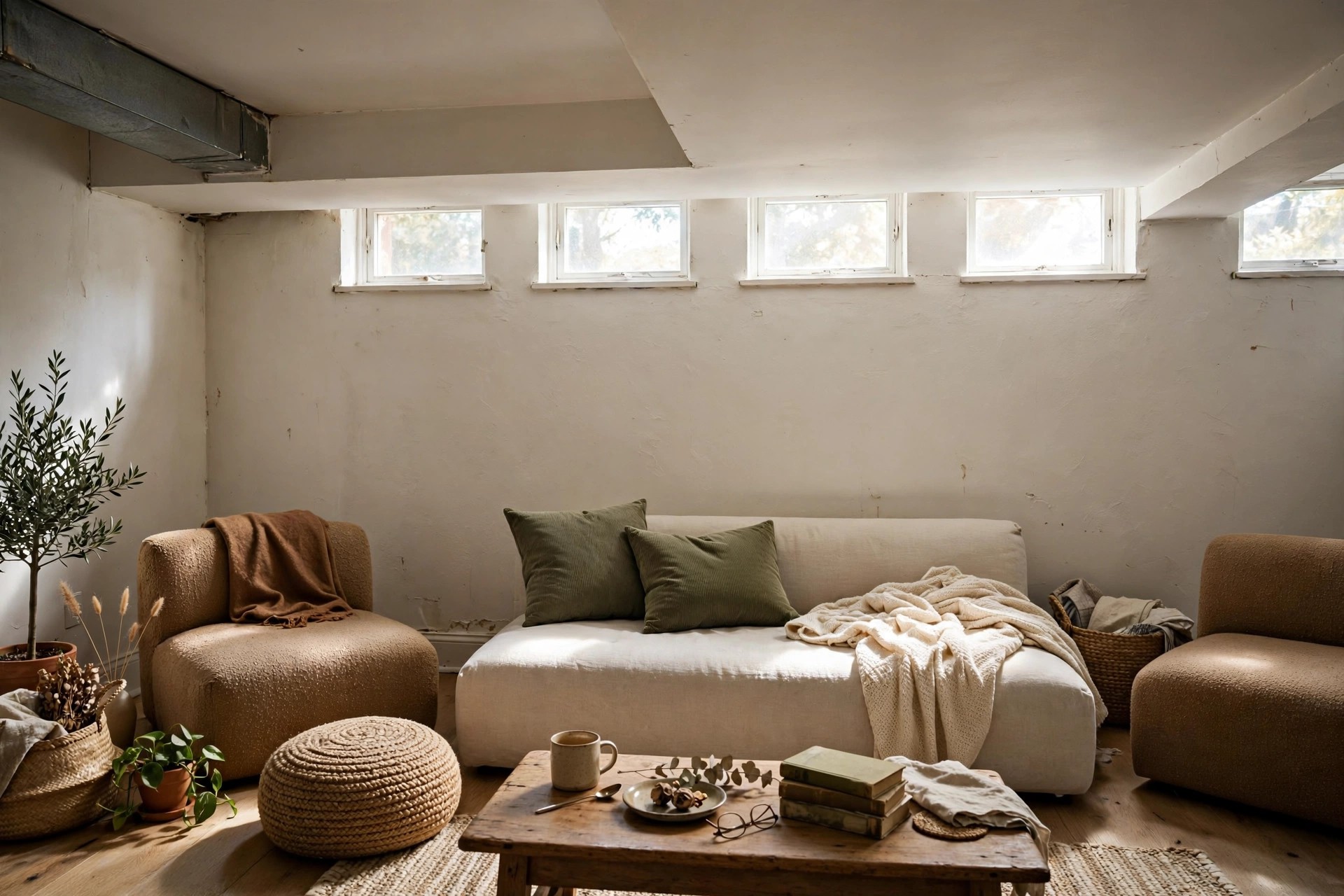
Furniture scaled for standard rooms looks oversized under a basement ceiling, and a tall-backed sofa crowds the small windows too. Choose low-profile pieces: backs well below the window sills, slim arms, seats slightly lower than standard. The breathing space above the seating line stops the ceiling feeling as if it is descending on you.
Storage follows the same rule. One long, low unit beats a tall bookcase stopping awkwardly near the ceiling. Stop shelving a clear margin below the lowest beam, and keep its top nearly empty — clutter against the ceiling line makes the room feel shorter.
6. Keep Soft Furnishings Off the Floor and Easy to Air

A skirted sofa sitting flat on the floor is harmless upstairs; in a basement it is a damp trap. Cool air settles at floor level, concrete can sweat, and fabric touching the floor wicks moisture and turns musty. Choose sofas and chairs raised on legs, high enough to vacuum and air underneath.
Make airing a habit: stand cushions on end by the window on dry days, open windows for through-air when weather allows, and leave a few centimetres behind the sofa on an outside wall. Furniture tight against a cold external wall is where basement mould quietly starts.
7. Give a Dehumidifier a Planned Home in the Layout

A dehumidifier dragged into the middle of the room whenever the air feels heavy always looks like an appliance on loan. Plan its home instead: beside a low unit, near the coldest outside wall and a socket, with clear space around its vents and an easy route for emptying the tank.
Run it regularly rather than waiting for a musty smell — that dryness protects your flooring, rug, sofa fabric and books. Keep its filter clean, keep soft furnishings out of its direct airflow, and if it hums, place it away from the main seat.
8. Set Mirrors Opposite the Windows to Double the Daylight

With windows this small, every shaft of daylight must work twice. A large mirror opposite catches the light band the high windows throw across the room and sends it back at seating level, brightening faces and far corners at once. Hang it roughly opposite the window’s centre, and check from the sofa you see reflected window, not ceiling.
One generous mirror beats a cluster of small ones, which chop light into glitter. Keep the frame slim and pale, and never place a mirror where it reflects a bare bulb or the television — that trades daylight for glare.
9. Define the Seating Zone With One Pale, Open Rug

Hard flooring is practical but can leave a basement echoey and unfinished. One pale rug under the seating warms the floor where bare feet land, absorbs the hollow sound hard floors bounce around a low ceiling, and draws a boundary around the living area. Warm cream or pale oatmeal lifts the room’s largest low surface.
Choose construction for the basement: a low, flat weave dries faster and traps less damp than deep pile. Size it for the sofa’s front legs, and leave hard floor visible around the edges — that border is your inspection strip, the first place damp would show.
10. Keep the Centre of the Room Clear for Air and Light

Basement rooms tempt you to fill the middle because the walls feel spoken for. Resist it. A clear centre lets limited daylight travel the room’s full depth instead of dying on a chair back, and lets air move freely — which below-grade rooms need most. Push seating to the edges and choose a light, low coffee table.
The payoff is practical too: floor space for stretching, a play mat or an airer without dismantling the room. Sharing with a cat? These hidden litter box ideas for small apartments sit inside furniture, not the room’s middle.
11. Use Plug-In Sconces and No-Drill Fixes Your Landlord Allows
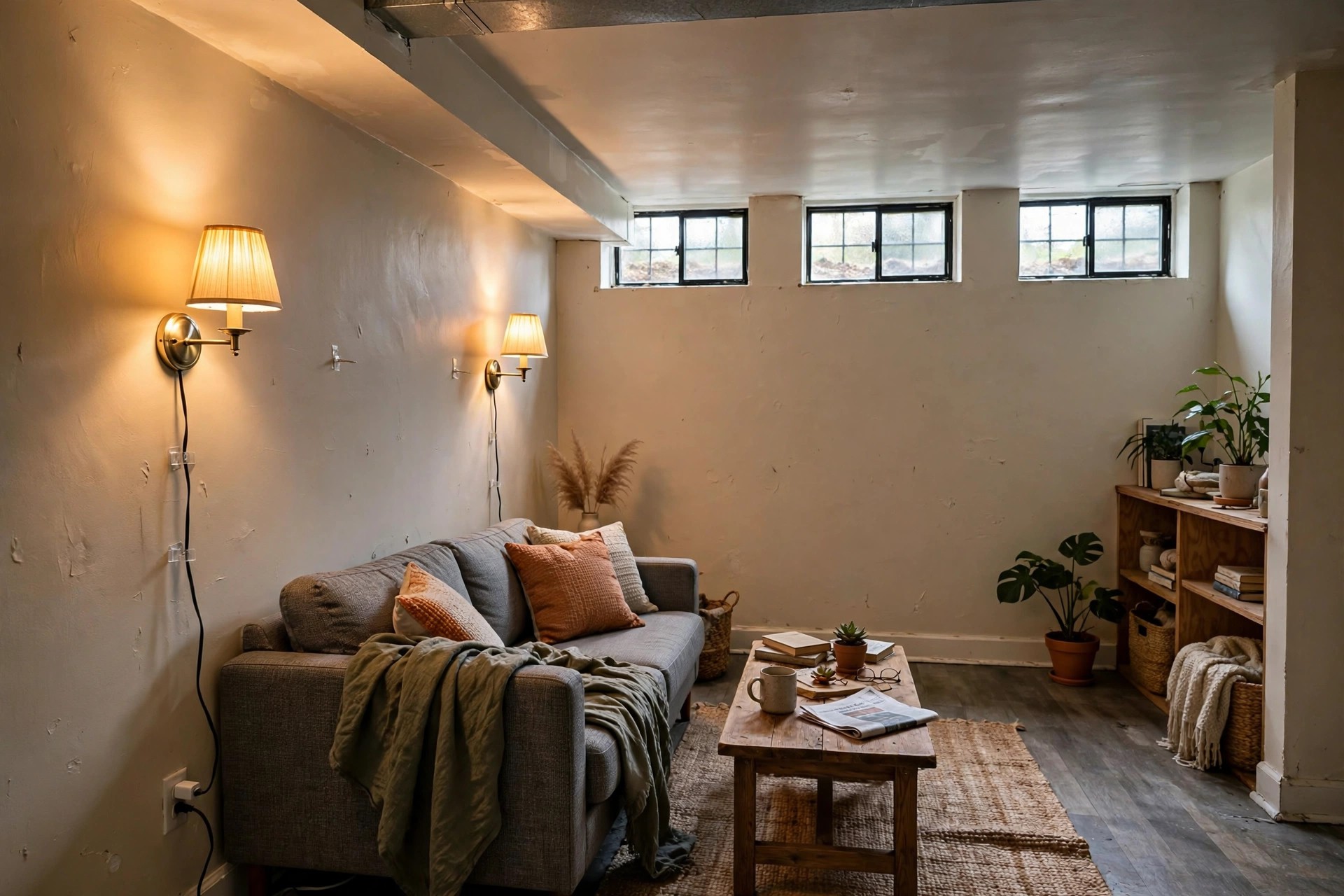
Most basement flats are rentals, and landlords draw the line at wiring and drilled holes — especially in external walls, where fixings can affect damp-proofing. Plug-in sconces are the workaround: one small fixing or adhesive pad, an ordinary socket, and light at the mid-wall height basement rooms lack. Hide cords in a paintable cover strip.
Extend the thinking everywhere: adhesive hooks for art, tension rods for curtains, freestanding shelves for books. Photograph walls before you start. Our tiny apartment living room ideas offer more small-footprint, tenancy-safe swaps.
12. Choose Warm Bulbs to Counter Cool Basement Light

Daylight reaching a basement has usually bounced off a window-well wall or neighbouring building, arriving cool, blue-grey and flat. Cold white bulbs double that chill, draining skin, wood and fabric. Warm bulbs undo it: choose warm white throughout, and keep every lamp the same warmth so layers blend into one glow.
Swap bulbs in matched sets — one leftover cool bulb in a corner undoes the rest — and favour fabric or frosted shades that soften light sideways. In the evening, when windows contribute nothing, that warm glow is the room’s whole atmosphere.
13. Bring In Low-Light Plants by the Window Wells
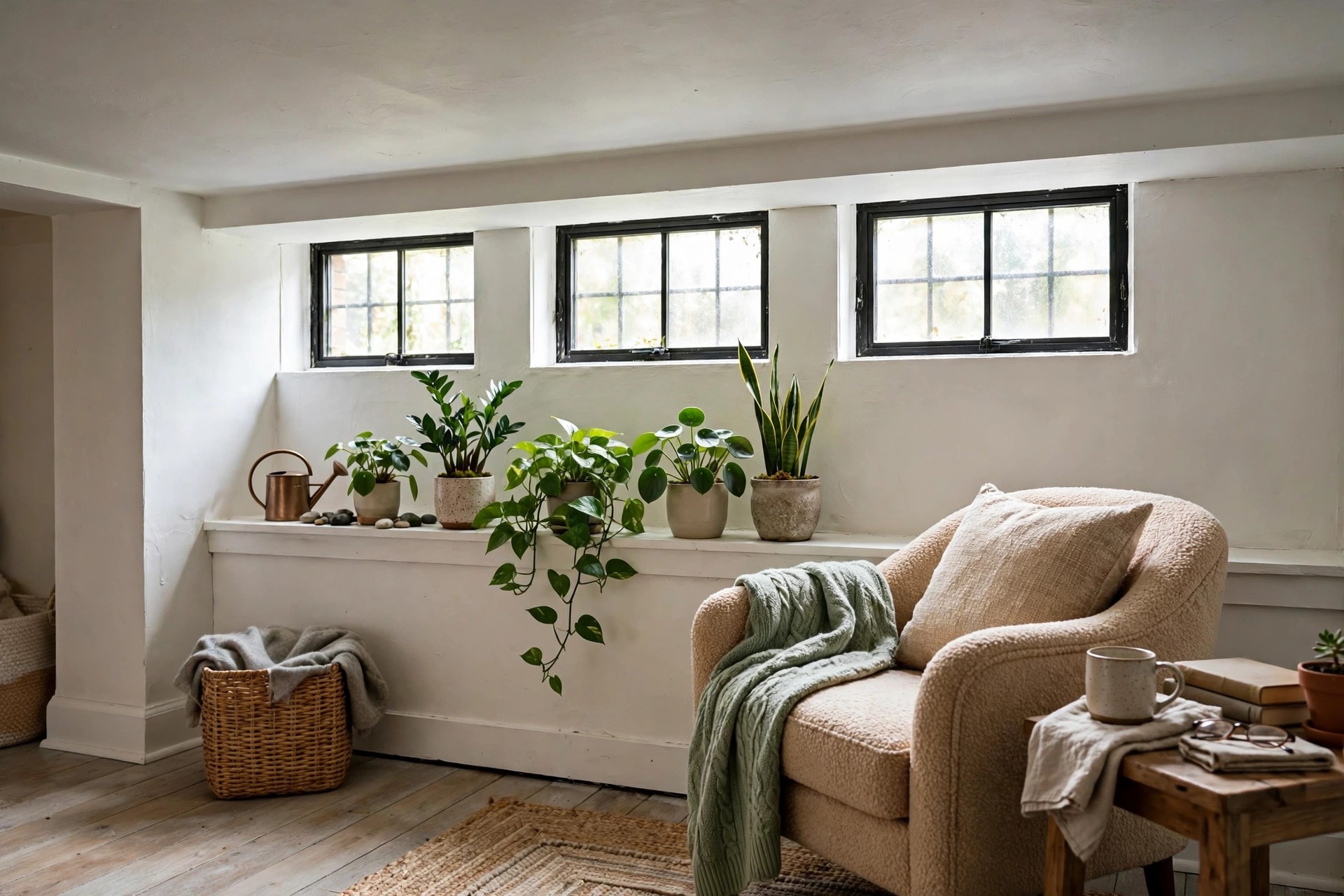
A basement can feel sealed off from outdoors, and plants break that feeling fastest — in the right place. Put them where light actually is: on the sill or a shelf directly beneath the high windows and window wells, not the dim centre where even tough plants fail. Choose low-light varieties and group two or three together.
Raise pots on stands or the sill — pots on the floor can hide damp and mark hard flooring — and use saucers. Rotate each plant regularly so it grows evenly toward the window, and wipe dust from leaves: in low light, a dusty leaf works with even less.
14. Layer Throws and Cushions to Fight the Basement Chill
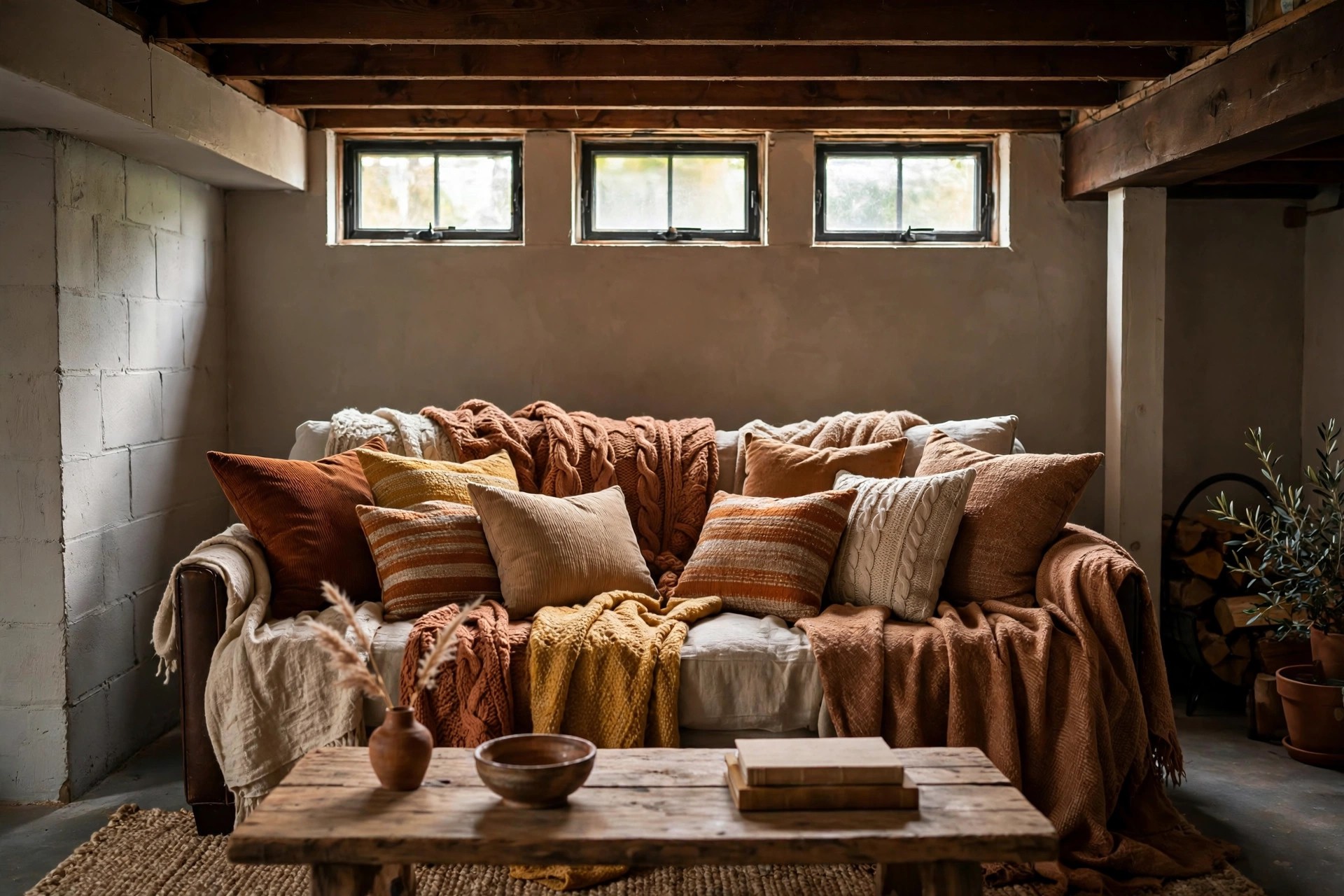
Even a heated basement carries background coolness upstairs rooms lack: walls against earth, floor on concrete, still air settling cold. Throws and cushions counter it twice — as insulation you wrap around yourself, and visually, because warm layered textures make a room read cosy instantly. Keep one throw on the arm nearest the coldest wall.
Choose breathable fabrics in warm pale tones — cream, soft rust, warm taupe — so layers warm without darkening. Pick washable covers, since basement textiles pick up mustiness, and store spares in a closed box off the floor.
15. Zone a Media Corner With a Low Unit That Stays Under Ceiling Lines

Give the television a deliberate home instead of letting it dictate the room. A low media unit, in a corner or on the wall furthest from the windows where glare is least, keeps screen and speakers below the room’s strong lines — window tops, beam edges, ceiling. A tall unit reaching upward makes one end feel as if it is closing in.
Seat viewing chairs opposite, keep the door-to-sofa route clear across the screen’s front, and hide cables behind the unit. One zoned corner leaves the rest of the room free for daylight, conversation and air.
Common Mistakes to Avoid
1. Blocking the small windows with tall furniture. A bookcase or high-backed sofa in front of a high basement window steals the room’s only daylight at its source. Keep everything beneath the windows low, and treat the glass and wall around it as untouchable.
2. Laying carpet or soft furnishings directly on the concrete. Carpet, deep-pile rugs and floor cushions on a basement slab trap cool damp underneath and turn musty long before they look dirty. Use moisture-proof hard flooring, a low washable rug, and furniture raised on legs.
3. Lighting the room with one cold ceiling bulb. A single cool overhead light flattens a low ceiling, leaves corners black and makes the room feel like a store room. Layer warm light around the edges at sitting height instead.
Frequently Asked Questions
How do you make a basement apartment living room feel brighter?
Paint walls and ceiling one warm pale colour, keep the small high windows unblocked, bounce their daylight across with a mirror opposite, and layer warm lamps around the edges. Pale flooring and a light rug lift the room’s lower half to match.
What flooring is best for a basement living room?
A waterproof, moisture-proof floor over the concrete with a suitable membrane — luxury vinyl planks are the common choice, laid floating without adhesive. Avoid solid wood, ordinary laminate and wall-to-wall carpet directly on a basement slab.
How do you stop a basement living room feeling damp?
Give a dehumidifier a permanent spot and run it regularly, keep soft furnishings raised on legs, leave an air gap behind furniture on outside walls, and air the room when weather allows. Recurring damp patches on a wall are a building issue to raise with your landlord.
Can you decorate a basement apartment if you rent?
Yes. Floating floors, plug-in sconces, tension-rod curtains, adhesive hooks, mirrors and low freestanding furniture are all reversible. Ask before painting, keep fixings removable, and photograph the room first so you can hand it back as found.
Final Thoughts
A basement living room feels bright when you decorate with its nature, not against it: light caught high and bounced low, floors and fabrics chosen for the concrete beneath them, furniture scaled to the ceiling above them. Get windows, moisture and headroom right, and below-grade stops meaning gloomy.


