

15 Rustic Brown Living Room Ideas That Bring the Outdoors In
There is a reason the most inviting living rooms so often feel like a cabin you never want to leave. Rustic brown living room ideas work because brown is the colour of the outdoors itself — tree bark, worn leather, river stone, wool fresh off the sheep — and when you build a room from those materials, it feels grounded in a way paint alone can never achieve. This is not a polished, showroom version of rustic. It is the real thing: rough-hewn beams, a stone hearth, furniture that looks better with every scuff and scratch.
The good news is that you do not need a log cabin or a mountain postcode to get this look. A single reclaimed beam, a well-worn leather sofa, or a wall of barnwood can shift an ordinary room toward the lodge end of the spectrum. Below you will find a complete guide to the rustic brown palette, followed by fifteen ideas that range from one-weekend projects to forever features — each one chosen to bring the outdoors in and keep the room feeling warm, honest, and lived in.
The Rustic Brown Palette: Wood, Stone, Leather, and Wool
Every successful rustic room starts with materials, not colour swatches. Think of the palette as four families of brown working together: the deep grain of wood, the cool weight of stone, the rich sheen of leather, and the soft matte of wool. Get those four right and the room almost decorates itself. If you have seen our guide to brown living room ideas for a modern farmhouse, you will notice this palette is rougher and more raw — where farmhouse smooths the edges, rustic leaves them splintered, cracked, and proudly imperfect.
The key skill is mixing wood tones without letting them fight. A reliable rule is to pick one dominant wood — say, the warm mid-brown of your floor or beams — then let everything else sit one or two shades lighter or darker, never exactly matching. Matching sets look manufactured; near-misses look collected over time. Repeat each tone at least twice so nothing looks like an accident. Stone should stay in the same temperature family as your wood: warm browns and rusts for fieldstone, cooler greys only if your woods lean grey-weathered too.
Finally, balance every rough surface with a soft one. For each expanse of stone or raw timber, add wool, linen, or sheepskin nearby to land on. That tension — hard against soft, dark against cream — is what keeps a rustic room feeling like a retreat rather than a cave, a balance we also explore in our traditional brown living room ideas if your taste runs more classic than cabin.
Idea 1: Exposed Reclaimed Wood Ceiling Beams
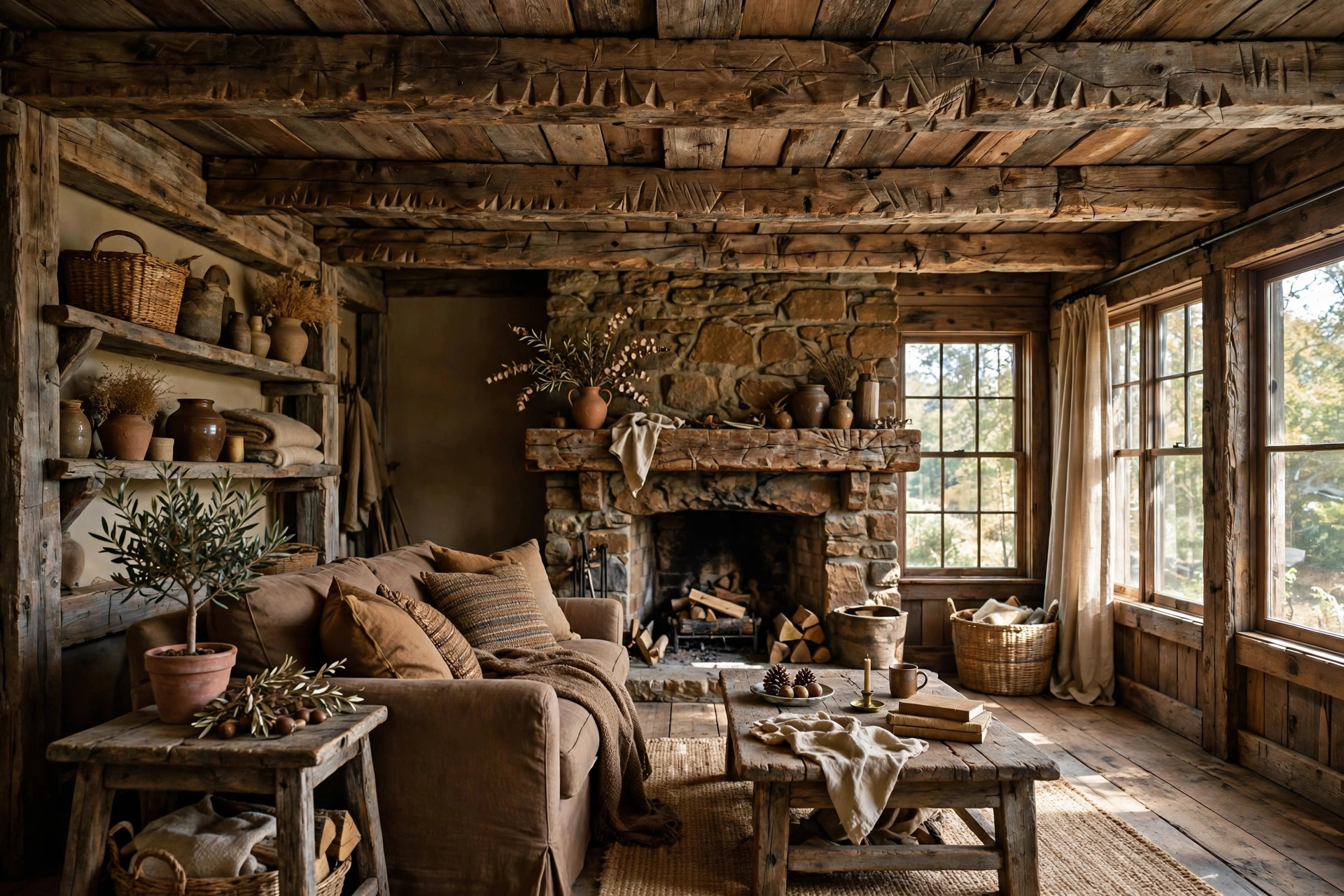
Nothing changes a room’s character faster than beams overhead. Reclaimed timber — salvaged from old barns, mills, and warehouses — carries saw marks, nail holes, and a silvered patina that new wood simply cannot fake. Even in a standard-height room, three or four beams stained in a warm mid-brown instantly suggest a structure that has stood for a century.
If genuine reclaimed beams are beyond the budget, hollow faux beams made from real weathered boards are a convincing stand-in and far easier to hang. Keep the finish matte, let the beams run the long direction of the room to stretch it visually, and resist adding too many: beams should feel structural, not decorative confetti.
Idea 2: A Floor-to-Ceiling Stone Fireplace With a Rough-Hewn Mantel
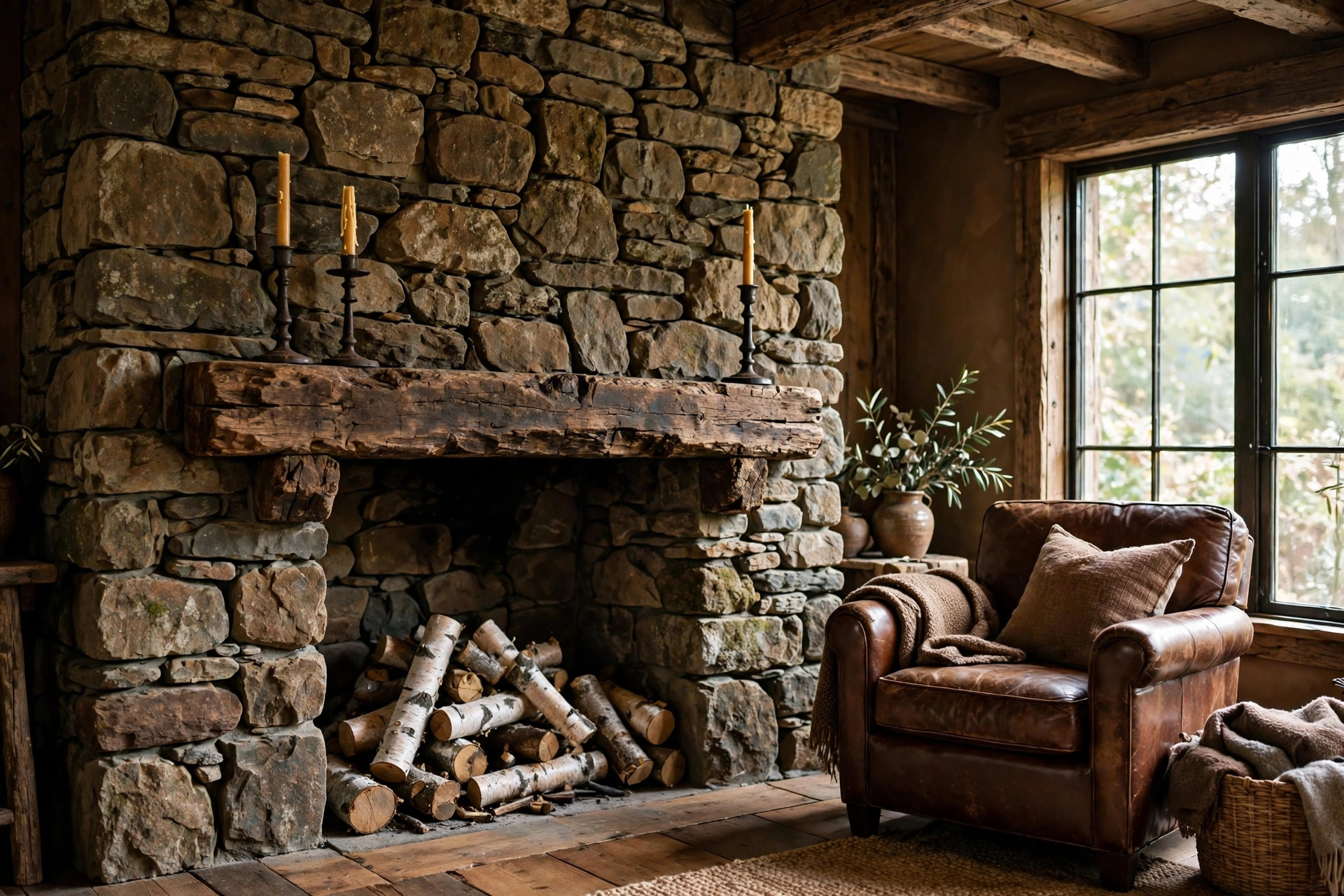
The stone fireplace is the beating heart of the rustic brown living room. Fieldstone, river rock, or stacked ledgestone in earthy browns, rusts, and warm greys gives the room a weight and permanence that anchors everything around it. Run the stone all the way to the ceiling if you can — the full-height treatment turns a fireplace into architecture.
Top it with a mantel cut from a single chunky timber, left rough-sawn with its edges slightly uneven. Style it sparingly: a pair of iron candlesticks, a small stack of books, perhaps a landscape painting in a worn gilt frame. A working fire is the dream, but even an unlit hearth dressed with birch logs and a woven basket of blankets reads as pure rustic comfort.
Idea 3: A Worn Brown Leather Sofa as the Anchor Piece

If rustic rooms have a uniform, it is the well-loved brown leather sofa. Full-grain leather in a cognac, chestnut, or chocolate tone deepens in colour where hands and bodies touch it, so the sofa literally improves with family life — the opposite of precious upholstery you are afraid to sit on. It is also the natural partner for wood and stone, echoing their organic origins.
Choose a relaxed silhouette: low arms, deep seats, maybe a Chesterfield’s tufting if you like a lodge-library mood. Dress it with wool and linen cushions in cream, rust, and faded plaid rather than anything shiny. For more ways to build a scheme around this piece, see our dark brown couch living room ideas — the layering principles translate beautifully to a rustic setting.
Idea 4: A Reclaimed Barnwood Accent Wall

One wall clad in weathered barnwood gives you the cabin feeling without committing the whole room to timber. Each board is different — greyed here, honeyed there, stamped with decades of sun and rain — and that variation is the entire point. Install the planks horizontally for a classic barn rhythm, or vertically to make a low ceiling feel taller.
Put the barnwood behind the sofa or around the fireplace, then deliberately keep the other walls a warm, quiet cream so the wood wall stays the star. Source boards from a salvage yard if you can, and leave small natural gaps between planks rather than forcing a perfect fit. Warm lamplight raking across the grain at night is where this wall truly earns its keep.
Idea 5: A Live-Edge Wood Coffee Table

A live-edge coffee table brings the tree itself into the room: one edge follows the trunk’s natural curve, bark line and all, while the top is sanded just smooth enough for a mug. No two are alike, and that one-of-a-kind quality is exactly what rustic style celebrates. Oak, walnut, and acacia slabs all sit comfortably in the brown family.
Keep the base simple — blackened iron legs or sturdy wood trestles — so the slab does the talking. Style the top with restraint: a stack of books, a stoneware bowl, a small potted fern. Because the table is a strong organic shape, pair it with a structured sofa and a geometric woven rug to keep the arrangement feeling intentional rather than woodsy chaos.
Idea 6: A Cowhide Rug Layered Over Woven Jute

Layered rugs are the rustic floor’s signature move, and the classic pairing is a natural cowhide thrown at an angle over a large woven jute or sisal rug. The jute gives you coverage, texture, and a warm sandy-brown base; the hide adds an organic outline and a ranch-house authenticity that no patterned rug can imitate.
Choose a hide in the brown-and-white or tricolour range to echo your palette, and let its irregular edge soften the straight lines of the sofa and coffee table — that contrast is what makes the layering look relaxed instead of staged. The combination is also practical: jute hides a multitude of crumbs and paw prints, and the hide wipes clean. Anchor the arrangement with the front legs of your seating resting on the rugs.
Idea 7: Chunky Wool Throws, Plaid, and Honest Knit Layers

Rustic comfort is something you can touch. Drape a chunky hand-knitted throw over the sofa arm, fold a brown-and-cream plaid wool blanket across the back, and pile cushions in nubby weaves — bouclé, raw linen, a little sheepskin — rather than anything smooth or shiny. These layers do the same work as a fire on a cold night: they make the room feel like it is looking after you.
Keep the colours inside the palette — cream, camel, rust, deep forest, and the browns of the wood itself — and mix scales so a big plaid sits beside a fine stripe. If you love this softer, more gathered side of brown, our bohemian brown living room ideas take the same natural fibres in a freer direction.
Idea 8: Wrought Iron Lighting With a Lantern Glow

Lighting is where rustic rooms most often go wrong, usually with fixtures that are too new, too chrome, or too bright. The right metals are blackened iron and aged bronze: a wagon-wheel or simple ring chandelier over the seating area, lantern-style pendants, and wall sconces that look borrowed from a stable yard. Their dark weight balances all that brown beautifully.
Warmth matters as much as the fixture. Use warm-white bulbs, put the main lights on dimmers, and layer in low lamplight at sofa height so the room glows rather than glares. Candlelight — real or good-quality flameless — in iron hurricanes on the mantel finishes the effect, picking out the grain in the wood and the texture of the stone.
Idea 9: A Vintage Trunk and Weathered Wood Storage

Pieces with a past give a rustic room its soul. An old steamer trunk or a battered wooden chest makes a characterful coffee table and swallows blankets, games, and remote controls between uses. Weathered crates stacked as side tables, a scarred farmhouse sideboard for the television, a dough bowl on the shelf — each one is a small story the room gets to tell.
Hunt at flea markets, estate sales, and salvage yards, and buy the wear rather than despite it: water rings, worn corners, and mismatched hardware are credentials here. Just keep the count honest — three or four genuinely old pieces read as collected; a room stuffed with distressed everything reads as a theme park.
Idea 10: Firewood Stacked as Decor Beside the Hearth

In a rustic living room, the log pile is not clutter to hide — it is decor. A built-in niche beside the fireplace, filled floor to ceiling with split logs, creates a wall of warm browns and concentric grain that designers spend fortunes trying to imitate with wallpaper. A simple iron log holder or a large woven basket achieves a smaller version of the same effect.
Even without a working fireplace, a neat stack of birch or oak logs beside the sofa signals cabin comfort instantly. Mix log diameters for a natural rhythm, keep the bark on for texture, and add an iron tool set nearby to complete the quiet suggestion that a fire is never far away.
Idea 11: Timber Posts and Log Details That Suggest Structure

Beams work horizontally; posts work vertically, framing doorways, defining the edge of a seating area, or flanking the fireplace with chunky timber uprights. Together they give a room the feeling of a frame built to last centuries. In an open-plan space, a pair of posts can mark where the living room begins without closing anything off.
For a bolder commitment, a half-wall or room divider of horizontal logs nods to true cabin construction, while a single log bench brings the same idea down to furniture scale. Use real timber with the bark or adze marks left in where possible — the imperfections are precisely what separate this look from a builder-grade “rustic style” package.
Idea 12: Antler, Horn, and Found-Object Accents From Nature
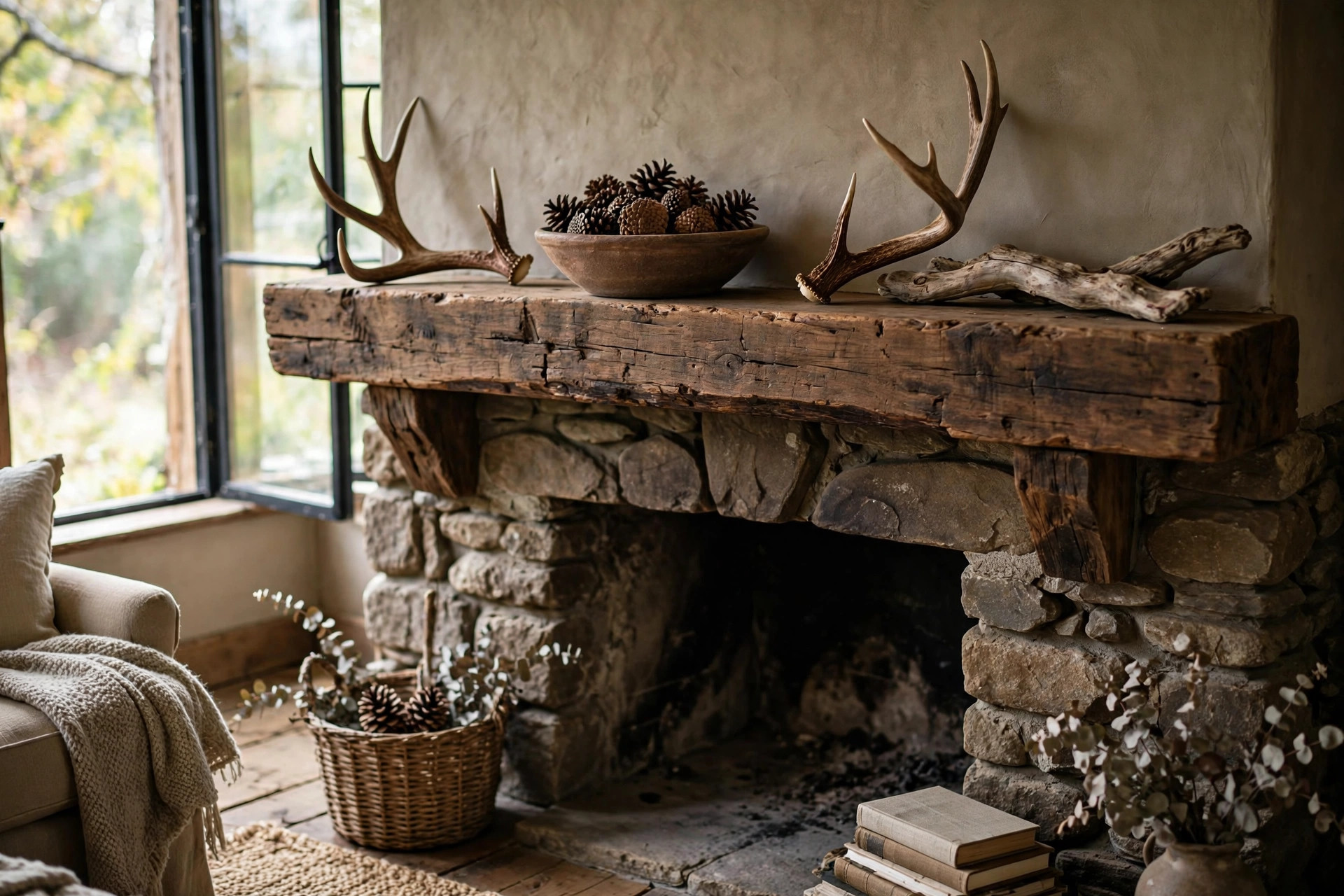
The finishing layer of a rustic room comes straight from the landscape: a pair of naturally shed antlers on the mantel, a bowl of pinecones, a length of driftwood on a shelf, feathers in a stoneware jug. These found objects cost little or nothing, and they connect the room to an actual place rather than a catalogue.
Restraint is everything. Choose a few large, sculptural pieces over a scatter of small themed knick-knacks — one antler chandelier or a single pair above the fireplace says “lodge”; a dozen novelty items say “gift shop.” Shed antlers are widely available from reputable sellers, and faux versions are now convincing enough to fool anyone not holding them.
Idea 13: Distressed Wood Furniture With Iron Hardware

Beyond the sofa, fill the room with wood furniture that looks worked by hand: a sideboard with a scrubbed, uneven finish, a console table of joined planks, nesting side tables with visible peg joints. The unifying detail is the hardware — heavy black iron handles, strap hinges, and nailhead trim that give each piece its frontier practicality.
You can distress newer furniture convincingly with sanding at the wear points, a diluted stain, and a matte wax finish — edges and corners first, where real life would have done the damage. Our guide to brown furniture living room ideas covers how to mix wood pieces without matching them, a skill every rustic room depends on.
Idea 14: Cream Linen and Canvas to Keep Rustic Light
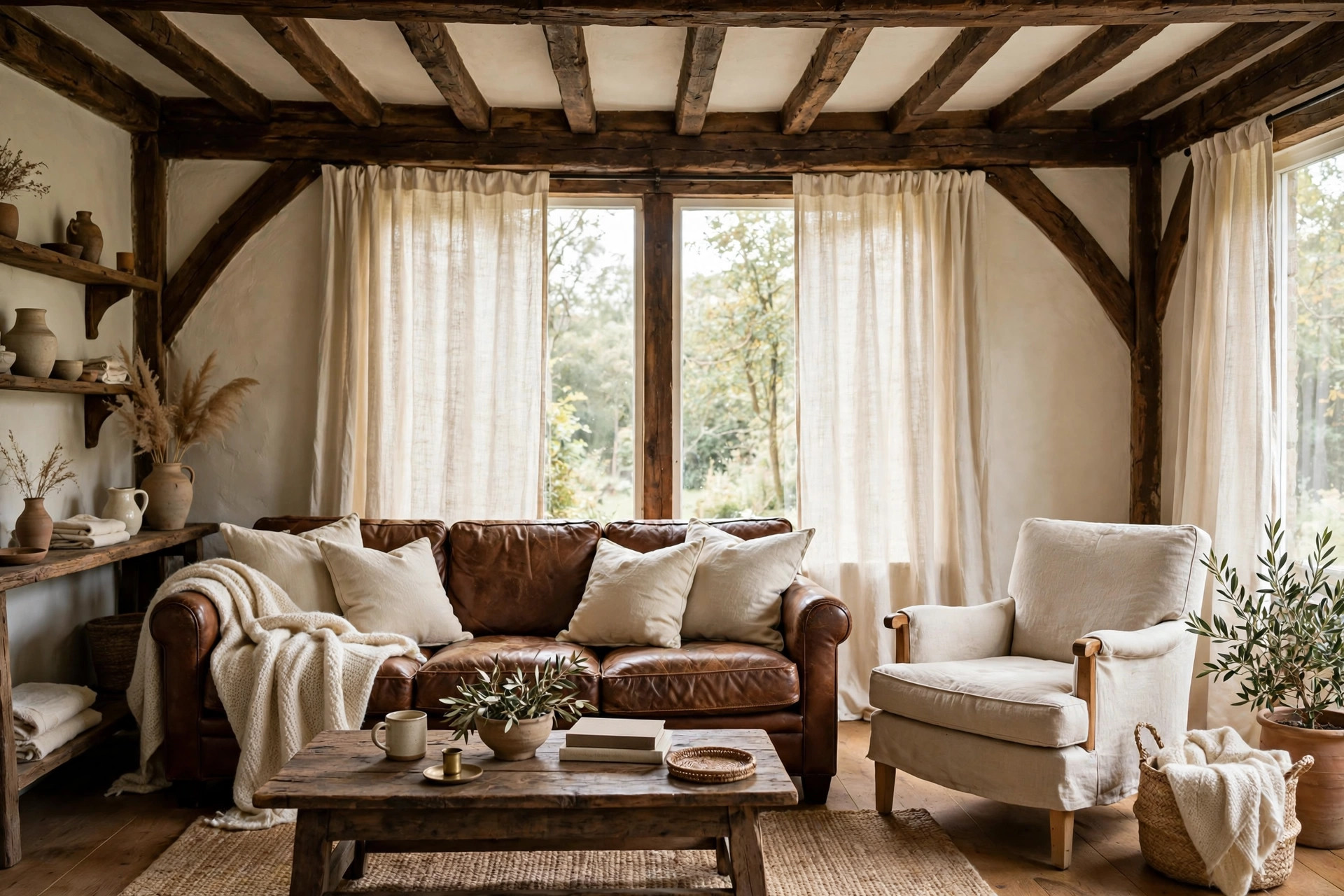
The fear with rustic brown is always the cave effect — too much dark wood, too little light. The antidote is a generous hand with cream and natural linen: unlined linen curtains that filter daylight, canvas cushions on the leather sofa, a pale wool throw, even one upholstered chair in undyed flax. These light neutrals are not a departure from the palette; they are its top end, the colour of raw wool and sun-bleached timber.
Aim for roughly a third of the room’s visible surfaces to sit in this pale range, concentrated where daylight lands. The contrast makes the dark beams and stone look richer, not heavier. For more on striking this balance, our brown and beige living room ideas explore the soft end of the brown spectrum in depth.
Idea 15: A Reading Corner With a Leather Chair and Sheepskin

Every rustic living room deserves one corner that exists purely for winter afternoons. Start with a deep leather armchair — a wingback or a club chair — angled toward the fire or a window, with a sheepskin thrown over its back and a wool cushion behind you. Add a stump side table or a small distressed stool for a book and a mug.
Finish the corner with its own pool of light from an iron floor lamp with a linen shade, and a small stack of books on the floor, because rustic rooms are allowed to look used. This is the seat everyone will quietly compete for, and it distils the whole rustic promise into two square metres: natural materials, honest wear, and nowhere else to be.
Common Mistakes to Avoid
Going dark on every surface. Brown floors, brown walls, brown furniture, and a brown ceiling will swallow the light and each other. Keep walls and textiles in the cream range so the deep tones have something to stand against.
Buying the whole “rustic” set at once. Matched distressed furniture from one store reads as a theme, not a home. Mix genuine old pieces with simple new ones and let the room collect itself over time.
Overdoing the themed accessories. One antler accent is charming; novelty signs, horseshoes, and animal motifs in every corner tip the room into kitsch. Edit until only the strongest few pieces remain.
Matching all the wood tones exactly. Identical stains on beams, floors, and furniture look manufactured. Aim for a family of related browns at different depths, repeated around the room, rather than a single uniform shade.
Choosing shiny finishes. High-gloss varnish, polished chrome, and satin-sheen fabrics fight the rustic mood at every turn. Stay matte: waxed wood, blackened iron, unpolished stone, and natural fibres only.
Forgetting softness. A room of only hard materials feels like a barn, not a retreat. Every stretch of stone or timber needs wool, linen, or sheepskin within arm’s reach to land on.
Frequently Asked Questions
What colours go with a rustic brown living room?
Warm cream, undyed linen, and soft beige are the essential partners, lifting the browns without cooling them. For accent colour, look outdoors: forest green, rust, ochre, and deep burgundy all sit naturally alongside wood and leather. Keep accents in textiles and small pieces so the brown materials stay dominant.
How do I make a rustic brown living room feel light instead of dark?
Concentrate the palest colours where the daylight lands: cream walls or curtains, a light rug, and linen cushions on dark seating. Use mirrors or pale artwork opposite windows, keep window treatments sheer or simple, and choose warm-white lighting on dimmers so the room glows in the evening rather than glooming.
Can I do rustic style in a small living room?
Yes — scale the ideas rather than abandoning them. One barnwood wall, a single faux beam pair, a cowhide over the rug, and a leather accent chair deliver the mood without the mass. Skip the chunky stone surround and oversized trunk, keep the palette light, and let texture, not size, do the work.
What is the difference between rustic and farmhouse style?
Farmhouse is rustic softened for everyday family life — cleaner lines, painted wood, brighter whites. Rustic is rawer: unpainted timber, rough stone, worn leather, and visible wear are the point. Our modern farmhouse brown guide shows the polished version; this article is the wilder sibling.
Is reclaimed wood worth it, or are faux beams and boards fine?
Genuine reclaimed wood has a depth of grain and patina that imitations rarely equal, suiting hero pieces like the mantel. For beams and full walls, good-quality faux or distressed new boards are lighter, easier to install, and convincing at normal viewing distance — a sensible place to save.
How do I care for a brown leather sofa in a rustic room?
Dust it weekly with a dry cloth, keep it out of harsh direct sunlight, and apply a leather conditioner a couple of times a year to prevent cracking. Blot spills quickly rather than scrubbing. Small scratches usually rub out with the warmth of your fingers — on rustic leather, they are part of the patina, not damage.
Final Thoughts
Rustic brown living room ideas endure because they are built from materials that age gracefully and colours that never really leave fashion. Start with the palette — wood, stone, leather, wool — add one or two of the statement ideas above, and let the rest collect slowly, the way real cabins do. If your taste later drifts sleeker, our modern brown living room ideas show how the same warm colour family works with clean lines instead of rough edges.
Above all, aim for a room that looks loved rather than styled. A scuffed beam, a sofa worn soft by Sunday naps, a log pile waiting for the first cold evening — that is the outdoors brought in, and it is a feeling no amount of new furniture can manufacture.


