

15 Minimalist Brown Living Room Ideas for Calm, Clutter-Free Comfort
There is a particular kind of calm that comes from walking into a room with almost nothing in it — and brown, handled well, is what stops that emptiness feeling cold. The most successful minimalist brown living room ideas all work on the same exchange: fewer objects, better materials. Walnut instead of a shelf of ornaments. One good leather chair instead of three average ones. Warm white walls, a small family of honest textures, and floor space left deliberately empty so your eye has somewhere to rest.
Brown suits minimalism better than almost any other colour, because it is the colour of the materials minimalists already love — wood, leather, linen, wool, clay. It grounds a pared-back room without needing pattern or decoration to feel finished, and it hides the scuffs of real life far more kindly than stark white. The influence comes from Japandi and warm Scandinavian design: low furniture, natural fibres, and the belief that a room should hold only what earns its place.
Below, we start with the principles that keep minimalist brown warm rather than bare, then fifteen specific ideas you can copy one at a time. If you are still deciding how far to strip things back, our gentler light brown living room design ideas show the softer end of the same palette.
How to Do Minimalist Brown Without It Feeling Bare or Cold
Build the palette from three browns and a warm white. Choose one light brown (oak, tan linen, pale camel), one mid brown (walnut, warm taupe) and one dark anchor (espresso leather or dark-stained wood), then let warm white or soft cream carry the walls and the largest textiles. Watch the undertones as carefully as the shades — keep every brown on the warm side, with yellow or red beneath it. Grey-leaning browns fight warm ones, and that quiet clash is the main reason brown rooms feel “off” without anyone knowing why.
Edit with one rule: everything earns its place. A piece stays if it does a job, or if you would genuinely miss it. Ideally it does both. This is not about owning nothing — it is about refusing to store things in your eyeline that contribute nothing. Work surface by surface, and when something new comes in, something else leaves. That discipline is what keeps the room calm a year later, not just on styling day.
Let texture do the work objects usually do. In a colourful room, interest comes from contrast. In a minimalist brown room, it comes from surfaces: matte linen against smooth leather, nubby wool over flat cotton, raw wood grain beside plain plaster. When every material feels different to the touch, the room reads as rich even with very little in it. This is the real secret — minimalism fails when everything is the same smooth finish, not when there is too little furniture.
Make storage disappear. Clutter is the enemy of this look, so storage must be closed, plain-fronted and preferably handle-free. Remotes, chargers, games and blankets live behind doors or inside lidded baskets, never on display. Open shelving is allowed only if it stays mostly empty.
Protect light and floor space. Keep furniture low and leggy so daylight travels under and over it, leave visible floor around every piece, and dress windows with sheers rather than heavy drapes. Brown absorbs light, so the emptier the room and the freer the windows, the warmer it feels.
Idea 1: One Low-Profile Sofa in Warm Taupe Linen

Start with the sofa and let it be the anchor everything else answers to. A low-profile frame in warm taupe or tan linen gives you the brown the room is built around, in its softest, most liveable form. Low backs matter more than people expect: they keep sightlines open across the room, let light pass over the seating, and stop a large piece of furniture from looming.
To copy it, choose one long sofa rather than a sofa-and-loveseat pair; a single piece always looks more intentional and takes up less visual room. Keep cushions to the pair the sofa came with, or add just one extra pair in paler cream linen. If your current sofa is the wrong colour, a loose linen slipcover in a mid-tan achieves the same effect without replacing the biggest item you own.
Idea 2: Warm White Walls as the Breathing Room

In a minimalist brown living room, the walls are not a colour choice — they are the breathing space that makes the brown feel warm instead of heavy. Warm white, with a hint of cream or beige beneath it, reflects daylight softly and flatters every wood tone against it. Pure brilliant white and blue-leaning whites do the opposite, making walnut and leather look muddy.
Paint the skirting boards and door frames the same warm white as the walls. It sounds like a small detail, but removing those contrast lines is what gives minimalist rooms their uninterrupted, gallery calm. Let all the brown live in the furniture and textiles, where it can be moved, layered and edited. For a slightly softer version of this balance, see how brown and cream living room ideas push more of the warmth onto the walls themselves.
Idea 3: A Cognac Leather Chair as the Single Statement

Every quiet room needs one piece with presence, and a single cognac leather chair is the most reliable choice in a brown palette. Leather brings the mid-to-dark brown the scheme needs, develops a patina that improves with every year, and its smooth surface contrasts beautifully with matte linen seating. Because it is the only statement in the room, it gets all the attention — that is the point.
Choose a simple shape with clean lines and slim legs rather than a bulky recliner profile, and angle it to the sofa with nothing beside it but perhaps a floor lamp. Resist adding a second leather piece — repeated statements cancel each other out. One chair, lots of empty space around it, and the room looks considered rather than decorated.
Idea 4: Walnut in Small, Deliberate Doses
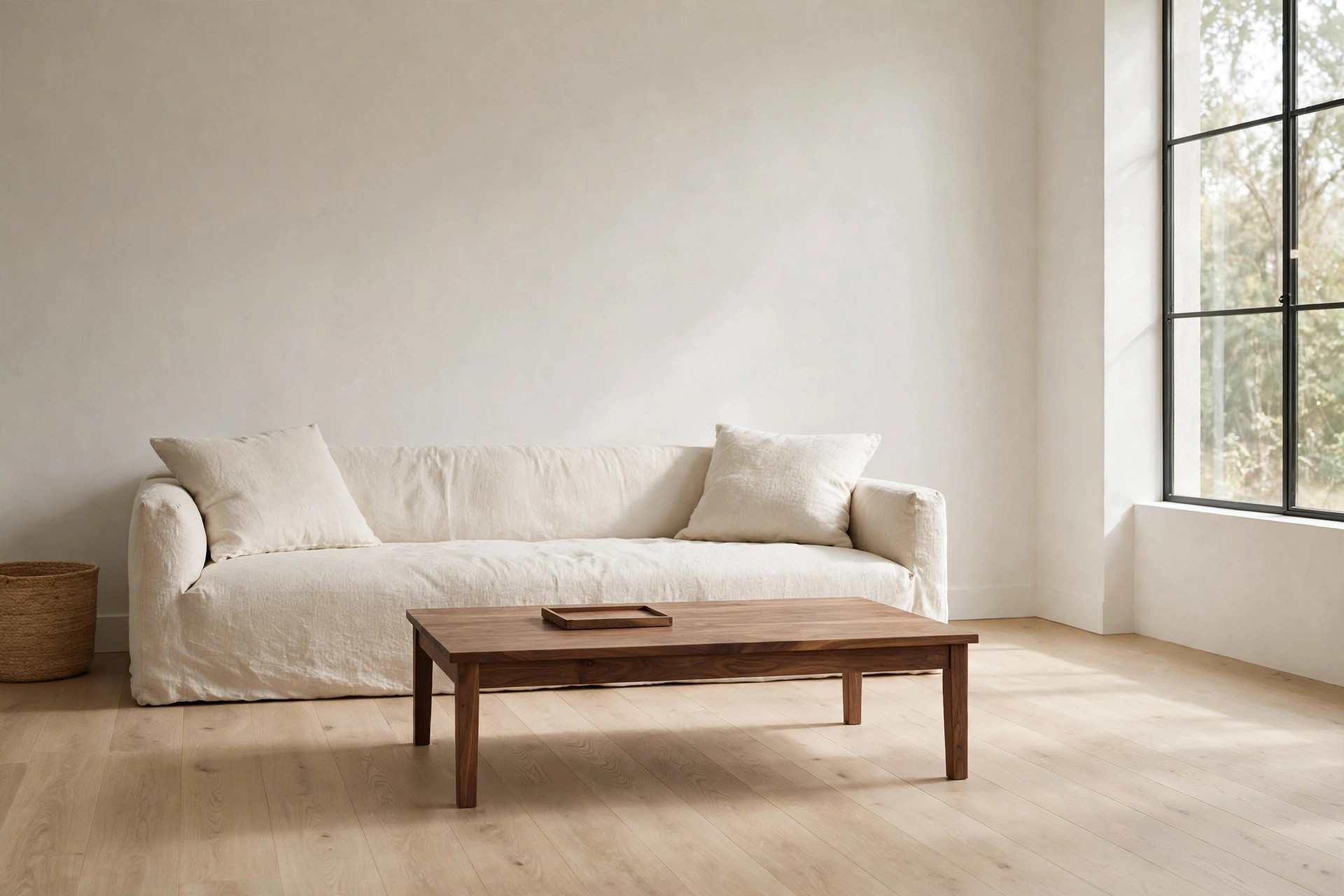
Walnut does the most work in this palette — rich, warm, and dark enough to anchor pale walls and light floors. The minimalist trick is rationing it. One walnut piece, repeated at most twice in smaller echoes (a coffee table plus a tray), reads as a decision. Five different walnut pieces read as a furniture set, and sets are the opposite of edited.
Just as important: limit yourself to two wood tones in the whole room. Pale oak underfoot with walnut as the accent is a common pairing, giving contrast without chaos. Adding a third, unmatched wood is one of the fastest ways a calm room starts to feel like a jumble, even with very little furniture in it.
Idea 5: Texture Doing All the Decorating

When the palette is this restrained, texture is not a finishing touch — it is the entire decorative scheme. Layer a slubby linen cushion against a smooth one, fold a nubby wool throw over the sofa arm, add a bouclé ottoman or a woven cotton rug, and the room gains all the depth that ornaments would normally provide.
Work to a simple rule: no two adjacent surfaces should share the same finish. If the sofa is linen, the throw should be wool or knitted cotton; if the coffee table is smooth wood, the bowl on it should be rough ceramic or stone. You can shop your own home for this — most people already own enough texture, it is just spread too thinly across too many colours.
Idea 6: A Low Japandi Coffee Table, Kept Nearly Bare

The coffee table is where minimalism usually goes to die, buried under remotes, magazines and decorative stacks. A low, light-oak Japandi-style table — simple slab top, plain legs, nothing carved or bevelled — sets the tone. Then comes the discipline of what you allow on it: one object. A handmade ceramic bowl, a single art book, a small stone tray for the remote. One.
The low height is functional as well as visual: it keeps the centre of the room below the sightline between sofa and window, so the space feels open. Everything else that used to live on the table needs a home inside the closed storage from Idea 7 — if it has no home, it is exactly the kind of thing the editing rule exists for.
Idea 7: Hidden Storage That Swallows the Clutter
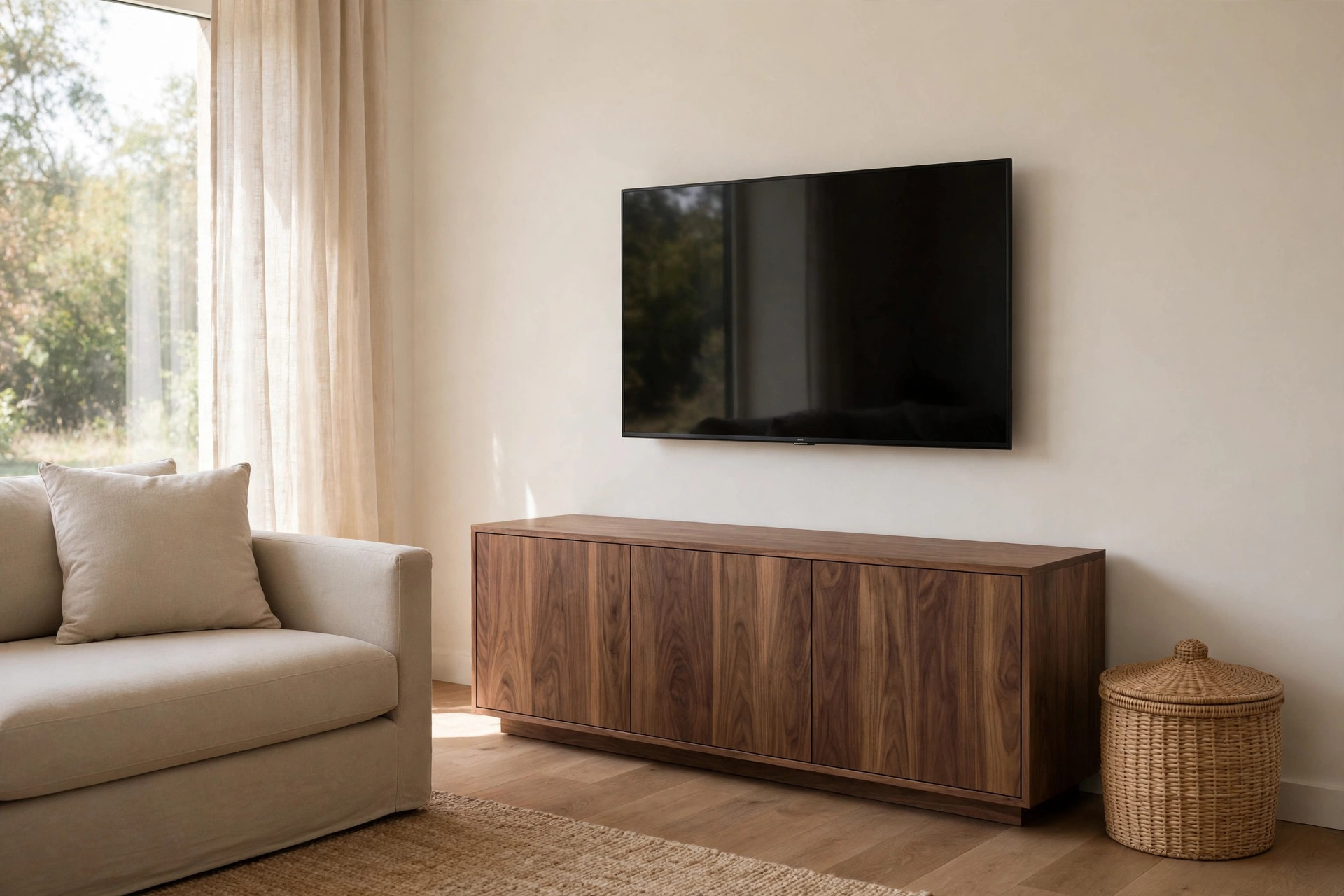
Nobody’s living room stays minimalist by willpower. It stays minimalist because the everyday mess has somewhere invisible to go. A plain-fronted, handle-free media console in walnut or warm white hides the router, games console and cable tangle; lidded woven baskets take blankets and toys; a storage ottoman swallows the rest.
Plan storage before anything decorative: roughly one closed unit per category of clutter. In smaller rooms this matters even more, and the dual-purpose approach in our brown living room ideas for small apartments — benches, ottomans and consoles that all store something — is worth borrowing wholesale. Open surfaces should be a choice, never a necessity.
Idea 8: One Large, Quiet Piece of Art
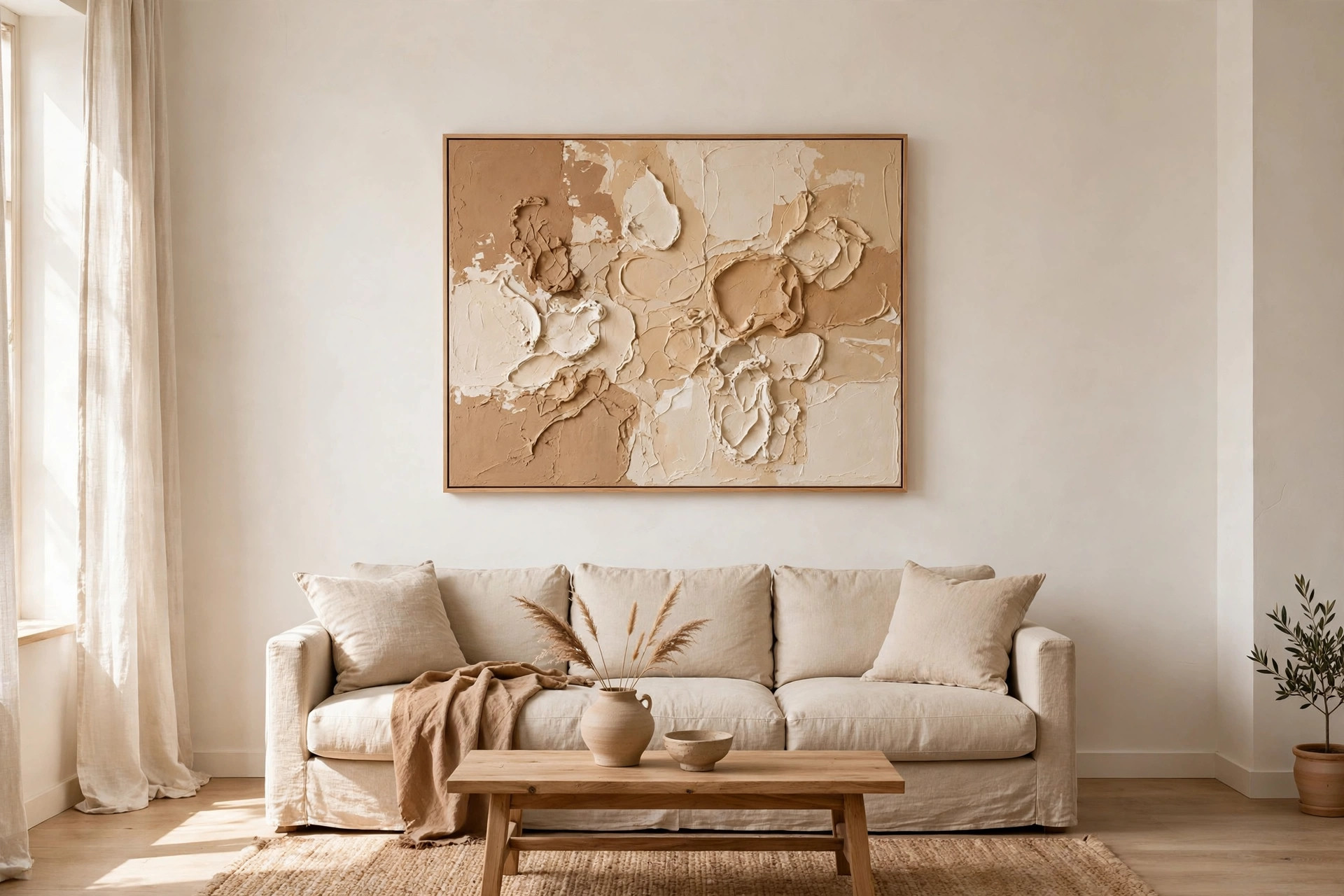
A gallery wall is visual noise, however tasteful the frames. In a minimalist brown living room, one large piece of art does the same job with a fraction of the energy: an oversized abstract in clay, tan, sand and cream tones, hung alone above the sofa with generous empty wall on every side. Scale is what makes it work — a big, quiet canvas looks intentional, while a small one looks like it is waiting for company.
Choose something with soft edges and no text, in a thin natural-wood frame or as an unframed canvas. Hang it lower than instinct suggests, closer to the sofa back than to the ceiling, so it reads as part of the seating arrangement. If you rent, one large framed textile or a plain limewashed panel gives the same calm focal point.
Idea 9: A Natural Flat-Weave Rug to Ground the Seating
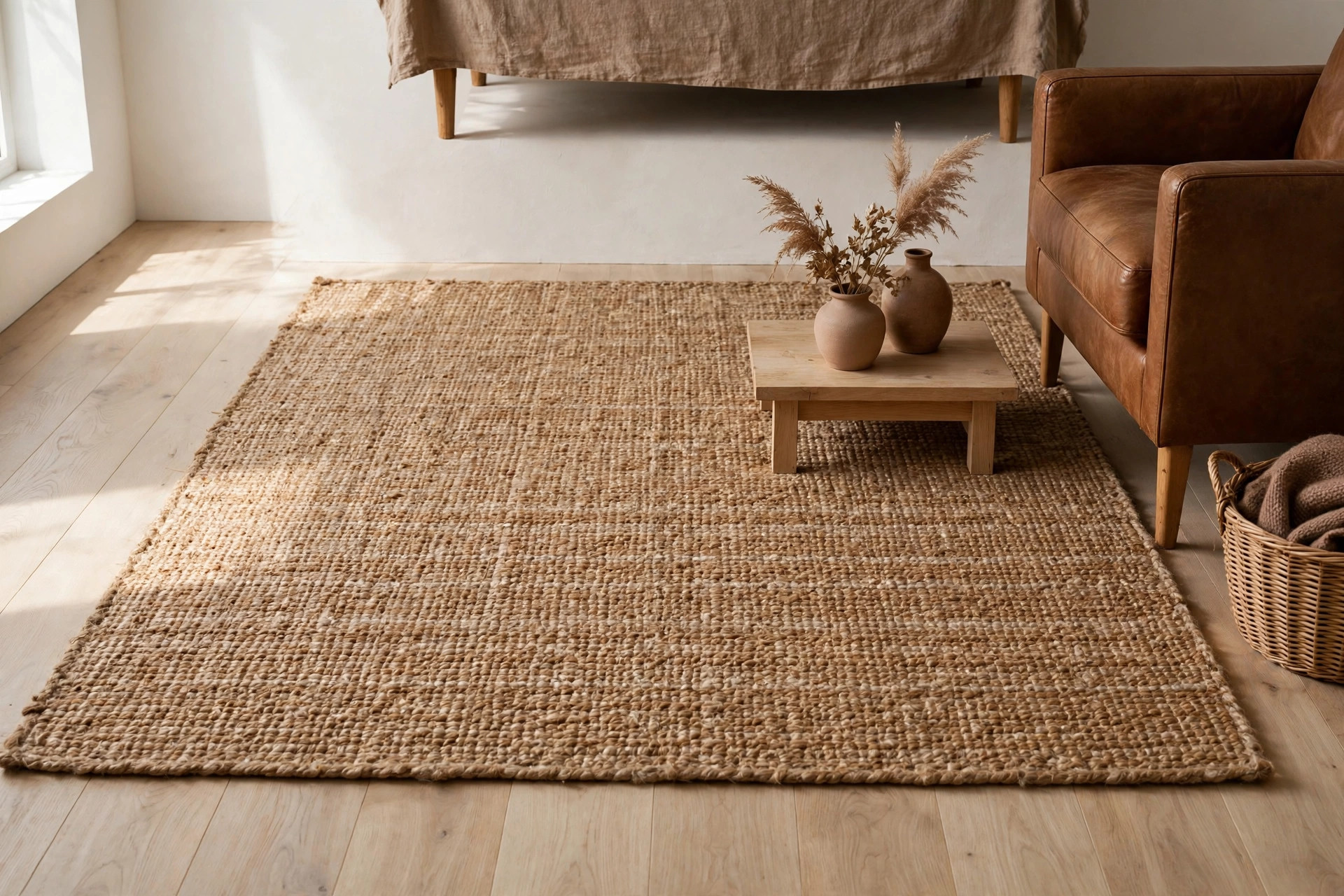
A rug is how a few separate pieces of furniture become one calm arrangement. In this palette, choose a flat-weave in natural jute, undyed wool or a wool blend in a warm tan — it adds the floor-level brown and a fibrous texture, without the visual noise of pattern or the formality of a deep pile.
Size is the detail people get wrong: the rug must be big enough for the front legs of the sofa and every chair to rest on it, with floor showing around the edges. A small rug floating in the middle fragments the room. Leave a border of bare wood or pale flooring visible — that frame of emptiness is part of what makes the seating zone feel deliberate.
Idea 10: Sheer Linen Curtains and Nothing Else
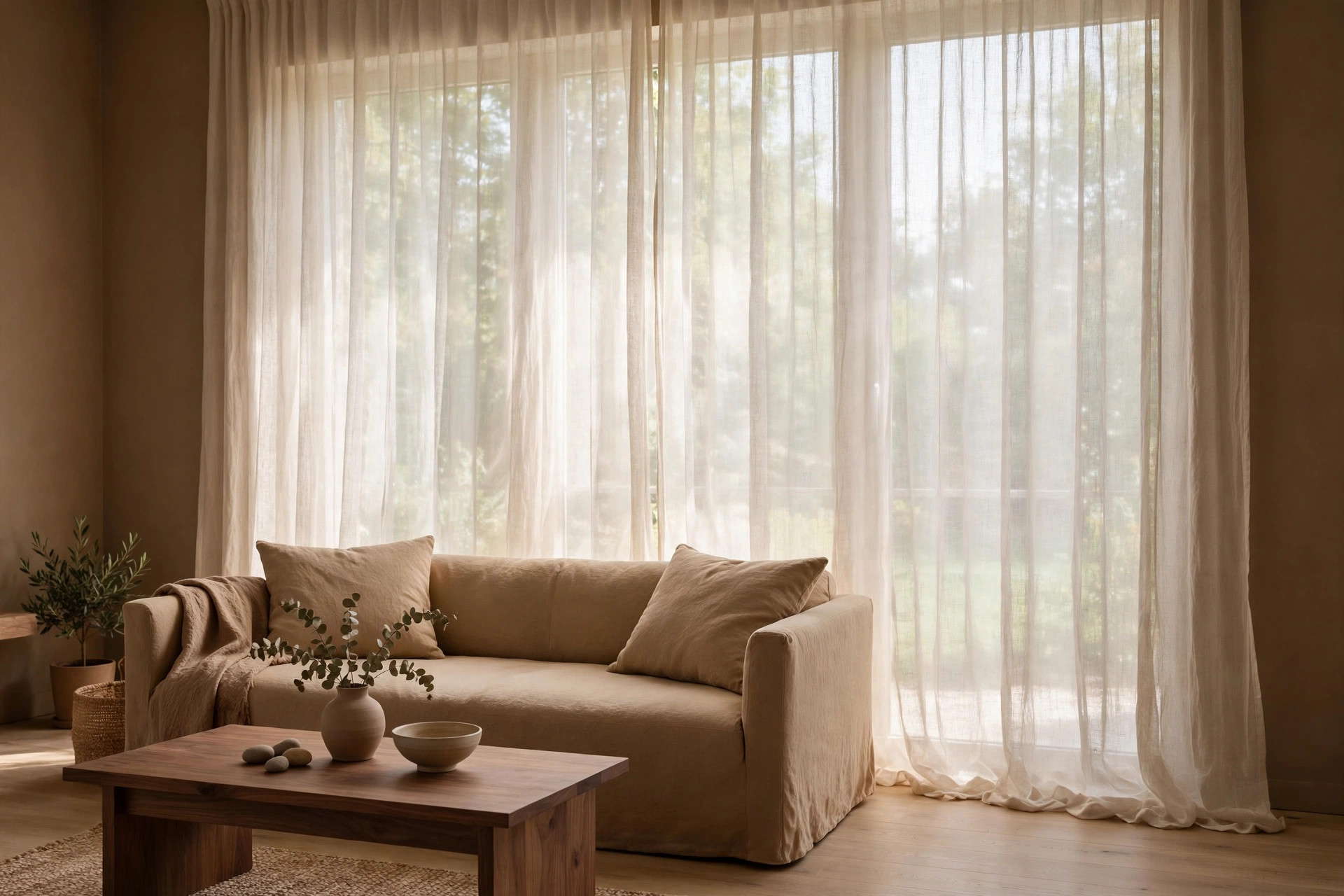
Windows in a minimalist room get one treatment only: full-height sheer linen curtains in a warm natural white, hung from just below the ceiling and falling to the floor. They filter harsh sun into the soft, even light that brown tones love, provide privacy without darkness, and add a gentle vertical texture. No tiebacks, no valance, no second layer of heavy drapes.
Hang the rod or track wider than the window so the curtains stack mostly on the wall when open, leaving the glass clear for maximum daylight. Brown rooms live or die by their light, and removing fussy window dressing is often the change that makes the whole scheme feel airy instead of enclosed.
Idea 11: One Sculptural Plant Instead of a Collection

Greenery earns its place in a brown room — it is the one colour that makes wood tones look richer — but minimalism applies to plants too. Instead of a shelf of small pots, choose one sculptural plant with an interesting silhouette: an olive tree, a fiddle-leaf fig, or a tall bird of paradise, in a plain clay or stone pot with no pattern. Surrounded by empty space, it reads as a piece of living furniture.
Place it where the room has a genuine gap — the empty corner beside the sofa, the space next to the console — not squeezed onto a crowded surface. Keep the pot in the palette too: terracotta, raw clay and warm stone sit comfortably inside brown schemes, while glossy coloured pots pull the eye for the wrong reason.
Idea 12: Tone-on-Tone Browns, Layered Light to Dark

The most sophisticated version of this look uses no second colour at all — just brown itself, arranged as a gradient. Cream rug, tan linen sofa, camel cushions, walnut table, one espresso accent at the far end. Because every tone is related, the room feels deep and layered while remaining completely calm.
The discipline is spacing the tones evenly. If everything clusters at the mid-brown level, the room goes flat and muddy; you need the pale end and the dark end present, even if only in small amounts. A dark cushion on a pale sofa, a cream throw over a walnut bench — these small extremes hold the whole gradient together. Our wider brown living room colour scheme ideas map out other pairings if you later want to widen the palette.
Idea 13: A Reading Corner Edited Down to Three Pieces

A reading corner is a good test of minimalist discipline, because it tempts you to keep adding — a footstool, a throw, a stack of books, a side table crowded with cups. The edited version is exactly three pieces: a comfortable chair (the cognac leather one from Idea 3 works perfectly), a slim floor lamp with a warm shade, and one small side table just big enough for a book and a drink. Nothing else.
Position the trio near the best natural light, angled slightly into the room rather than pushed into the corner, and leave floor space around it — the emptiness is what makes it feel like a retreat. Current reading lives on the table; everything finished goes back to closed storage, so the corner never turns into a dumping ground.
Idea 14: Floating Shelves Styled Two-Thirds Empty
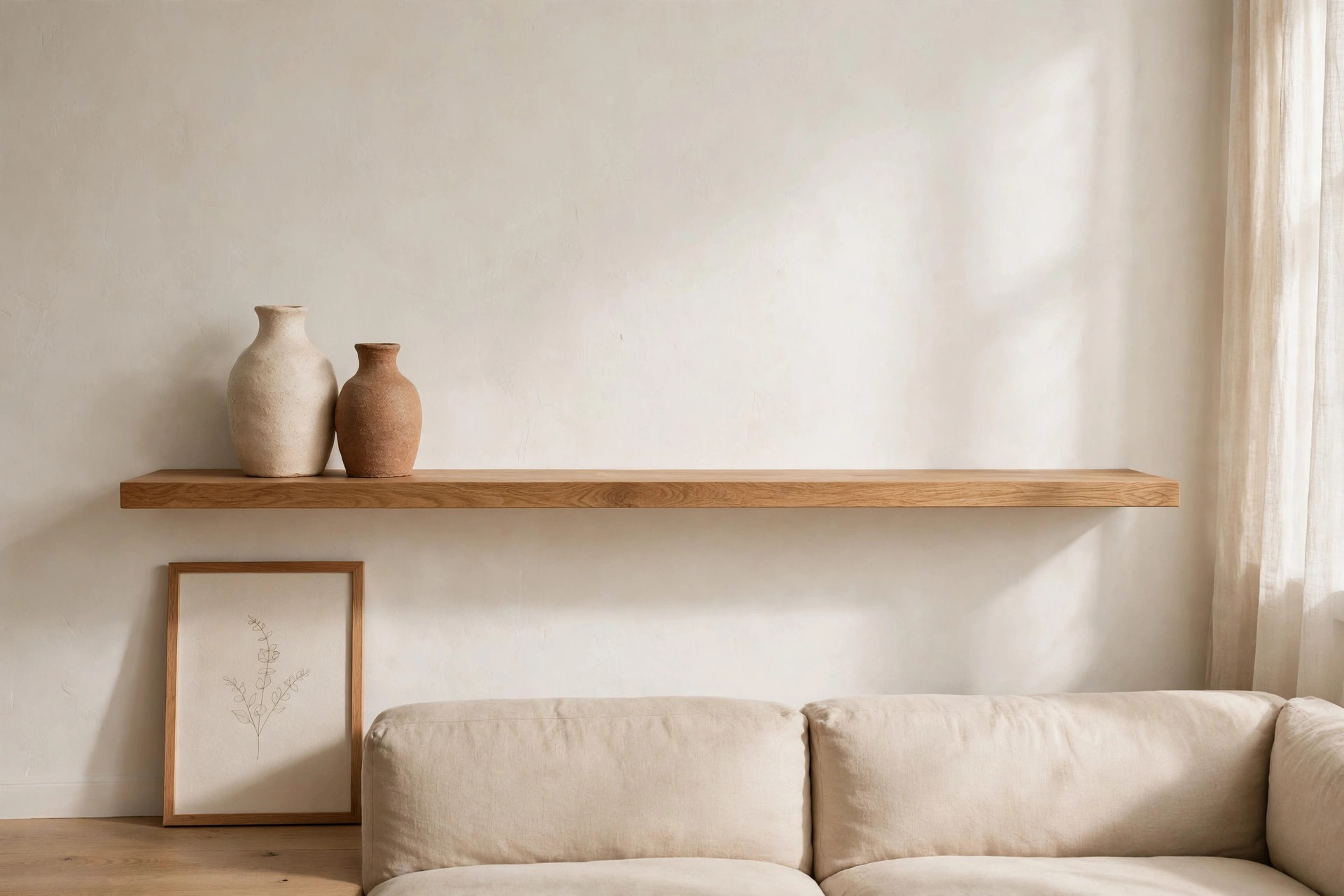
If you keep any open shelving, treat empty space as the main thing on display. One floating oak shelf — or two at most — holding a couple of ceramic vases, a small framed print leaned against the wall, and then long stretches of nothing. The shelf reads as a considered composition instead of storage that happens to be visible.
A practical way to style it: group items at one end, leave the rest bare, and remove one thing more than you think you should. If everything on the shelf sits within the brown-and-cream palette, even the fullest version stays calm. And be honest about the alternative — many minimalist rooms are better with the shelves removed entirely and the wall left peacefully blank.
Idea 15: Soft, Low Lighting With Warm Bulbs Only
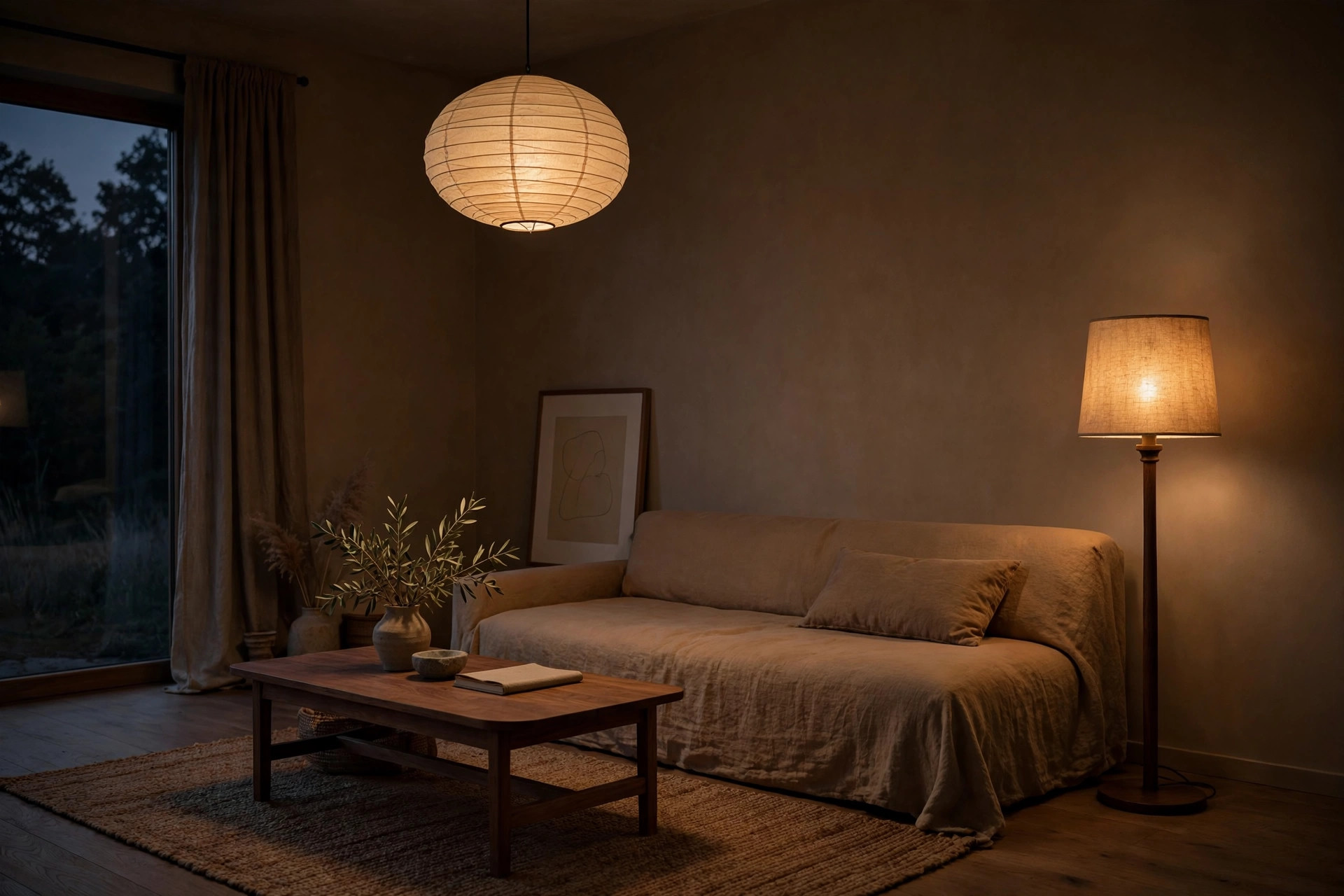
Minimalist rooms are finished by their light, and brown is unforgiving under the wrong kind. Replace any central ceiling glare with two or three low, warm sources: a paper or linen pendant over the coffee table, a floor lamp by the reading chair, perhaps a small lamp on the console. Warm-toned bulbs throughout — cool white light greys out wood and leather, while warm light deepens them.
Fewer, softer sources suit the edited mood: light pools where life happens and leaves the corners in gentle shadow, making the room feel enclosed and finished. Fit dimmers if you can, and keep every shade in natural materials — paper, linen, rattan — so the fittings stay inside the palette even when switched off.
Common Mistakes to Avoid
Mixing browns with clashing undertones. A grey-leaning taupe sofa against red-toned walnut looks wrong no matter how little furniture you own. Hold wood samples and fabric swatches together in daylight before committing, and keep every brown on the warm side.
Filling every corner because it “looks empty”. Empty corners are the design. The moment you add a plant stand, basket and lamp to fill a gap, the room stops breathing — negative space is a deliberate material in minimalism, not a problem waiting for a purchase.
Pairing brown with cold white or grey walls. Blue-white paint and cool greys make warm wood look dirty and leather look orange. If your walls are already a cool neutral, warm them up; the palette only relaxes when the background shares its warmth.
Adding pattern to compensate for the quiet palette. A patterned rug plus printed cushions plus busy curtains undoes the whole scheme. Interest should come from texture and material; if you truly want one pattern, let it be the only one in the room.
Skimping on closed storage. Minimalism without storage lasts until the first ordinary evening — then remotes, blankets and chargers colonise every surface. Budget for the console and baskets first; they make the look survivable in real life.
Choosing tall, bulky furniture. High-backed sofas and chunky cabinets block light and sightlines, shrinking the room visually. Low, leggy pieces keep the top half of the room empty, which is where the sense of space actually comes from.
Frequently Asked Questions
What colours go best with a minimalist brown living room?
Warm white and cream are the essential partners — they carry the walls and large textiles and keep brown from feeling heavy. Within the scheme, layer tan, camel and walnut, then use one small dose of soft black (a lamp base, a frame) if you want definition. Keep any extra colour muted and natural rather than bright.
How do I stop a minimalist brown room from looking boring?
Boredom in these rooms almost always comes from flat texture, not too little furniture. Mix matte linen, smooth leather, nubby wool and raw wood within the same tones, include one statement piece like a cognac chair, and run the browns from pale to dark. A tone-on-tone room with four different surfaces feels richer than a busy room with one.
Is brown too dark for a small living room?
No — the trick is where the brown sits. Keep the walls, rug and largest textiles at the pale end (warm white, cream, light tan) and reserve mid and dark browns for the sofa, one chair and small wood pieces. Low furniture, sheer curtains and visible floor keep the room feeling open, so the brown reads as warmth rather than weight.
Which wood tones work best in a minimalist brown scheme?
Walnut is the classic anchor — warm, mid-to-dark and full of grain — while white oak and ash suit the pale end of the palette. Limit the room to two wood tones, and repeat each at least twice so nothing looks accidental. Avoid orange-toned pine and very red mahogany finishes, which fight the calm, muted mood.
How many accessories should a minimalist living room have?
Fewer than instinct suggests: one object on the coffee table, two or three on any shelf, one plant, one piece of art — with more empty space than objects on every surface. If unsure about an item, remove it for a week; minimalist rooms are edited by subtraction, and most things are never missed.
Can I mix brown and grey in a minimalist living room?
Yes, if the grey is a warm one. Greige and warm stone tones blend naturally with brown because they share its warmth; blue-greys and cold charcoals are the ones that clash. Use the grey in small, soft places — a cushion, a throw — rather than on the walls, and check swatches together in daylight first.
Final Thoughts
A minimalist brown living room is not about owning less for its own sake. It is a room where everything left has been chosen — the sofa you actually relax on, the chair with the beautiful patina, the wood you can see the grain in — and where the empty space around those things does quiet, constant work. Start with the edit and the storage, then build the palette light to dark, and the calm follows.
If you want the same restraint with sleeker lines, our modern brown living room ideas take this palette in a more polished direction. For more pattern and personality, our bohemian brown living room ideas loosen the rules considerably, while brown and white living room designs sharpen the contrast for a crisper feel. The brown stays; only the mood changes.


