

15 Contemporary Brown Living Room Ideas With Sleek, Sculptural Style
Brown has quietly become the most interesting neutral in the living room, and the rooms proving it look nothing like the brown spaces of twenty years ago. If you are searching for contemporary brown living room ideas, expect a different recipe: curved sofas instead of boxy ones, stone and smoked glass instead of wall-to-wall wood, and several shades of brown layered in one space so the colour feels deep rather than flat. Brown now does the job black and grey used to do, but with far more warmth.
What makes these rooms feel current is confidence. One sculptural piece is allowed to dominate while everything else stays calm, textures are mixed boldly, and the palette runs the full length of the brown spectrum, from near-black espresso to pale café tones, inside one scheme. The result reads polished and architectural, yet still welcoming.
One honest note on language: “modern” properly describes the mid-century movement and its fixed rules, while “contemporary” simply means the design of right now, free to borrow from anywhere. If you love the stricter mid-century version, our guide to modern brown living room ideas covers it in depth. Here, we are firmly in the present.
What Makes Brown Feel Contemporary Right Now
Four ingredients show up again and again in the best current brown rooms. The first is sculptural form. Contemporary furniture is rounded, generous and often a little exaggerated: sofas with crescent backs, chairs that look carved from a single block, coffee tables built like plinths or pebbles. Against that softness, everything else is kept linear and quiet, so each curved piece reads as deliberate design.
The second ingredient is tonal layering. Instead of one brown repeated everywhere, contemporary schemes stack a dark-to-light range in the same room: espresso walls or cabinetry, walnut furniture, a cognac or chocolate sofa, then camel, tan and cream textiles on top. Because every layer is recognisably brown, the room feels unified; because the values differ, it never feels flat. Getting that spread right is the heart of a successful brown living room colour scheme, so plan the gradient before you buy anything.
Third, contemporary rooms run on contrast between statement and background. One or two pieces carry the drama, an oversized artwork, a sculptural light, a stone-clad wall, while the remaining furniture keeps a low, simple profile. Finally, the materials have changed. Travertine and large-format stone bring a cool, mineral calm; smoked glass adds sleekness without weight; brushed brass warms everything it touches; and bouclé softens all the hard surfaces. Brown ties these current materials together.
Idea 1: Anchor the Room With a Curved Sofa
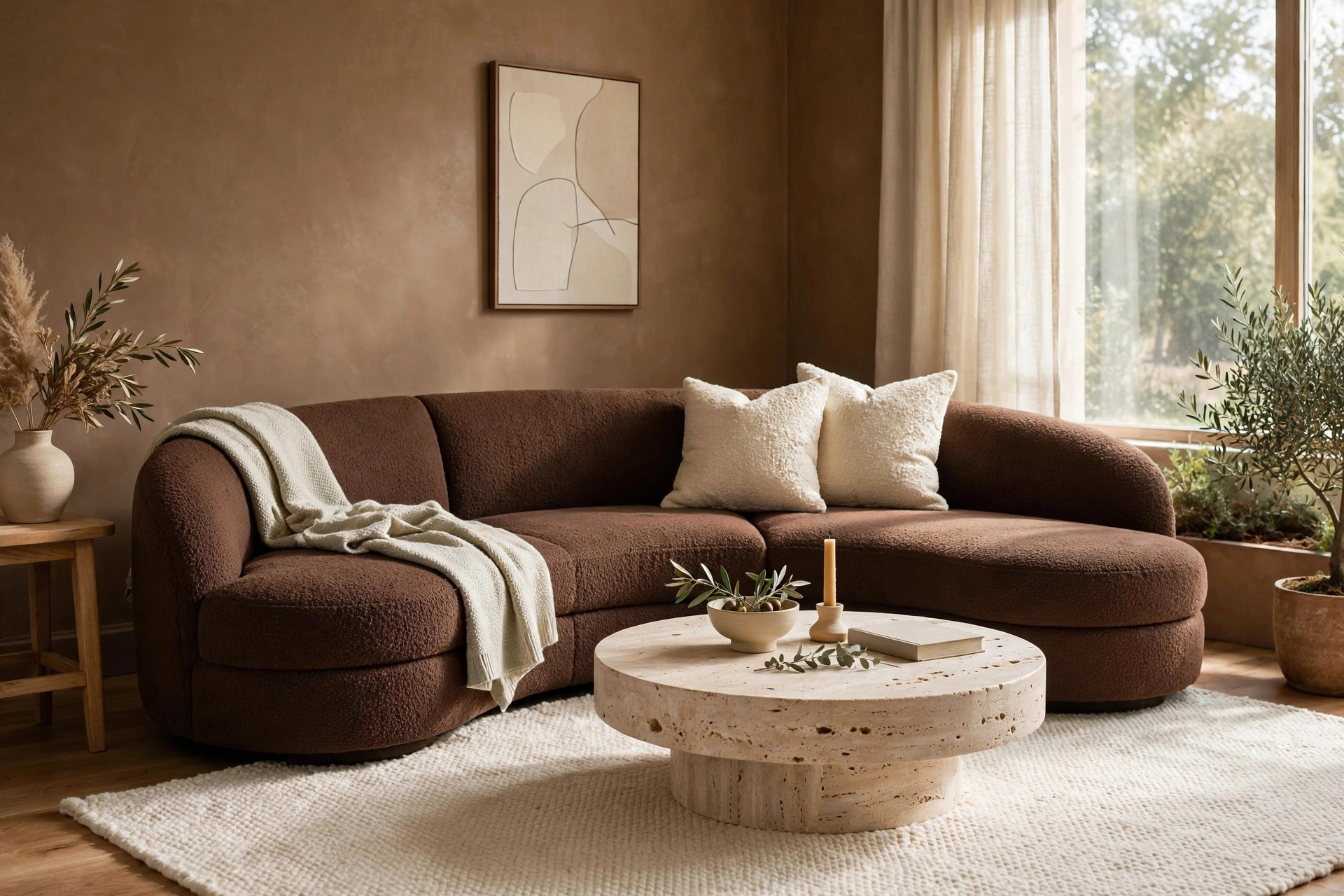
The fastest way to make a brown living room feel contemporary is to change the silhouette of its biggest piece. A curved or crescent-backed sofa in chocolate, chestnut or deep cognac instantly signals the current era, unlike the straight, squared sofas of the last decade. Upholster it in bouclé or a textured weave and the curve becomes tactile as well as visual.
Curves also change how a room works. A rounded sofa softens the walkways around it, makes conversation groupings feel more intimate, and gives you a natural focal point without needing a feature wall. Pair it with a low stone coffee table that echoes the rounded lines.
To copy the look, choose one curved piece only and keep the rest of the seating simple. A single arc sofa with two plain armchairs looks designed; three competing curves look like a showroom accident. If a curved sofa is out of reach, a curved loveseat or swivel barrel chairs deliver the same signal at a smaller scale.
Idea 2: Layer Brown on Brown, Dark to Light

A single shade of brown repeated across walls, sofa and curtains is what made older brown rooms feel heavy. The contemporary approach is a gradient. Start with the darkest brown in the room, perhaps espresso-painted joinery or a walnut media unit, then step down through mid-tones in the furniture and finish with pale camel, sand and cream in the rug, cushions and throws.
This dark-to-light stacking creates the depth a one-note scheme lacks. Your eye reads the layers as richness rather than monotony, and because everything belongs to one colour family, the room stays calm. Texture does the separating work: matte paint against glossy leather, rough linen against smooth stone.
Practical tip: line up paint swatches, fabric samples and wood offcuts darkest to lightest before committing. If two neighbouring layers are almost identical in value, swap one for a different texture or shift it a shade. For a softer take, see how brown and cream living room ideas stretch the pale end of the gradient further.
Idea 3: Hang One Oversized Piece of Art

Gallery walls have given way to a single, confident statement. One oversized canvas, wider than the sofa beneath it or tall enough to lean on the floor, gives a contemporary brown living room its gallery calm. Choose abstract work in the room’s own register: sweeping umber, ochre, rust and charcoal tones on a warm off-white ground, with visible brushwork that rewards a closer look.
Scale is the whole trick. Art that is too small gets swallowed by brown walls; art that is generously sized lightens the scheme, because the pale ground of the canvas acts like a window in the room. A slim black or brushed-brass frame keeps the edge crisp and current, while an unframed canvas feels softer.
Hang the centre of the piece at eye level when standing, not seated, and light it properly: a picture light or adjustable ceiling spot transforms a good canvas into the room’s evening focal point.
Idea 4: Choose a Plinth-Style Travertine Coffee Table

Travertine is the signature stone of the contemporary brown room, and the coffee table is where it earns its place. Current designs favour solid, architectural shapes: a thick oval top on cylindrical legs, a low rectangular plinth, or two drum forms side by side. The stone’s natural pitting and soft beige-brown veining bring a mineral coolness that balances warm upholstery beautifully.
Unlike a glass table, travertine has visual weight, which a brown scheme needs at its centre, and its matte, chalky finish sits comfortably beside bouclé and leather without competing for attention. The stone’s cool surface also gives warm-toned rooms a welcome temperature contrast.
Style it sparingly: two large books and one ceramic vessel are enough, because the table itself is the sculpture. Use coasters, since travertine is porous and marks easily, and seal it once a year.
Idea 5: Add Smoked Glass for Sleek Contrast

Every warm scheme needs one cool, sleek note, and smoked glass is the contemporary choice. A pair of smoked-glass side tables or a low media console with tinted doors introduces a grey-brown transparency that sharpens the room’s edges.
The tint matters. Clear glass disappears; smoked glass in a warm bronze or soft charcoal tint echoes the brown scheme while still reading as modern and a little moody. It pairs especially well with blackened metal frames and brushed brass handles, and it keeps the deeper schemes in our black and brown living room ideas from feeling solid and heavy.
Keep glass pieces few and purposeful, two or three at most, and mix them against matte textures so the shine has something to play against. Fingerprints show, so choose pieces you can wipe in seconds.
Idea 6: Panel One Wall in Walnut Slats

Fluted and slatted timber panelling has become the contemporary way to give a living room architecture it was not built with. Narrow vertical walnut slats, run floor to ceiling behind the sofa or around the television, add rhythm, shadow and warmth. The fine shadow gaps between slats make it feel current rather than like seventies wood panelling.
Walnut is the right timber for a brown scheme because its grain already contains the whole palette, deep chocolate streaks through warm mid-brown, so the wall harmonises with furniture in almost any brown you choose later. Ready-made slatted panels with acoustic felt backing also soften echo in hard-floored, open-plan rooms.
One wall is enough; panelling everywhere turns the room into a sauna. Keep the slatted wall nearly bare, perhaps just the oversized artwork from Idea 3, and wash it with warm light so the grooves model beautifully in the evening.
Idea 7: Go Large-Format With a Stone Fireplace Wall

When contemporary rooms want drama, they go big and plain rather than small and busy. Cladding a whole fireplace wall, or the full height of a media wall, in large-format stone slabs or oversized tiles gives a living room the calm monumentality of a boutique hotel. Travertine-look porcelain, honed limestone and warm quartzite all sit naturally in a brown scheme.
Large formats mean fewer grout lines, and fewer lines mean the surface reads as one continuous material, which is the essence of the look. Run the stone floor to ceiling; stopping at picture-rail height dates the treatment instantly. A simple linear fire opening, no mantel, keeps the composition clean.
If a full wall is too much, scale the idea down: a chimney breast clad in stone-effect tiles, or a deep stone hearth slab. The principle stays the same, one generous, uninterrupted surface in a natural material, left almost bare.
Idea 8: Pick Low, Wide Modular Seating in Caramel Leather

Contemporary sofas sit low and spread wide, and caramel or cognac leather is their most forgiving upholstery. A modular sectional with deep seats and a low back creates the lounge-like profile that defines current living rooms, while the leather’s patina means the piece improves with use.
Leather also plays a textural role. In a room full of matte bouclé, linen and stone, one smooth, slightly glossy surface catches the light and keeps the scheme from feeling dusty. Caramel sits mid-spectrum, bridging dark walnut furniture and pale cream textiles effortlessly.
Arrange modules to suit the room rather than accepting the showroom layout: an L-shape for television rooms, two facing runs for conversation, or a chaise end aimed at the window. If you already own a leather sofa and want to modernise around it, our chocolate brown sofa living room ideas show how darker leather anchors a similar scheme. Keep cushions few and large so the leather stays the star.
Idea 9: Mix Your Metals on Purpose

The single-metal room, all chrome or all brass, belongs to an earlier decade. Contemporary brown living rooms mix metals deliberately: brushed brass for warmth on lamps and cabinet handles, matte black for structure on shelving and frames, and perhaps a touch of bronze or antique copper where the two need a bridge.
The rule that makes mixing look intentional is repetition. Each metal should appear at least twice, ideally three times, around the room, and one metal should clearly dominate, usually the warm one, since brown flatters brass and bronze far more than icy chrome. Keep finishes brushed, satin or aged; mirror-polished shine reads as bling.
Start with lighting, where mixed metals are easiest, then echo the combination in curtain poles, picture frames and side-table legs. Done well, the room gains a layered, collected quality rather than a matched-suite look.
Idea 10: Treat Lighting as Sculpture

In contemporary interiors, light fittings are chosen the way artwork is chosen, for their shape in daylight as much as their glow at night. An oversized arc floor lamp sweeping over the sofa, a cluster of globe pendants at staggered heights, or a single dramatic chandelier with organic, branching arms gives a brown room its finishing flourish.
Warm metal finishes suit brown schemes best, and warm-white bulbs are non-negotiable: cool light turns brown muddy. Layer lighting at three heights, ceiling, lamp and low-level, so the room shifts from bright daytime to a soft evening glow that makes brown look richest.
Scale up bravely. A pendant that feels slightly too large is usually exactly right, while a small, timid fitting disappears against brown walls. If you change only one thing, change the central light; every visitor registers it.
Idea 11: Add Barrel Chairs in a Richer Brown

A pair of barrel or tub chairs, ideally on swivel bases, is the contemporary room’s favourite supporting act. Their fully rounded backs echo the curved sofa, their compact footprint suits smaller rooms, and upholstering them in a richer brown than the main seating, rust velvet against a taupe sofa, say, adds a deliberate accent inside the tonal scheme.
Swivel bases are more than a gimmick: chairs that turn let a seating group adapt, facing the sofa for conversation, the television for film night, or the window for coffee. Velvet gives the saturated colour contemporary rooms love, its pile shifting tone as light moves across it.
Place the pair opposite the sofa with a small drinks table between them, or angle one in a corner with a floor lamp as a reading spot. Keep their cushions plain; the silhouette and colour do all the work.
Idea 12: Style a Monochrome Brown Vignette
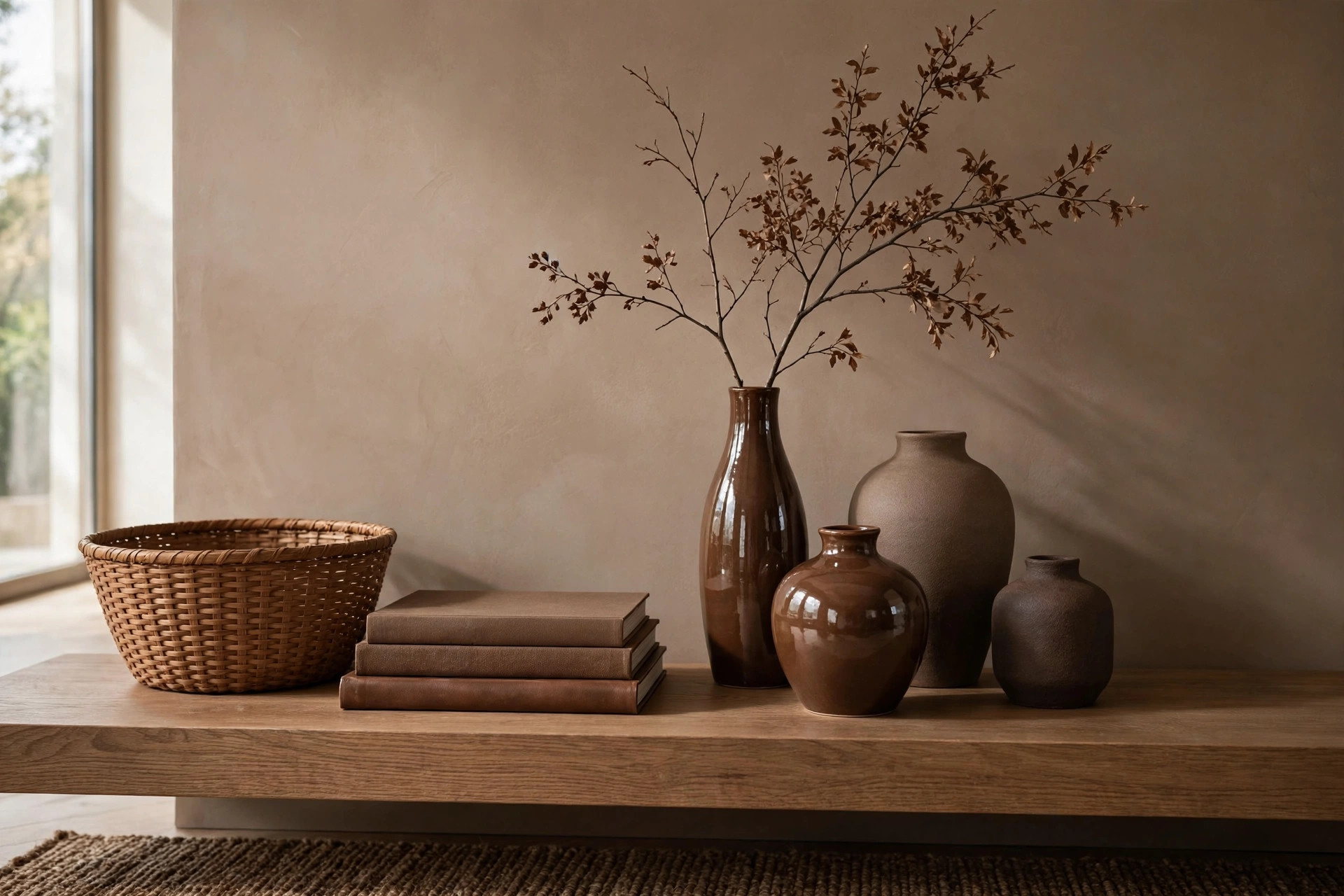
You do not need a whole room to test the contemporary brown look. A single console, mantel or open shelf styled as a monochrome vignette, everything brown, nothing else, delivers the same sophisticated effect in miniature. The secret is mixing finishes: matte ceramic beside glossy glazed pottery, rough stone next to polished wood, woven basket against smooth leather-bound books.
Because the colour is constant, the eye reads shape and texture instead, which is precisely the contemporary trick. Group objects in odd numbers, vary the heights in a gentle triangle, and include one organic silhouette, a branch in a vase or a piece of driftwood, to stop the arrangement feeling staged.
This is also the easiest idea to refresh seasonally: swap the branch for pinecones in winter or pale pampas in summer. If the discipline of a single colour appeals, the pared-back schemes in our minimalist brown living room ideas take the same restraint across a whole room.
Idea 13: Soften the Architecture With Full-Height Drapery

Contemporary rooms balance their hard materials, stone, glass, metal, with one grand soft gesture, and floor-to-ceiling curtains in a warm brown-family fabric are usually it. Hung from just below the ceiling and pooling slightly on the floor, they make ceilings feel taller and windows feel like architecture.
Choose warm taupe, mushroom or soft cocoa in a linen-look weave or matte velvet, and let the curtains be a mid-layer of your tonal gradient rather than a contrast. Sheer linen panels behind them filter daylight into the soft, even wash that makes brown interiors photograph so well.
Fit the widest track you can, so the curtains stack back clear of the glass and the full window shows when open. A simple ceiling-mounted track in matte black or brass gives the same clean line as a motorised one, for far less fuss.
Idea 14: Repeat the Curve in Arches and Rounded Edges
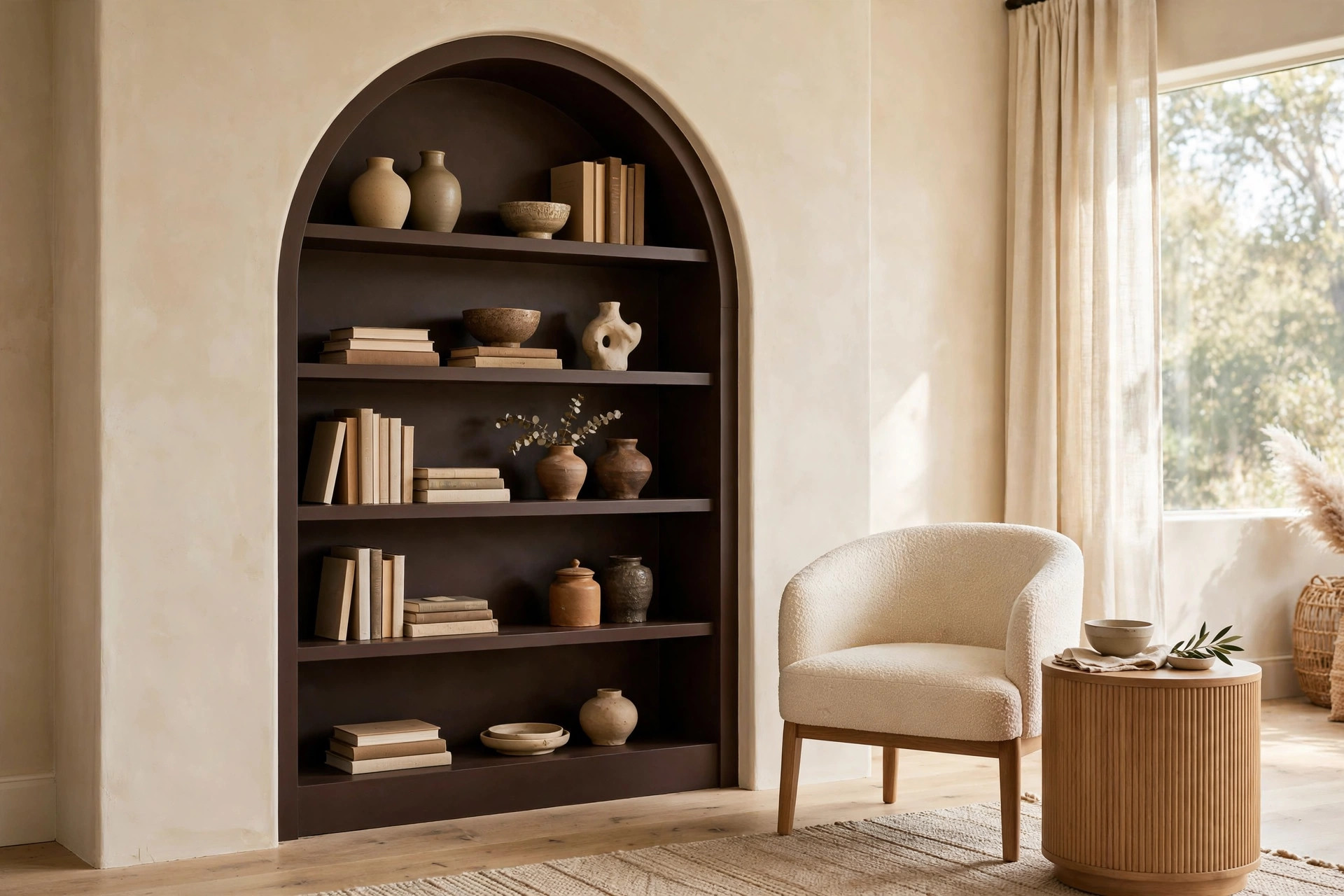
Once the sofa introduces a curve, contemporary rooms repeat the gesture in the architecture. An arched bookcase or bar niche, a round mirror over the console, a doorway softened into an arch, or simply rounded corners on cabinetry and shelving, these small echoes turn a single curved sofa into a coherent design language.
Painting the inside of an arched niche a deeper brown than the surrounding walls is a particularly effective move: the shadowed curve gains depth, displayed objects read like exhibits, and the room gets a focal point for little more than a tin of paint. Rounded-edge furniture, drum side tables, oval rugs, reinforces the theme quietly.
Restraint matters here too. Choose two or three curved elements beyond the sofa and let them converse; a room where everything is round feels themed rather than designed.
Idea 15: Finish With Oversized Ceramics and One Big Plant

The last layer of a contemporary brown room is scale in the accessories. Replace clusters of small ornaments with a few oversized pieces: a floor vase tall enough to stand beside the sofa, or a weighty ceramic bowl on the coffee table. In brown, cream and terracotta glazes, these pieces read as quiet sculpture.
Then add one genuinely large plant, an olive tree, a ficus or a mature monstera in a stone or raw ceramic planter. A single architectural plant looks contemporary; a windowsill of small pots looks accidental. The green also gives the eye relief from the brown spectrum and makes every brown tone look richer.
Keep surfaces at least half empty. Contemporary styling is defined as much by the bare space around objects as by the objects themselves, so when a shelf looks busy, remove one thing rather than rearranging everything. That discipline, more than any purchase, keeps the room feeling current.
Common Mistakes to Avoid
Buying a matching brown suite. Sofa, chairs and curtains in the identical brown fabric is the fastest route to a dated room. Contemporary depth comes from a gradient of browns in different textures, never from one shade repeated.
Letting every piece compete. A curved sofa, a stone wall, a dramatic chandelier and oversized art at full volume cancel each other out. Choose one or two statements and keep everything else low and quiet.
Choosing brown under shop lighting. Brown shifts dramatically between daylight and lamplight. Always test paint and fabric samples at home, in the room’s own light, morning and night, before committing.
Going all smooth, all matte. Brown needs contrast in finish as much as in tone. If sofa, walls, rug and tables are all flat matte, the room reads dusty; add one glossy, metallic or glass surface to lift it.
Ignoring the light temperature. Cool-white bulbs turn warm brown grey and muddy. Fit warm bulbs throughout and layer light at different heights so the palette glows instead of glooming.
Filling every surface. Small clutter is the enemy of the contemporary look. Edit accessories down to a few large pieces and protect the empty space around them.
Frequently Asked Questions
What exactly is a contemporary brown living room?
It is a living room designed in the style of right now, using brown as its main colour. Expect sculptural, often curved furniture, a layered range of browns from espresso to cream, and current materials such as travertine, smoked glass, brushed brass and bouclé, arranged with breathing space.
How is contemporary different from modern in a brown living room?
Modern refers to the mid-century movement, with its own rules: tapered legs, teak, geometric patterns, a fixed palette. Contemporary simply means current design, so it borrows freely, mixing curved sofas, stone surfaces and newer shapes in ways that break mid-century rules while still feeling warm and ordered.
Which colours pair best with brown in a contemporary scheme?
Stay close to home first: cream, camel, taupe and black all sit naturally beside the brown family. For one accent colour, deep teal, olive or rust add contrast without fighting the warmth. Warm off-whites work far better than bright blue-toned whites, which make brown look orange by comparison.
How do I stop a brown living room looking dated or heavy?
Use a gradient of browns rather than one shade, include at least one curved or sculptural piece, and keep accessories large and few. Good warm lighting matters enormously, and a pale rug or a large, light artwork will lift the whole scheme.
What materials define the contemporary brown look?
Travertine and other pale stones, walnut and dark-stained woods, smoked glass, brushed brass and bronze, bouclé upholstery, full-grain leather and natural linen. The pattern to copy is matte against glossy and rough against smooth, with brown carrying through every material.
Can a small living room pull off contemporary brown?
Yes, if you choose the lighter half of the gradient for big surfaces and save deep browns for one or two pieces. A curved loveseat, a travertine side table and tonal cushions give a small room the full contemporary character without closing it in.
Final Thoughts
Contemporary brown works because it treats a familiar, comfortable colour with new discipline: sculptural shapes, a dark-to-light gradient, honest materials and far less clutter than brown rooms used to carry. Start with the single change that excites you most, perhaps the curved sofa or the tonal repaint, and let the rest of the room quieten down around it.
And if, after living in calm neutrals, you fancy one confident splash of contrast, the pairing explored in our teal and brown living room ideas shows how a single cool accent can wake up the whole brown family.


