

15 Village Kitchen Ideas — Rustic, Collected & Lived-In, Not Theme-Park
A village kitchen is not a theme. It is a room that looks as though it grew, piece by piece, around the people who cook in it — a table that has hosted a thousand ordinary Tuesdays, shelves holding the plates that are actually used, and wood that shows its grain instead of hiding under gloss.
That collected, lived-in feeling does not need a cottage or a renovation. It is built from honest materials, freestanding pieces and small signs of daily life, added one at a time. If you love farmhouse kitchen ideas, think of the village version as its softer, less staged cousin: fewer slogans, more worn edges and real crockery.
Below are fifteen ideas you can copy individually or layer together. Start with the ones that change how the room works, and let the decorative layers arrive slowly — a village kitchen collected over a year always beats one ordered in a weekend.
1. Open Shelves Stacked With Everyday Crockery

Replace one run of wall cabinets with two sturdy wooden shelves and fill them with the plates, bowls and jugs you reach for daily. Open shelves are the fastest way to make a kitchen look lived-in, because the display is simply your real life, lightly edited. Keep the palette tight — cream, stone and clear glass — group similar pieces together, and leave small gaps so it reads calm, not cluttered. Fix brackets into studs or solid masonry, keep heavy stoneware lowest, and choose boards about 25 to 30 centimetres deep — enough for dinner plates without crowding the worktop.
2. Put a Big Farmhouse Table at the Centre
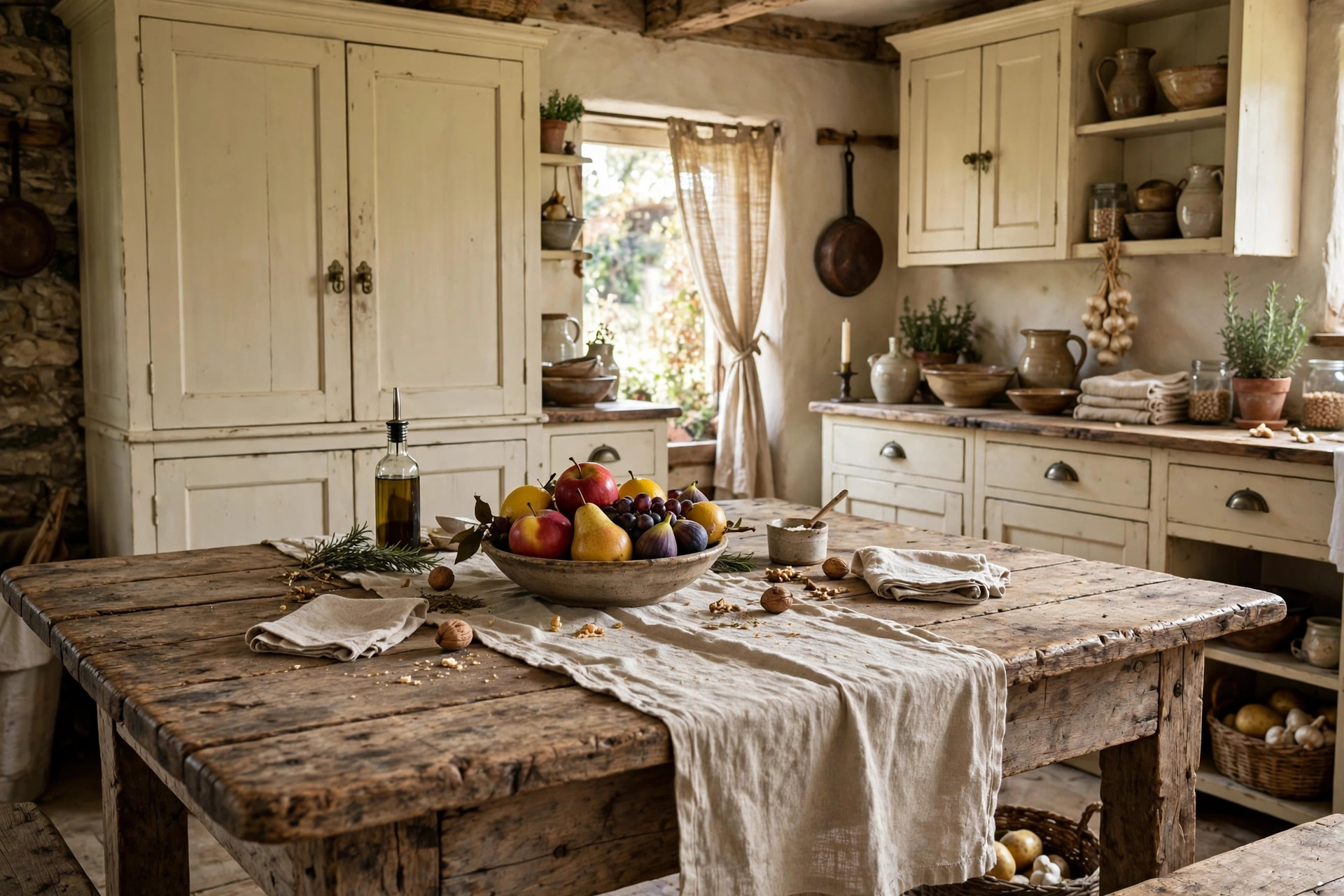
In a village kitchen the table is the island, the desk and the place every conversation ends up. Choose the biggest solid-wood table your space can hold with comfortable walking room around it, and do not worry about scratches — a worn top is the point. Dress it simply with a linen runner and a bowl of fruit. If it looks ready for someone to sit down with tea, it is styled correctly. Leave about 90 centimetres between table edge and cabinets where space allows, and soften any sharp corners if small children will be racing around it daily.
3. Mix Mismatched Chairs Collected Over Time

Nothing says theme-park faster than a perfectly matched dining set. Instead, gather chairs one or two at a time — a spindle-back here, a ladder-back there, perhaps a bench along one side. Keep them in a similar wood family, or paint one or two the same colour, so the mix feels intentional. Second-hand chairs are plentiful, sturdy and full of the patina new furniture only imitates. Before buying, sit on each chair and lean back gently: a quiet creak is character, but a shifting joint needs gluing and clamping first.
4. Show Honest Wood — Beams, Boards and Grain

Village kitchens celebrate wood that looks like wood. If you have beams, leave them matte; if not, add texture lower down with unpainted cabinet fronts, a boarded pantry door or shelves in reclaimed timber. Avoid orange varnish and high shine, which turn rustic into dated. Clear wax or oil keeps the colour true and lets knots, saw marks and grain do the decorating for you. Test finishes on the back of a door first, and refresh oil or wax in thin coats on surfaces that take daily steam and spills.
5. Choose a Deep Butler Sink With a Linen Skirt

A deep ceramic butler sink is practical in a way shallow modern sinks are not: roasting tins, big pots and bunches of flowers all fit without a fight. Underneath, swap the cabinet door for a gathered linen curtain on a simple rod. The skirt softens the whole run of cabinets, costs very little and can be washed or changed seasonally. Add an aged brass tap and a wooden worktop to complete it. Measure your biggest roasting tin before ordering — a useful butler sink should swallow it flat — and hang the skirt so it slides aside one-handed.
6. Pick Handmade-Look Tiles With a Little Wobble

Perfectly flat, identical tiles belong to a different kind of kitchen. For a village feel, choose tiles with visible variation — rippled glaze, slightly uneven edges and small shifts in tone. Cream, sage and soft clay keep things calm behind a cooker or sink. Laid in a simple stack or brick pattern, the irregular surface catches the light, and that gentle wobble makes a new kitchen feel as though it has a history. Live with a sample board against the wall for a few days first, checking the glaze in morning and evening light, because handmade-look tones shift noticeably.
7. Build an Open Pantry From Baskets and Jars

You do not need a walk-in pantry for the village pantry look. Dedicate one shelving unit or deep cupboard to dry goods in glass jars, onions and potatoes in woven baskets, and oils on a tray. Decanting staples is not just prettier — you can see what you have, so less gets wasted. Mix basket shapes and jar sizes freely; uniformity is the enemy here. Tape the contents and filling month onto each jar lid, and group one full meal’s staples together so cooking stays quick on tired evenings.
8. Hang Copper, Cast Iron and Worn Brass to Use Daily

A rail of real pans above the worktop is decoration that earns its keep. Slightly tarnished copper, well-seasoned cast iron and worn brass utensils bring a warmth and age that nothing new can fake. The rule is simple: hang only what you genuinely cook with, in the order you reach for it. A pan unused for a year is clutter in costume; used daily, this corner polishes itself. Space the hooks so pan rims cannot chip each other, and rub tarnished copper with a halved lemon and salt only when it starts bothering you.
9. Add a Dresser Hutch for Plates and Storage

The traditional kitchen dresser is the village kitchen’s hardest-working furniture: plate grooves up top, drawers and cupboards below, and a surface that becomes a serving station at big meals. A freestanding dresser can be added without touching fitted cabinets, and it instantly breaks up the built-in, showroom look. Display your prettiest plates and jugs, hide everyday essentials behind the doors, and give one shelf to cookbooks. Measure the plate grooves before buying, because modern dinner plates are wider than many antique ones, and anchor the top half to the wall for safety.
10. Soften Hard Edges With Linen and Ticking Stripe

Kitchens are full of hard, wipeable surfaces, so textiles do important softening work. Linen tea towels on a rail, a ticking-stripe curtain under the sink, a washable runner along the worktop and half curtains at the window all add pattern without fuss. Stick to natural fibres and a restrained palette — flax, cream, an indigo stripe — and everything can still go in the wash. Buy two of any washable favourite — one in use, one in the wash — and pre-wash linen before hemming, because natural fibres shrink and soften.
11. Keep Herbs and Produce Out in Daily Use

A village kitchen always has food visibly in progress: herbs on the windowsill, eggs in a bowl, tomatoes ripening on the worktop, bread under a cloth. These are not props — they are the styling. Keep a board out with whatever is next to be cooked, and grow herbs you actually use. It is the same instinct behind grandma core kitchen ideas: a kitchen that looks cooked in, because it is. Turn herb pots a quarter turn every few days so they grow evenly toward the light, and keep board, knife and compost bowl together beside the sink.
12. Go Unfitted With Freestanding Wooden Pieces

The original village kitchen had no fitted units — just separate pieces of furniture, each doing one job. Borrow that feeling by swapping even one element for a freestanding piece: a larder cupboard, a movable butcher’s block, a simple table on castors. Gaps between pieces and furniture-style legs loosen a rigid layout. For contrast, see how white oak and black kitchen ideas use fitted cabinetry for a sharper mood. Leave a hand’s width of clearance behind freestanding units, so crumbs, leads and lost spoons stay easy to retrieve when you clean behind them.
13. Make the Range Cooker the Hearth of the Room
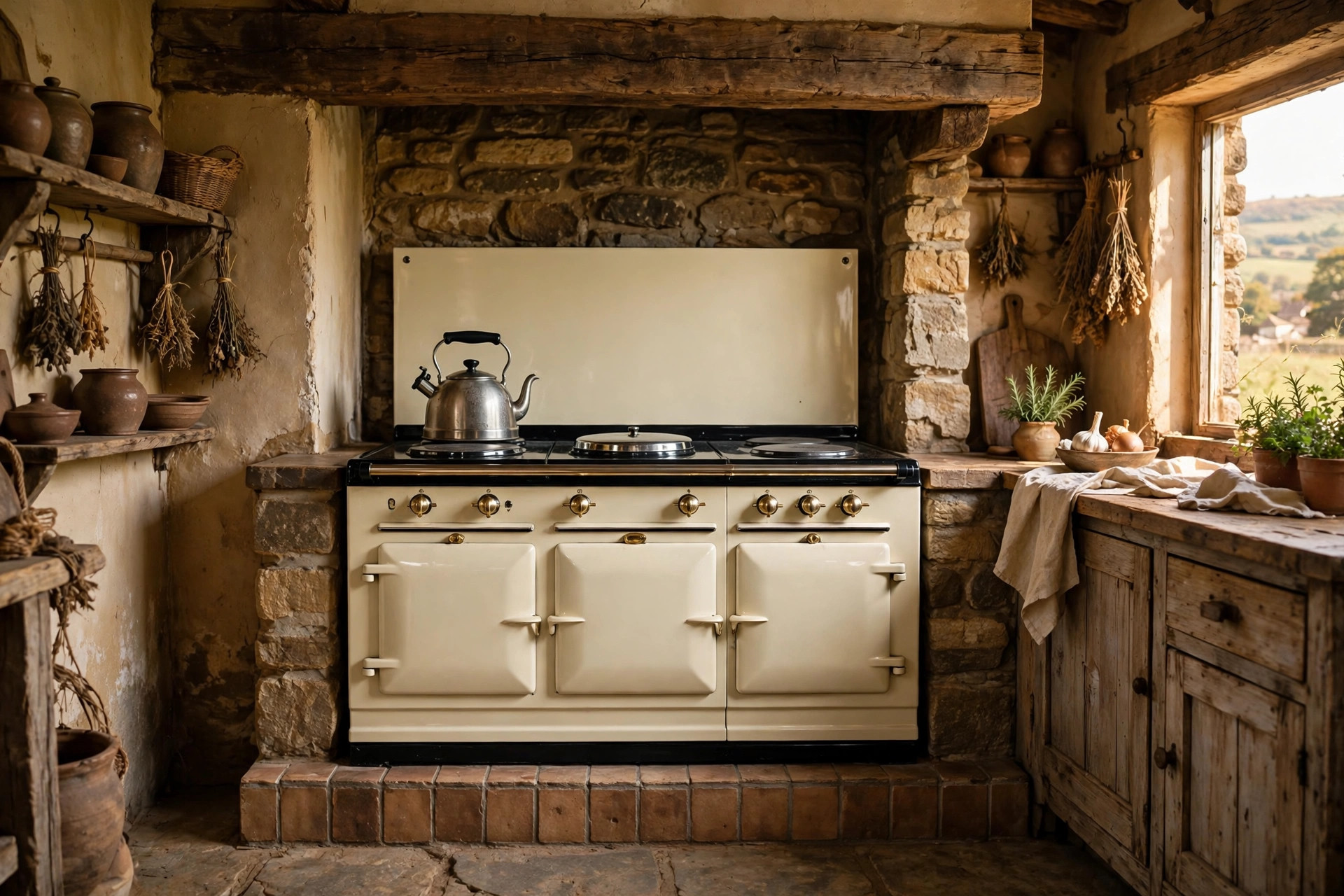
Every village kitchen has a hearth, and in a modern home the range cooker plays that role. A cream, black or deep green range-style cooker, with a kettle permanently on top, gives the room a warm focal point built-in ovens cannot. Frame it with a simple beam or shelf above and tiles behind, and keep your best pans within reach — people naturally gather here while dinner finishes. If a full range is out of reach, borrow the effect: a deep shelf, a cream or black cooker and one generous kettle, centred on the main wall.
14. Layer Low, Warm Lighting Instead of One Bright Light

A single ceiling light flattens everything it touches. Instead, layer three low sources: simple pendants over the table, a small lamp on the worktop or dresser, and candles for evenings. Choose warm bulbs and shades in metal, enamel or linen that suit the room’s materials. The effect is closer to firelight than a showroom. For a moodier glow, see our dark cottagecore kitchen ideas. Put pendants and lamp on separate switches, so the room drops from prep-bright to supper-soft in seconds, and hang pendants low enough to pool light, not glare.
15. Carve Out a Small Window Nook for Slow Mornings

If there is a window with a little spare wall beside it, claim it for a tiny eating nook: a bench or window seat, a small round or drop-leaf table, and two chairs. It becomes the spot for morning coffee, lists and peeling vegetables in company. Keep cushions in washable linen. In a compact room this nook can replace a dining area entirely — our small cottage kitchen ideas show more ways to make small kitchens work hard. Aim for a seat depth of about 40 to 50 centimetres, with a cushion you can plump, and the bench stays comfortable from quick coffees to slow Sundays.
How to Build a Village Kitchen, Step by Step
Start with one piece of real, worn wood — the table, a dresser or shelves — because honest material sets the tone for everything else. Next, open up storage: convert one cupboard run to shelves or a pantry corner so daily things become the display. Then fix the textiles — sink skirt, towels, runner, window dressing — for softness, and layer the lighting. Add small collected pieces last, and slowly. If any step makes the kitchen harder to cook in, undo it: in this style, usefulness is the aesthetic.
Work in passes, not all at once: first clear the worktops and return only what you use weekly, then hang the rail or put up the first shelf. Over the next month, sort the textiles, skirt one cabinet and borrow a lamp from another room to test the lighting. Let a whole season of cooking choose the final pieces, placing each one where your habits already gather — the dresser where serving actually happens, the nook where the morning light actually lands. That order, function before decoration, is what stops the finished room feeling staged.
Common Mistakes to Avoid
1. Buying the whole look at once. A kitchen decorated in a single weekend reads as a set, however lovely the pieces. Matching distressed finishes and a full rail of unused pans give it away. Collect gradually, and mix real old pieces with honest new ones.
2. Confusing clutter with character. Lived-in does not mean covered. Every worktop still needs a clear stretch for cooking, and every displayed object should be used, loved or both.
3. Overdoing the rustic signals. Slogan signs, faux beams everywhere, chicken wire on every door and novelty farm animals tip a kitchen into theme-park territory. One or two rustic gestures per view is plenty — good materials and useful things carry the look.
Frequently Asked Questions
What is a village kitchen?
A rustic, collected style inspired by traditional country cottages: honest wood and stone, freestanding furniture, open shelves, a central table and visible signs of daily cooking. It values usefulness and patina over matching finishes, and should look gathered over time.
How do I get the village look in a modern fitted kitchen?
Keep your cabinets and change the layers around them: add one freestanding piece, convert one wall run to open shelves, swap a cupboard door for a fabric skirt, and layer in linen textiles and warm, low lighting. Those changes shift the whole room’s feeling.
What colours suit a village kitchen?
Warm, earthy neutrals: cream, stone, warm white, sage and soft clay, with small accents of indigo, brick or deep green. Keep the base quiet and let wood, textiles and food provide the colour.
Are open shelves practical?
Yes, if they hold what you use daily — plates, bowls, glasses and jars in constant rotation do not sit long enough to gather much dust. Keep closed cupboards for appliances, plastics and anything reached for only occasionally.
Final Thoughts
The heart of these village kitchen ideas is a simple test: does the room look ready for real life? A table waiting for people, pans within reach, herbs on the sill and shelves of honest crockery will always feel warmer than a perfect, untouched scheme. Build it slowly, choose useful things, and let your kitchen collect its character one ordinary, well-cooked day at a time.


