

15 Warm Wood Kitchen Ideas — Earthy Modern Cabinets, Shelves & Styling
Warm wood kitchen ideas are having a quiet moment, and for good reason: after a decade of grey paint and gloss-white units, a kitchen built around real wood — oak, walnut, alder, even reclaimed pine — feels calm, grounded and unmistakably lived in. The grain does the decorating, so the room needs less styling, fewer accessories and no chasing of the latest colour.
The trick is control. Warm wood turns muddy when too many tones fight, and dated when the finish shines. Get the species, grain direction and sheen right, though, and you have an earthy modern kitchen that pairs with almost anything and ages gracefully. Below are fifteen warm wood kitchen ideas, from full cabinetry runs to small styling moves, plus a step-by-step guide to choosing tones that actually sit well together.
1. Run White Oak Cabinets Wall to Wall, Finished Matte

A full run of white oak is the backbone of the earthy modern kitchen, and rift-sawn boards are the cut to ask for: the grain runs straight and even, without the dramatic cathedral patterns that can make a large run feel busy. Keep the finish matte — a hardwax oil or matt lacquer at a low sheen level — because shine is what tips warm wood cabinets into dated territory. Let the grain run vertically on doors and drawers so the run reads as one calm surface, and choose integrated or edge-pull handles that keep the fronts uninterrupted. White oak’s undertone is gently honeyed rather than yellow, which is why it sits happily beside stone, plaster and brushed brass. Specify sample doors, not swatches, and view them against your floor before committing to the whole run.
2. Pair Walnut Base Cabinets With a Pale, Quiet Upper Run
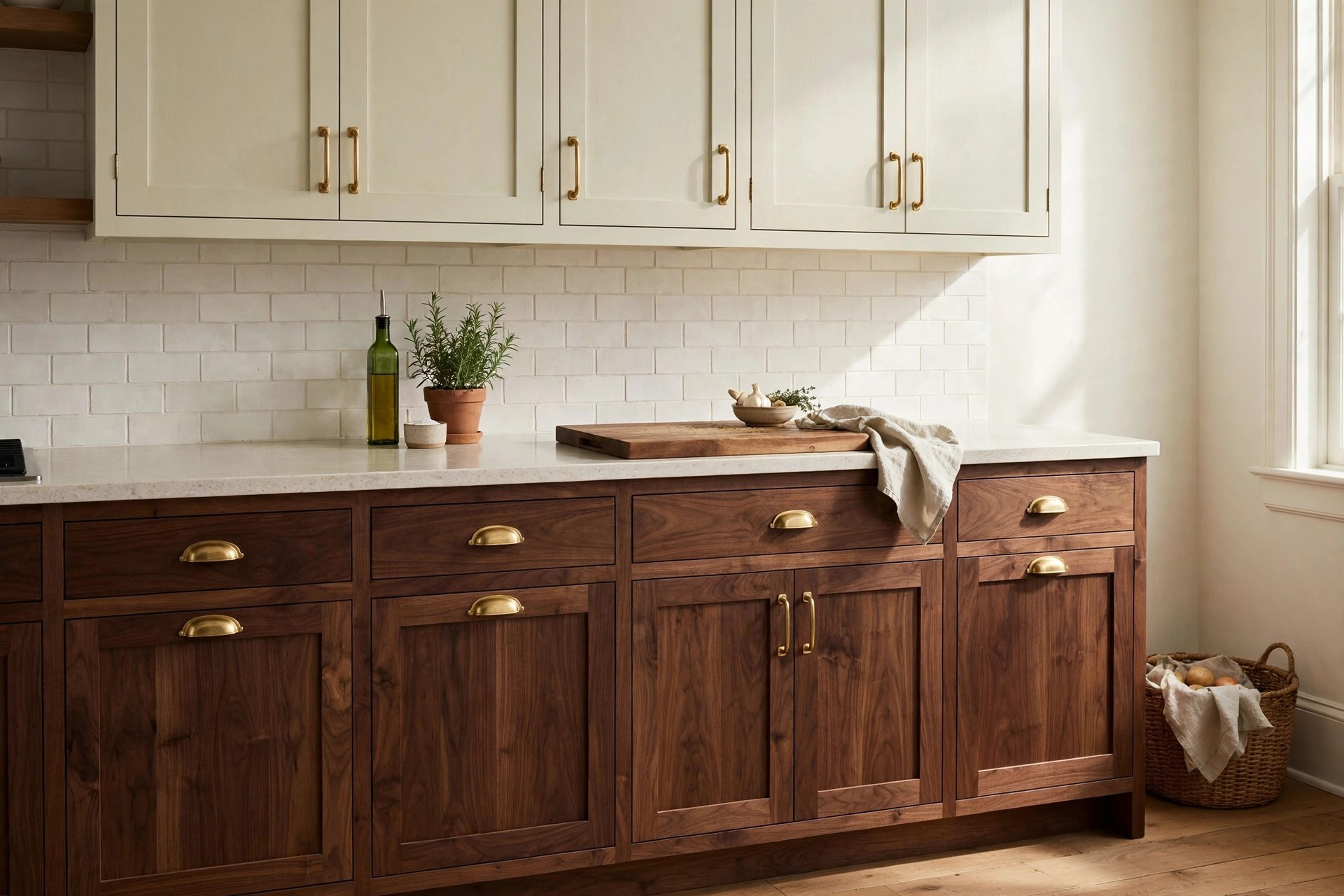
Walnut is the deepest of the warm woods — chocolate-brown, fine-grained and naturally elegant — but a whole kitchen of it can swallow the light. The fix is the classic two-tone split: walnut on the base cabinets, where its weight grounds the room, and a pale painted finish above, where the eye wants air. It is the same logic that makes two-tone kitchen cabinet ideas so reliable, with wood doing the heavy lifting instead of a second paint colour. Keep the upper colour warm — a soft cream or warm white, never blue-white, which fights walnut’s red-brown undertone. Run the walnut grain horizontally on wide drawers for a furniture feel, and repeat the tone once more, in a shelf or stool, so the dark base does not feel like a separate room.
3. Float Thick Wood Shelves Against a Soft Plaster Wall

Thick floating shelves — 40 to 50 millimetres of solid oak or alder — bring warm wood into a kitchen without touching the cabinetry, and they look best against a wall with some texture of its own: limewash, microcement or a soft matte plaster in a warm off-white. The contrast is the point: smooth planed wood against a cloudy, hand-finished wall. Keep the shelf tone close to your cabinet or floor wood, never a third unrelated tone, and anchor the fixings into studs or masonry so the shelves can carry real stoneware. Style them the way you actually cook — everyday bowls, jars and glasses in loose groups, with gaps left deliberately — and stop adding things a shelf earlier than feels natural. Two shelves carry a kitchen further than three crowded ones.
4. Build the Island From Reclaimed Pine and Let It Show Its Age

An island is the one place a kitchen can take real character, and reclaimed pine brings it ready-made: nail holes, saw marks, knots and a honeyed colour that new timber only imitates. Source boards with a consistent thickness, have them planed just enough to sit flat, and finish with a clear hardwax oil that protects without plastic shine. Keep the island’s construction simple — panelled ends, a plain frame, generous overhang for stools — because the timber is the decoration. This is the freestanding, furniture-first instinct behind village kitchen ideas, translated to a modern layout. One caution: reclaimed pine is soft, so treat the top as a working surface that will gather marks gracefully, or cap it with stone and keep the characterful pine for the body and ends instead.
5. Choose Slab-Front Alder for a Soft Earthy-Modern Line
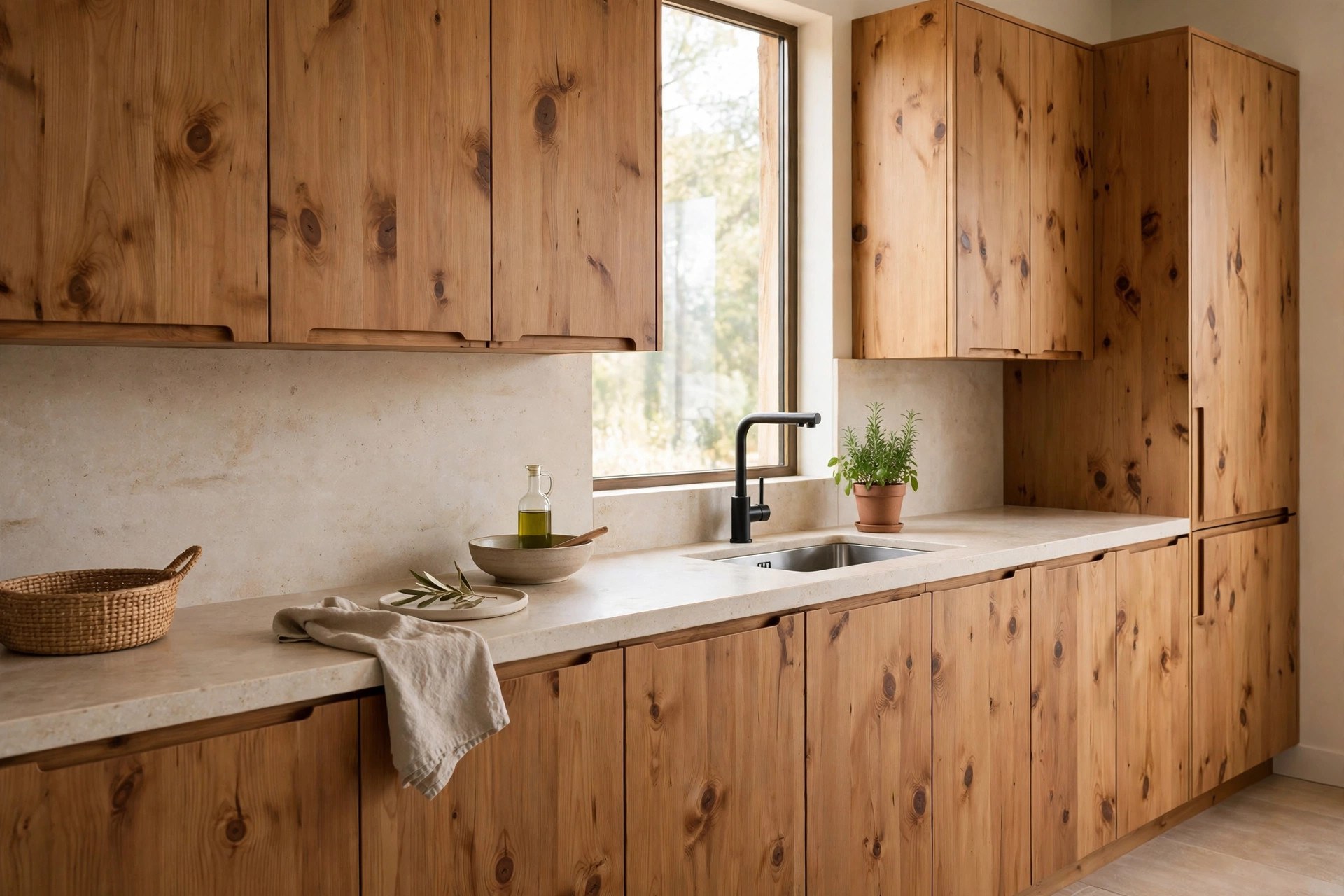
If oak feels too crisp and walnut too formal, alder is the warm wood in between: honey-toned, fine-grained, with small knots that give slab fronts just enough life. Slab fronts — flat doors with no frame or bevel — are the earthy modern default because they let a continuous run of grain act as the pattern, and alder takes stain evenly, so you can nudge it paler or deeper without blotching. It is the species to choose when you love the warmth of rustic modern kitchen ideas but want cleaner lines. Keep hardware minimal, a slim edge pull or a push-latch, and let tall units run to the ceiling so the grain reads as panelling. Ask for the doors to be sequenced from consecutive boards where the budget allows; matched grain across a run is the detail that makes simple fronts look expensive.
6. Repeat the Cabinet Tone in Ceiling Beams

Beams are the oldest warm-wood gesture there is, and they work in a modern kitchen for one reason: repetition. When the beams echo the cabinet tone — same species family, same matte finish — the room reads as one material idea carried from floor to ceiling, rather than a rustic accessory dropped in. Solid beams are heavy and costly to retrofit, so consider hollow box beams in real oak veneer or thin solid boards; fitted carefully, they are indistinguishable once up. Keep the number low, two or three across the room, and align them with the island or the main run rather than scattering them. This is the structural warmth that farmhouse kitchen ideas have always traded on, and it is why beams succeed here and fail when they clash with the wood below.
7. Lay Butcher-Block Worktops and Keep the Sheen Low

A butcher-block worktop is the most affordable way to put serious warm wood into a kitchen, and the most honest: it will be cut beside, set down on and wiped a thousand times. Choose a dense species — oak, beech or walnut over soft pine — with the grain strips running lengthways, and seal it with oil or hardwax oil rather than varnish. Oil gives a low, warm sheen, can be spot-repaired with a cloth and ten minutes, and never peels; varnish shines, then chips. Re-oil the areas around the sink and hob whenever water stops beading, and keep a board under anything very hot or heavily pigmented. A practical compromise many earthy modern kitchens use: stone around the sink and hob, butcher block on the island or a secondary run, so the wood works where it is driest.
8. Turn the Grain Vertical on Tall Cabinet Fronts

Grain direction is a design decision most people never make, and it changes a room. On tall units — larder, oven housing, a full-height run — running the grain vertically draws the eye upward, makes ceilings feel higher and gives a flat modern front a quiet, architectural rhythm. Horizontal grain, by contrast, stretches a low run and suits wide drawers. The rule of thumb: vertical on tall doors, horizontal on wide drawers, and be consistent within each run, because mixed directions read as a mistake rather than a choice. Rift- or quarter-sawn boards hold a straight vertical line best. If you are ordering semi-custom cabinets, specify grain direction on the order, not at installation — it is chosen when the boards are laid up, long before the doors reach your kitchen.
9. Tuck a Wood Banquette Into the Sunniest Corner

A built-in banquette is warm wood doing three jobs at once: seating, storage and architecture. Build the bench body in the same oak or alder as the cabinets, top it with a hinged lid over a storage box, and soften the back with loose linen cushions rather than fixed upholstery, which dates faster and costs more to change. A bench seat around 45 centimetres high and 40 to 50 deep, with a round or oval table, lets people slide in without the chair-shuffling a square corner demands. Place it where the morning light lands if you can — a nook in a dark corner gets used for storage, not breakfasts. Finish the bench in the same matte oil as the cabinetry so it reads as part of the kitchen, and let the cushions carry whatever soft colour the room wants.
10. Clad the Range Hood in the Same Warm Wood

A stainless hood can slice a warm wood kitchen in two. Cladding the chimney in the same wood as the cabinets — walnut panels over walnut bases, oak over oak — turns an appliance into a piece of the architecture and gives the cooking wall a calm, continuous backdrop. Keep the shape simple: a tapered or straight box with mitred corners, finished in the same matte sheen, reads modern; add applied mouldings and it tips traditional. Practicalities matter: use the manufacturer’s clearances, line the interior with metal where the maker requires it, and choose a finish you can wipe, because the hood collects grease film like nowhere else. A slim shelf or rail beneath the hood, in the same wood, completes the picture and holds the pans and utensils you reach for daily.
11. Contrast the Floor and Cabinets by Two Shades, Never More
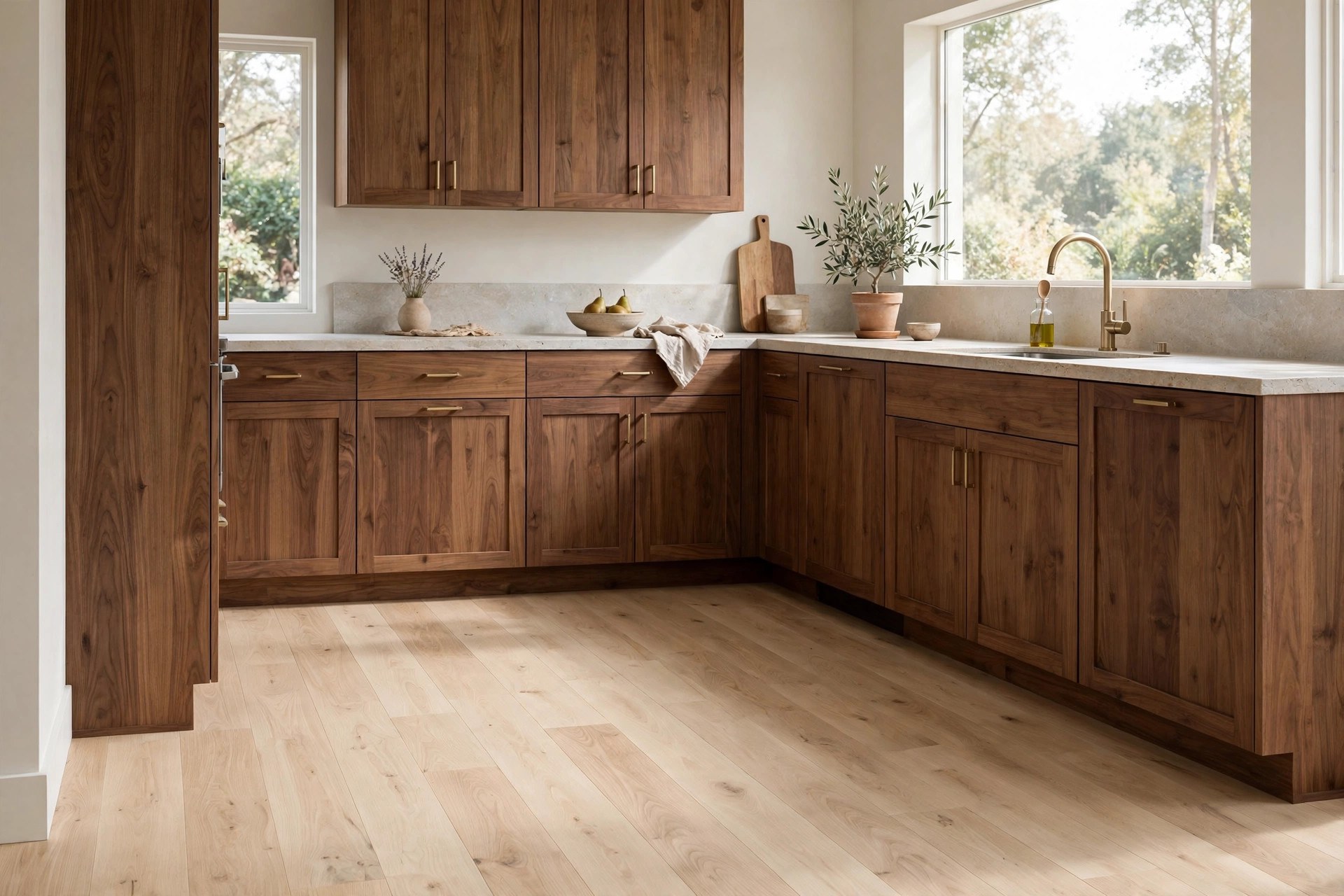
The most common warm wood failure is a floor and cabinets that nearly match: close enough to clash, too close to contrast. Wood on wood works when the difference is deliberate — aim for about two shades of separation on the same warm scale. A pale oak floor under mid-tone walnut cabinets is the clearest version; a mid-oak floor under pale white-oak cabinets works the other way. Test actual boards together, not screen images, and test them vertically as well as flat, because light hits a door and a floor at different angles and shifts both. If your floor is fixed and mid-toned, steer the cabinets clearly paler or clearly deeper rather than chasing a match. One more guardrail: keep the two woods in the same undertone family — both honey-warm or both slightly greyed — or the contrast will read as an argument. For the boldest version of this thinking, see how white oak and black kitchen ideas push pale wood against near-black contrast.
12. Use Glass-Front Uppers in a Warm Wood Frame
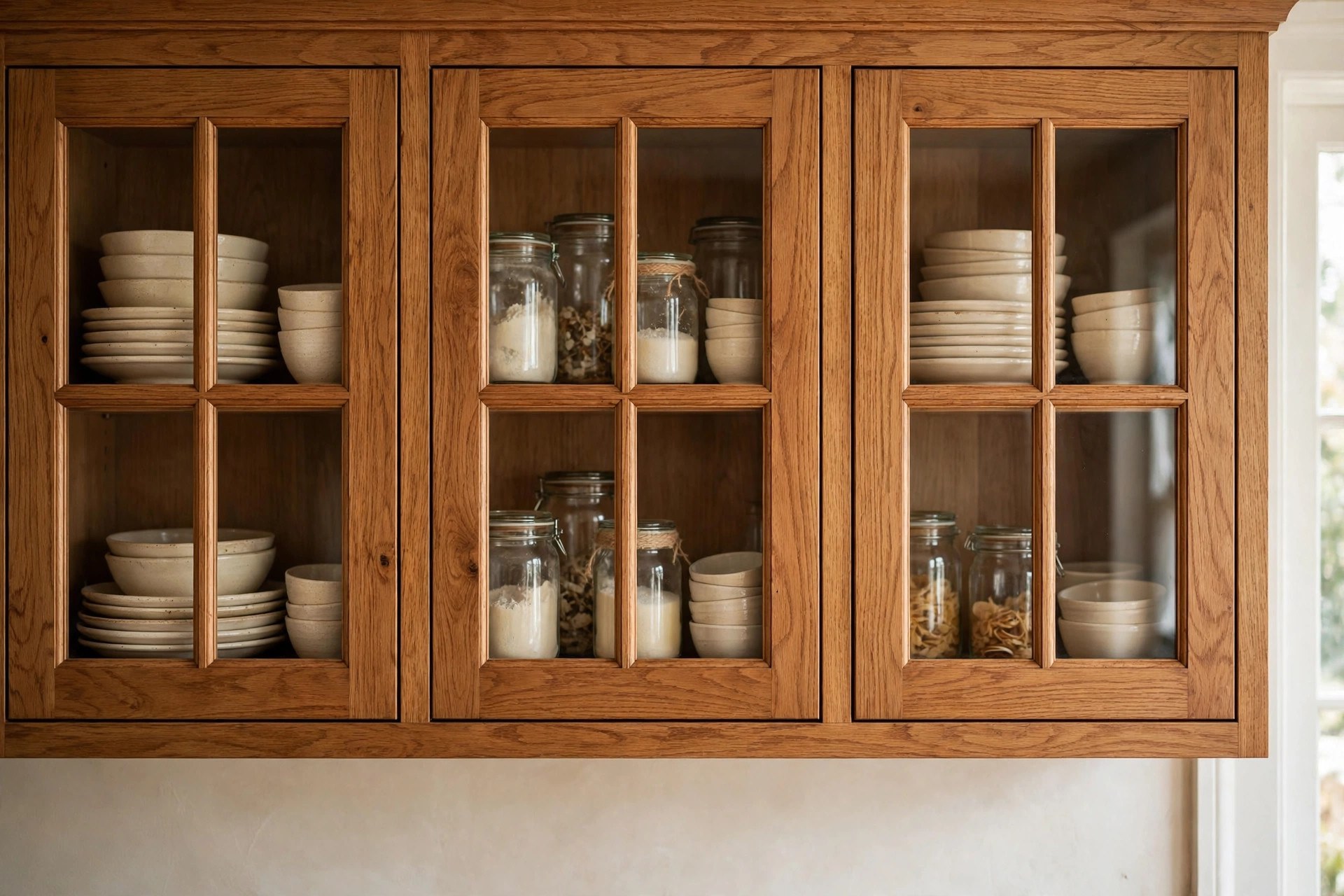
Glass-front uppers lighten a full run of wood without breaking its material story, because the frame carries the same oak or alder as the solid doors below. They work hardest over a sink or along the wall you see from the doorway, where a solid run would feel heaviest. Behind the glass, keep to one calm palette — cream dishes, clear glass, a few wooden boards — since everything is on permanent display; this is not the cupboard for novelty mugs. Plain glass keeps the look modern and honest, while reeded glass softens the contents and forgives less-than-perfect stacking. Match the interior to the frame or paint it the colour of your walls so the cupboard reads as a window into the room, and use them for the pieces you use weekly, which keeps the display fresh by itself.
13. Panel One Wall in Narrow Wood Slats

A single wall of narrow wood slats gives an earthy modern kitchen texture, rhythm and a little sound-softening, all in one treatment. Slats around 25 to 40 millimetres wide with a slim shadow gap, run floor to ceiling in oak or alder, suit the wall behind a dining table, the end of an island run or the face of a peninsula best — one surface, treated fully, rather than strips scattered around the room. Keep the finish matte and the tone inside your existing wood family. Slatted panels are widely available as ready-made boards, which makes this a weekend-scale project rather than a joinery commission. Dust settles in the gaps, so give the wall a soft-brush vacuum when you do the floors. Stop the slats at the kitchen’s edge; carried everywhere, the rhythm that made one wall special becomes visual noise.
14. Let Stools, Boards and Bowls Carry Wood to the Room’s Edges

Not every warm wood idea needs a joiner. Stools in turned oak, a stack of end-grain chopping boards leaning at the splashback, turned bowls, a wooden utensil pot — these small pieces carry the material to the edges of the room so the cabinetry does not feel like the only wood in it. The discipline is tone and number: keep small pieces within your main wood family or deliberately echo the secondary one, and group them in odd-numbered clusters rather than lining them up. Choose things that work for their place — boards you cut on, bowls that hold fruit, stools people sit on daily. A stool is also the cheapest full stop in a kitchen that feels almost right: swap metal or painted stools for solid wood and the whole island end warms up for very little money.
15. Style Warm Wood With Stone, Linen and Something Green
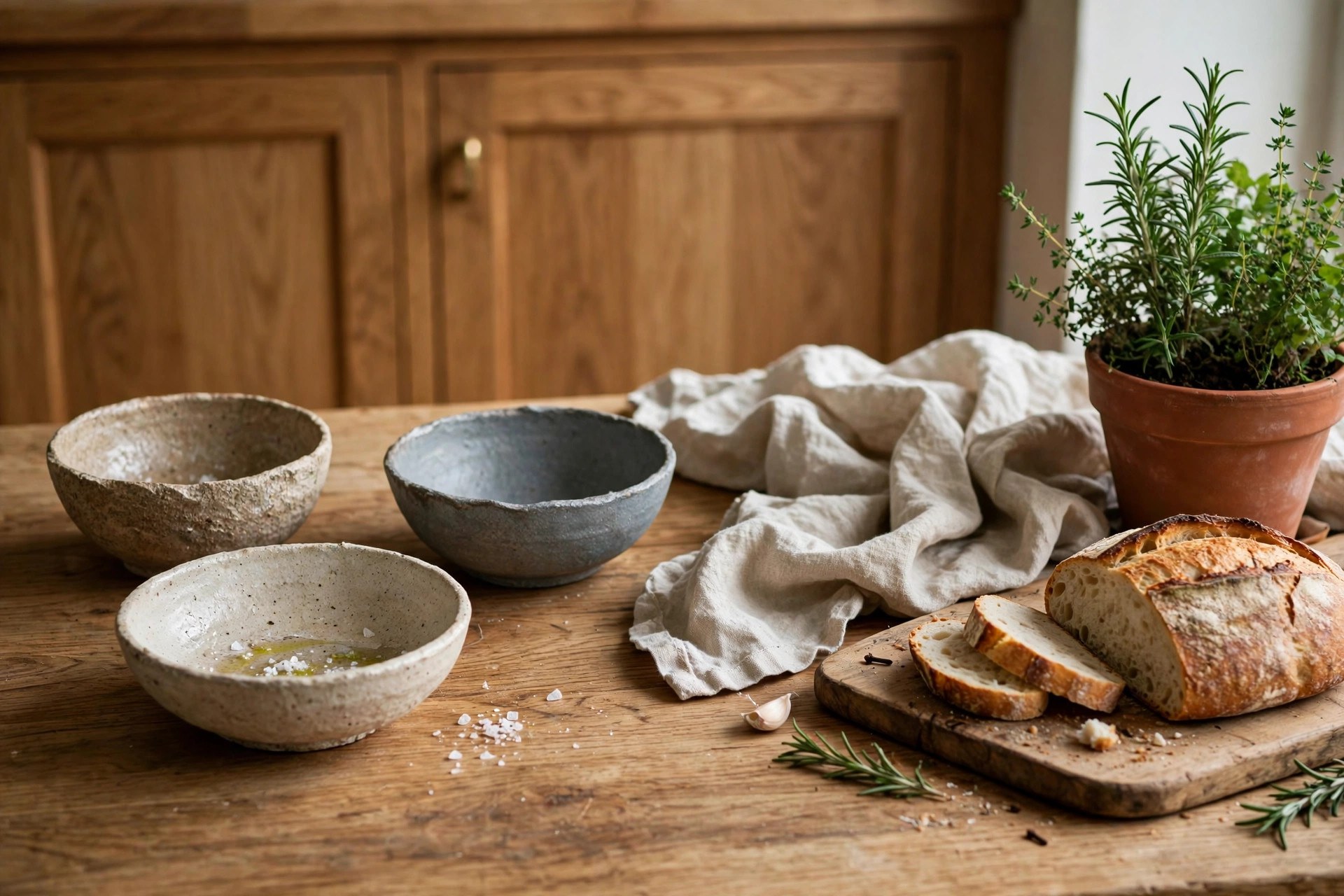
Warm wood is a background as much as a feature, and it is styled best with materials that share its honesty. Cool stone — a marble or granite board, rough stoneware bowls — sharpens wood’s softness and stops a room sliding into brown-on-brown. Linen does the softening: a rumpled runner, napkins, a curtain at the sink window, in flax, cream or a faded stripe. Then add something alive: a terracotta pot of herbs on the sill, a branch in a tall jar, a bowl of lemons or artichokes on the island. Keep metal to one finish, ideally brushed brass or aged bronze, whose warmth flatters every wood in this article. The test is tactile: if everything in the room is smooth and shiny, add texture; if everything is rustic, add one smooth stone piece. Balance, not more stuff, is the finishing move in all warm wood kitchen ideas.
How to Choose Warm Wood Tones for Your Kitchen, Step by Step
Step 1: Read the undertone, not the colour name. Every warm wood carries an undertone — honey-yellow in white oak, red-brown in walnut and cherry, pinkish in some pines. Hold your sample against a sheet of plain white paper in daylight and the undertone shows itself within seconds. Write it down. Every later choice, from paint to floor, has to agree with that undertone, because woods with clashing undertones look dirty next to each other even when each is beautiful alone.
Step 2: Check your light before you choose a depth. North-facing kitchens receive cool, blue-grey light that deepens warm wood and can make walnut feel almost black by evening; south-facing rooms flood wood with warm light and can push honey oak toward orange. A mid-tone wood is the safe centre in dim rooms, with pale wood reserved for genuinely dark ones and deep walnut best where daylight is generous. Note which way your kitchen faces before you fall for a sample photographed in someone else’s sunshine. If the room faces north and your heart is set on walnut, plan the balance early: pale worktops, a light floor and warm-white walls will give the deep wood the contrast it needs to glow rather than gloom.
Step 3: Limit the room to two woods. One main wood — the cabinets — and one supporting wood — the floor, island or shelves. A third wood almost always reads as an accident. If your floor already counts as wood one, your cabinets are wood two, and shelves, stools and boards must borrow from one of those two families. This two-wood rule is the single most useful discipline in warm wood kitchen design.
Step 4: Test big samples, in place, for several days. Small swatches lie. Order or borrow full door samples and offcuts of the floor, prop them where they will live — doors vertical, flooring flat — and look at them in morning, midday and lamplight. Check the junctions: floor against cabinet, worktop against door. Live with the combination through a full cycle of cooking and cleaning before you sign anything off. Photograph the samples on your phone in each light as well — a camera exaggerates undertone clashes your eye forgives in person, and a clash visible in a photograph will quietly bother you for years.
Step 5: Fix the finish and the grain direction on paper. Decide the sheen — matte or low-satin almost everywhere — and the grain direction for tall doors and wide drawers, and get both written into the order. These two choices cost nothing and change everything, and both are effectively impossible to alter once the kitchen is made. When every sample passes the undertone test, the light test and the two-wood rule, your combination will hold together for decades.
Common Mistakes to Avoid
1. Mixing three or more wood tones. Oak cabinets, a walnut island, pine shelves and a beech floor each look fine alone; together they read as leftovers. Pick two woods and make every later purchase answer to them, or the room never settles.
2. Choosing a glossy or orange-toned finish. High-sheen varnish and amber stains are what make warm wood look dated. A matte oil-based finish keeps the colour true to the timber, can be refreshed in place, and ages by deepening rather than peeling.
3. Matching the floor and cabinets too closely. A near-match is worse than a clear contrast: the two surfaces blur into one brown mass and both look wrong. Separate floor and cabinet tones by roughly two shades, and keep their undertones in the same family.
Frequently Asked Questions
What is the warmest wood for kitchen cabinets?
Walnut and white oak are the two most reliable warm choices. Walnut brings deep chocolate-brown warmth and suits a two-tone scheme with pale uppers; white oak is honey-toned, versatile and the backbone of most earthy modern kitchens. Alder is a softer, more budget-friendly warm option, and reclaimed pine gives the warmest, most characterful finish of all.
Can you mix two wood tones in one kitchen?
Yes — two is the working maximum. Pair one main wood with one supporting wood, separate them clearly in depth (about two shades), and keep their undertones in the same warm family. Repeat each wood at least twice in the room so both read as decisions, not accidents.
Which finish keeps warm wood from looking orange?
A matte or low-sheen hardwax oil, or a matt lacquer, finished without amber-tinted varnish. Oil-based clear finishes deepen the grain without adding yellow-orange colour. Always test the finish on the back of a door or an offcut first, since finishes darken every species slightly.
Does warm wood work in a small kitchen?
Yes, if you choose the paler end of the warm range and keep surfaces calm. White oak or alder cabinets, a matte finish, vertical grain on tall doors and one glass-front run will make a small kitchen feel warm without closing it in. Save deep walnut for a base run or the island.
Final Thoughts
The heart of these warm wood kitchen ideas is restraint: two woods, one undertone family, a matte finish and grain you have chosen on purpose. Get those four decisions right and almost any layout — full oak run, walnut two-tone, reclaimed island — will feel earthy, modern and calm. Choose slowly, test big samples in your own light, and let the grain be the decoration it already is.


