

15 Above-Bed Decor Ideas When You Have No Headboard
A bed without a headboard is not an unfinished bed — it is a blank wall waiting for a better idea.
The headboard’s real job was never the board itself: it gave the bed a focal point, filled the empty stretch of wall above the pillows, and made the room feel anchored. Art, paint, fabric and panelling can all do that job.
The trick is to treat the wall itself as the headboard: work to the width of your bed, hang things lower than you would above a sofa, and choose treatments that connect to the pillows rather than floating in space.
Our modern bedroom wall art ideas show the frames and scales that work hardest in a bedroom.
Below are fifteen above-bed decor ideas for beds with no headboard, from an oversized print to a painted arch.
This post contains affiliate links. If you buy through them, we may earn a small commission at no extra cost to you. See our Affiliate Disclosure.
1. Hang One Large Print Low and Centred
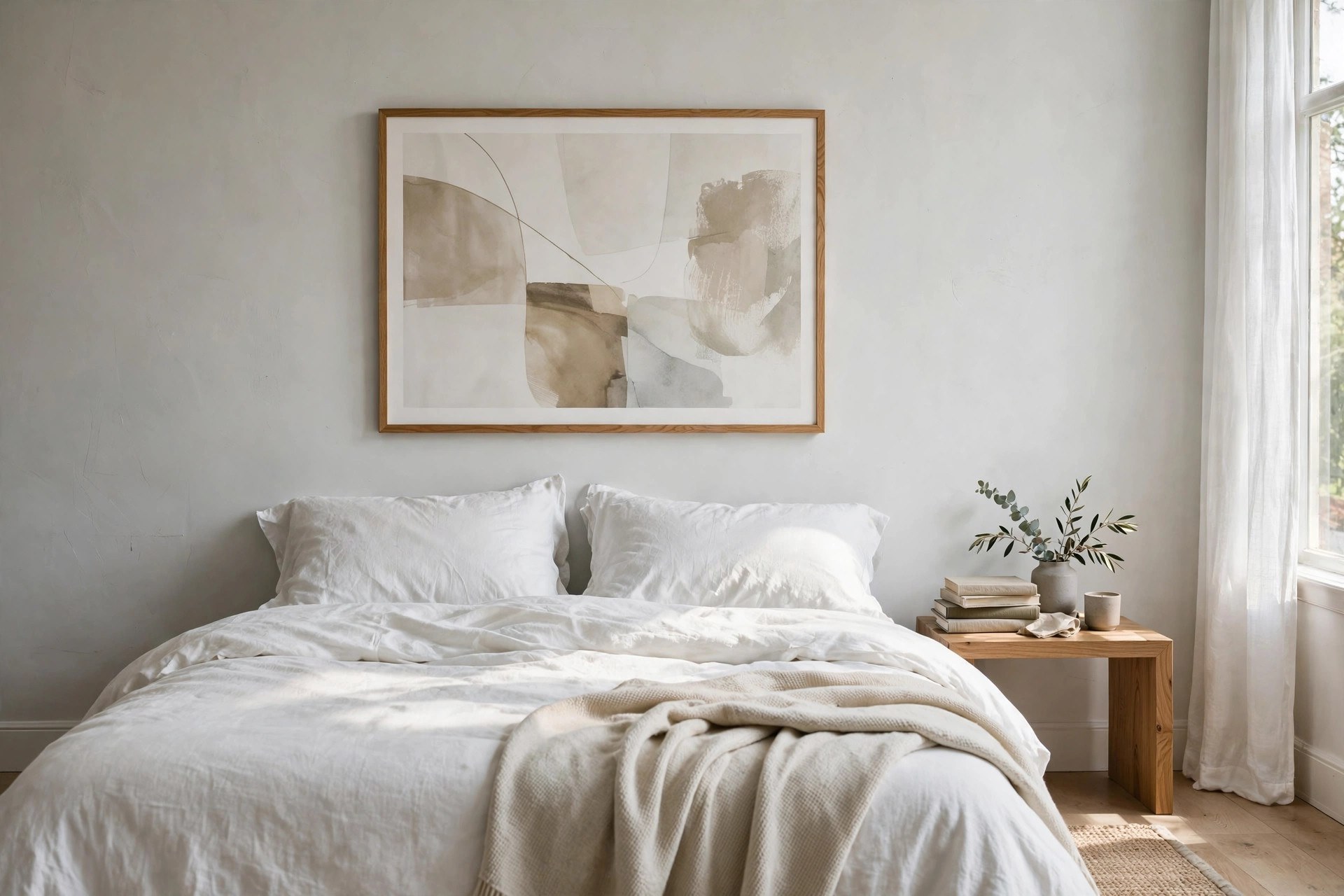
One generous print is the simplest substitute for a headboard, and the sizing is what makes it work. Aim for a frame roughly two-thirds the width of your mattress, so the art feels married to the bed rather than passing over it.
Hang it lower than instinct suggests: the bottom edge should sit about 20 to 25 centimetres above the top of your stacked pillows, close enough that art and bedding read as one composition.
Choose a calm, wide image — landscape, abstract, soft photography — in a slim frame, centred on the mattress rather than the wall.
2. Paint a Faux-Headboard Arch
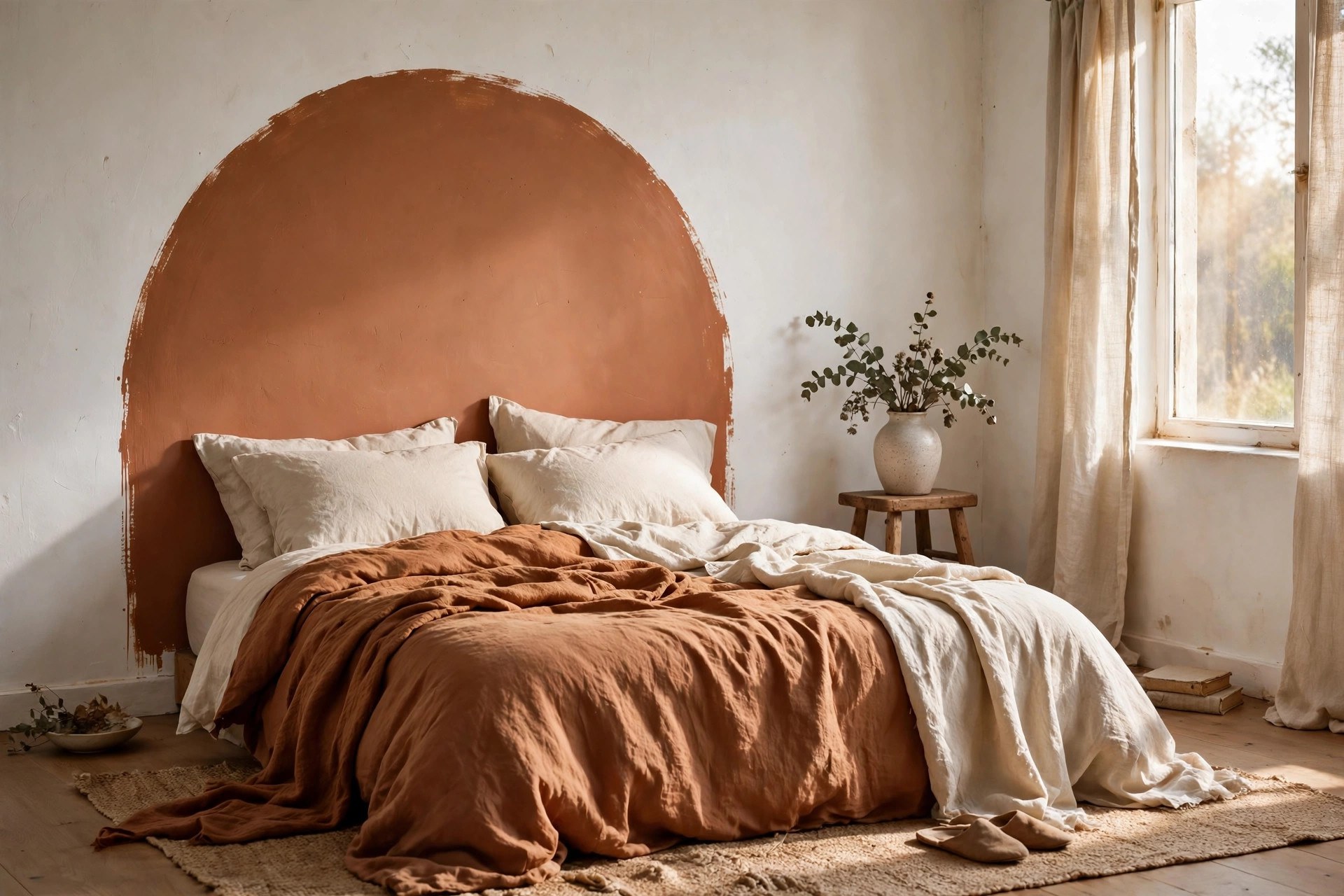
A painted arch gives you the silhouette of a headboard for the price of a sample pot.
Mark the centre of the bed on the wall, then draw an arch 10 to 15 centimetres wider than the mattress on each side, rising to around 140 centimetres from the floor.
A string looped around a pencil, pinned at the centre point, draws a smooth curve; tape keeps the sides straight. Fill it in two coats, brushing vertically for an even finish.
Terracotta, clay, sage and warm ochre all sit happily behind cream bedding — and one coat of paint undoes it entirely.
3. Hang a Matching Pair for Instant Symmetry
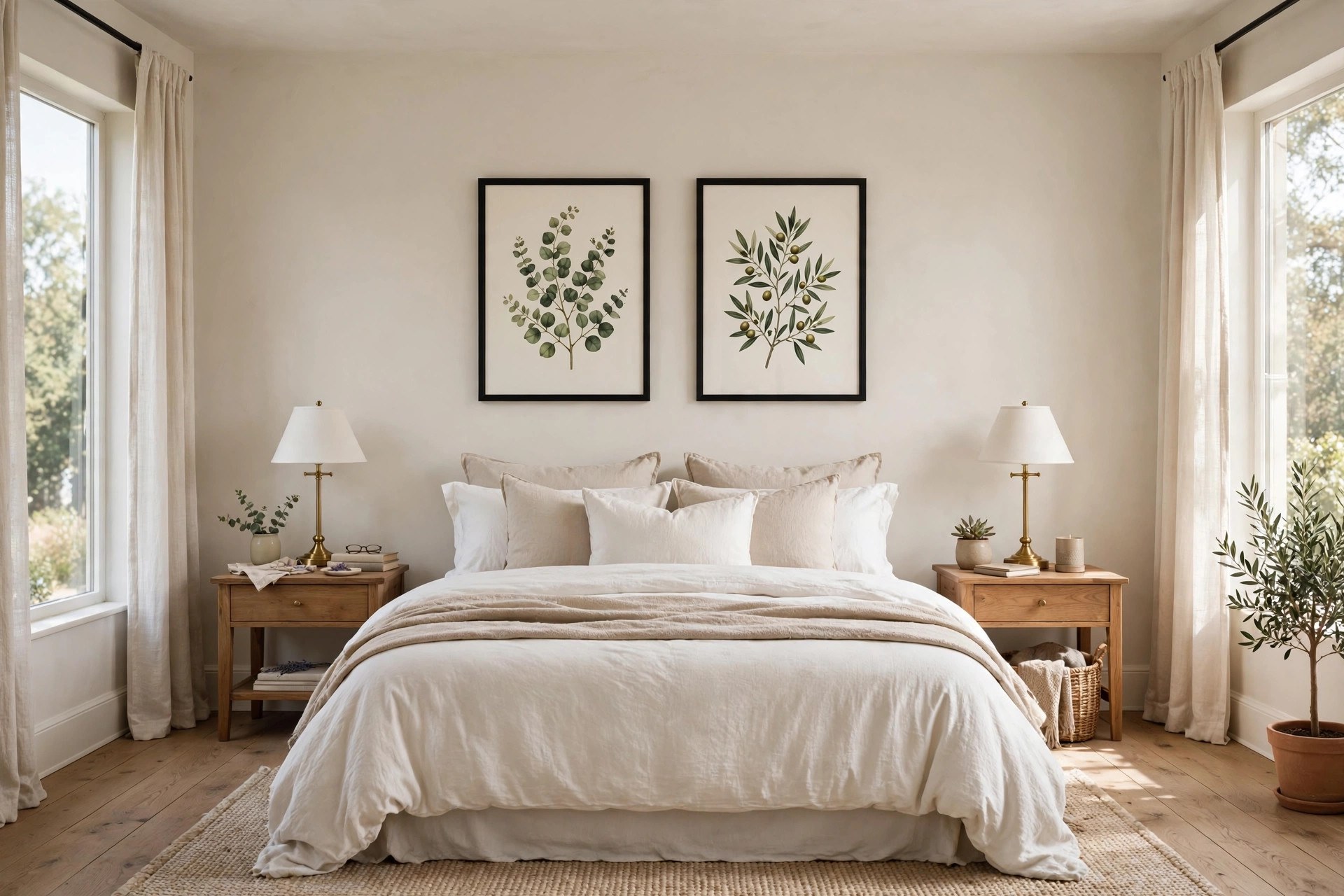
If measuring one huge frame feels risky, split the job in two. A matching pair of prints — botanical studies, line drawings, the same photograph in mirrored crops — creates the balanced, deliberate look a headboard gives, with far less measuring anxiety.
Together the pair should span about two-thirds of the bed’s width, with a gap of 5 to 8 centimetres between the frames, tops level and bottom edges just above pillow height.
Symmetry suits calm, traditional schemes best, and it flatters matching nightstands and lamps, because the whole wall settles into a rhythm that reads as finished.
4. Hang a Woven Tapestry From a Simple Rod
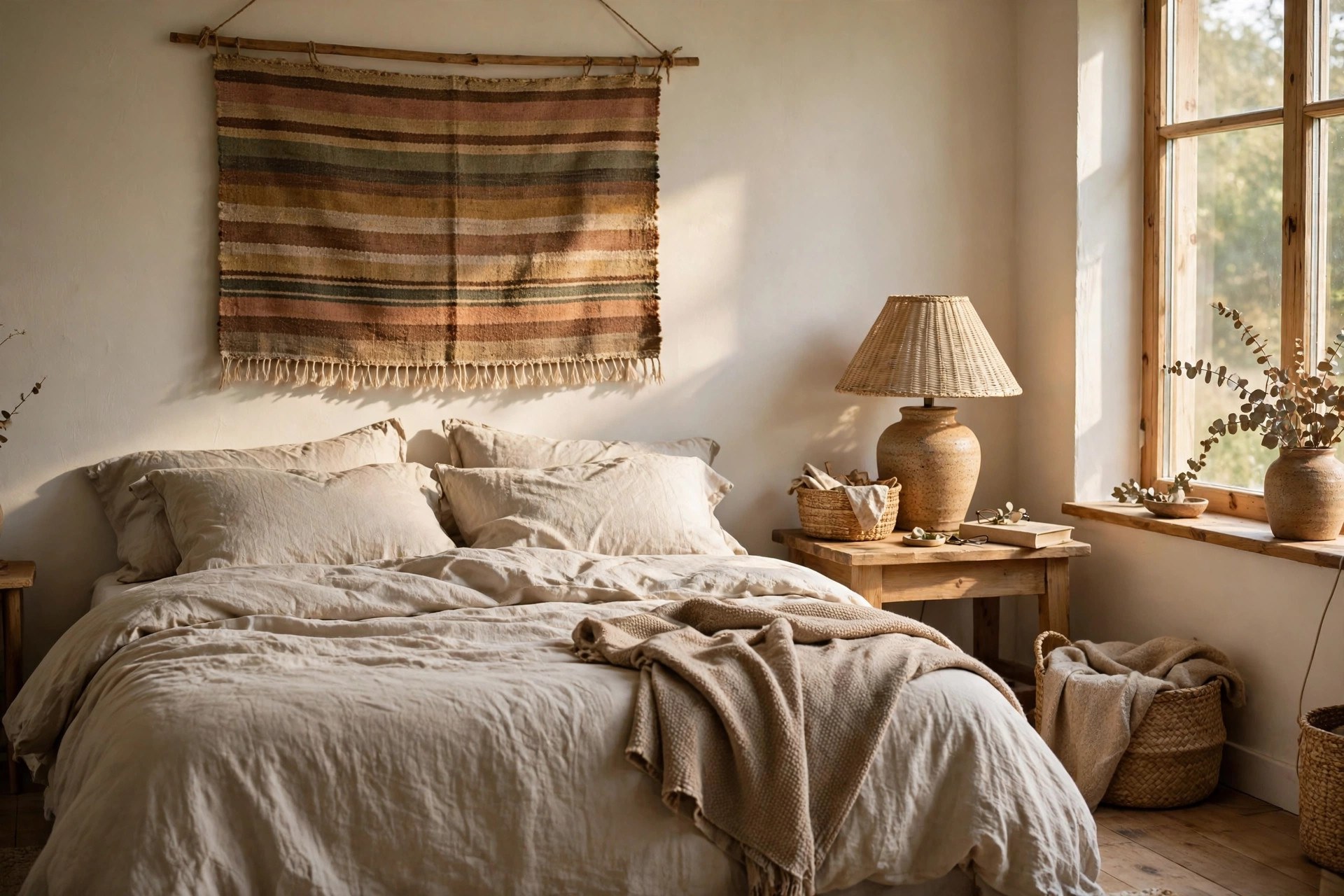
Fabric does what no frame can: it softens the hard rectangle of the bed and muffles a bare wall.
A woven tapestry, kilim-style hanging or even a beautiful throw, suspended from a slim wooden dowel or metal rod, covers a wide area for very little weight — a real advantage above a bed, where heavy fixings are unwelcome.
Choose a hanging close to the full width of the mattress, its bottom edge stopping just above the pillows so it reads as a headboard’s back panel. Steam it flat first; creases catch the light and cheapen the effect.
5. Build a Gallery Wall Inside an Invisible Rectangle
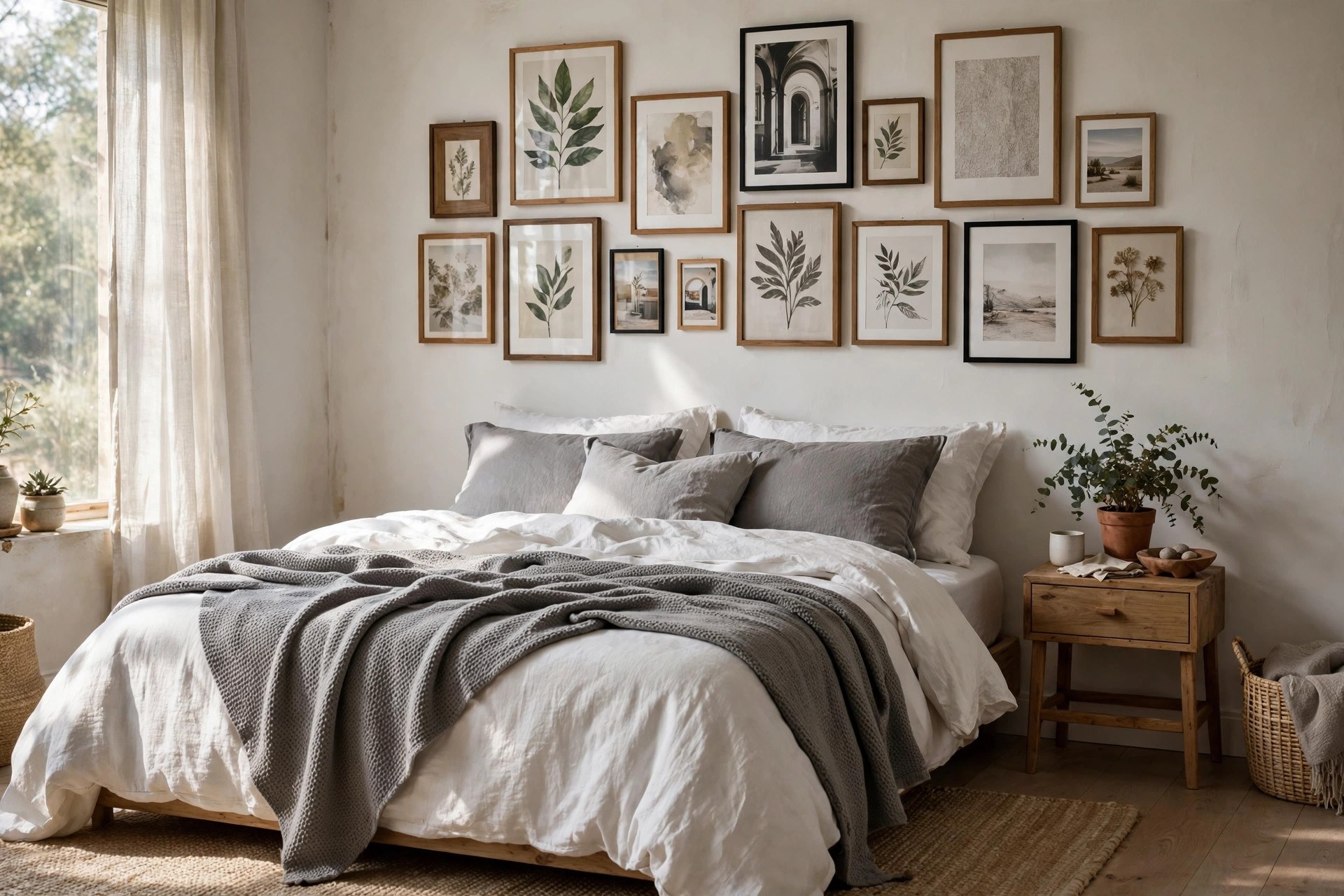
A gallery wall works above a headboard-free bed if it behaves like one big picture. Mark an invisible rectangle on the wall: roughly the width of the bed, starting just above the pillows and rising 60 to 90 centimetres.
Every frame stays inside it, spaced 5 to 8 centimetres apart, with the largest piece slightly off-centre at eye level.
Mix frame finishes if you like, but keep the art in one loose family — botanicals, black-and-white photography, soft abstracts — so the group feels collected, not random. Our bedroom gallery wall ideas show more layouts.
6. Fit a Slim Picture Ledge — and Fix It Properly
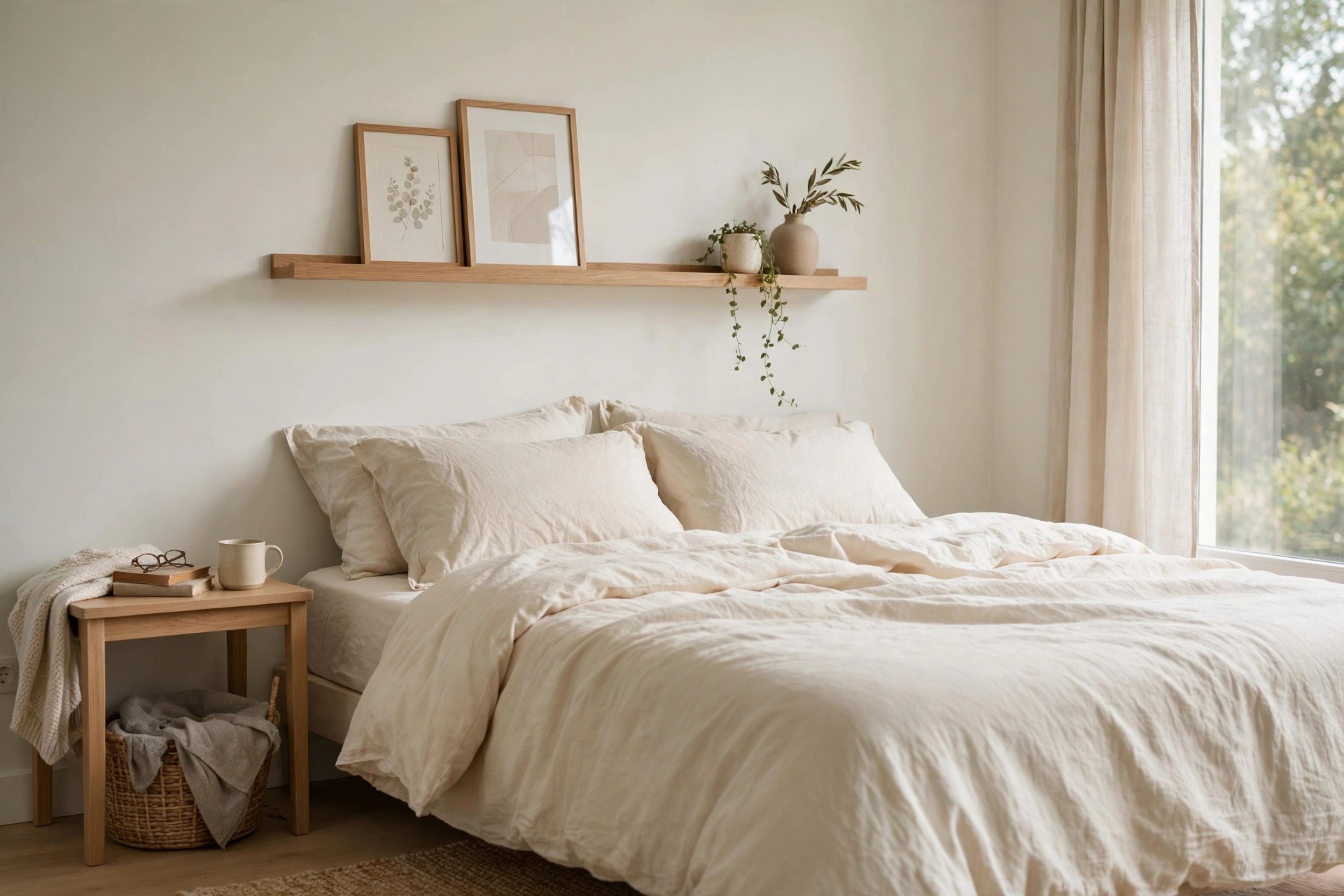
A picture ledge gives you gallery-wall flexibility with two screws: lean small frames, swap them seasonally, add a trailing plant.
Choose a ledge at least two-thirds the width of the bed, mounted so its underside clears the top of your pillows by a good 40 centimetres. The safety note matters, because this shelf hangs where you sleep.
Fix into studs or use anchors rated well above the loaded weight, keep frames light with acrylic rather than glass glazing, and choose a ledge with a raised lip so nothing can creep forward. Heavy ceramics stay off it — small prints and plants only.
7. Use a Round Mirror to Soften the Wall
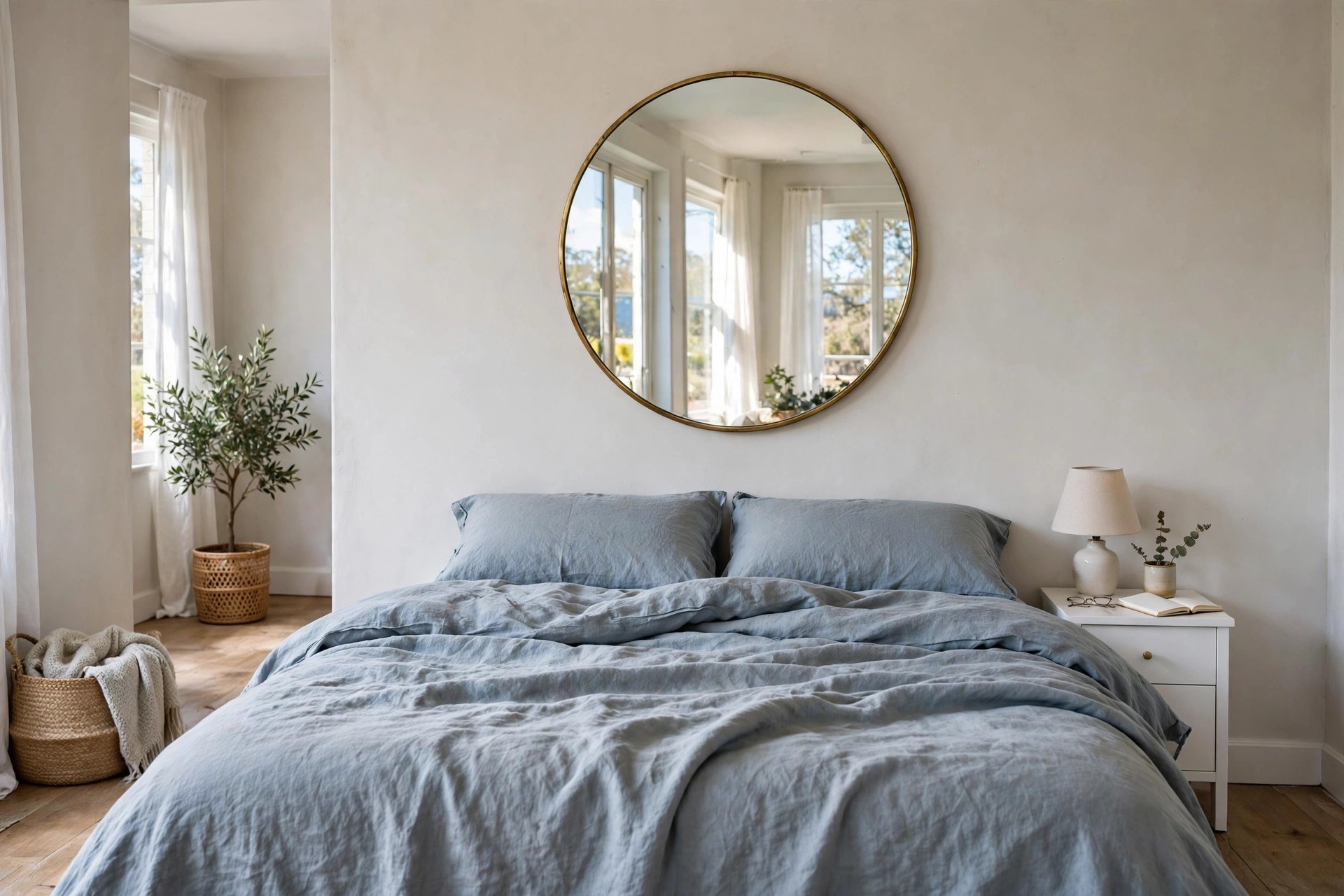
Every other shape above a bed is a rectangle, which is exactly why a round mirror works so well.
It breaks the grid of mattress, pillows and wall, bounces window light deeper into the room, and adds the polish that stops a headboard-free bed looking improvised.
Go large — 60 to 80 centimetres across — hung with its centre around 140 to 150 centimetres from the floor, low enough to belong to the bed.
Before fixing, sit against the pillows and check the reflection: a window or a plant, not a bare ceiling. Slim brass, black or pale wood frames behave best.
8. Panel the Wall With Narrow Wood Slats
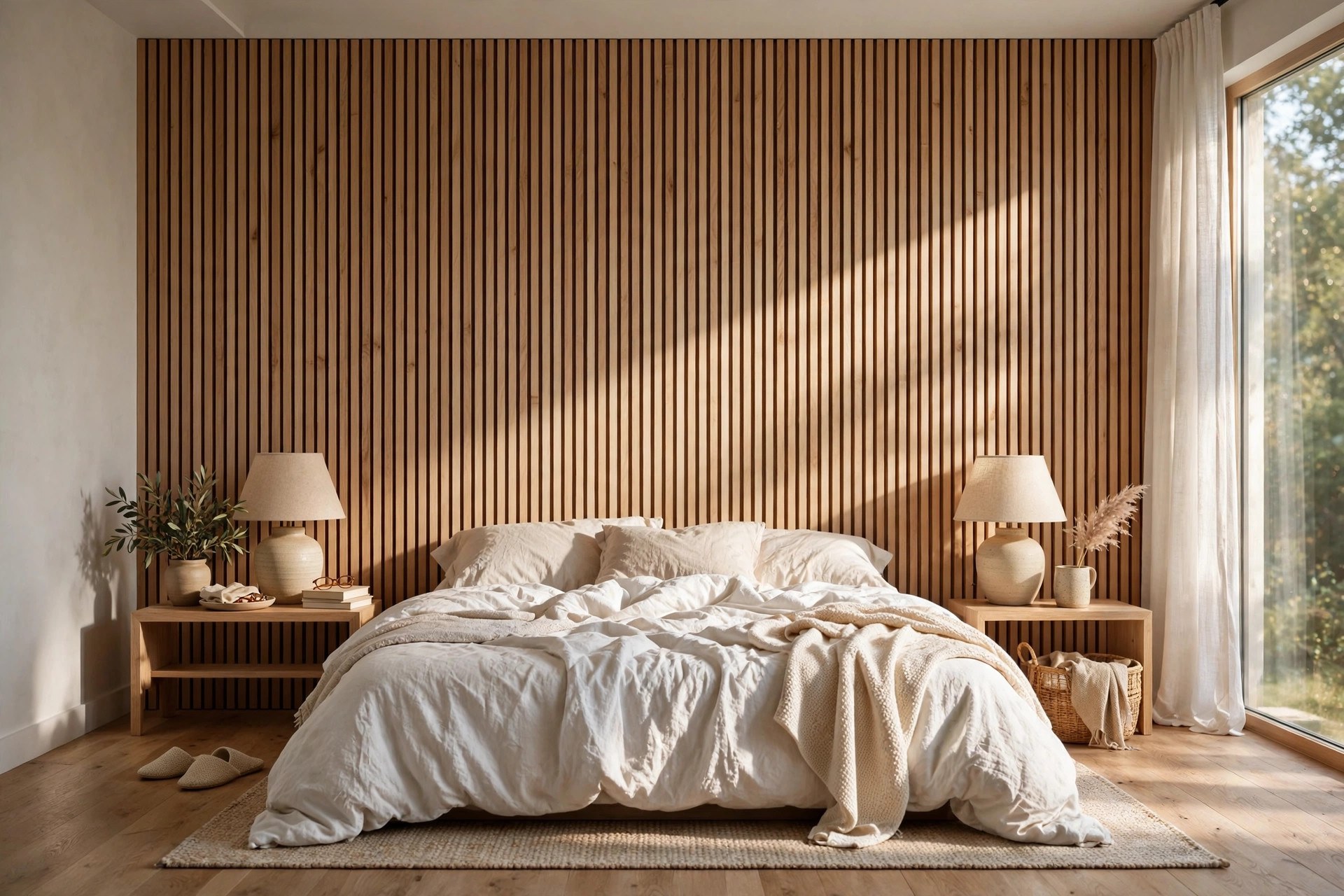
Wood slat panelling replaces both headboard and art in one move: the wall itself becomes the feature. Narrow vertical slats in oak or painted timber, run from floor to ceiling, add warmth, rhythm and a little sound softening.
Confine them to a panel the width of the bed plus 20 centimetres each side, or commit to the whole wall for a stronger architectural feel. The verticals also make a low ceiling feel taller, which no horizontal headboard ever could.
Because slats sit flat and fully fixed, there is nothing to knock or slide — a practical bonus above pillows. Keep the finish matte.
9. Let Wall Lights Frame the Bed
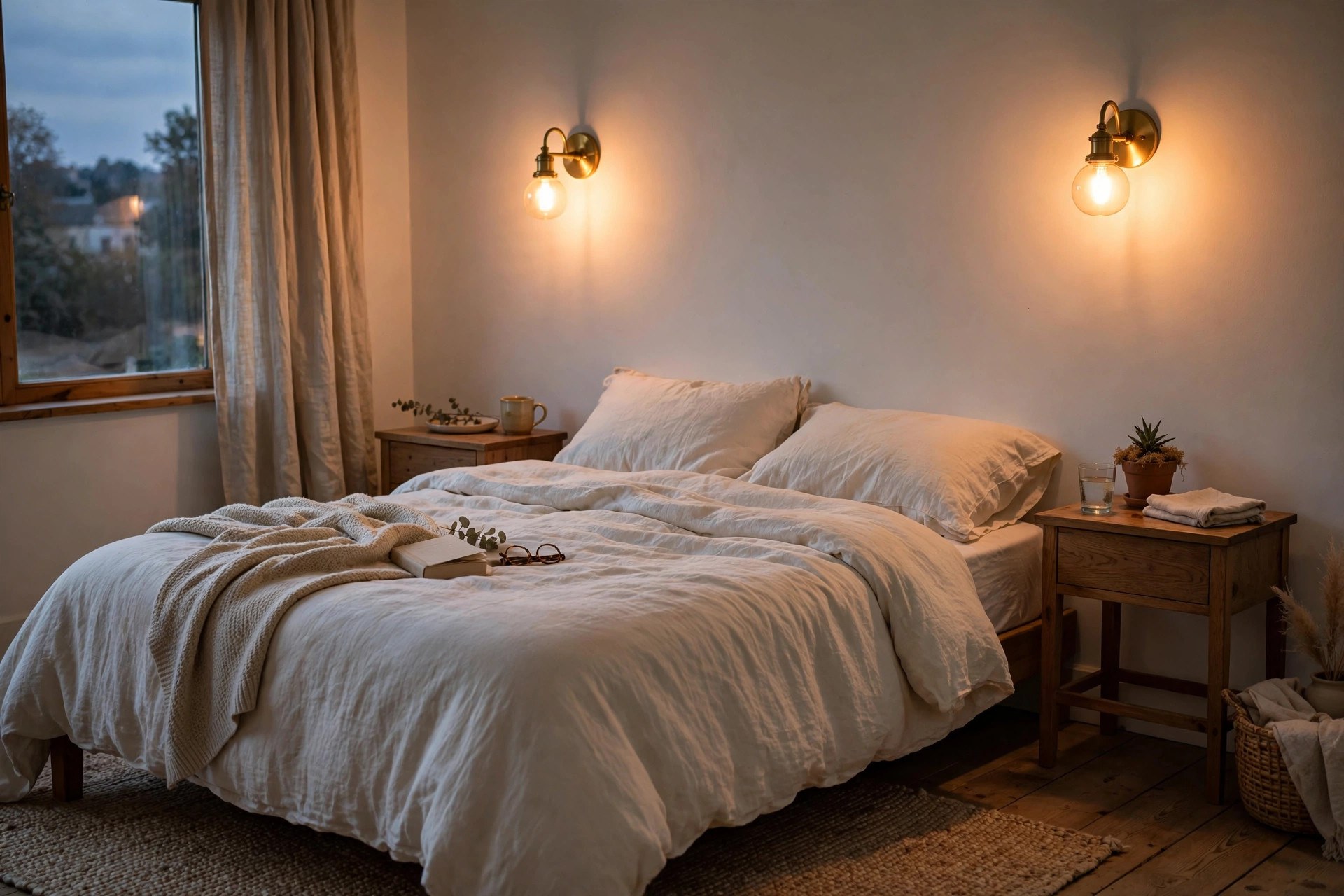
A pair of wall sconces does the framing job of a headboard while also being the light you actually read by.
Mount them symmetrically at about 150 to 160 centimetres from the floor, either side of the bed or as a pair above the pillows on a narrow wall.
Warm metals — aged brass, brushed bronze — keep the look soft, and linen shades cast the gentle glow bedrooms want.
This layered-light thinking is the same trick that anchors the schemes in these cool blue bedroom ideas, where warm metallic light stops a cool palette feeling chilly. Plug-in sconces avoid rewiring entirely.
10. Stretch a Macramé Hanging Across the Wall
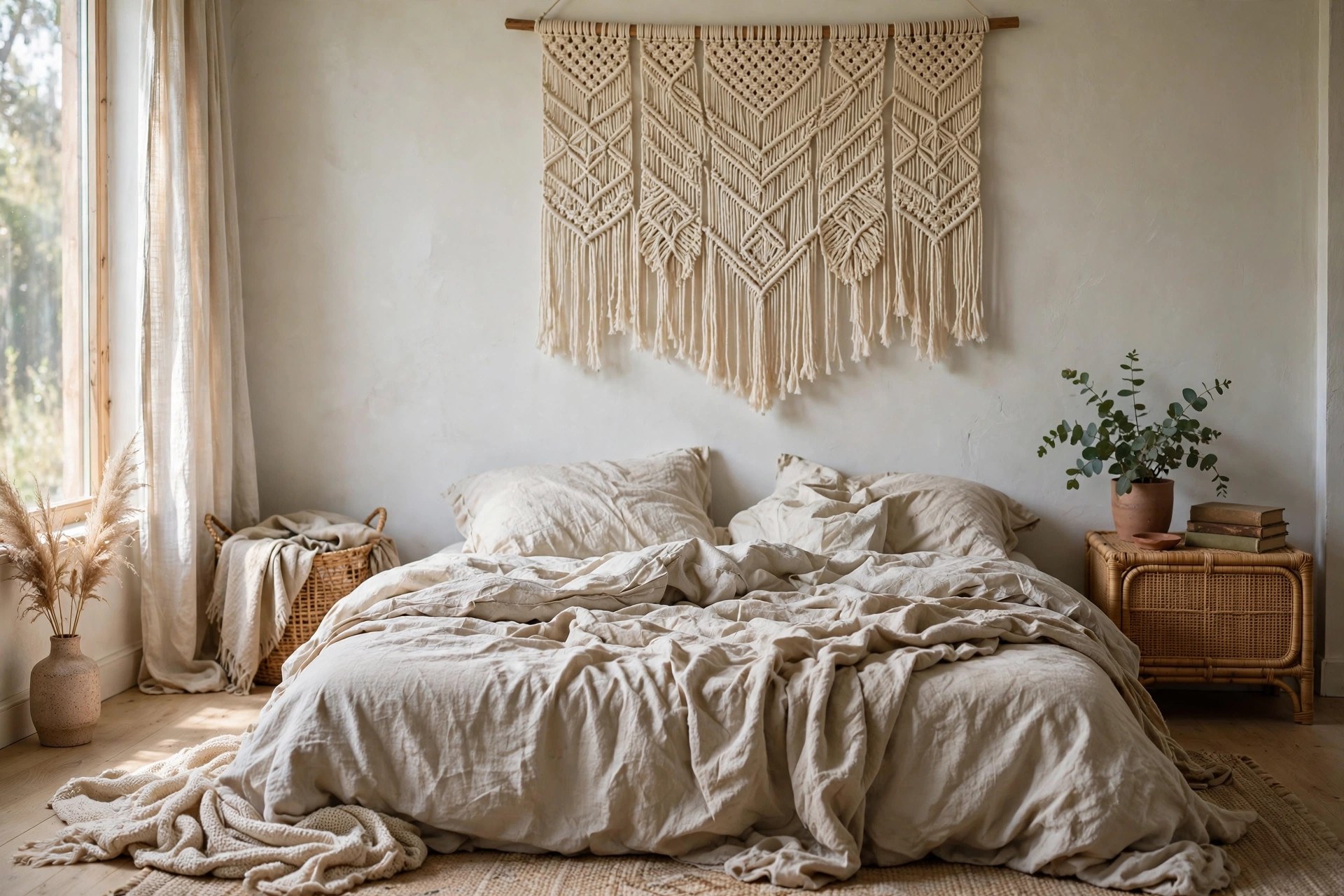
Macramé is the tapestry’s airier cousin: knotted cotton on a dowel, wide enough to claim the whole wall zone above the bed while weighing almost nothing.
Choose the widest hanging you can find — ideally within 20 centimetres of the mattress width on each side — because a small one looks lost and apologetic.
The fringe should end just above pillow height, where its texture does the work a headboard’s upholstery once did. Cream and natural cotton suit linen bedding and rattan furniture best. One rod, two small hooks, nothing heavy overhead.
11. Paint a Rectangular Colour Block
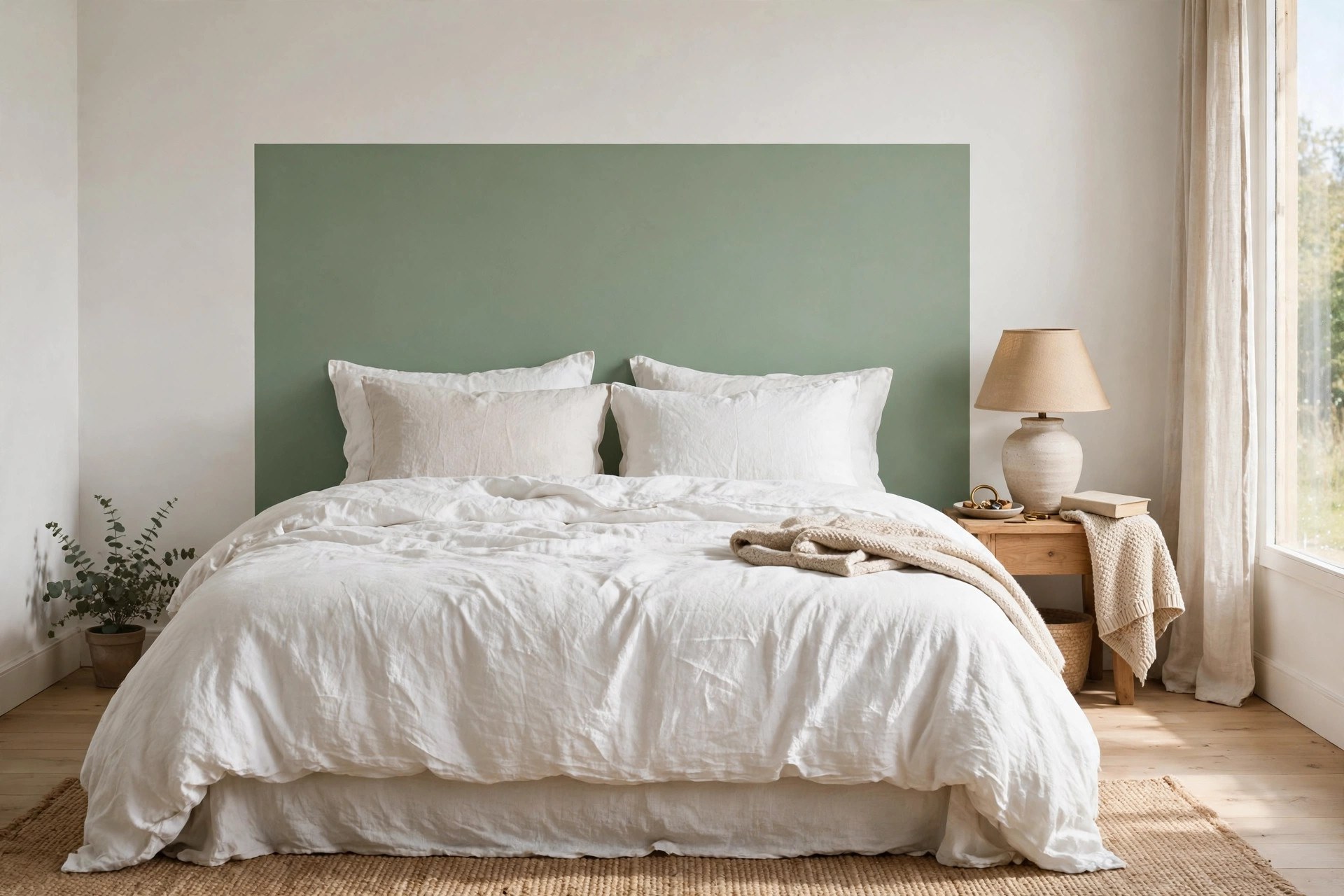
If an arch feels fussy, its straighter sibling is even easier: a crisp painted rectangle.
Mask a block 10 to 15 centimetres wider than the mattress on each side, rising to about 120 to 140 centimetres from the floor, and paint it in a colour with real presence — sage, dusty blue, deep clay, softened black.
Good painter’s tape, pressed firmly and peeled while the second coat is still slightly tacky, gives the sharp edge that makes this look intentional. The rectangle behaves exactly like a headboard: bedding layers against it, lamps flank it, and white bedding pops against the colour.
12. Hang a Quilt or Vintage Textile on a Rod
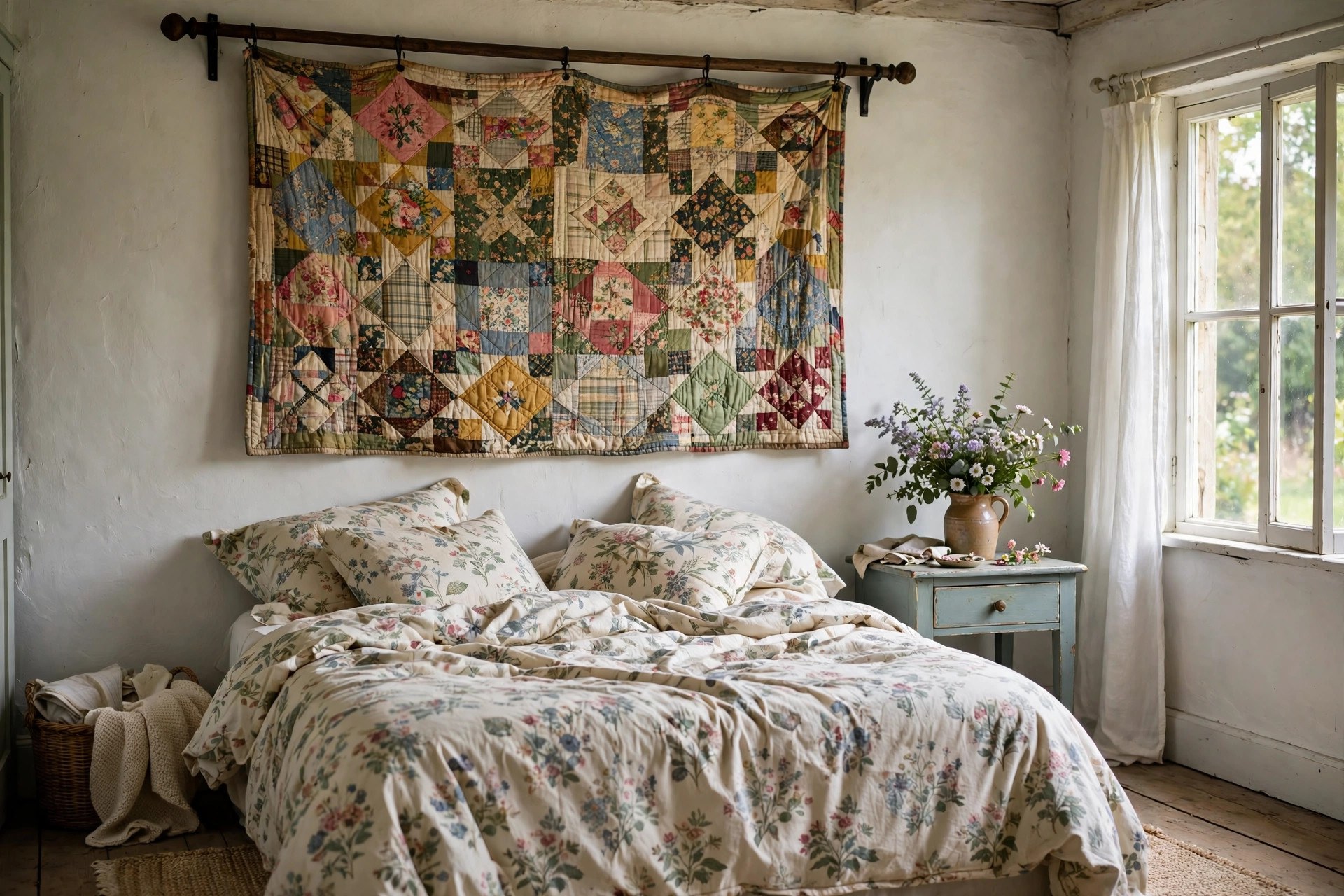
A handmade quilt or embroidered textile deserves better than a cupboard, and above a bed it becomes instant heritage. Hang it from a sturdy wooden rod using clip rings or a sewn sleeve, spreading the weight evenly so the fabric never strains at two points.
Let it hang flat and full-width: a quilt roughly the width of the bed reads as a woven headboard, complete with pattern and story.
Keep it out of harsh direct sun, which fades old dyes, and take it down a few times a year to air and refold along different lines so creases never set.
13. Create a Wallpaper Panel Behind the Bed
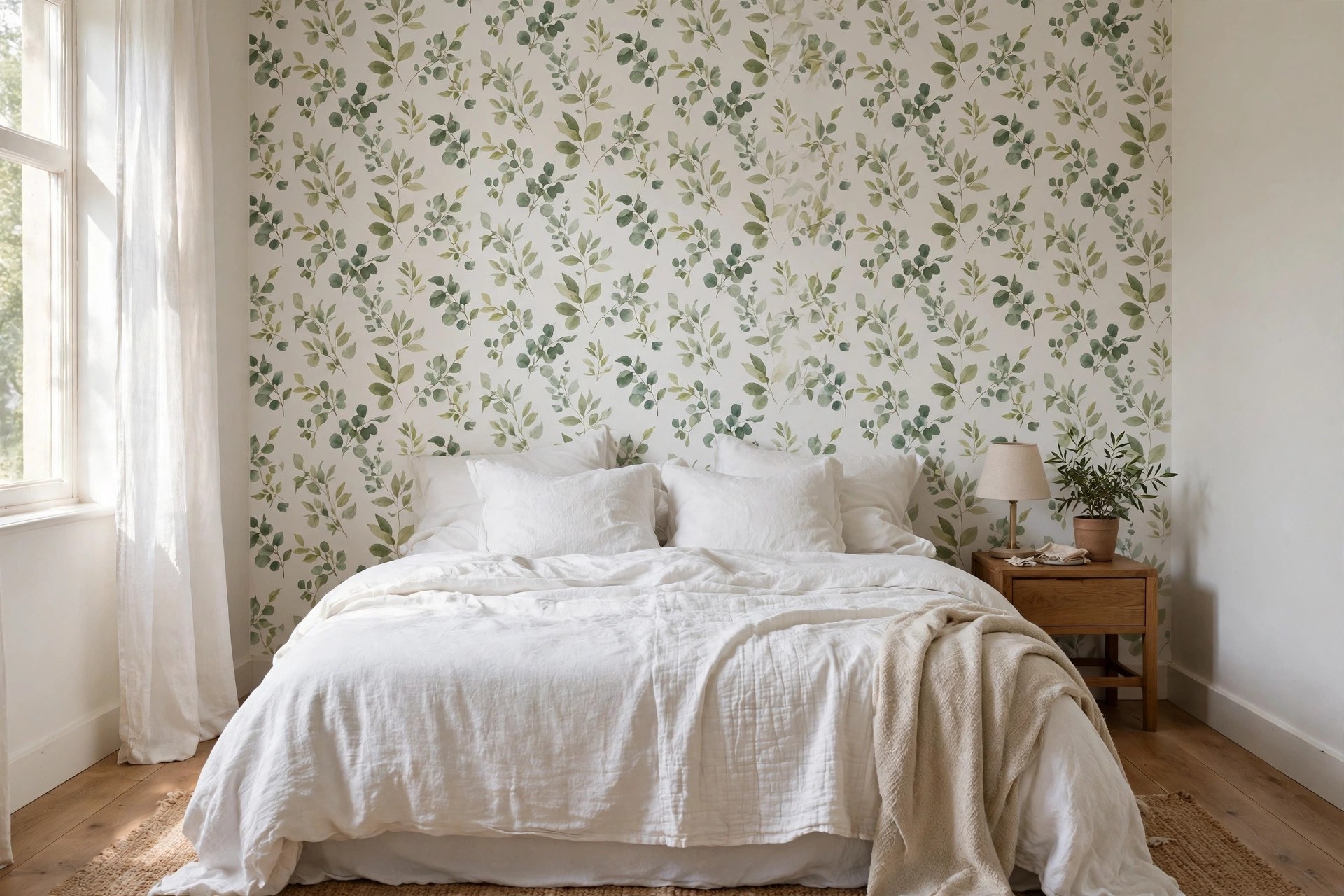
Wallpaper gives a headboard-free bed a backdrop with real depth, and you do not have to paper the whole room.
A single panel — the width of the bed plus a margin, edged with slim painted timber trim — reads as a deliberate framed feature, like an oversized artwork. Peel-and-stick papers make the same move reversible.
Botanical prints, soft geometrics and grasscloth textures suit the scale; avoid tiny busy patterns, which vibrate behind pillows, and very dark grounds in small rooms, which swallow the bed. Keep the bedding plain: against a patterned wall, white linen looks expensive, not bare.
14. Line Up a Neat Grid of Small Frames
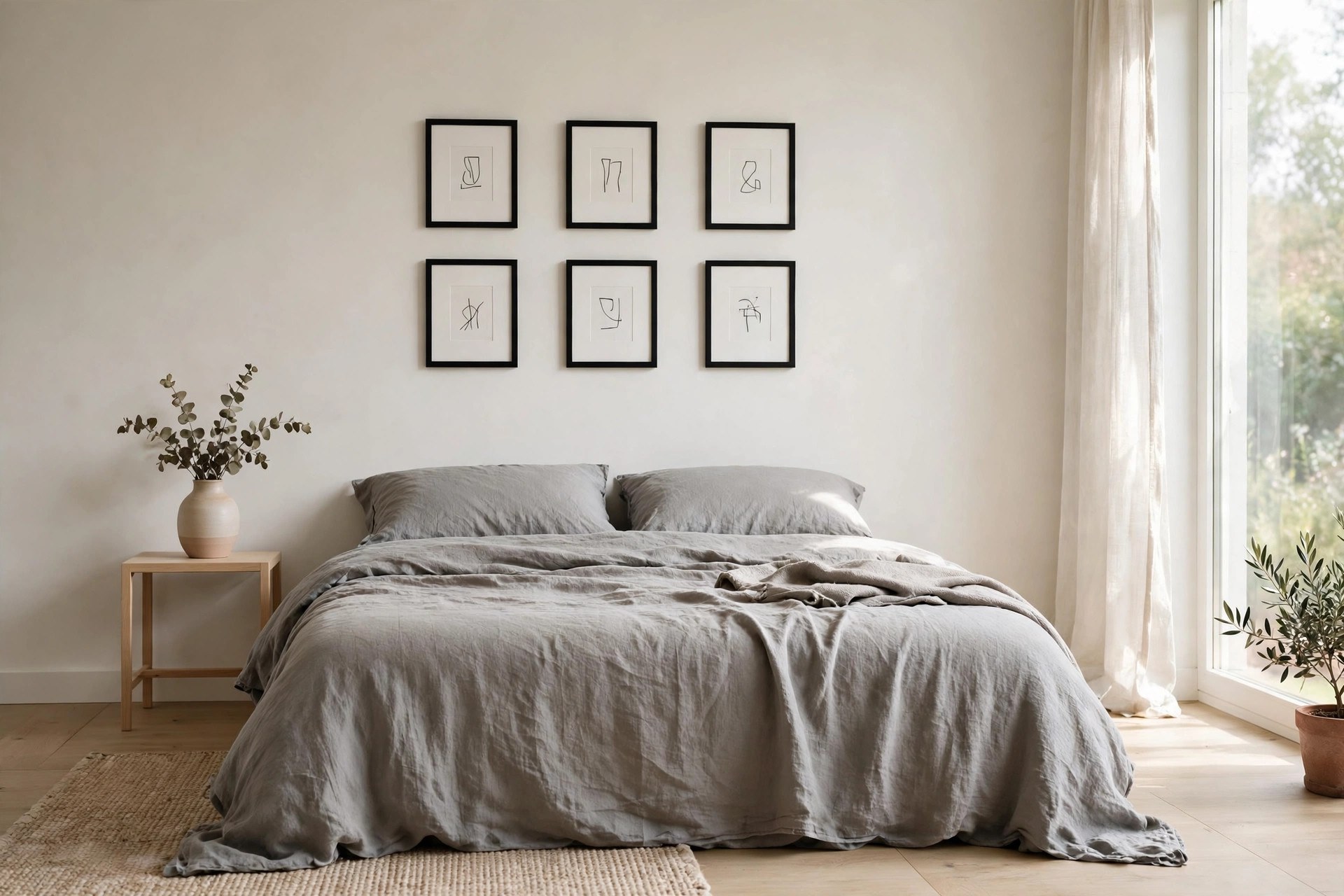
Where the gallery wall is relaxed, the grid is tailored. Six or eight identical frames in two even rows — same size, same finish, same mount — create a calm, architectural block that suits modern, minimalist bedrooms.
The discipline is in the spacing: 5 centimetres between frames, edges aligned exactly, the whole grid centred on the mattress and spanning about two-thirds of its width. Abstract line art, pressed leaves or photographs in one tone keep it serene.
Tape a paper template up first and check it from the doorway; a grid is unforgiving of a frame a centimetre adrift.
15. Drape a Garland and String Lights for the Evening
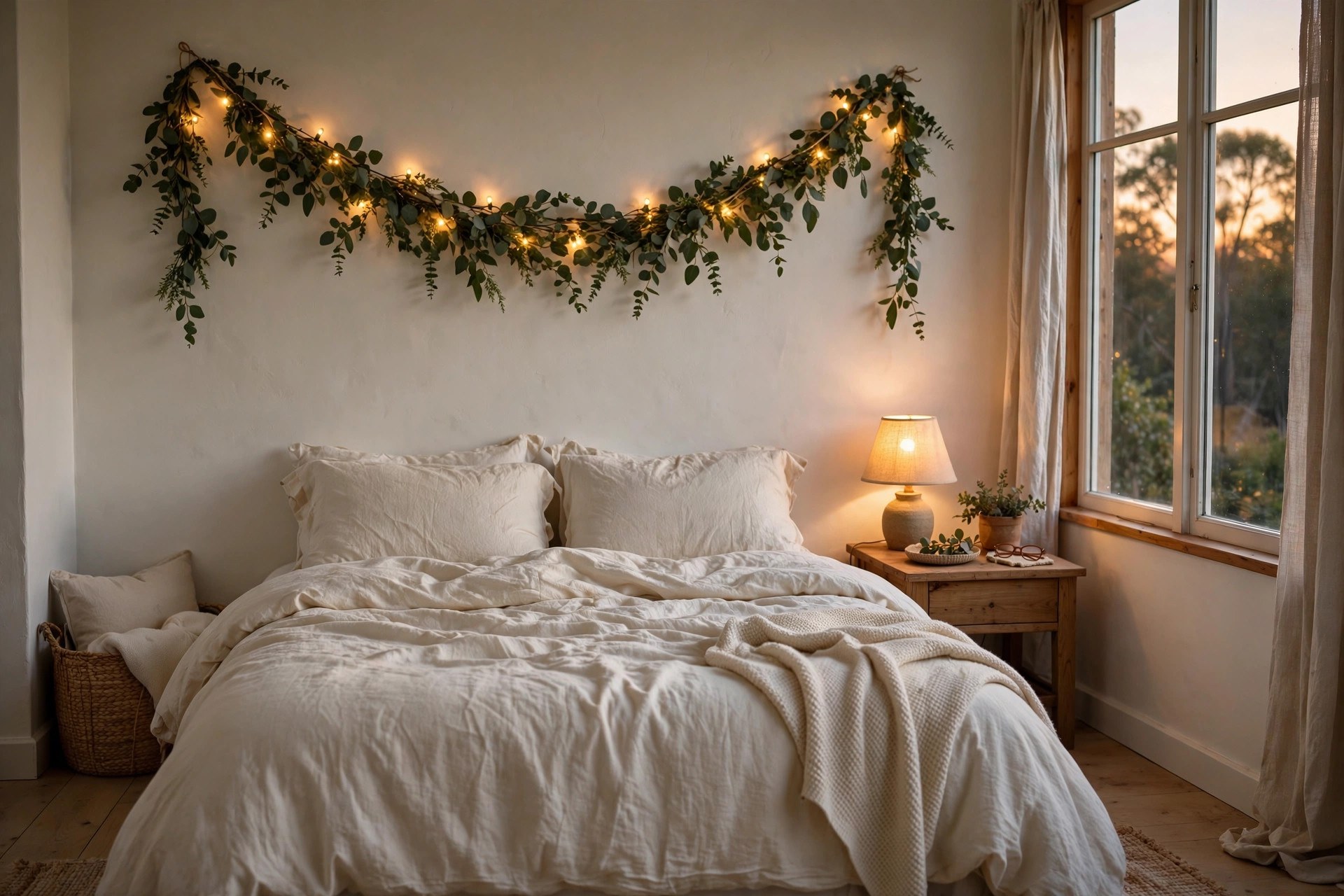
Some above-bed decor only needs to work after dark. A faux eucalyptus or ivy garland swagged in a gentle curve across the wall, threaded with warm-white string lights, gives a headboard-free bed a soft halo that finishes the room at bedtime.
Fix it at three or five points with small removable hooks, letting the dips fall evenly and the lowest point stay well clear of the pillows. Use LED lights only — they stay cool — and choose battery or timer sets to avoid trailing cords.
Swap the garland with the seasons: blossom in spring, dried grasses in autumn, pine at Christmas.
How to Decorate Above a Bed With No Headboard, Step by Step
Start by measuring the mattress width and marking its centre line on the wall with painter’s tape.
That width governs everything: your art, panel, arch or hanging should span between half and the full width of the bed, and the decorated zone runs from just above the pillows to roughly 90 centimetres higher.
Choose one treatment only — a ledge, a pair of prints or a painted shape — because two competing ideas split the focal point. Build it at full size in paper templates first and live with it for a day.
When you fix, fix for a sleeping room.
Use studs or anchors rated for the load, two fixings wherever a piece is wide, and keep anything heavy or glass-fronted out of the zone directly above the pillows — that space belongs to paint, fabric and paper.
If your bed sits in a compact room, our above-bed wall decor ideas for small apartment bedrooms show how to scale these treatments down without losing their impact.
Finish by dressing the bed tall: stacked pillows bridge the gap, and wall, art and bed finally read as one.
Common Mistakes to Avoid
1. Hanging everything too high. Without a headboard there is nothing to connect floating art to the bed, so a frame hung near the ceiling looks lost and the bed stranded.
Keep bottom edges within about 20 to 30 centimetres of the top of the pillows.
2. Going too small. A single small frame above a wide bed is the most common failure of all — decoration at postage-stamp scale. Whatever you choose should span at least half the width of the mattress; two-thirds is better.
If your art is small, group it, grid it, or set it over a painted block.
3. Weak fixings for heavy pieces. A bedroom wall is the one place a falling frame really matters. Never hang heavy wood, thick glass or a loaded shelf above pillows on a single picture hook. Use two rated fixings and acrylic glazing instead of glass.
Frequently Asked Questions
How high should I hang art above a bed with no headboard?
Lower than you would above a sofa. Aim for the bottom edge to sit about 20 to 30 centimetres above the top of your stacked pillows. The centre of a single large piece usually lands around 140 to 150 centimetres from the floor.
What can I put above my bed instead of a headboard?
Almost anything flat, light and wide: a large print or pair of prints, a painted arch or colour block, a tapestry, quilt or macramé hanging, a picture ledge, a round mirror, panelling or a wallpaper panel.
Paint and fabric are cheapest; panelling makes the strongest statement.
Is it safe to hang a shelf or heavy frame above a bed?
It can be, if the fixings do the work. Use studs or anchors rated well above the object’s weight, keep shelf loads light and unbreakable, and swap glass glazing for acrylic above pillows. A genuinely heavy piece belongs on a side wall instead.
How do I decorate above the bed in a rental?
Lean on minimal fixings: tapestries and macramé on a rod hung from two small hooks, peel-and-stick wallpaper panels, and lightweight prints on removable strips. Painted arches and colour blocks are the only ideas here that need a landlord’s permission first.
Final Thoughts
A missing headboard is only a problem if the wall above the bed stays empty. Give that wall one confident treatment — sized to the bed, hung low, fixed safely — and the room gains its focal point back.
Once the bed wall feels finished, give the corner beside it the same attention: these reading nook ideas turn a spare corner into the cosiest seat in the house.


