

15 Reading Nook Ideas for Any Corner — Chair, Light, Shelf & Softness
The best reading nook ideas are not really about the corner you choose. They are about three things working together: a chair your body can settle into, light that lands on the page instead of in your eyes, and everything you need — book, drink, blanket — within one lazy arm’s reach. Get those three right and almost any spare patch of floor becomes the seat everyone in the house quietly competes for.
A nook also asks very little of a room. A metre of wall beside a window, the dead space under the stairs, even a wardrobe you no longer use can hold one. Below are fifteen reading nook ideas that work in real homes, from the chair maths that keeps your back happy to the small styling layers that make a corner feel like a destination, plus a step-by-step guide to building one that actually gets used every day.
1. Start With a Chair You Can Sit in for an Hour
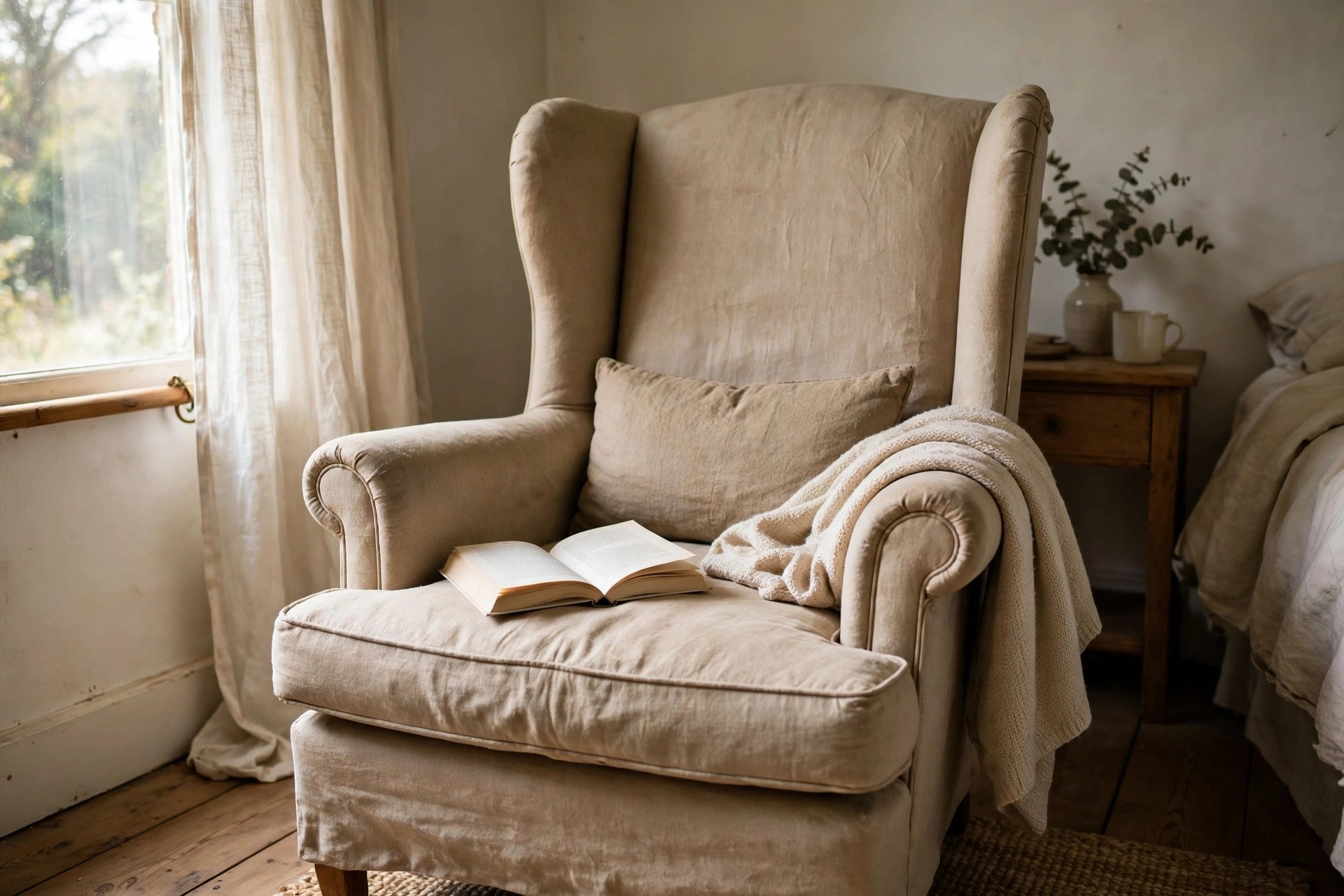
Every good nook begins with the chair, and the honest test is time: if you cannot sit in it for a full hour with a book, it is a photo prop, not a reading chair. Look for a seat depth of roughly 50 to 60 centimetres so your back reaches the backrest while your feet stay grounded, and a back tall enough to rest your head against for the last chapter. Arms matter more than style — they carry your elbows and the book’s weight at a comfortable reading height. Wingbacks and softly rolled arms suit long sessions because they quietly hold your posture without you thinking about it. Sit in any chair before you commit, wearing what you would wear to read, and bring the book. If the shop will not let you settle in for five minutes, that tells you something too.
2. Put the Light Over Your Shoulder, Never Overhead
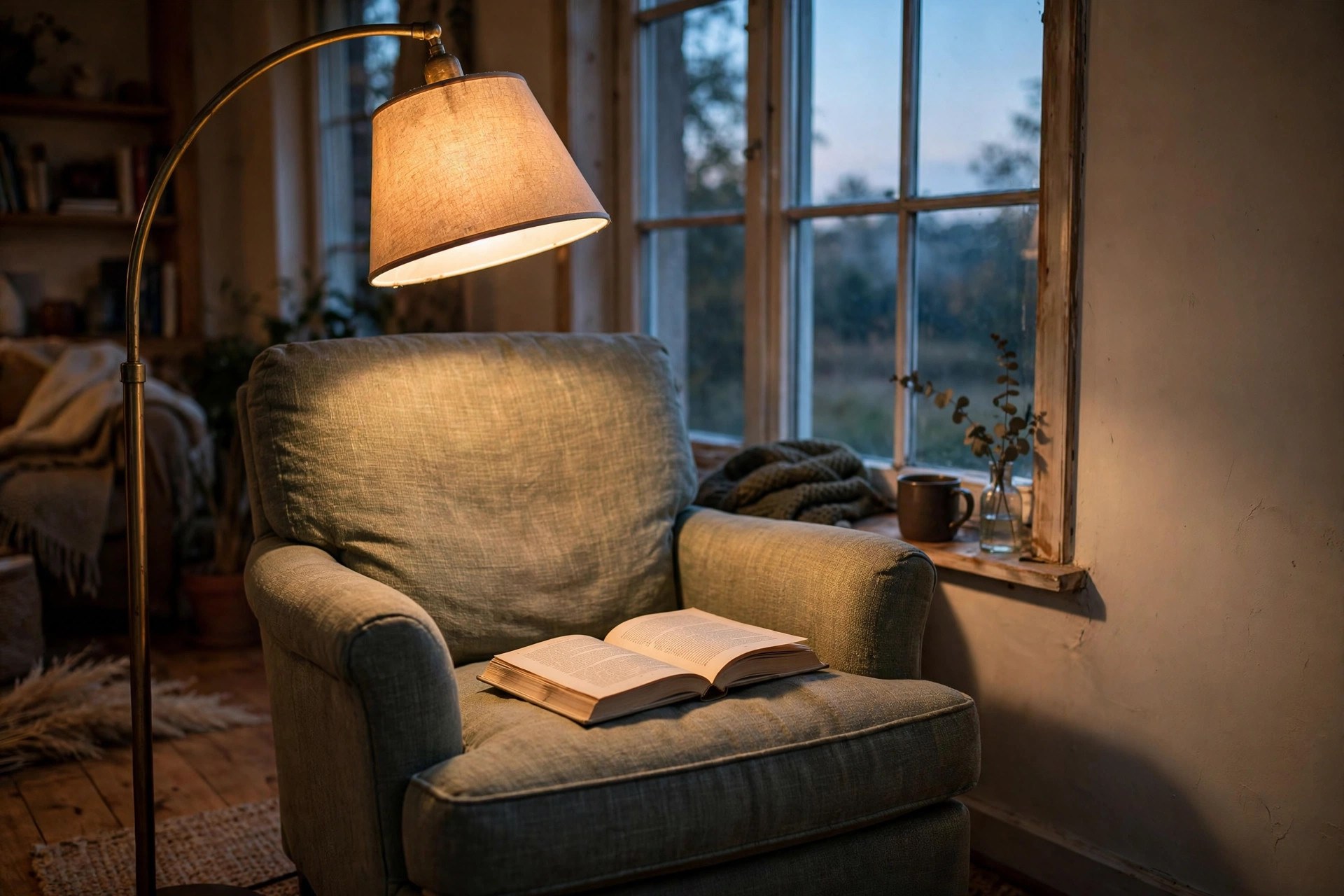
Ceiling light is the enemy of a good read: it throws the shadow of your own head and hands across the page. The classic fix is a lamp behind and slightly beside the chair, angled so the light falls over your shoulder onto the book. An arched floor lamp does this without any furniture juggling; a swing-arm wall light does it in the tightest corners. Choose a warm bulb — around 2700K — because cool, blue-white light makes a nook feel like a waiting room and tires eyes faster over a long session. A fabric shade softens the beam better than a bare bulb or a metal shade aimed at the page. If your lamp has a dimmer, even better: bright for non-fiction concentration, lowered for the last, sleepy pages of a novel.
3. Keep a Shelf Within One Arm’s Reach

A nook fails quietly when the book pile lives across the room. Keep your current reads, your next-up stack and the one comfort book you re-read every year on a shelf you can reach without standing up. A narrow bookcase, a single floating shelf or even a deep windowsill will do; what matters is that the distance from cushion to book spine is one arm, not one journey. This is also the shelf for the small things that anchor a session — reading glasses, a bookmark that is not a receipt, a coaster. Readers building a whole room around their shelves will find plenty of inspiration in these bedroom wall art ideas for bookworms, but the principle stays the same at nook scale: books stored where they are read get read.
4. Add a Footstool So Your Legs Can Fully Let Go

The difference between sitting and settling is usually your feet. A footstool, ottoman or low pouf at roughly the height of the chair seat lets your legs stretch out and takes the pressure off your lower back, which is what turns twenty minutes into two hours. Match the stool top to the seat height of your chair, give or take a few centimetres, and choose a firm-ish cushion — something too soft lets your heels sink and your ankles ache. A stool with a removable lid earns double keep as storage for the blanket and the spare book light. If space is truly tight, a sturdy woven basket turned upside down or a stack of large floor cushions can stand in. Test the pairing together: chair plus stool is a single piece of furniture in everything but name.
5. Use the Throw-and-Cushion Formula

Softness in a nook is a formula, not an accident: one throw you can actually wrap up in, plus one cushion that supports the small of your back. That is usually enough. The throw belongs over the arm or the chair back where your hand finds it without looking, in a natural fibre — wool for winter weight, cotton or linen for summer — because synthetics trap heat and crackle with static. The cushion should be smaller and firmer than a scatter cushion, placed behind your lower back rather than behind your shoulders. More pillows than that and you spend the first five minutes of every session excavating a seat. Keep the palette calm and tactile rather than busy; the nook’s job is to slow your eyes down, not entertain them before the book even opens.
6. Claim the Window — or Build a Window Seat
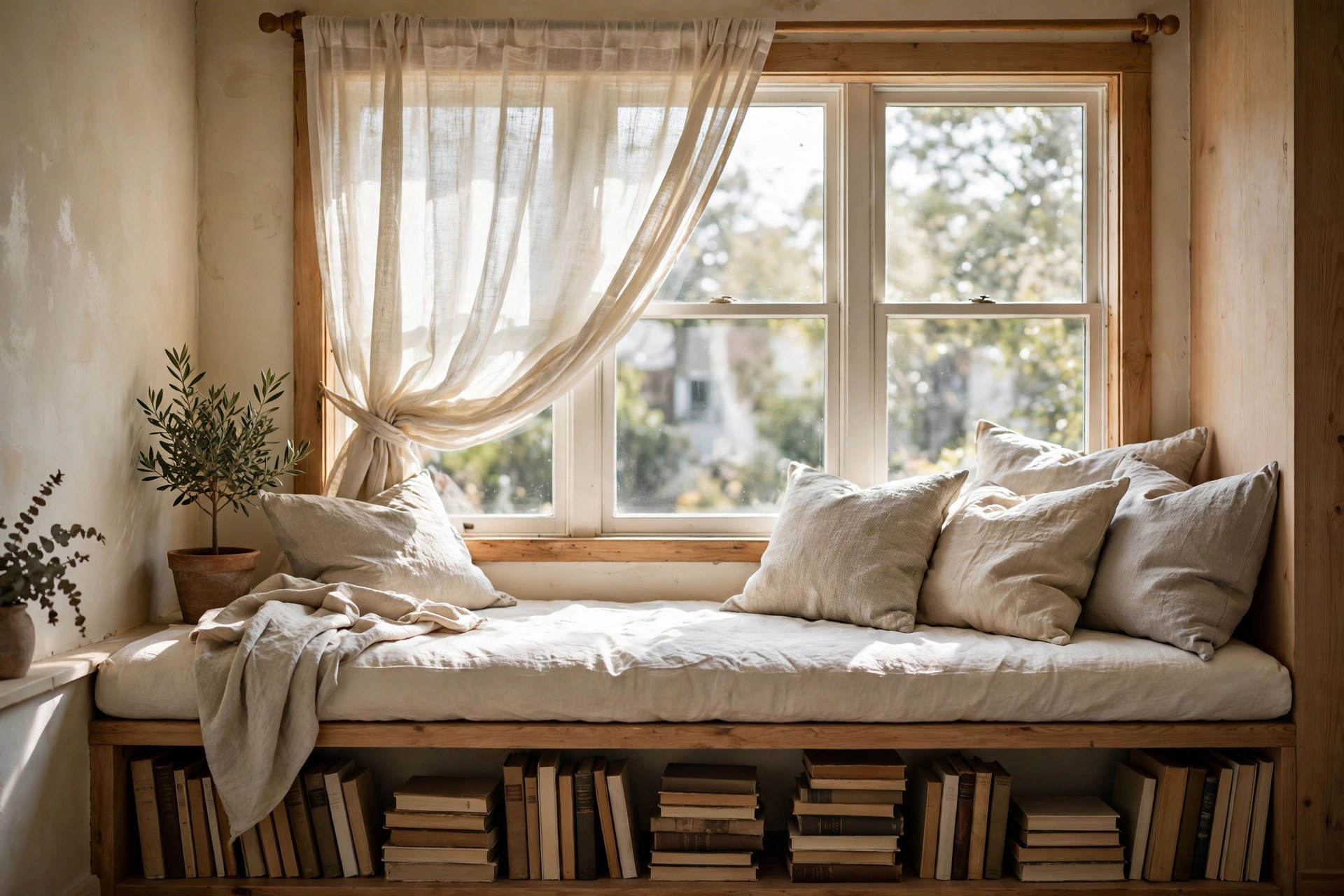
Daylight is the finest reading light there is, and a window nook spends it wisely. If your bedroom has a wide sill or a bay, a fitted cushion turns it into the most coveted seat in the house; add a low shelf or storage box beneath and the architecture does half the styling for you. Angle the seat so the light comes from your side or over your shoulder rather than straight into your eyes, and hang a sheer or linen curtain you can pull when the sun moves round. No bay? A chair pulled close to any window, with the same side-light logic, captures most of the benefit. These cozy small bedroom wall art ideas show how much warmth a window wall can carry when the seating beneath it is planned rather than parked.
7. Turn an Awkward Corner Into the Whole Point

Every bedroom has one: the corner that fits nothing, collects laundry and gathers dust. That corner is a nook waiting to be claimed. Angle the chair into it at forty-five degrees rather than pushing it flat against either wall — the diagonal instantly reads as intentional, softens the room’s geometry and leaves a natural triangle behind the chair for the lamp or a tall plant. A small round rug under the chair draws a boundary that says this patch of floor has a job. Corners work because two walls wrap the sitter, damping sound and draughts on both sides. Measure before you shop: most armchairs need a square of about one metre, plus room for the side table tucked into the remaining wedge. If the corner takes the chair, it takes the nook.
8. Borrow the Space Under the Stairs
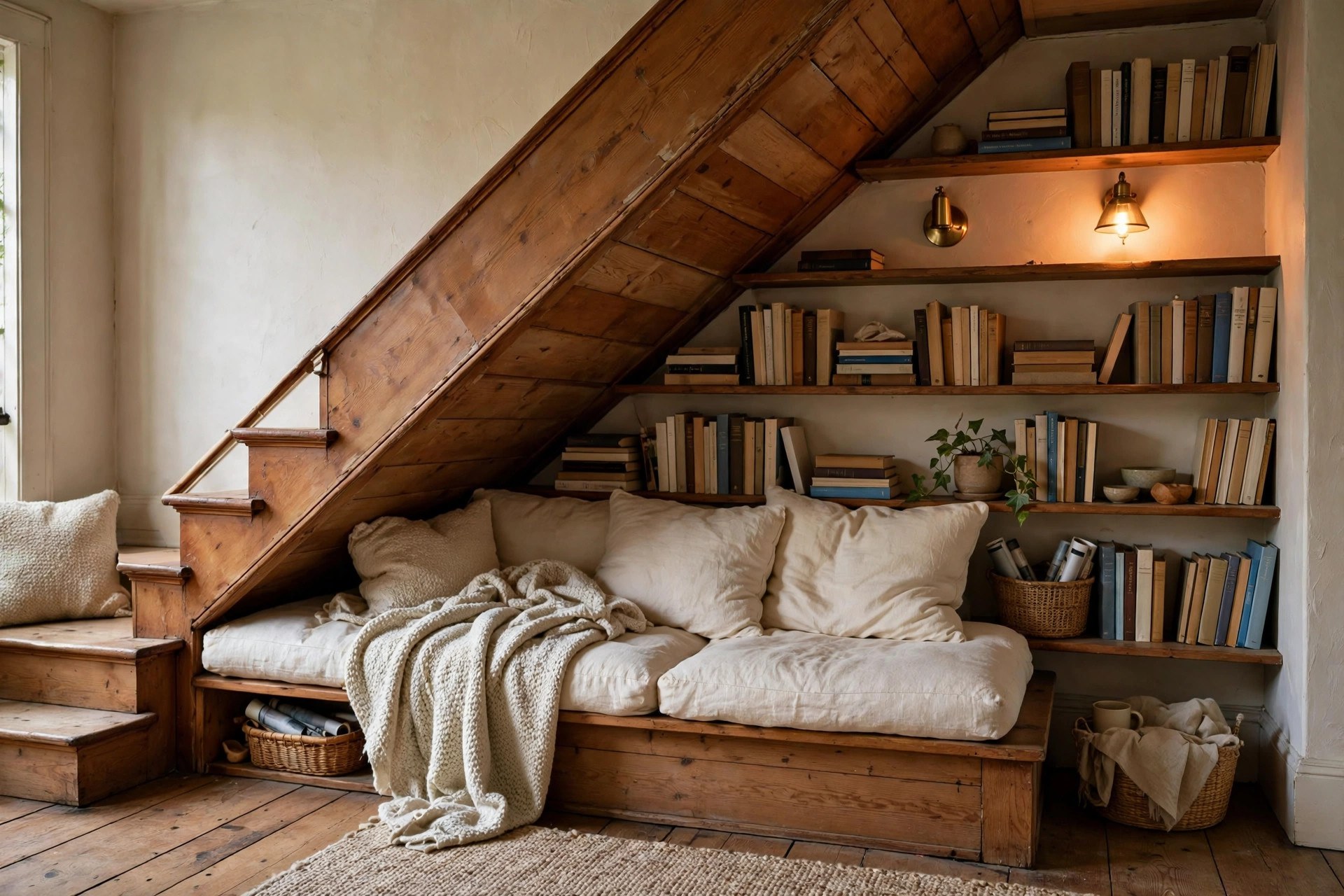
The triangle under a staircase is some of the most wasted square footage in a house, and some of the cosiest once it is claimed. A built-in bench or a low daybed mattress fits the slope, with shelving stepped down the wall following the angle of the stairs. The low ceiling that makes the space useless for standing makes it perfect for sitting — it feels like a cabin berth in the best way. You will need a wall light or a plug point for a lamp, since borrowed light rarely reaches in, and a switch you can reach from the bench is worth planning before cushions go in. Keep the palette pale if the spot is deep, and let one darker throw or cushion give it depth. Children annex these nooks on sight, so size the bench generously if you hope to share it.
9. Convert a Spare Wardrobe Into a Hidden Nook
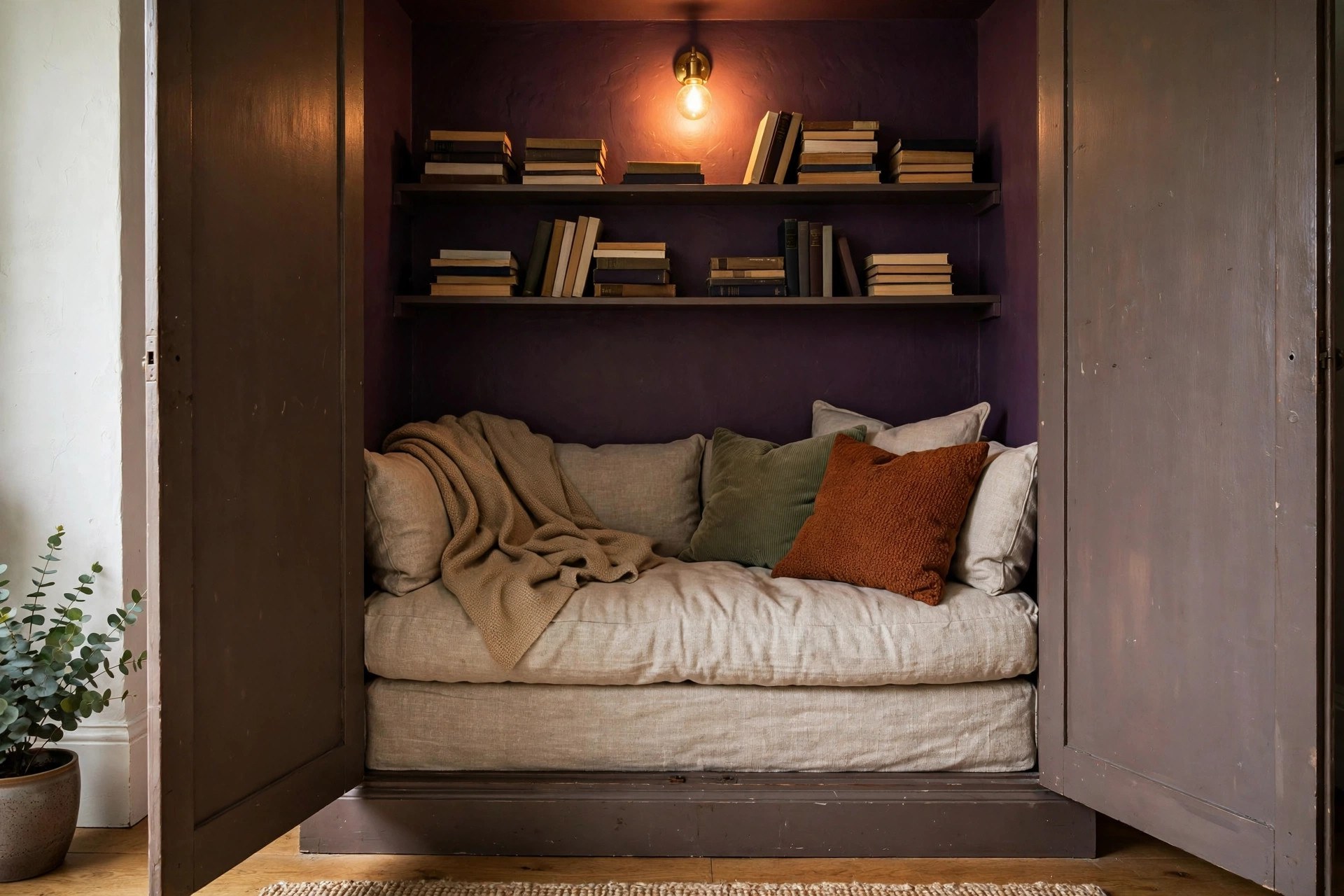
If a bedroom wardrobe stands half empty, its doors are hiding a ready-made nook. Remove the doors (or leave them to close the world out), fit a bench cushion at seat height inside, and line the back wall with a colour or paper that makes the little room-within-a-room feel deliberate. Shelves above head height hold the book stack; a battery or hardwired wall light solves the lighting, since wardrobe interiors are famously cave-like. The charm is the enclosure: three walls and a low opening wrap you in quiet, and the sound of the house drops a full notch. Deep, cocooning colours work beautifully at this scale — the same thinking behind plum noir bedroom ideas — because a small hidden space can carry a richness a whole room might find heavy. Keep the removed doors safe; the conversion reverses in an afternoon.
10. Choose a Side Table at Elbow Height

The side table is small, silent infrastructure, and its height decides whether the nook flows or fumbles. Aim for a top roughly level with the chair’s arm, or a touch below — around 55 to 60 centimetres for most armchairs — so your hand finds the mug without your eyes leaving the page or your shoulder hitching up. Too high and you lift every sip; too low and you fold yourself in half. Size matters as much as height: the top needs room for a book laid open, a drink and your glasses, and not much more. A round table suits tight corners because there are no corners to catch your knee on in the dark. A lower shelf or a table with a lip earns bonus points for holding the current chapter’s supporting cast.
11. Soften the Sound, Not Just the Seat

Quiet is a material. Hard floors, bare walls and a leather chair reflect every noise in the house straight back at the reader, while fabric swallows it. A thick rug under the chair, curtains rather than a blind at the nearest window, and upholstery rather than bare wood under you will drop the room’s echo more than any single accessory. This is why nooks tucked against a wall of books feel so hushed — a hundred uneven paper spines are excellent sound absorbers. If your nook sits in an open-plan space, a tall bookcase or a folding screen on the exposed side builds a soft wall that blocks both noise and sightlines. You do not need silence, exactly; you need the house to sound far away. Layer textiles until it does.
12. Hang a Curtain to Signal “Away”
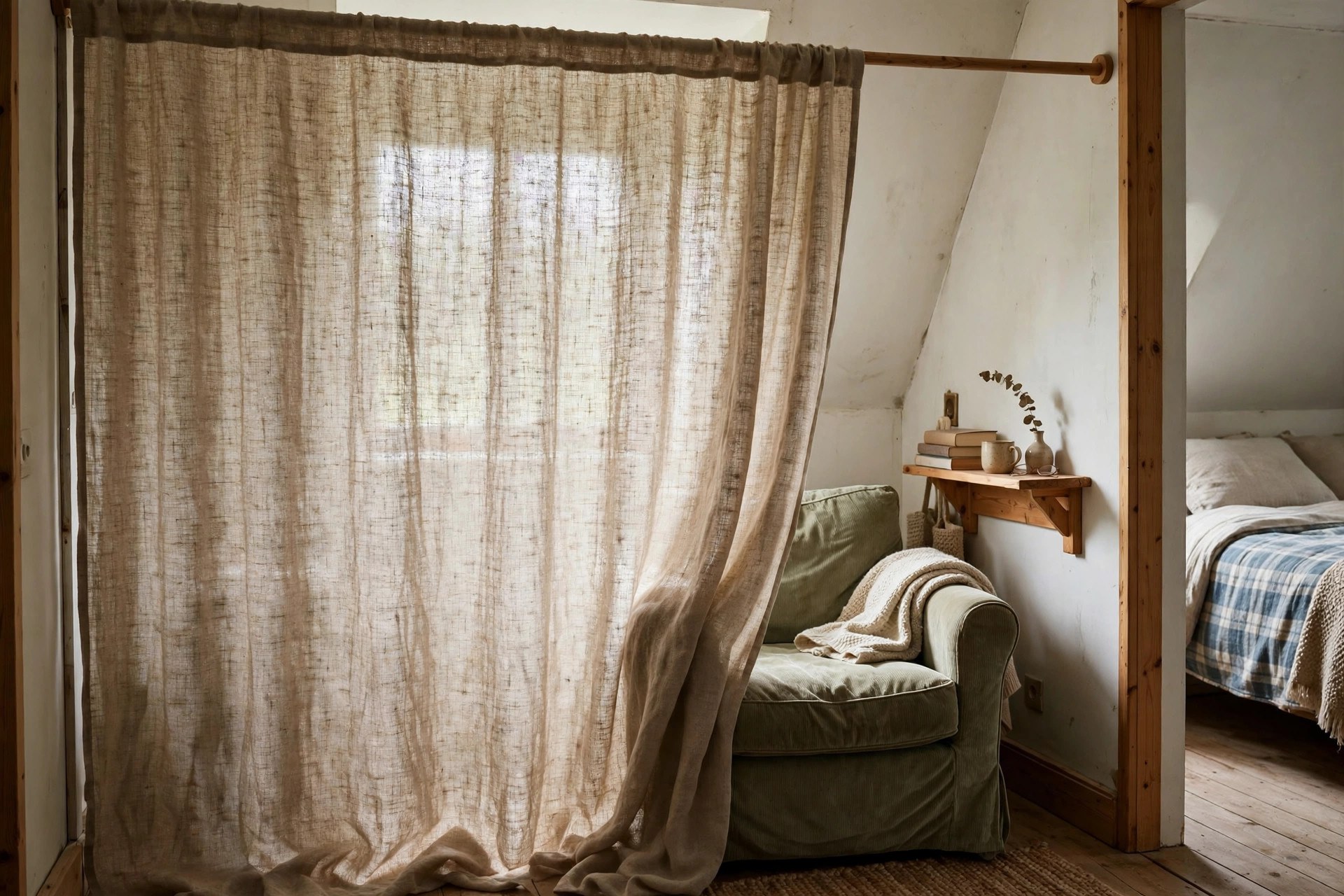
In a shared home, a nook needs a “do not disturb” sign that is not a sign. A curtain on a simple rod or wire across the nook’s opening does the job with softness: drawn, it tells the household you are away; open, the chair rejoins the room. Linen or a heavy cotton weave blocks sightlines while letting light breathe through, and it moves the air gently rather than sealing the corner stale. The same trick defines a nook inside a larger bedroom or studio where walls cannot go. Choose the fabric in the room’s existing palette so the nook feels designed, not partitioned. If a curtain is a step too far, a tall plant or an open shelving unit at the nook’s edge draws a lighter line with the same message.
13. Tuck the Nook Beside the Bed for Night Readers
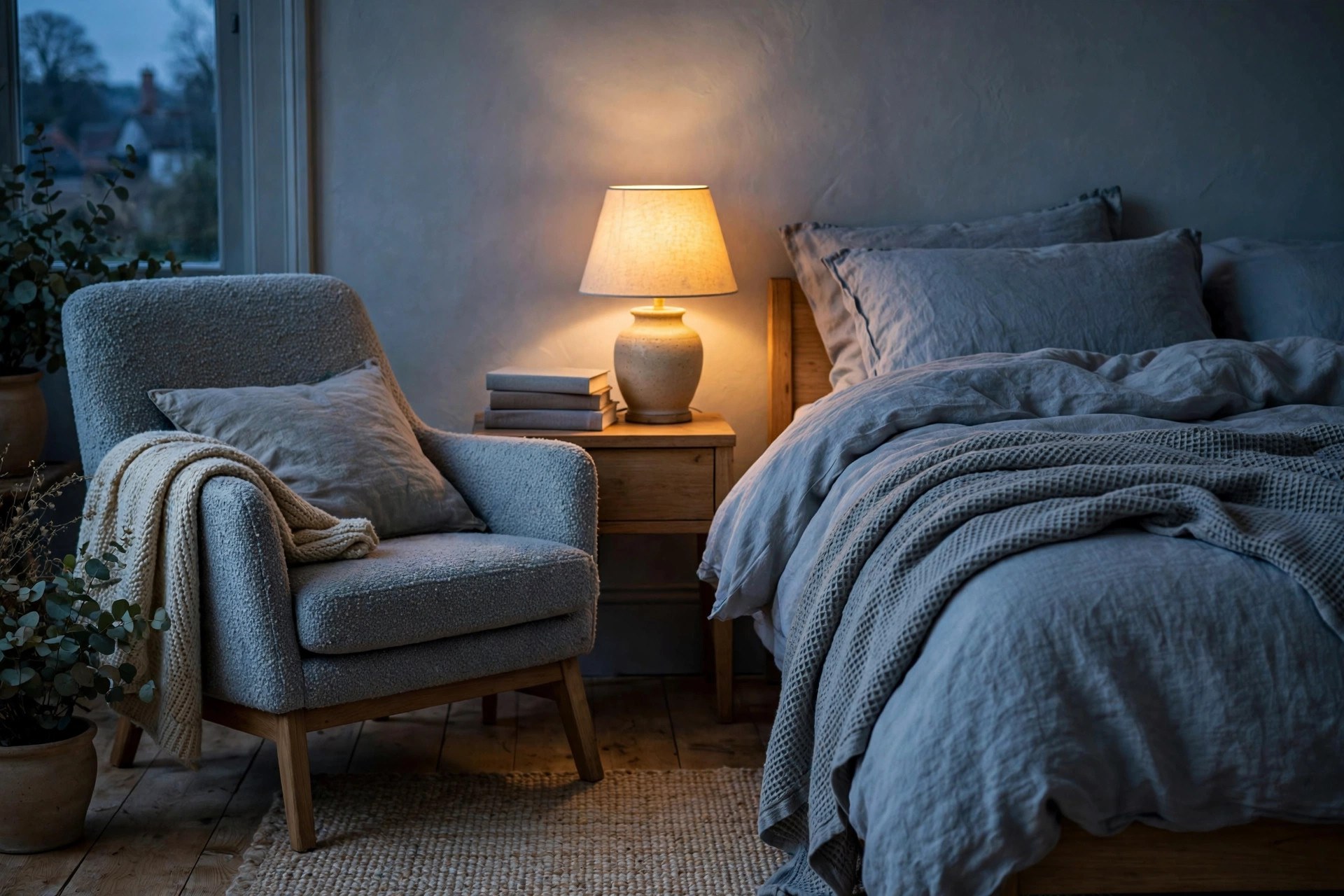
If your reading happens in the last hour of the day, put the nook where the ritual already lives: beside the bed. A compact chair angled from the bedside, a warm lamp you can reach from both chair and pillow, and a shared surface for the book means the whole wind-down happens in one pool of light. This arrangement rescues the dead corner between wardrobe and window in countless bedrooms. Keep the colours restful and the light low and warm — the nook becomes part of the room’s sleep hygiene rather than a bright interruption. Calm colour stories like those in cool blue bedroom ideas pair naturally with a night-reading nook. The final test: from book to bed should be three steps and one lamp switch, with nothing to put away in between.
14. Add One Plant and Something With a Grain

A nook styled entirely in fabric can feel flat, however soft. One living plant — a trailing pothos on the shelf, a small olive or fern by the window — adds the irregular, breathing quality that makes a corner feel settled rather than staged, and it quietly improves the air around a chair you sit in daily. Balance it with something that has a grain: a wooden stool as the side table, a rattan basket for the blanket, a clay pot with a matte, imperfect finish. These natural textures are the backbone of relaxed, layered rooms like the ones in these boho dream bedroom ideas. Keep it to one plant per nook unless you are a confident keeper of green things; a single thriving plant beats a shelf of struggling ones.
15. Finish With a Personal Layer, Not a Showroom Layer

The last layer is the one no stylist can choose for you: the things that make the nook yours. One framed print you actually love, the blanket with a history, the battered paperbacks you will never lend out. A small piece of art at reading eye height — seen when you look up and think — rewards the pauses between chapters. Keep this layer edited: three or four personal things read as character, while fifteen read as clutter and start stealing the calm the nook was built for. This is also where a nook can absorb the odd, beloved objects that never quite fit the rest of the room. Rotate this layer with the seasons if you like — a different print in winter, a lighter blanket in June — so the nook keeps feeling chosen rather than frozen. When a guest sits down and immediately understands whose chair this is, the nook is finished.
How to Build a Reading Nook That Actually Gets Used, Step by Step
Step 1: Choose the spot by behaviour, not by leftover space. Watch where you already drift with a book for one week. The right corner is usually near a window, away from the television’s pull and out of the walkway between doors. A nook built where reading already wants to happen gets used; one built in the only empty corner, however pretty, becomes a chair for laundry.
Step 2: Measure the square, then the chair. Mark out one square metre with tape and live with the outline for a day, walking past it, opening the wardrobe, making the bed. Most reading chairs need 65 to 75 centimetres of width and similar depth, plus the stool in front and the table at the side. Check the swing of any door and the pull of any drawer against your taped square now, not after delivery. Buying the chair first and the accessories second prevents the classic failure: a beautiful nook with nowhere to put your feet or your tea.
Step 3: Fix the light before anything decorative. Position the lamp behind your dominant shoulder, fit a warm bulb of around 2700K, and read a full chapter at the time of day you actually read. If the page glares or your shadow falls across it, move the lamp, not your standards. A dimmer or a three-way bulb gives the nook range from morning papers to midnight chapters.
Step 4: Build the reach zone. Shelf, table, glasses, coaster, blanket — everything for one session should be reachable without standing. Sit in the chair and mime the whole ritual: pick up the book, take a sip, pull the throw over your knees, set the book down open. Anything that makes you get up gets moved closer or stored in the stool.
Step 5: Layer softness in order. Rug first if the floor is hard, then the chair, then the footstool, then one throw and one lumbar cushion. Add the curtain, plant or art last, and only one at a time, sitting with each addition for a day. If the floor is timber or tile, the rug is not optional decoration — it is what stops the chair skidding, the stool scraping and the whole corner sounding hollow. Nooks assembled slowly stay honest; nooks styled in one afternoon tend to be dismantled within the month.
Step 6: Give it a trial week and adjust without mercy. Read in the nook every day for a week and note every small irritation — the lamp’s hum, the cushion that migrates, the table that wobbles, the draught that finds your ankles at half past nine. Fix exactly those things, in the order you noticed them. Keep a pen in the nook for the week; the fixes you write down are the ones that happen. A used nook is never the first draft; it is the third, and the adjustments are almost always small, cheap and entirely personal.
Common Mistakes to Avoid
1. Choosing the chair for the photograph. A sculptural accent chair with a shallow seat and no arms looks wonderful and reads terribly. Comfort over a full hour is the only audition that matters — depth, back height and arm support first, appearance second. If you have to perch, you will not stay.
2. Lighting the room instead of the page. A bright ceiling light or a lamp in front of you glares off the paper and shadows the text with your own hands. Light belongs behind your shoulder, warm in tone and aimed at the book. Getting this wrong makes even a perfect chair feel like hard work.
3. Building the nook in a walkway. A chair wedged where people pass, talk and carry laundry past your shoulder will never feel like retreat, however soft it is. Nooks need an edge or a corner — somewhere the household’s traffic flows around, not through.
Frequently Asked Questions
How much space does a reading nook actually need?
Less than most people expect. A chair, a small table and a lamp fit into a square of roughly one metre by one metre, or a corner of about 120 centimetres along each wall once the stool is included. Under-stairs spaces and wardrobe interiors work at similar footprints because the enclosure does the styling for you.
What is the best chair for a reading nook?
One with a seat depth around 50 to 60 centimetres, a back tall enough to rest your head on, and arms that support your elbows at book height. Wingbacks, rolled-arm chairs and deep lounge chairs all qualify. The real test is personal: sit in it with a book for at least five minutes before deciding.
How do I make a reading nook in a small bedroom?
Use the corners the room wastes: beside the bed, under the window, or inside a half-empty wardrobe. Choose a compact chair, a wall light instead of a floor lamp, and a stool that doubles as storage. A curtain across the nook’s opening gives privacy without taking any floor space at all.
What lighting is best for reading in a nook?
A warm bulb, around 2700K to 3000K, positioned behind and beside the chair so light falls over your shoulder onto the page. A fabric shade softens the beam, and a dimmer lets you lower it for evening reading. Avoid relying on overhead ceiling light, which shadows the page and strains your eyes.
Final Thoughts
A reading nook is not a decorating project so much as a small promise you make to yourself: one chair, one lamp, one shelf, arranged so well that sitting down to read becomes the easiest decision of the day. Start with the chair and the light, keep everything within reach, and let the personal layers arrive slowly. The corner will do the rest.


