

15 Small Kitchen Ideas With Open Corner Shelf Styling
That back corner above your counter probably holds nothing, or it holds one sad jar pushed where nobody can reach it.
Corners go dead because straight shelves stop at the turn and cabinets hide the deepest spot behind a door. Open shelves that wrap the turn fix that problem in plain sight.
These small kitchen ideas with open corner shelf styling stay on the corner only: shelf shapes that fit the angle, styling that works on both faces, and honest rules for dust and grease. Pick the moves that match your corner, and leave the rest.
Measure the corner first, along both walls and up from the counter. Those three numbers decide which shelf shape fits and how many tiers the corner can hold.
Then look at what you own. The bowls, jars, and mugs you use most should shape the plan, not a photo of someone else’s shelves.
This post contains affiliate links. If you buy through them, we may earn a small commission at no extra cost to you. See our Affiliate Disclosure.
1. Wrap the Shelves Around the Turn in One L Shape

Run one shelf along the left wall, turn it at the corner, and keep going along the right wall. That single L shape turns two short, useless ends into one long run.
Keep the depth the same on both faces, around eight to ten inches. Matching depth makes the turn read as one shelf, not two shelves that happen to meet.
Style the run as one line too. Let a row of jars cross the turn without a gap, so your eye follows the corner instead of stopping at it.
Two tiers of this wrap suit most small kitchens. A third tier near the ceiling can hold spare serving pieces, as long as a step stool reaches it safely. The wrap works above any counter run.
2. Choose a Curved Front Edge to Soften the Angle
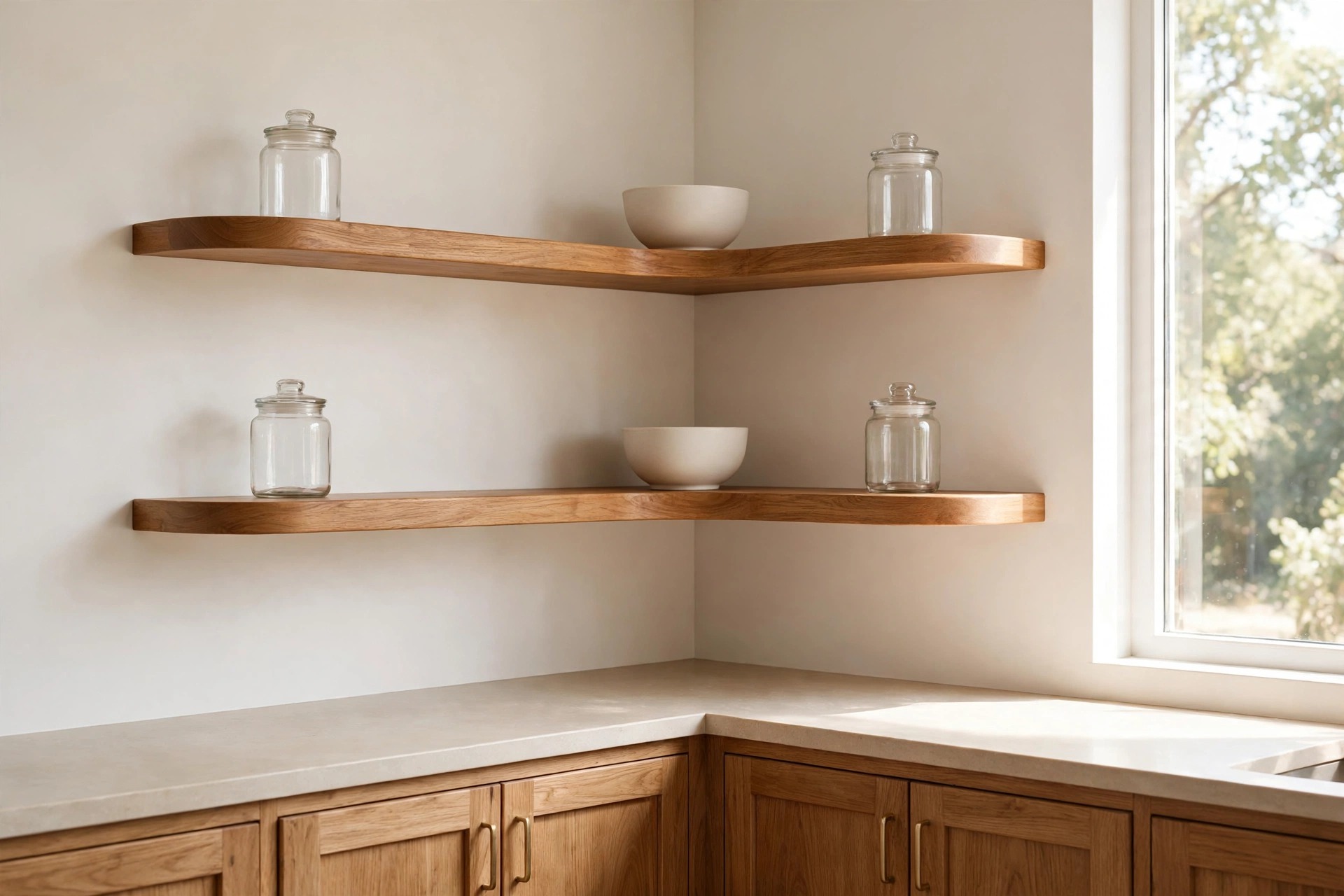
A corner shelf with a rounded front edge takes the sharp point out of the turn. In a tight kitchen, that curve is the part your hip passes every day.
The curve also gives you a natural center. Place one round bowl or a small plant right on the bend, where a square shelf would leave an awkward pointed gap.
Keep the two straight ends for square items like jars and stacked plates. Curve in the middle, straight at the sides, and every inch still earns its place.
Rest one hand on the bend while you work at the counter below. If the curve feels smooth and never catches your sleeve, the shape is right for daily use. A soft edge suits small kitchens especially well.
3. Use Small Triangle Shelves in a Very Tight Corner
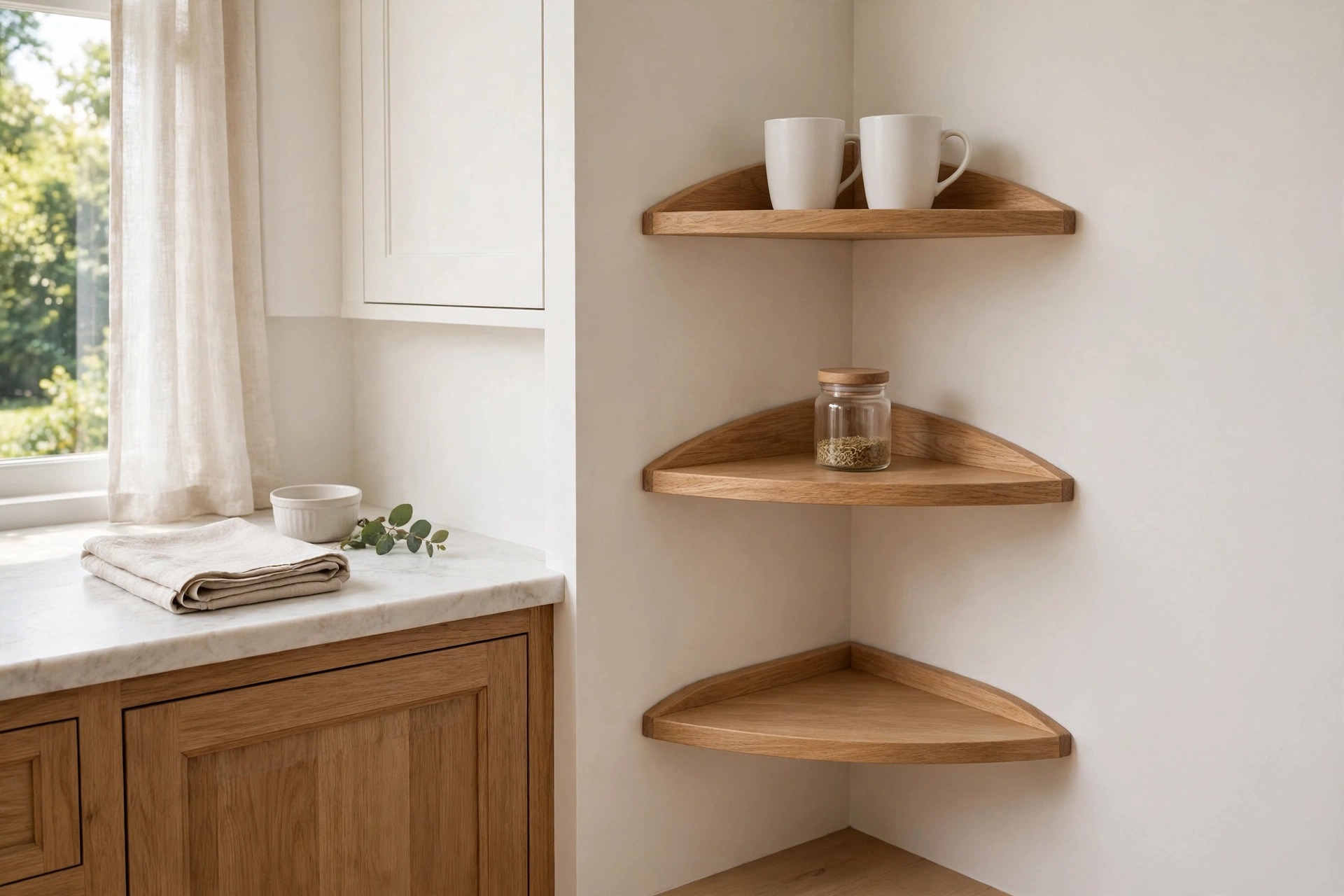
Some corners are too narrow for a full L run. A small triangle shelf, cut to fit the angle, still claims that dead spot without crowding the counter below.
Stack two or three triangles with clear space between them. Each one holds a single group: mugs on one, a sugar jar and spoon rest on the next.
Triangles hold less than they look like they will. Weigh them for light things only, and keep heavy stacks of plates on a longer shelf or inside a cabinet.
A single triangle also works above a corner sink, where a long shelf would crowd the faucet. Keep it to soap, a small plant, and one folded cloth. Small shelves suit renters with one free corner.
4. Give Each Face of the Corner a Different Job
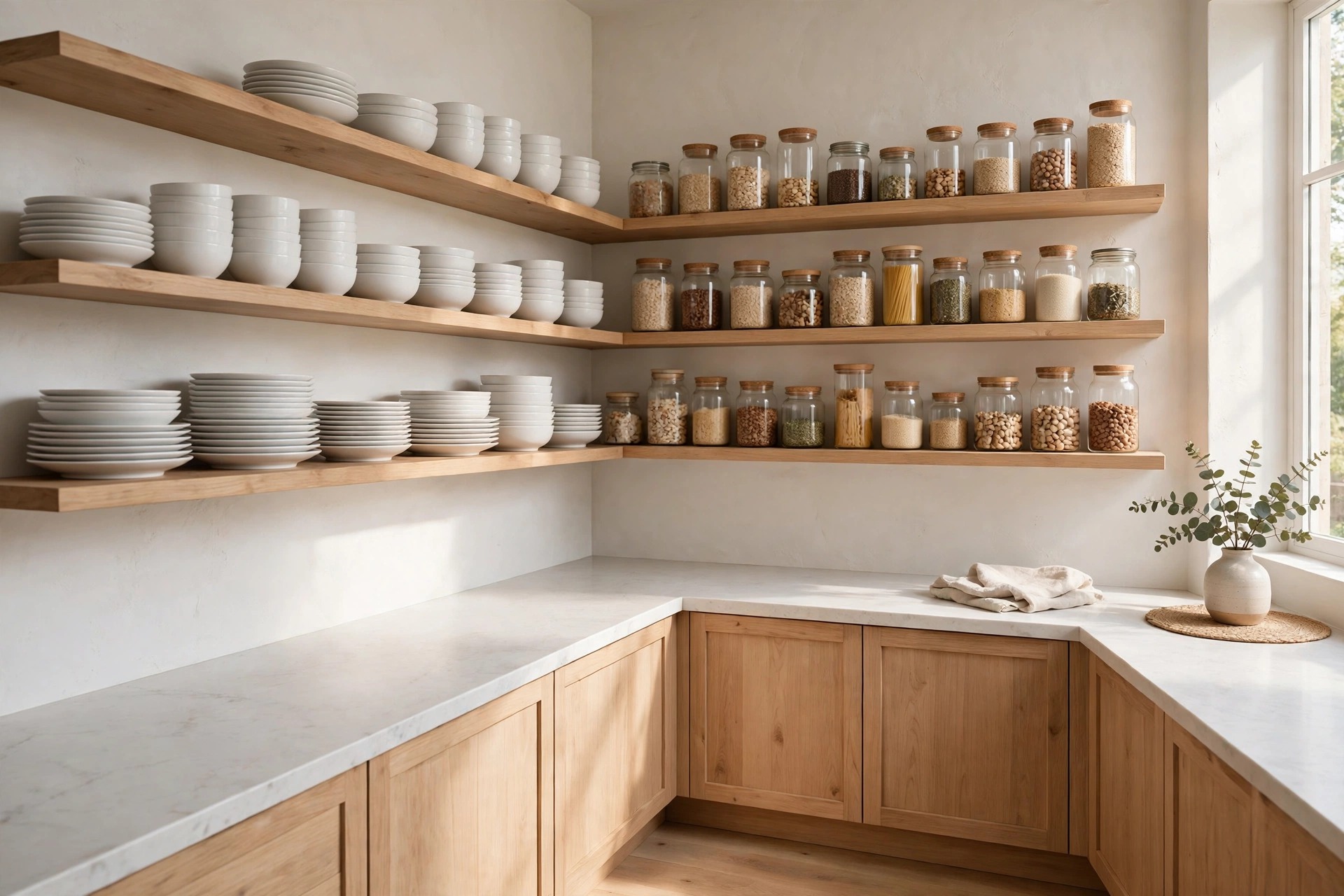
The left face and the right face of a corner shelf do not need the same contents. Give one side daily dishes and the other side jars and dry goods.
Put the dish face near the sink or dishwasher, and the jar face near the stove or prep spot. Items then sit close to where hands actually use them.
If the wall beside the corner is free, small kitchen ideas with a pegboard storage wall can take overflow tools, so the corner shelves stay clear for dishes and jars.
Label the jobs in your head before you load the shelves. When a stray item appears, ask which face it belongs to, and the corner stays sorted on its own. Two clear jobs beat one mixed pile.
5. Send Tall Items to the Deep Back Corner

The deepest point of the corner is hard to reach, so give it height instead of daily items. Tall bottles, a vase, or a stack of cookbooks standing upright belong there.
Tall pieces at the back lift the whole arrangement. Shorter bowls and jars in front stay easy to grab, and nothing small gets lost behind them.
Test the reach before you settle it. If you need to stand on tiptoe for an item, that item is decor or storage, never something you use every morning.
Check the back corner from across the room too. Tall items should read as a calm backdrop, not a crowd of bottle necks fighting for attention. Height at the back also hides plain storage jars.
6. Keep the Low Shelf Front Edge for Daily Reach

The front edge of the lowest corner shelf is the best real estate in the whole arrangement. Reserve it for the mugs, bowls, and glasses you reach for daily.
Line them up in a single row, one deep. The moment items go two deep on an open shelf, the back row stops being used and starts collecting dust.
Leave a hand-width of empty edge at one end. That small gap is where a hot mug lands while you pour, and it keeps the row from feeling packed.
Rotate this row with the seasons if you like. Soup bowls come forward in winter, and tall glasses take the edge in summer, while the back rows stay put. This edge is where guests notice tidiness first.
7. Vary the Height Gaps Between Corner Tiers
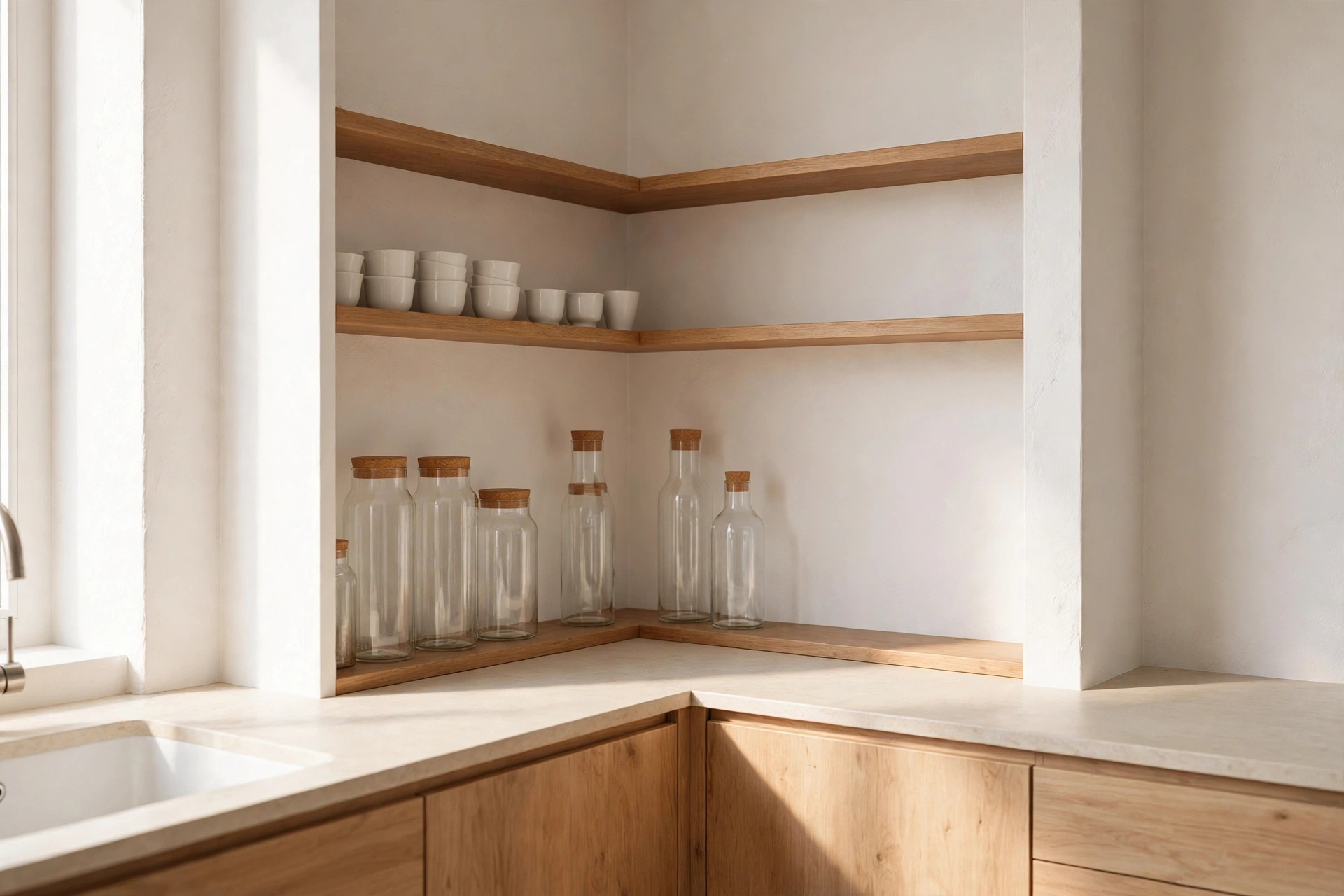
Even spacing looks tidy on paper and wastes space in real life. Give the bottom tier a tall gap for bottles and jars, and the top tier a shorter gap for cups.
Measure your tallest jar first, lid on, and add two fingers of clearance. Set the shelf above it from that number, not from a guess.
Varied gaps also guide the eye. A tall, airy bottom tier reads as the main shelf, while the snug top tier reads as a finishing line near the ceiling.
Write the gaps on painter’s tape before anything goes up. Living with the tape lines for a day shows you fast if a tall jar will clear the shelf above. Honest measuring beats refitting a shelf twice.
8. Let One Group of Three Straddle the Turn

Groups of three sit well on shelves, and the corner gives you a trick a straight shelf cannot offer. Place one item on one face, one on the bend, one past it.
A straddling group ties both walls together. Try a jar, a small plant on the bend, then a matching jar, and the corner stops looking like two separate shelves.
Keep other groups fully on one face each. One straddle per tier is enough; more than that and the turn starts to look busy instead of linked.
Vary the heights inside the group: one tall, one medium, one low. Three items at the same height read as a row, not a group, and the trick fails. The bend item should be the prettiest of the three.
9. Repeat One Color Across Both Faces
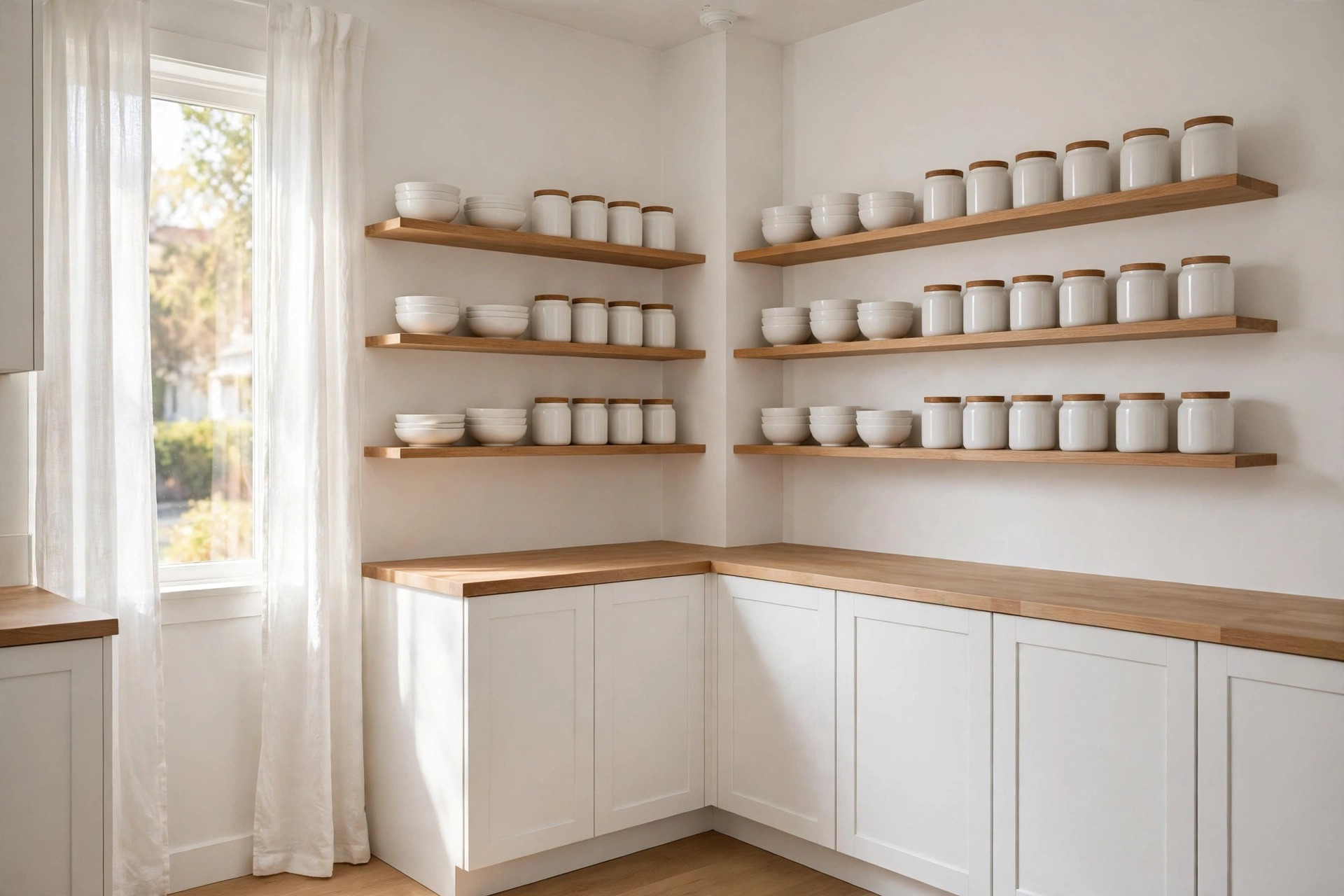
A corner shelf holds mixed things, and mixed things can look scattered fast. Repeating one color on both faces, white bowls here and white jars there, holds it together.
Plain white pieces are the easiest repeat, which is why they anchor so many small white kitchen ideas as well. Glass jars with matching lids do the same job.
Match the shelf tone to your cabinets with care. The pairings in small kitchen ideas with two tone cabinets that work show how a wood shelf can bridge two cabinet colors.
One repeat is enough. Chasing a second matching color across a small corner gets fussy, and the shelves start to look staged instead of used. Wood lids or white lids repeat just as well.
10. Trail a Plant Down From the Top Corner

The top corner is too high for daily items, so give it a trailing plant. Green strands falling down the bend soften the hardest angle in the room.
Set the pot back from the front edge, with the trails falling beside the shelf, not across the items below. A trail in your cereal jar helps nobody.
If real plants fail in your light, use the top corner for a seldom used serving piece instead. Be honest about the light before you buy the plant.
Trim the trails every few weeks. A plant that reaches the counter steals light from the shelf below and starts to trap dust where you prep food. One plant is plenty for a small corner.
11. Anchor a Tea and Coffee Spot at the Corner
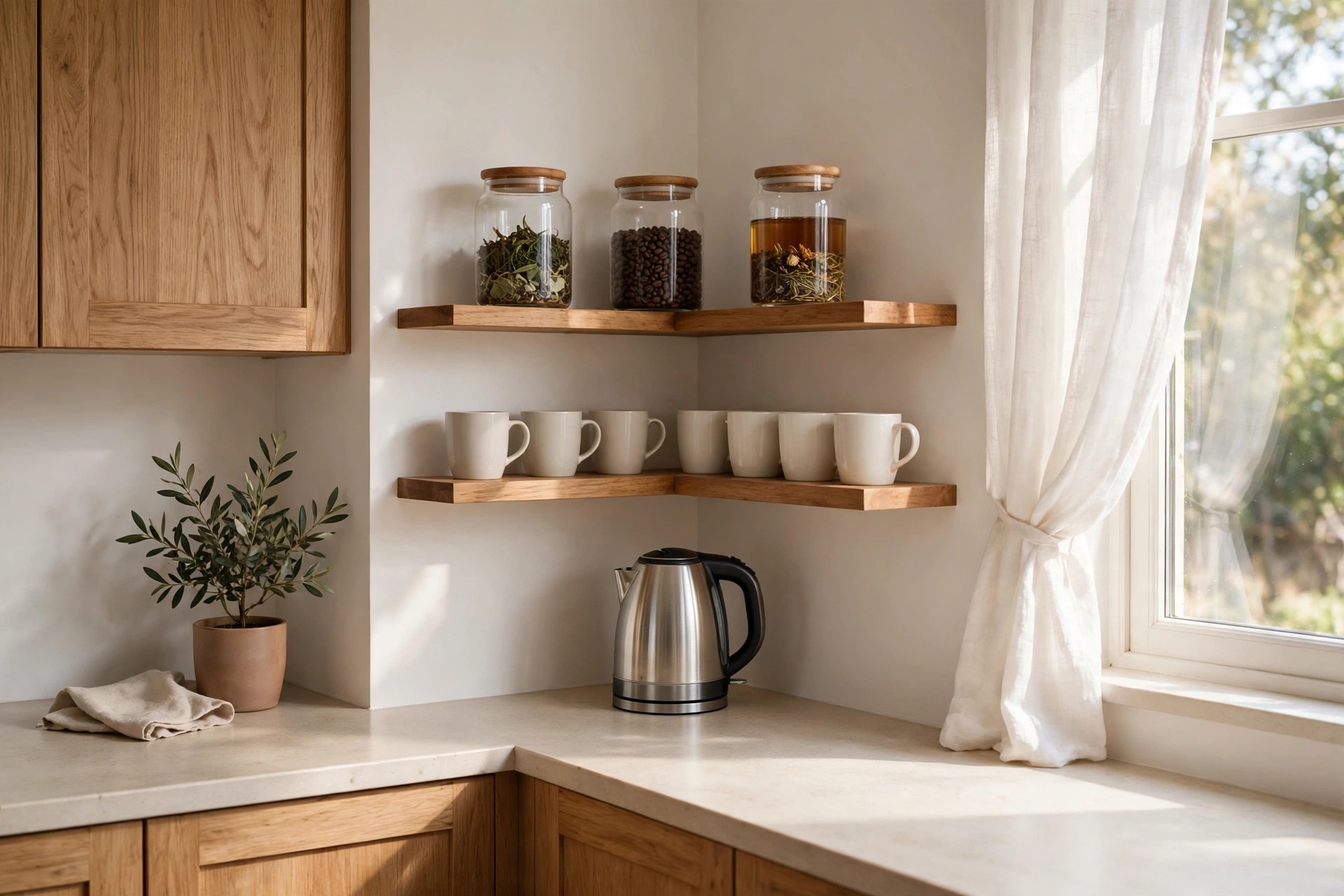
A corner above the counter where the kettle sits makes a natural drink station. Mugs go on the low shelf, tea and coffee jars on the face above them.
The turn itself holds the shared items: sugar, spoons, and a small tray that catches drips. Both faces feed into that one center point, so nothing wanders.
Keep the counter below this corner clear on purpose. A drink station fails when the kettle gets pushed behind chopping boards and the mugs drift to another shelf.
Add one small hook under the low shelf if mugs crowd the surface. Two hanging mugs free just enough room for the jar of spoons to stay put. Guests can help themselves without opening cabinets.
12. Near the Stove, Keep Only Washable Pieces
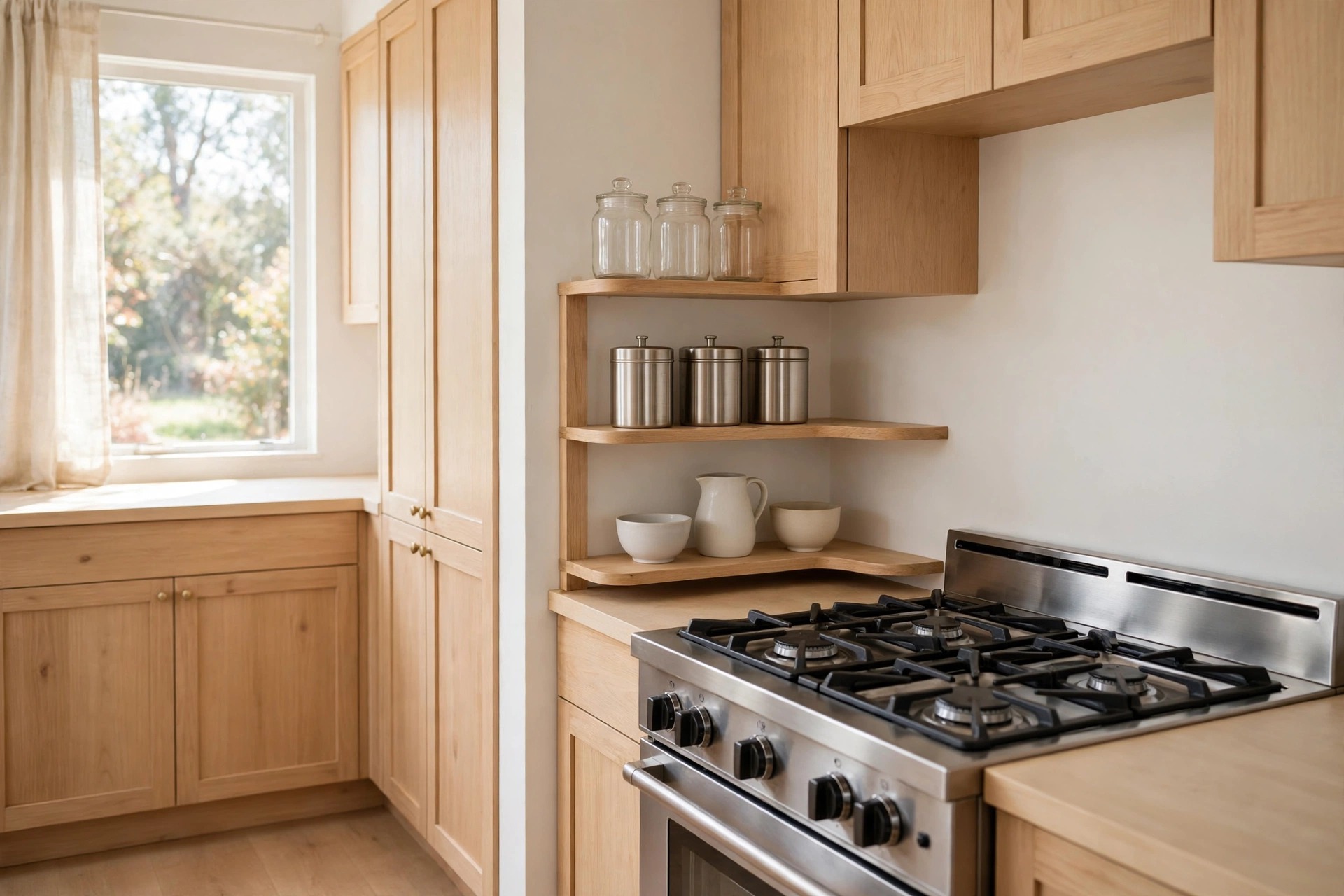
Now the honest part. A corner shelf near the stove collects a fine film of grease, and any styling plan that ignores that fact will look tired in a month.
On the stove side face, keep only items that wash easily: glass jars with lids, metal canisters, and plain ceramic pieces you already use and rinse often.
Move fabric, paper, and woven baskets to the far face or off the shelves entirely. Grease on a cookbook cover never really comes out, however often you wipe it.
Wipe this face last when you clean, with a damp cloth kept just for the job. Two minutes weekly stops the film from building into a sticky layer. Glass and metal wipe clean in seconds.
13. Choose Lidded Jars So Dust Stays Out
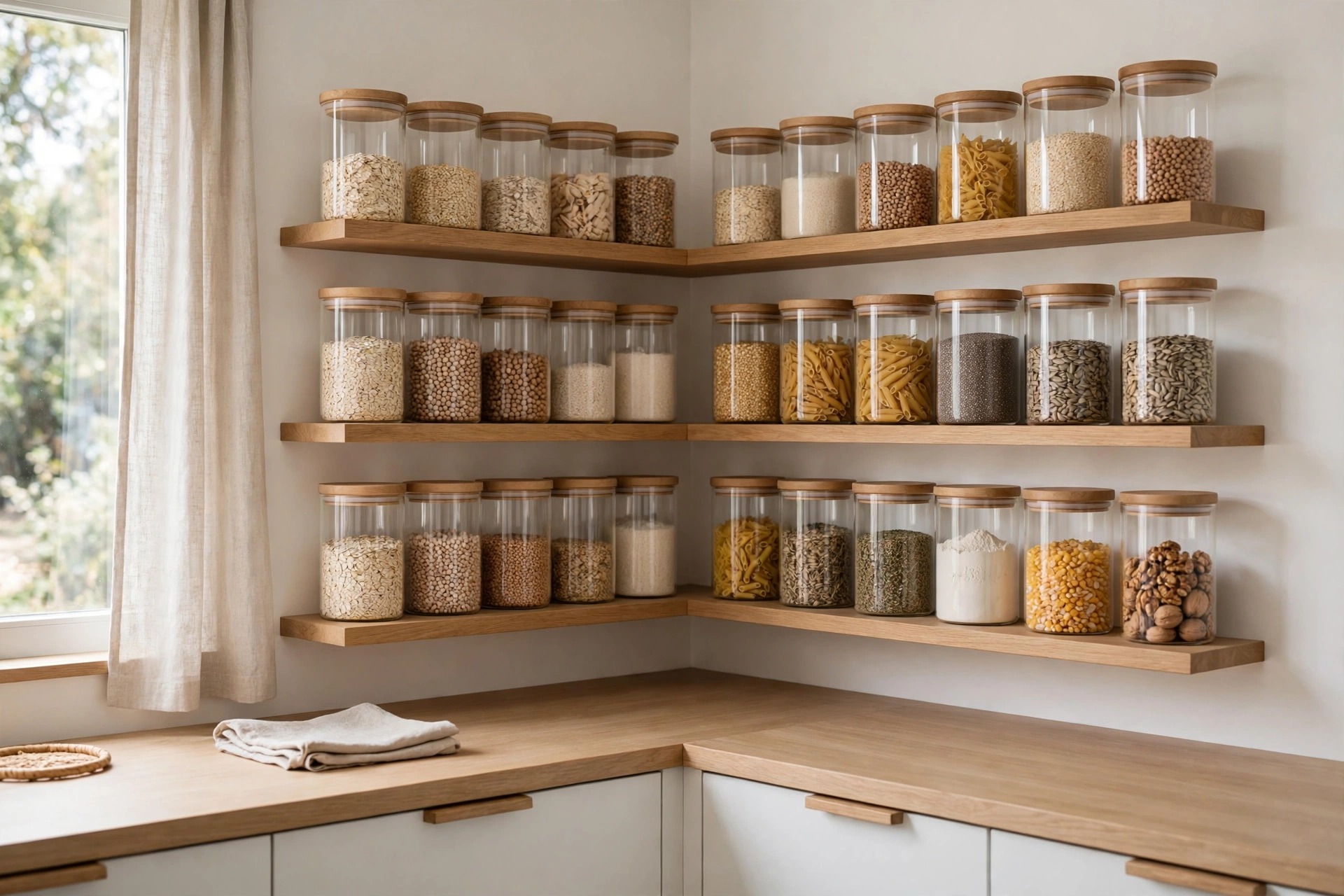
Dust settles on open shelves everywhere, and the corner is no exception. The simple fix is a lid: dry goods in lidded jars stay clean between uses.
Open bowls on the top tier gather the most dust, since that shelf gets wiped least. Either use those bowls weekly or store them lower, where wiping is easy.
A quick weekly wipe of the shelf boards keeps the whole corner fresh. Several of the small kitchen storage mistakes readers report start with shelves that never get wiped at all.
Match the lids if you can. A row of jars with the same lid color looks calm, and you spot the one you need without reading a single label. Lids also keep cooking smells out of dry goods.
14. Make One Face Longer Than the Other
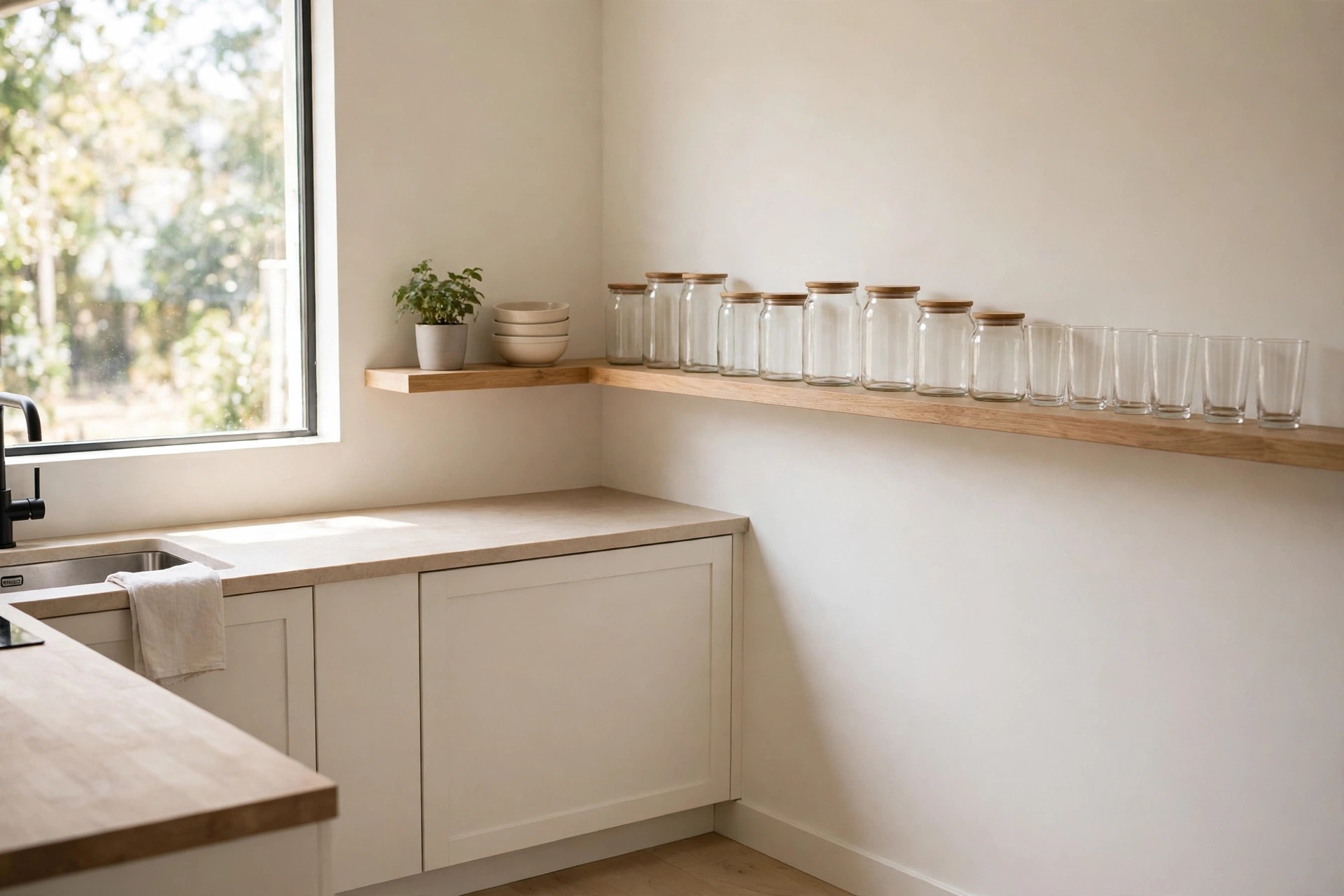
Equal lengths are not a rule. If one wall has more free space, run that face longer and stop the other face short, and the corner still works as one piece.
The short face suits a single stack or one plant. The long face takes the working row of jars or glasses, close to the counter space it serves.
End the long shelf in line with something below it, like the edge of the counter or a cabinet side. An end that lines up looks planned, not cut off.
Stand back and check the balance from the doorway. The long face should lead, the short face should answer it, and neither should reach past the counter below. Asymmetry looks relaxed, which suits open shelving.
15. Leave the Corner Point of One Tier Empty
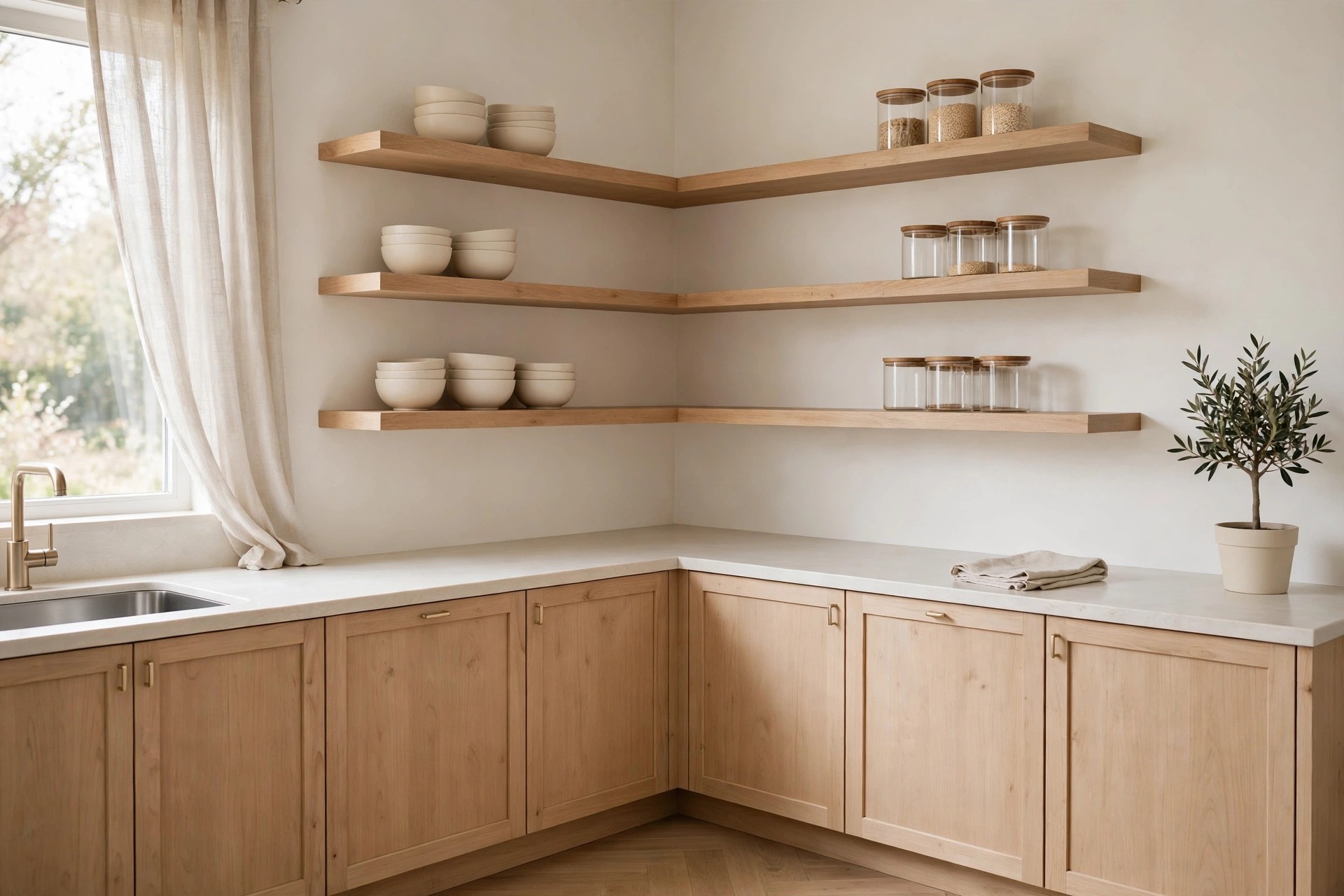
The strongest styling move on this list costs nothing. On one tier, leave the corner point completely empty, with full groups on either side of the gap.
That empty bend gives your eye a rest and makes the groups beside it look chosen. Crowding the deepest point is the fastest way to make corner shelves look stuffed.
For the wider view beyond one corner, our guide to small kitchen ideas with open shelves covers whole runs of shelving. Here in the corner, empty space is a styling choice, not wasted space.
Try the gap for one week before you fill it. Most people find the corner looks calmer, and the empty bend never gets filled again. Empty space makes the filled shelves look richer.
Start with the shelf shape, because an L wrap, a curve, or a small triangle changes everything you can place on it. Then give each face a job, keep daily items at the front edge, and be honest about grease near the stove.
Good small kitchen ideas with open corner shelf styling come down to editing: tall pieces at the back, lids on the jars, and one corner point left empty on purpose.
Save this to your small kitchen ideas board for later, and measure your corner before you buy a single shelf.


